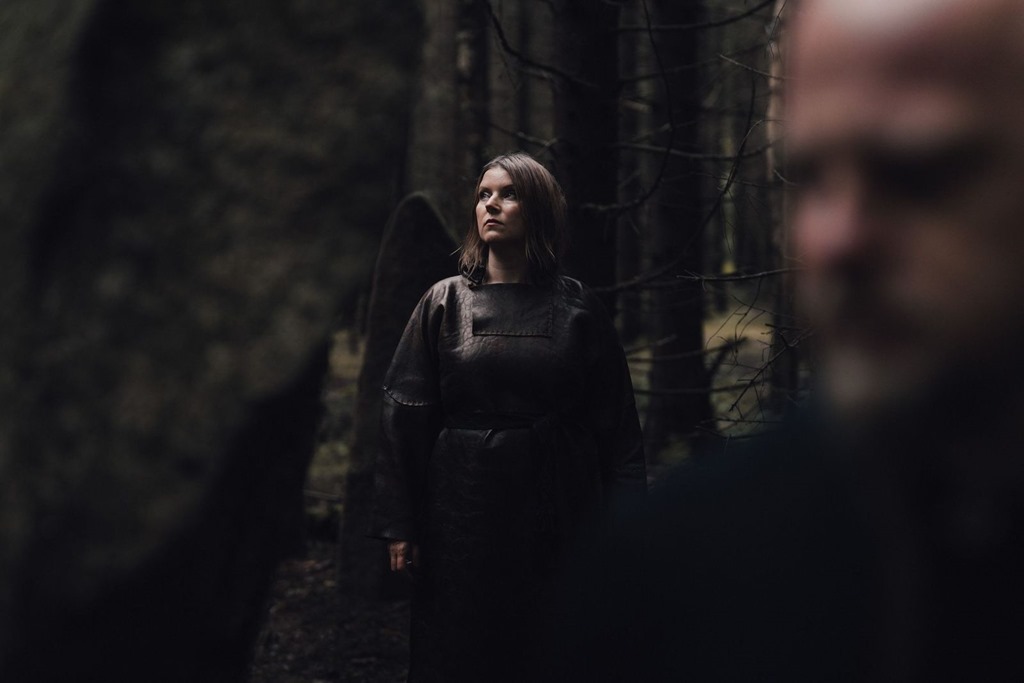
Norwegian collective Wardruna present the title track of upcoming album Birna, accompanied by a music video. Birna – the she-bear in Old Norse – is a work of art dedicated to the warden of the forest, nature’s caretaker. The release is set for January 24, 2025 via Sony Music and By Norse Music.
Through Wardruna’s signature soundscape, this heavy, progressive song shows the unshakeable connection between humans and the natural world. Main composer Einar Selvik comments: “The song illustrates a dialogue between man and bear, exemplifying the various traits and abilities we humans have sought to borrow from these significant totemic animals throughout history.”
As Einar points out, the bear frequently figures in the oldest myths of mankind in the Northern hemisphere, with many indigenous peoples still regarding this animal as a totem – “The bear doesn’t need my help or any human traditional ornamentation to be its own powerful self. It is quite the opposite if one looks to past bear-traditions worth remembering. We learn, we dream of borrowing its traits and abilities. We fear, revere, and try to walk alongside but on separate paths. Respectfully, claim space and give space. However inconvenient it may be, further taming of the wild can never be the fruitful way forward. For me, it profoundly felt like the right time to give voice to the Birna, mother and shepherd of the vanishing woods,” Selvik concludes.
Humans have always identified with the bear in various ways. In some cultures, “treading the path of the bear" means pursuing what you’re meant to do in life. The bear’s body underneath the fur strongly resembles that of a man, which may have inspired legends that the bear actually originated from humans. For thousands of years we have striven to emulate its strength and wit.
The music video for “Birna” was filmed in Rondane National Park in Norway and directed by Wardruna´s longtime collaborator Tuukka Koski, produced by Breakfast Helsinki and Ragnarok Film.
Having had something of a chuckle at Henge for their pseudo-space mythology and psychedelic psilliness, I find myself squaring up to purveyors of genre-straddling experimental doom, Codex Serafani. Their biography explains: ‘Their journey started a long time ago, some say on Saturn, some say in the subconscious of the human psyche, coming out in different manners through the ages, channeled by mystics, witch doctors, shamans, free thinkers, free spirits. But we do know that what has become Codex Serafini travelled here from their home world on Enceladus in 2019 and crash landed into the music scene of Sussex.’ Of course they did.
But what are the chances that a I’m writing this review, an article from The Guardian pops up in my news feed reporting on how astronomers have spotted a six-thousand mile plume of water vapour blasting from Enceladus – a small moon belonging to Saturn believed to be one of the most promising places in the solar system to find life beyond Earth? As coincidences go, this was an usual one, and one which befits this band.
With a name which references Luigi Serafini’s Codex Seraphinianus, an illustrated encyclopaedia of an imaginary world, written in an imaginary language, it’s clear these guys have a keen interest in the realms of fantasy and mythology, to state it lightly.
I suppose that the concept piece whereby the concept includes the artist as much as, if not more than, the album goes back to Bowie – but back in 1972, this was new and novel, and moreover, Bowie was unique and an artist whom you could almost believe was from another planet. But even then, however much the concept became all-encompassing, it was also clear that the concept was a persona. But to base an entire career on a persona – not a media or public persona, but a far-fetched one which requires the suspension of disbelief – can be somewhat limiting. Where do you go when you’ve explored the concept to its logical limits?
In creating such a vast and multi-faceted alternative universe, Codex Serafini have ensured an abundance of time and space in which to explore and expand their concept, and rather than it being self-limiting, the challenge will be to test the capacity of their imagination, not only conceptually, but also musically.
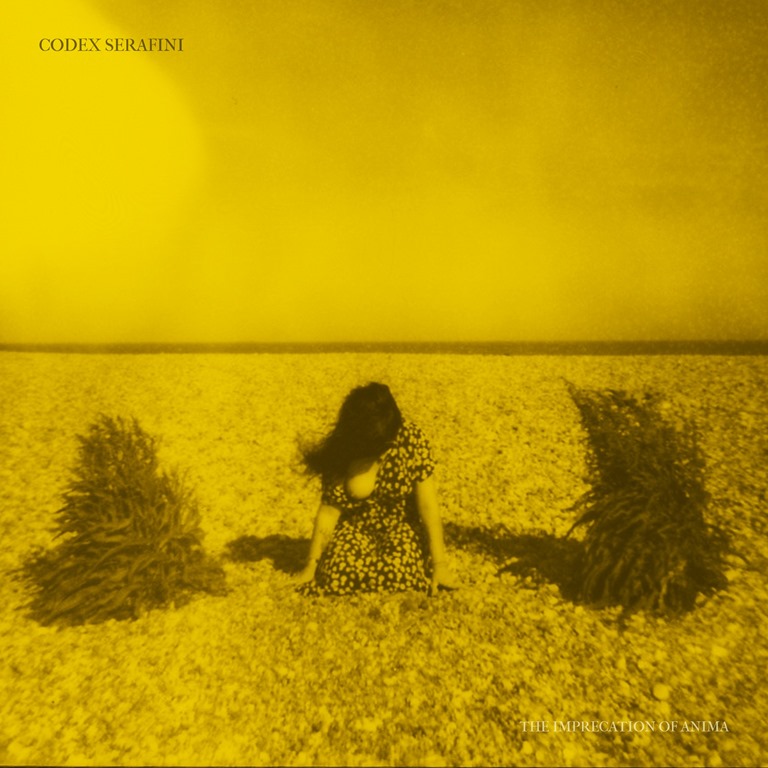
While the adage that you should never judge a book by its cover hold some merit, one can tell much about an album by the ratio of its duration to the number of tracks, and The Imprecation Of Anima has a running time in excess of forty-five minutes and contains just four tracks. We know we’re in ‘epic’ territory before hearing a note, and the first of the four compositions, ‘Manzarek’s Secret’ unfurls slowly with a long droning organ (which one suspects is no coincidental nod to The Doors) and chiming percussion. It’s not long before a thick, gritty bass and reverb-heavy vocal incantations are joined by some wild brass to burst into the first of numerous big, jazz-flavoured crescendos. At nine-and-a-half minutes long, it’s epic, but only an introduction ahead of the fifteen-minute swirling mystical monster that is ‘Mujer Espritu’, which brims with Eastern promise and sprawls in all directions at once.
Single release ‘I Am Sorrow, I Am Lust’ is perhaps the least representative song of the album as a whole: it’s snappy, exuberant, uptempo, jazzy, rocky, busy, climactic, and fairly structured – and clocking in at three minutes, it feels like a single when standing alone, but more like an aberrant interlude in context of the album ahead of the seventeen-and-a-quarter minute ‘Animus in Decay’. Now this is a wig-out! It’s heavily psychedelic and transitions through a succession of passages on the path to – what? Enlightenment? It’s certainly a journey, whichever angle you approach it from. It builds and grows in volume and tempo, then falls again and there are some expansive ponderous sections and shifts like sand dunes in a vast sonic expanse.
And so it may be that the concept is a little daft, but they deliver The Imprecation Of Anima – a work that’s as ambitious as it is immense – with absolute conviction, and the vast sound pulls you into Codex Serafini’s (other) world. Inventive and accomplished, it’s a truly mighty record.
It’s easy in the age of the Internet to conduct enough research behind the scenes to present oneself as having an extant k knowledge of a subject. It’s also a huge temptation to do this as a reviewer or critic, because there’s a certain expectation from audiences that if you’re going to proffer opinions on things, you ought to know what you’re talking about. It’s that knowledge and authority that ought to differentiate someone who presents insightful critiques from the boorish tosser down the pub – or, as is more common now, on social media who has an opinion on everything but talks out of their arse because they know nothing.
But life is an open-ended learning experience, and the day you stop learning, you’re effectively dead. And so it is that while I’m familiar with Malcolm McDowell, primarily for his role in A Clockwork Orange, and Massimo Pupillo of ZU, but not the Italian poet and essayist Gabriele Tinti – which is surprising given his prolific output and the immense reach of his work, especially considering that his career hasn’t been without controversy. Still, the fact he is prolific and has immense reach, as well as being a keen collaborator, explains the coming together of these three for a collaborative album, which finds McDowell reading Tinti’s works over music by Pupillo.
McDowell reads five pieces from the 2021 collection Ruins, dedicated to what he calls the “living sculpture of the actor”, ruminating on the distant past as it echoes through to the present. In keeping with the subject matter – where art and mythology of the ages provide evocative contemplation – there are weighty words, formulated with such syntax as to accentuate their gravity and import, and McDowell’s delivery does them admirable justice. As much as Tinti is given to elevated tone, there’s both a resonating sense of spirituality and an earthiness to his words, and McDowell reads with nuance, bringing the more visual aspects to the fore as he speaks of flesh and blood and bones wounds and exploding veins. There’s a physicality to the writing which possesses a rare potency, and as such, the words are well-suited to the context.
Pupillo’s atmospheric score, conjured using ‘a plethora of different sources, various synthesis, samples of eastern European choirs, processing McDowells’ voice,’ lends further layers of depth: at times choral and monastic voices rise and ring out against elongated drones, rich and organ-like, at others billows of sound creep like tendrils of fog.
Songs Of Stone may only be some twenty minutes in duration, with each side working nicely as a single, continuous soundwork punctuated by the spoken segments, but its grave intensity means that any longer would be difficult to digest. As it stands, Songs Of Stone feels perfectly formed.
After being involved with Heilung for two years, and more recently with the worldwide-acclaimed movie The Northman as songwriter and actor, Jonas Lorentzen decided to focus on his own musical expression, based on a reimagination of Nordic Folk and spiritually driven music. The result is Nebala, spearheaded by Jonas Lorentzen, but assisted and graced by powerful talents such as Sebastian Gainsbourough (Vessel, The Northman, Manchester Collective), Kjell Braaten (Wardruna, Origami Galaktika) as well as non-musician minds assisting in the conceptual development, Doctor Mathias Nordvig (Professor of Pre-Christian Religion at CU Boulder) and Philosopher Naina Gupta (University of Kingston).
Nebala unveils today the new single ‘Ant Mér Sjalfri Þér’, a song about unfulfilled love, desire and longing consuming us. It refers to the myth in which Wōdan sought the Billingas magwia, the Maiden of the Fleeting Moment. In this myth, love and desire are ripped away from the ones who have let themselves be consumed. The artist also releases a new video, a short film in which the songs ‘Ant Mér Sjalfri Þér’ and ‘Laþu’ merge to create ‘The Eternal Child’.
Jonas Lorentzen comments: "This is the entire art film as we originally intended. A story about a man trying to come to grips with his own demons and desires. Inspired by mythology and Jungian archetypes."
Watch the video here:
Using traditional frame drums, lyre, tagelharpa, Tibetan singing bowls, and throat singing, Jonas Lorentzen has developed a unique Indo-Nordic sound for Nebala that toys with timescapes, soundscapes, and cultural boundaries to bring you back to the primordial experience of music itself.
He comments on the album: “When you let yourself be taken by desire and lust, you will be consumed by what the ancient Germanic peoples called Laþu. The ancestor of our modern word “to let,” laþu suggests giving into natural desire and emotion. When Wōdan sought the deepest knowledge of the cosmos he had to brave the dangers of the deep caves in Hnitbjörg and let himself be taken by the desire of Gunlaþu, the forceful goddess of the underworld.”


 Aural Aggravation