Sub Rosa – 15th May 2026
Christopher Nosnibor
Mick Harris may have left Napalm Death some thirty-five years ago, but it’s still for his work with them – and his coining of the term ‘grindcore’ – that he’s largely known. There are, of course, far worse things one could be known for, particularly as this meant that he featured on the band’s seminal debut album, Scum. While having participated in numerous projects in the years since, Scorn will forever be an enduring standout in cult circles, but beyond this, Harris has explored far further-flung corners of the musical spectrum on many occasions with comparatively little recognition, with dark atmospherics having been his primary focus for a good number of years now.
The fact that this is the third instalment of Murder Ballads, recorded in collaboration with Martyn Bates and released on estimable Sub Rosa label in Belgium – which has released albums by William S. Burroughs, Brion Gysin, Test Dept, Oren Ambarchi, David Toop, Bill Laswell, Asian Dub Foundation… the list goes on – is a measure of how Harris has transitioned to what one might call more ‘arty’ territories, which may sound snobby or poncey to some, but let’s focus on the work at hand – at least, in due course.
Although murder ballads are likely most commonly associated with Nick Cave in popular culture, they have a long cultural heritage, with roots in the folk history of Scandinavia, England, and lowland Scotland reaching back as far as the 1750s. The entire premise of murder ballads is bleak and grim, and Harris and Bates remain true to this principle here, on an album which is mercilessly dark and lugubrious.
There’s no avoiding the fact that the subtitle brings an element of discomfort. We’re in a strange place right now, culturally, in that half of the world – or maybe that’s just half of the US and those in the UK who for inexplicable reason who describe themselves as ‘patriots’ while also being fans of Donald Trump – seem to think that paedophilia is just fine, and in many states, marrying cousins is similarly just fine. Similarly, incest porn and step-sibling porn is all the rage. Why? What is wrong with people? But then, history is built on tales of incest, going right back to Greek mythology. This is no more than an observation, and to note that as a species, we’ve been warped for the entirety of our existence. That discussion is an entire thesis in itself, though.
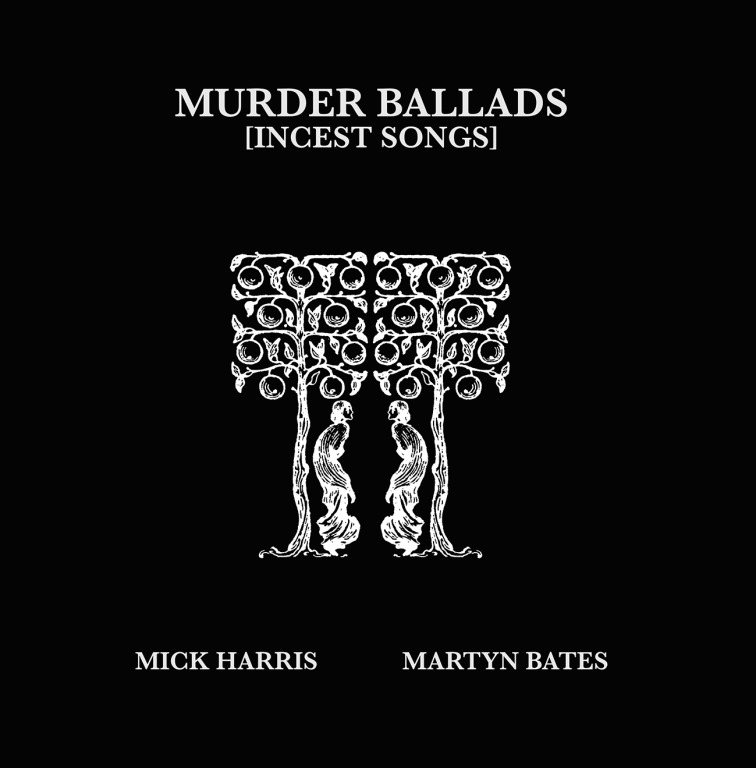
Murder Ballads [Incest Songs] is a long way from Peter Sotos territory. But what it is, is four ominously-shaded longform compositions which are uncomfortable and uneasy. As they pitch it, ‘Incest Songs is the final chapter of the Murder Ballads trilogy, and its most fully realized expression. Where Drift and Passages explored the post-isolationist frame through voice and single instrument, this third volume dispenses with that approach entirely, opening instead onto a more labyrinthine sonic architecture – one built from overlapping, saturating, blurring voices, all of them Martyn Bates’.
Bates does indeed prove to be versatile, and capable of conjuring the most moving vocal evocations. ‘The Bonny Hind’ is essentially a folk song, a shanty, even, at heart, but the lilting vocal, which would work as readily acapella as against conventional instrumentation – flute, or fiddle, for example – takes on a more ominous shade when pitched against groaning, shape-shifting drones. The result is unsettling, and would sit within the soundtrack of a folk horror movie in the way a warped, discordant rendition of a nursery rhyme would in more mainstream projects.
‘Sheaf and Knife’ is notable for its sparse nature. Bates’ voice is practically in your ear – and this ism no small feat of the production. Whispers, echoes, and reverberations echo around, and it’s not immediately apparent that most of this is Bates, the wind and the air, and the dank, low drones which define this album. ‘The Two Brothers’ – a seventeen-minute monster of a composition – drifts into moments of space-age spin, flanged swirl and fractal details turning a textured sonic nebula behind the vulnerable vocals – and the narrative said vocals deliver is chilling, a tale of a stabbing, whereby the narrator washes the blood off and goes about his business. Or something. While the lyrics sometimes trail away in swathes of reverb the auditory experience is gripping in itself. This is the sound of heavy fog, and of silent decomposition. This leads us to the album’s final cut, ‘Edward’, extending beyond seventeen and a half minutes is magnificently haunting. At times so sparse as to be barely there, it’s a trawl into the darkest of spaces, suffocating, claustrophobic. Bates croons and quavers with a detachment which accentuates the sense of disconnection. There’s something in the way he delivers the words, against sparse, eerie, near-ambient backdrops of difficult drones, that is quite chilling: calm, soft, psychopathic. Enjoy, but watch your back.
AA
AA
 Aural Aggravation