Posts Tagged ‘influence’

Bearsuit Records – 5th September 2025

Christopher Nosnibor

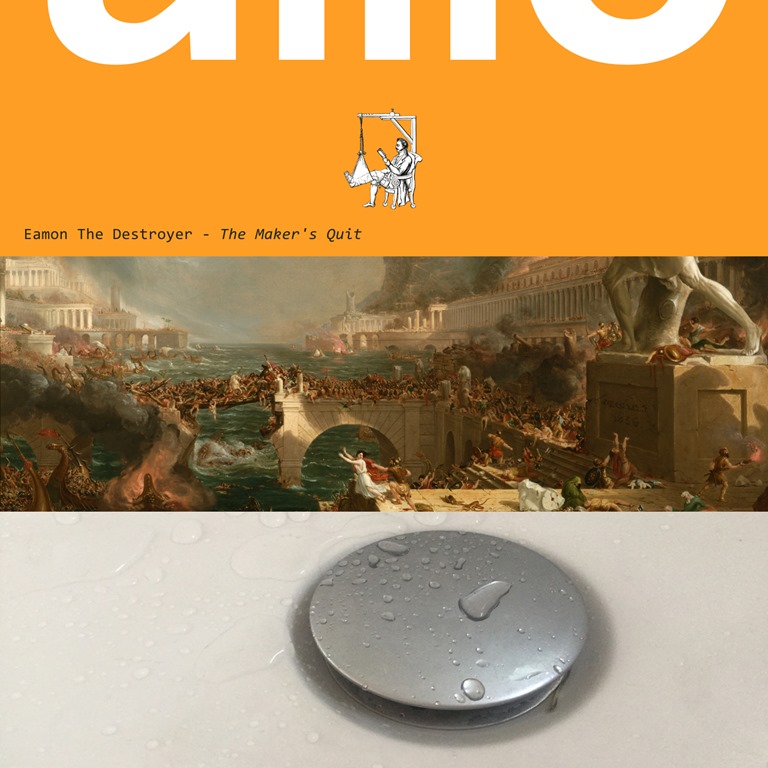
The thing with Eamon the Destroyer is that you never know what you’re going to get. The Maker’s Quit is different again from We’ll Be Piranhas, which in turn was quite unlike Small Blue Car (which remains a personal favourite, even if it does make me feel impossibly heavy on the inside). If We’ll be Piranhas marked a step forward in terms of experimentalism and optimism, The Maker’s Quit sees a greater emphasis on songwriting and structure – but don’t for a second think it’s in any way straightforward, and that the experimentalism has taken a back seat – it’s still very much a copilot here, and with the accent on the mentalism.

Here, the title track commences what is an incredibly varied set with a song that has the theatricality of Alex Harvey crossed with 1990s Leonard Cohen, before ‘Silverback’ confounds all expectation by bringing some shuffling funk-infused jazziness. In contrast to the fairly minimal arrangements common to previous ETD releases, this is pretty busy, then is settles into a mellow groove that’s almost loungey – bar the mid-section, which is rent with a protracted burst of extraneous sound. It’s almost as if he purposefully weaves around the line between genius and self-sabotage simply to tests us as listeners. There are some nice, light, poppy moments on here, and – albeit fleetingly – some captivating grooves. But it wouldn’t be Eamon the Destroyer without a huge helping of straight-up weird shit mashups, and The Maker’s Quit brings the lot, from frenzied jazz and post-grunge, wonky vaudeville waltzes and whistling, via electropop and slices of pan-culturally inspired melody.

More often than not, the verses and choruses are so contrasting as to seem to have been spliced from different songs – that’s when there are verses and choruses. ‘Three Wheels’ is a veritable patchwork, which compresses segments of what sounds like half a dozen songs into five minutes as it spins from grandiose heavy country dirgery by way of an intro, which even hints vaguely at recent Swans, before swerving into Europop with a hint of Sparks, through a off-kilter but gentle soundscaping that slides into laid-back salsa before winding up with a segment of jaunty indie rock. But rather than feel like an identity crisis, the effect is more that of a multi-faceted artist showing all his facets simultaneously. It’s hard to keep up, but one can only imagine what it must be like to live in his head.

The lyrics are equally fragmented, between stream of conscious and cut-ups, producing a Burroughsian, dream-like quality. This snippet from ‘The Maker’s Quit’ exemplary: ‘Saturn kid – spins and reels – in a city / Little Feet – lost in a wave – out to sea / A grandmother – nods – to a space in the crowd / Cap gun assassin – emerges – from a conjurers cloud…’ Beyond oceans and waves, it’s impossible to pin down any notion of themes or meanings. The images float up and fade out instantaneously.

‘The Ocean’ begins dramatically, a swelling, surging drone that halts abruptly, yielding to one of the most typically Eamon the Destroyer passages – lo-fi folktronica with a low croon reminiscent of Mark Lanegan, which slowly tilts its face upwards from scuffed boot-tips towards the sun…. and then all mayhem happens in a brief but explosive interlude, and your head’s suddenly spinning because wherethehellhasthiscomefrom? It’s this wild unpredictability and unapologetic perversity which is – strange to say – a substantial part of the appeal of Eamon the Destroyer.

When Eamon the Destroyer goes downtempo, as on the mournful, string-soaked introductory segment of ‘Captive’, you can actually feel your heart growing heavier by the bar, but then it twists onto some semi-ambient avant-jazz, and the sensation transitions to bewilderment.

The final track, ‘The Buffalo Sings’, is a twelve-minute behemoth is s slow, surging lo-fi electronic exploration. Face the strange? It embraces it, hard, then absorbs it by ghostly osmosis. If ever a song was less country, less ‘Buffalo’… maybe some of the western themed electrogoth songs by James Ray and the Performance are on a par on that score, but this wanders into a sonic desert without even a hat for protection from the punishing sun, and slowly, everything melts in the heat. Circuits bend and warp, and the weirdness rises like a heat haze… and it’s wonderful to be immersed in a work which celebrates creative freedom with no sense of constraint or obligation.

On reflection, with Eamon the Destroyer, you know exactly what you’re going to get: visionary hybridity, moments of aching sadness and fractured beauty, shards of melancholic memory , unbridled inventiveness and fevered creativity, and music like nothing anyone else is making. In a world where meaning seems to have all but evaporated and it’s increasingly difficult to make sense of any of it, The Maker’s Quit feels like a fitting soundtrack. It exists purely in its own space, and it’s the perfect space to escape to in these most dismal of times.

AA
Eamon-TD-3_Cover

Interview: John Wisniewski

Introduction: Christopher Nosnibor

It’s fair to say that Mars was a band ahead of its time. Formed in 1975, they were early to land on the No Wave noise-rock scene, and they’d called it a day before the scene really broke, and with only a handful of performances under their belts.

The history goes that Mars played live about two dozen times, and never ventured beyond Manhattan. Their first show was at CBGB’s in January 1977; their last one was at Max’s Kansas City on December 10, 1978. Their sole release during their brief existence was a seven inch single, plus a track on the influential No Wave New York compilation, produced by Brian Eno, although a live EP would emerge shortly after they called it a day, and their entire recorded output – which totalled half an hour’s music – would be released a couple of times in the mid ‘80s and in the ‘00s.

As is often the case, the legacy and influence far exceeds their brief history and scant catalogue, no doubt enhanced by the fact they never reformed. However, while most of the band’s members have disappeared from view, and both co-founder Nancy Arlen (drums) and vocalist Sumner Crane died in the early 2000s, since the end of Mars, bassist Mark Cunningham has remained active, and very much forward-facing in his musical output, most recently with solo albums Odd Songs (2020) and Blue Mystery (2023)

John Wisniewski caught up with Mark Cunningham to ask about Mars and their legacy, his recent releases, and plans for the future.

JW for AA: How did you get involved with music, Mark?

I’ve been playing since I was a kid. my uncle was a jazz drummer and he hooked me up with my first horn, and I played in the school band growing up. and as a teen I picked up guitar and bass to play in cover bands, but when I learned to really play and improvise was at college, surrounded by likeminded rock, free jazz and acid freaks studying avant-garde movements and playing all the time.

Any favorite music artists?

Lots, I grew up in the 60s, out in Jersey, and started going to shows at the Fillmore East in 68. saw a lot of the greats there, as well as little known strange psychedelic bands. I ate it all up, not discriminating too much, but of course Hendrix, The Doors, Jefferson Airplane, Zeppelin and a few others were extra special, and Electric Miles, who I first saw in 69 and showed me the future. Later at college I discovered the Velvets, Eno, Bowie and all the free jazz greats. I still followed Miles though.

0018927842_10

When did you join MARS, and what was the idea for how MARS should sound? Did you improvise?

Mars came together in late 75, a chance meeting that led to a year of working out our own way of expression before playing shows. At first we took the Velvets as a model, even jammed on some of their songs, and from there started making our own, somewhat similar frameworks and improvising on them. But we weren’t free improv. The character of the song and lyrics always came first. This has stayed with me through all my bands, although i do play 100% free in some duos and trios dedicated to that.

Why did you want to form your own record labels?

The first and most serious venture was Hyrax Records, which I managed to make happen in 1980 to release the John Gavanti LP and a Don King cassette. In those days it was possible to get distribution in the States and we sold quite well. But it still became a hassle and an expense to keep it going. DIY labels started getting popular in the 80s, when cassette recording and reproduction got cheap and easy. And in the 90s with CDRs. So I did some of that, especially with our duo Convolution, with my partner Silvia Mestres. We put out all our albums on CDR. Of course streaming killed that off completely. Nowadays all you have to do is put it out on Bandcamp and / or use the streaming platforms, which suck but do get it out there. So I do that with the more experimental stuff which we record on the cheap.

What were audience reactions to the music of Mars?

We had a pretty loyal and very vocal fan base in the city, which you can hear on some of the live stuff I’ve curated through feeding tube records and bandcamp. We always managed to draw enough of a crowd to keep things moving, even playing once or twice a month in the same clubs, which we did in Manhattan for two years, in *77 and *78. Unfortunately we never made it out of the city. Sometimes we got on bills with some more conventional bands and a mixed crowd, which provoked some interesting reactions. When we opened for Patti Smith at CBGB Theater, we had screamers both for and against, it was great!! We certainly were extreme, but never for its own sake, for us it was always about the music.

Mars,_12__EP_cover

What did you think of the No Wave New York scene?

That’s quite a question. At the time it was mainly a lot of work and fun. all of those bands worked hard to make their own music and sound. Mars rehearsed at least 5 days a week and sometime more. Something that could never happen later, when life became too expensive and distracted. So we were really a product of a time and place very special, with a lot of music and art movements sharing the same neighborhoods. It was a 70s phenomenon, which continued into the 80s but wasn’t the same as everything else was changing too quickly. It was over for us by the mid 80s, when I was working with my band Don King and started going to Europe, and in 91 I moved to Barcelona. Another thing altogether is the echo it’s had over the years, which keeps expanding, especially for Mars.

What was it like working with Brian Eno?

We got on really well. in fact we’d become quite good friends in those months he was in the city, I was living with Arto Lindsay at the time and he used to come over and listen to our records, as we had a lot of African and Asian stuff. So actually working with him was great though it was only a couple days, one for recording and the other for mixing. Recording he just let us get on with it, but then he was really hands on with the mixing, and had great ideas.

Tell us about your latest Blue Mystery album, and Odd Songs, your 2020 release? What was it like recording these albums?

Odd Songs, which came first, was half collaborations which I’d recorded over the previous few years and the other half playing everything myself, and on Blue Mystery I got deeper into that, plus it was during the Covid lockdowns, so it was really easy to spend all day working at home. Now I’m working on the third volume, Asombra7, which I’m recording at a rehearsal space I have in an arts factory in Barcelona, and some of the other residents are helping me out. Promising stuff, which I hope to finish by end of summer or so. I like taking my time and going as deep as I can, songwise and soundwise.

AA

Any future plans and projects?

I have lots of other projects already, some full time like my band Blood Quartet. which is marking 10 years now, others occasional, duos and trios with improvisers mostly. I have two recent LPs out, one, Infini with Marc Hurtado, formerly of the French industrial band Etant Donnes, the other Next, also a duo, with Jørgen Teller, a Danish experimental guitarist.

17th December 2024

Christopher Nosnibor

It’s inevitable that with the sheer volume of music in existence, there will be a fair bit which bypasses even the keenest enthusiast of the obscure. Trek and Quintronic is a pairing I feel I really ought to be familiar with. Emerging in 1980 Paul Wilcox (Trek) and David Kane (Quintronic) recorded two albums, noted for pioneering ‘electronic rock’, with Landing in from 1980, and the self-titled follow-up Trek w/ Quintronic LP the following year, created using an array of synths, plus pedals and six- and twelve-string electric guitars. There was a reissue, entitled Landing Plus, released in Europe in 2012 and the US a couple of years later, which featured the entirety of Trek w/ Quintronic and a couple of additional cuts by way of the ‘plus’, but twelve years on, it’s not exactly easy to come by, and this new release offers something quite different, featuring as it does ‘9 of the original Tw/Q tracks plus 11 new, never released songs written by Paul Wilcox, spanning a period of 40 plus years, all remixed and remastered.’

This means that some of the material was recorded after their second album, without seeing the light of day, while some of the contemporaneous recordings have been flaking away on old tapes since 1980 or thereabouts, and their restoration and repair has been quite an undertaking, achieved quite remarkably by David Lawrie of The Royal Ritual. The aim, as they state on the website, was to ‘present the definitive collection of the best of Trek with Quintronic’, and containing some twenty tracks, this is a wide-ranging, and in-depth summary of their work – and it’s often the case that musical careers consist of considerably more than the material that was released at the time, for whatever reasons.

That ‘You Might be Lonely’ and ‘As We Sing’ first appeared on Landing makes this a truly career-spanning document, which showcases the full span of their musical vision and innovation. It’s often easy to forget just how new to the market (affordable) synths were at this point in time. The advent of 80s synthpop and industrial music came about as a result of the emerging technology, which also, notably, included drum machines. It was a revolution.

There’s a gothic, church organ feel to the introduction, and its grandeur also makes a nod to the prog past of the pair, but it’s listening to ‘You Might be Lonely’ that the span of their influences coupled with the use of the kit at their disposal becomes apparent: it’s like Hawkwind but with synths, both rumbling and swirling and with additional laser blasts and primitive drum machine knocking out a metronomic rhythm, all coalescing to provide a backdrop to a vocal delivery that’s an overt Bowie rip.

The Bowie influence looms equally large on the glammy ‘All the Rave’, only here with the addition of sweeping string sounds. It sounds remarkably fresh, as well as prefacing – by a long way – the trend for orchestral flourishes which would be a big thing in the late 90s with, and winding up with a big, flashy guitar solo. It’s visionary stuff, and the execution is remarkably sophisticated, particularly for the time.

Some of the songs sound more of the era: ‘Zolian Space’ lands somewhere in the region of OMD and Ure-era Ultravox, but it’s a nifty enough pop song. There are a fair few of those on offer here, not least of all the bouncy Suicide-meets-Bowie ‘White Hoods’, and the hyperactive twitch of ‘Twin Forces’.

The guitars are to the fore on the previously unreleased ‘Built to Average’, hinting perhaps at one of the many directions they could have veered. It’s a solid tune, but coming on like a collision between Bauhaus and Mr Mister, it’s dated more than some of the other material, whereas, in contrast, the spiky ‘Wally And The Rich Kid’ is pure vintage yet still more impactful in its stark, dramatic stylings.

Some of – what at least I assume to be – the later material stands out because it sounds different: ‘Religion’ is slicker, the drum machine in particular more ‘real’ sounding, and in a way it tells a story of technological advancement and its effect on music-making. Objectively, it sounds better, in terms of clarity, fidelity, separation, but for everything that’s been gained, something has been lost, and it’s something that using emulators or even vintage gear can never fully recapture. There was an unmistakeable zeitgeist about the ‘79-’82 spell, which was unique, and Trek with Quintronic were right there and probably didn’t even realise at the time. No-one did, really.

Hindsight really is everything. Stranger Than Today is an outstanding compilation which goes beyond in providing a hitherto unseen insight into the context of their groundbreaking second album and beyond.

AA

a3920472662_10

19th May 2023

Christopher Nosnibor

A couple of months after the epic grind-influenced outing that was ‘I Am Weak’, Bournemouth-based quartet Solcura return with their fourth single since their debut album, Serotonin, released in 2021, ‘Imposter Syndrome’. They describe it as an ‘absolute rager’ and ‘a result of the miasma of deceit and media tyranny we are all forced to swallow every single day of our lives.’

Music that was so angry and overtly political was rare only a year or so back. Practically every other release was a lockdown project, or addressed the challenges and traumas of lockdown; the isolation, the depression, and it was only natural that that would be the case. Not everyone is over lockdown or has recovered from the impacts of the pandemic and its handling, not by a long shot. Many suffer from levels of anxiety – particularly social anxiety – not experienced before, and many still haven’t got back on track financially, either. So many people got fucked in so many ways, and the likelihood is that it will take years – and years – before people are back to themselves again.

But the mood has definitely shifted, at least here in the UK, and particularly in England. The zeitgeist is no longer one of reflection, and if the mood remains on the downside, it’s no longer directed inward, as the fallout of the Johnson administration has ignited an incendiary rage that eclipses any inward-looking darkness. As the corruption of our government becomes exposed with new revelations practically by the day, from the billions tossed to mega-rich buddies for PPE that either never materialised or was otherwise unfit for purpose, to the crumbling NHS and public network system, while top execs and shareholders gouge immense profits while workers – now striking en mass – are being told there’s no spare cash for wages because of inflation, the swell of anger at the sense not only have we all been had, but that we’re being utterly screwed and lied to, brazenly, has built from a mutter of dissent to a scream of rage.

For a time, Sleaford Mods and Killing Joke were pretty much the only acts telling it like it is, but the explosive rise of Benefits, on paper the band least likely to go massive and hit the festival circuit of all time tells you precisely where we’re at now as a nation. And this is where Solcura are at: they’re pissed off and are going to shout about it.

‘Imposter Syndrome’ finds Solcura exploring some richly atmospheric vibes at the start, with spaced-out, slightly trippy, stumbling guitar and mystical wordless vocals that radiate spiritualism. Then, thirty-odd seconds in, the guitar slams in on hard overdrive and bangs into Soundgarden territory, with a beefy riff. The drums really stand out among it all, the snare a sharp crack that cuts through the thick distortion, with a hint of Therapy? pulling through it all.

The commination of melodic, reverby vocals and chunky riffage also reminds me of early Amplifier, but then there are some dark overtones and screamy backing vocals that are more nu-metal than neo-prog, and the two elements combine to optimal effect. This is some savvy musical alchemy here, and ‘Imposter Syndrome’ is a dense work with depth and dynamics. Yes, it harks back to the early 90s, but that’s another reflection of the time we live in. Recycling is good, especially when it’s done this well. Believe the hype. Believe in Solcura.

IMG_1703