Posts Tagged ‘electronic’

NYC-based electronic punk band LIP CRITIC, who are no strangers to Aural Aggro, have shared a new song and video, ‘The Heart’.

They may have switched labels and stepped things up a bit, but you couldn’t exactly say they’ve sold out.

Watch the video here:

The video was filmed in a barn in Roxbury, NY, and follows their Partisan debut single ‘It’s The Magic’, which earned them praise from Rolling Stone (‘Song You Need To Know’), NME (“on their way to becoming the next great NYC band”), Paste (“an apocalyptic wasteland of NYC’s best underground punk”) and more.

‘The Heart’ is a high-speed train of delirious percussion (two drummers!) and wonderfully demented electronic samples, weaving in and out of frontman Bret Kaser’s lyrics that inquire into the state of spiritual marketplace and the isolating results of consumption. It’s an exhilarating and singular piece of hardcore electronic punk, with Lip Critic using a broad palette of only the most extreme hues of emotion, each marked by a distinctive danceable mania.

Fresh off dates with Screaming Females for their last-ever tour and shows in London and Pitchfork Paris, Lip Critic will tour extensively in 2024. Their first-ever headline tour will kick off this summer. Prior to that, the band will play a special hometown show on 22 Feb at Elsewhere (Zone 1) in Brooklyn and stop at SXSW for a string of shows.

9136074e-8dc0-dd9f-a068-639db61eb466

Credit: Justin Villar

Prohibited Records – 27th October 2023

Christopher Nosnibor

The… the… you know? Clicking fingers, gesticulating, waving hands in a rolling motion around your ears. The… thing? The… you know? The thing? The thing!

We’ve all been there. It’s on the tip of your tongue, the fringes of your memory. It hangs like a shadow, a fraction beyond the reach of the active brain. You curse your mind because you know it, and your interlocutor would, too, if only they had a clue what you were on about. The thing. The fucking thing.

The very prospect of reviewing Shane Aspergen’s EP flung me into a spin , because the title tossed me into the frantic headspace in which words run out and everything feels overwhelming, and it’s all down to the title. Because… well, that’s the thing. What is the thing? And how do you even begin to describe it?

This EP, we’re told, ‘comes as a precursor to a forthcoming album (tentatively titled Emblems of Transmuting Heat) that was finished a few months prior to the conceptualization of this four-track EP. While recent in its development, the music originates from the same period of transition, during which Shane Aspegren relocated from Hong Kong to Los Angeles.’

It feels like the sonic articulation of transition, of movement, and it feels transitory, ephemeral, fleeting moments, some of which leave an indelible imprint, others which fade instantly or barely even register in the moment. Precisely how or why this is, it’s hard to pinpoint with any kind of exactitude. But then, that feels like the point: the pieces are impressionistic sound collages. It’s a molecular morass of clamorous, scrabbling treble and scratching insectoid busyness and bubbling synthines which dissolves in a fuzzy hum and clatter; a cross of Gregorian chant, ambient, experimental electronica, and dance.

Aspegren explains how the title track ‘is a complete reworking of a different piece [he] started in 2022. “I completely abandoned the original in its initial form — the raw vocalizations were the only thing that I wanted to keep when I went back to revisit those sessions. The voices were recorded as a form of cathartic release during a period of time that I was heavily exploring voice and frequency as a form of somatic connection and release. In the end, this morphed through several different iterations, and finally turned into this version more than a year later, after moving to LA.” The sense of movement here is one of a forward propulsion, which comes largely from the subtle but insistent beat.

‘Imaginal Pathway’ is but a brief interlude, as was intended, penned as an interlude for the Imaginal Pathways app for which Aspegren was the lead artist. It’s a mere minute and a half – of eddying ambience layered with light, hovering drones which bends and droop amidst birdlike tweets, over which a narrative – seemingly lifted straight from an education video – explains the workings of the ear, a ‘magical’ organ ‘which transports perceptual vibrations from the physical realm into the experiential’.

The final track, ‘iTiS’, is the most recent composition, which came about following his relocation, with Aspegren recounting “It started with a Moog Subharmonicon improvisation and turned into a slow build of layers and structure. Strangely, it feels like the oldest track to me… like I made it in another era of my life.”. It certainly sounds like music from another era, too, the contemporary kit very much harking back to more vintage analogue sound. There’s a soft, squelchiness to the bass tones, a blurring edge to the broad space-filling sweeps. But perhaps sometimes the equipment determines the mood and the sound more than the creator. Either way, it makes for a fitting close to the EP – for having brought the listener through a journey of upheaval, of uncertainty, of feeling unsettled, it ends with what feels like a sense of final settlement, of resolution. And end, but also a new vista, and the possibility of a new beginning.

AA

PRO065_art

Davide Compagnoni, aka ‘KHOMPA’, has been pushing musical boundaries since the release of his ground-breaking debut album, The Shape of Drums to Come in 2016, featuring an adventurous mix of drumming, electronics and cutting-edge drum triggering technology. The album, featured on Ableton Live and Modern Drummer, introduced this unique audiovisual live project, whose main elements are: a drummer, a conventional drum kit, 3 state-of-the-art drum sensors, a laptop and a stepsequencer. Each drum controls a virtual musical instrument (synthesizers, samplers, arpeggiators, etc.) within Ableton Live music software that, in combination with a custom stepsequencer developed with MaxforLive app, allows Davide to perform real melodies/electronic orchestration without the use of any backing track. 100% live. In addition to that, he also uses a microphone set up in the middle of the drumkit to capture the dynamics of the acoustic drums and translate them through ‘envelope followers’ into electronic parts in several ways.

KHOMPA’s second album, Perceive Reality, which followed in 2022, saw the further integration of audio and visual components, with AI-generated 3D visuals created by Riccardo Franco-Loiri (alias Akasha) all triggered and modulated live from the drumkit.

Tre Trigger Contro Tre Trigger is a companion piece to Perceive Reality, drawing on the same technology but venturing into a more trance-inducing territory, with oscillating synths snaking around a pulsating, primal drumbeat, rising in pitch to a cathartic peak.

The video for ‘Tre Trigger Contro Tre Trigger’ is a 100% live performance where all the sounds and visuals were triggered in real time with KHOMPA’s drum kit as a reflection of the punk/chaotic/hypnotic energy of the song. The piece is also the closing track of the live performance "Perceive Reality A/V" that the artist is currently playing in festivals, cinemas and clubs in Italy. In the video, words that seem to be extracted from a manifesto of perceptual dissociation bounce off the screen activated and distorted by the drum kit itself.

Watch the video for ‘Tre Trigger Contro Tre Trigger’ here:

AA

thumbnail_image002

The Helen Scarsdale Agency – 4th August 2023

Christopher Nosnibor

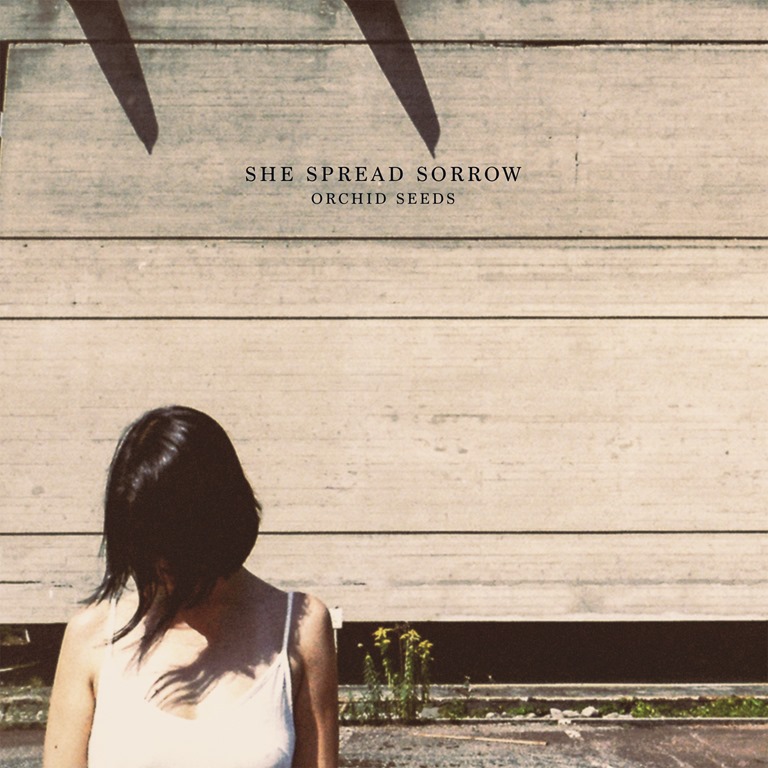
She Spread Sorrow is the musical vehicle for Italian artist Alice Kundalini, and over the course of a number of releases, the majority via Coldspring, she has explored a minimal industrial style, stark yet dense, and characterised by an eerie, whispered vocal delivery.

As the accompanying notes explain, ‘Orchid Seeds was originally published as part of the instantly out of print On Corrosion – a 10 cassette anthology from 2019 that was housed in a handcrafted wooden box and featuring full albums from Kleistwahr, Neutral, Pinkcourtesyphone, Alice Kemp, She Spread Sorrow, G*Park, Relay For Death, Francisco Meirino, Fossil Aerosol Mining Project, and Himukalt. The collection also stood as the 50th release for The Helen Scarsdale Agency, an imprint founded in 2003 and dedicated to post-industrial research, recombinant noise, surrealist demolition, existential vacancy and then some.’

Four years on, it finally gets a standalone release, both digitally and on vinyl.

Kundalini states that the album, “is about 5 different women of my family. Each track is about one of them with their difficult story and strengths. My family is totally destroyed now, no relation between anyone, but in the past there was a strong tradition of women with

interesting personalities.”

And even by the standards of She Spread Sorrow, Orchid Seeds is stark and eerie, dark and unsettling. The reverby, robotic vocals that whisper and moan over the sparse backing of ‘The Solitude in the Giant House’ may set the tone, and with a vintage drum machine thudding and clopping in the background, it has that late 70s vibe – somewhere between Young Marble Giants and cabaret Voltaire.

Things twist into darker territory with ‘Star’ as strains of feedback and grating, serrated synth ripples fizz and crackle beneath her gasping monotone vocal. This is much more reminiscent of Throbbing Gristle. It makes for a tense eight minutes: so often, when acts capable of producing great and heartstopping noise show such restraint as to keep it minimal yet audibly straining, the effect is amplified. This is one such composition; you find yourself moving to the edge of your seat, limbs tensing, waiting for something that never comes.

While the songs are about different people, ‘She Didn’t Care’ and ‘Queen of Guilt’ show opposite aspects of a theme, and perhaps provide some insight into the dynamic of the familial relationships and why they collapsed. The former is built around a stammering beat and hovering, hesitant synthesized organ hum; the sound and overall performance is primitive, immediate, while in contrast, the latter is dominated by a slow, heavy beat defined by a thunderous, reverberating snare, over which a simple synth wanders as echoed vocals drift, fuzzed and breathy and way off in the distance. The effect is some king of industrial dub, and it’s unsettling but not altogether unpleasant, perhaps because it contains stripped-back elements of common pop and dub tropes and so its oddness is countered by a certain stylistic familiarity.

The fifth and final track, ‘The Fortune of Others’, builds through serrated oscillations to grind away for what feels like a slow-throbbing eternity of electronic claustrophobia. It’s important to bear in mind the context: this is an album that’s equal parts narrative and concept, and the execution really pushes the concept to the fore, building the atmospheres of moments missed.

Without more detail – and let’s face it, more detail would likely be unsettling, even potentially traumatic – it’s impossible to determine the full extent of the meaning and also the pain behind the title. But for better or worse, the prospect of taking a firm grasp on the album seems to grow ever further away as it progresses. There is something magnificently and also frustratingly elusive about Orchid Seeds, and however deep you delve, however long you seek it, one suspects it will remain eternally beyond grasp.

AA

HMS050J_front

13th June 2023

Christopher Nosnibor

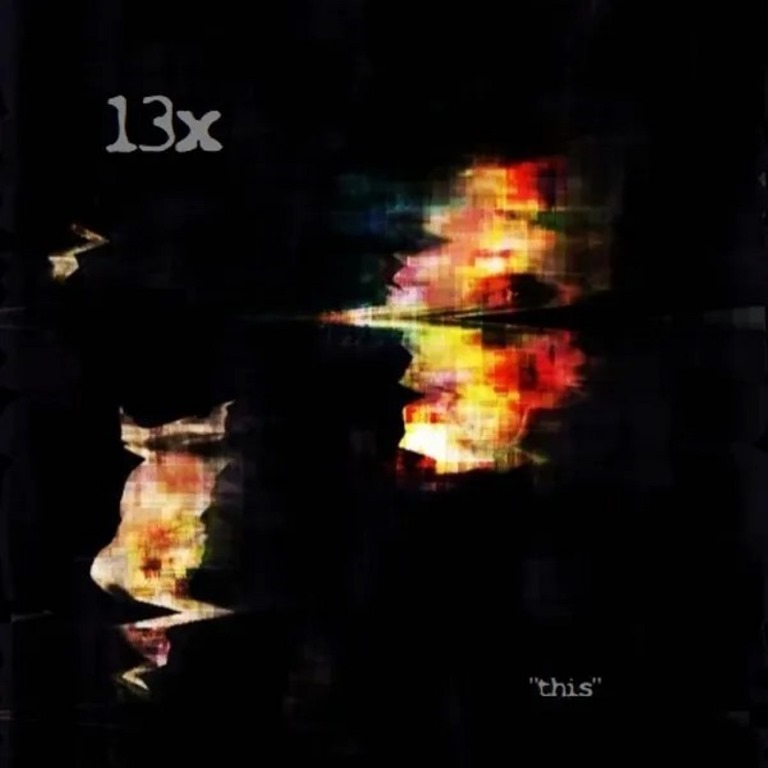
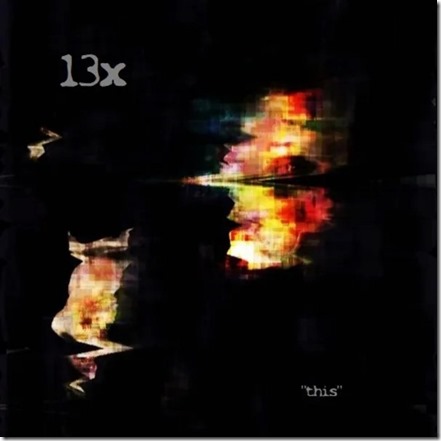
This. It’s a statement in itself. It’s simple, direct, to the point. It might indicate the image of a finger pointing down at the thing in question, like some kind of cartoon graphic or meme in the making – but there’s no need for it, or anything else. ‘This’ requires no qualification: it simply is. Self-contained. Precise. And this… well, this is 13x

It’s been a while since we last heard from ‘Multi instrumentalist transgirl’ 13x, who melted our brains good and proper in 2019 with antiscene. And it’s been a while because reasons, as the notes which accompany This outline: ‘Recorded over a 3 year period, this difficult release was made at the start of lockdown, and remained unfinished until now. Dealing with topics such as racism, transphobia, disingenuine people, the Government, abuse, loss and isolation, it goes from manic, crushing noize to quieter, more sombre tracks.’

Many, even most, of us, have endured some truly awful times these last three years, but it’s fair to say that some have endured more and worse shit than others. This is a document of some of the aforementioned shit of the notes, and the track titles encapsulate the mood and / or sentiment pretty neatly.

The first track, ‘TERFkilla’ is largely sparse and minimal in terms of both sound and arrangement, as a dissonant synth bleeps over a stuttering beat and low, droney bass. But shrill noise breaks over the top and the anger crackles within the cloud of abrasive noise. ‘fukt’ is, well, fukt, a sprawling mess of grinding synths and scratches, and some murky snippets of vocals with something of a hip-hop feel, and they sound sampled but appear to not be. They’re so cut and mangled, that when twisting and stammering against a backdrop of a shuffling drum loop and some low-end distortion it’s hard to know what the hell is going on – and it works.

There are plenty of samples woven into the fabric of This, and from an eclectic range of sources, ranging from Nirvana to a 60s interview with a catatonic schizophrenic, via a BLM interview after George Floyd was brutally murdered and Kate Winslett from Eternal Sunshine Of The Spotless Mind.

‘Fucking cunts’ is the looped refrain from the stomping aggrotech beast that is ‘Cistem Error vx.02’ – the most accessible and danceable track on the album, and simultaneously the most hard-hitting, while ‘brOkEnhEddz’ encapsulates the entirety of the album in just five minutes. Warped, woozy, it’s fractured and dark, whirring electronics and stuttering beats – but it builds and finds a groove, and from the chaos emerges something magnificent, an expansive, driving slab of dark synth pop.

I still find it unfathomable that we live in a world where vast swathes of society proclaim themselves to be anti-woke: if you’re anti-woke, you’re expressly pro-racist, pro-misogynist, pro-homophobic, pro-abuse, pro-anything that’s cunty. But then, we live in a world where vast swathes of people subscribe to Donald Trump’s view that ‘antifa’ is the enemy. But if you’re anti-antifa, you’re expressly pro-fa. There is something gravely wrong with this picture. ‘Truth Against Fascism’ and ‘The System Is Wrong (For George)’ are in effect a diptych of thematically-linked compositions. The former is a bleak mid-tempo trudge through mangled circuitry that reminds of the synapse-twisting impossibility of engaging in meaningful, rational discussion with right-wing shits who harp on about ‘stopping the boats’ and so on, while the latter has a gentler, more contemplative tone, laced with a wistful melancholy.

It’s this melancholy, expanded deeper into an aching sadness, which drapes itself all over both ‘Neeko’ and the album’s final track, the twelve-and-a-half-minute ‘Wintercutz’. I’m reminded vaguely of The Cure’s ‘Carnage Visors’ soundtrack from 1981, perhaps primarily because of the rolling drums of ‘Neeko’ and the expansive atmosphere which permeates both pieces. But there’s something special here: you can almost taste the nostalgia, and after the aggressive, angry start, there’s a sense that by the end of This, there is some sense of peace, acceptance, and a looking to the horizon in the hope of… something.

There’s often a significant disparity between the lived experience and its articulation in any medium: such is our wiring that even the most accomplished and attuned artists spend lifetimes striving to find the method that best suits them in their quest to convey what’s in their head to an audience who exists outside of their head. Sometimes, it’s not even about the audience: sometimes, the creation of art is a process by which to make sense of and deal with all of it. By purging the shit from the mind into something constructive and creative, however unappealing it may be to the masses, and there’s a strong sense that This is as much about purging and process as it is about communicating. But what This achieves is, in fact, both. This speaks without words, and says much, while at the same time, leaving substantial room for the listener to pour their own experience and frames of reference into the shifting sonic spaces. Over the course of ten pieces, This achieves a considerable amount: This has range. And This, while drawing on a host of elements from different places, sounds quite unlike anything else. This is This.

AA
a4153800615_10

Cosmic Dross – 26th May 2023

Christopher Nosnibor

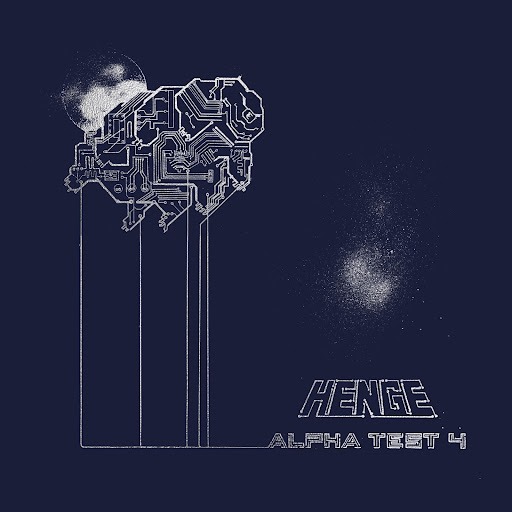
When it comes to spaced-out, trippy conceptual stuff, I can’t help but wonder if large quantities of drugs are involved, or of the creators are just a bit crackers. Their debut album Attention Earth! Featured a song called ‘Mushroom One’, which makes mee think drugs – or perhaps just the image they want to portray. The members of HENGE, Mancunian purveyors of self-styled ‘cosmic dross’ go by the names of Zpor, Goo, Grok and Nom, and Zpor, their ‘front-being’, explains of the new album: “Alpha Test 4 is our third Planet Earth LP release. With each record we have sought to fine tune our extraterrestrial sounds for human ears, optimising these alien frequencies in order to more effectively access the pleasure sensors in the Sapien brain…We believe that the wisest lifeforms are always open to new learning, and we have been conducting our own studies on the human beings that we’ve encountered on Earth so far. We have discovered that exposure to this alien music can have a profound effect on the human nervous system, and have recorded an average increase of 72% in the happiness levels of human specimens attending our experiments”.

If you’re going to do performance, you need to commit to it completely: there can be no half-measures, no stepping out of character off stage, and HENGE clearly live and breathe being HENGE, and one would like to think they’re entirely aware of the absurdity of it all, but happy with the trade of preserving the identities they enjoy at home and in their dayjobs or whatever. I’m going to at least hope that Zpor doesn’t insist that his wife and kids and colleagues address him as such.

Alpha Test 4 is noodly, doodly, silly fun that harks back to the 70s with its cheesy, wibbly synths and tinfoil futurism that was retro even at the time. It’s not so much prog in its primary inspirations, so much as ‘Where’s Captain Kirk?’

‘DNA’ brings stupid funk and daft robotix vocals and it’s probably fun if you’re into it, but mostly it’s annoying: their space-age daft Punk shtick just feels obvious, derivative, passé. And yes, everything is just recycling now: that was postmodernism, where we accepted that originality was dead and celebrated that the future was built on assimilations and permutations of the past. Progress lay in the innovations of new hybrids and how genres were intermingled, and we reached a point, I’m not quite sure when, where it all came down to the execution. It ain’t what you do, it’s the way that you do it… and HENGE do it, and with wild abandon and great enthusiasm.

But great energy does not make for a great record on its own. Alpha Test 4 is bursting with energy and brimming with bubby synths: ‘Ra’ is exemplary, an explosion of Lucozade and Red Bull-fuelled 8-bit twitchy pop that crosses XTC with D‘n’B, and spins in a dash of Eastern promise alongside a swirl of experimentation. The worst excesses of YES are tossed into the mix along with Jean Michele Jarre and Yello. It has its moments, but most of those moments are indulgent and rather corny. But HENGE likely know this and don’t care, because unless they are from another planet and spent their time hovering in space, they’re aware and self-aware, and grasp the absurdity of what they do with both hands before jettisoning the junk, and no doubts regardless of my views – and likely because of them since the chances are everything I dislike is everything fans love – Alpha Test 4 will go stratospheric.

AA

793f4928-efba-26d1-5287-6d6b5e45d6e7

Christopher Nosnibor

‘I’m sorry, I’ve been busy’. We’ve probably all heard it: and most of us have probably spoken the phrase. I’m guilty, too, and hate myself for it. Everyone is fucking busy. Too busy to text, to open a message even, too busy to reply to emails, catch up with friends, too busy to fucking live. What is everyone so busy doing, and why is it that in a time when technology was supposed to make our lives easier, and in supposedly affluent western cultures, people are both fiscally porr and time-poor?

Naturally, I blame the current strain of capitalism: keep everyone too busy to live, to breathe, and too skint, and they’re not going to be protesting, they’re going to be too busy wondering where the next meal is coming from to fuck shit up. After everything, they’ve only got the juice to be ‘busy’ bingeing Netflix or the new season of The Mandalorian.

Admittedly, I have been genuinely busy parenting, publishing stuff, and writing a review a day while battling through an evermore overwhelming volume of submissions, but is that really a reason, or just an excuse? Right now, I’m not sorry either way. I keep myself to myself and I write when I can when I’m not doing laundry or cleaning or paying bills or feeding the cat

Gintas K is always busy, and he’s been having albums released at a ratee beyond that at which I can even download them, let alone listen and digest. And so it is that March and April have seen the release of three – yes, three – albums by the prodigious Lithuanian.

I must have been absolutely nuts to have set myself the task of reviewing all three together. The idea was to soak it all in with an evening of electronica, and report on what I expected to be an immersive experience. But knowing Gintas K’s work over the years, this was, in hindsight, an unlikely outcome. The headline here is that there is no overarching theme, there’ s no evolutionary trajectory, and nothing to really take hold of. But that in itself is K’s selling point: his work is exploratory, varied, sometimes playful, and often difficult.

Resonances, the first of these, ‘was recorded live, using computer, midi keyboard & controller on Autumn 2021’ and has been released by Sloow Tapes in an edition of 70 copies. It spins slow-swirling vortices around hovering hums and low-humming drones over the course of its ten, comparatively short (only a couple extend beyond four minutes), ponderous tracks. It’s perhaps one of his more varied works, both sonically and atmospherically – and Resonances really does explore atmospheres and cavernous swampy echoes.

Resonances

a1449704449_10

Fluxus +/- is a split collaborative release, which finds him working with Kommissar Hjuler Und Frau on a longform track, while a piece by Wolfgang Kindermann & PAAK occupies the other, and what we get here is just shy of eighteen minutes of really weird shit, bubbling swampy noise and loose collage layering of all sorts of snippets and a mish-mash of all kinds of everything that’s not easy to digest.

And then April saw the arrival of Sound & Spaces #2, which is perhaps more Gintas K’s standard fare of bubbling, foamy froth and stuttering, stammering glitch-heavy sonic mayhem. It stutters and scuffs, bleeps and wibbles, and at times sounds like the speakers are shredding, the cones torn and flapping in the blasts of random noise bursts, while at others… well, at times it’s a foaming froth and as others, it’s really not very much at all. The pieces run into one another to create a continuous stream of crackling distortion and bibbling trickles of tweeting and twittering, and while the effect is the most incomprehensible and difficult to digest, it’s by far the most quintessentially K. If it’s what I’d expected, then what this trio of releases demonstrates is that Gintas K continues to defy expectations and to produce work that’s different and diverse.

Sound & Spaces #2

a1377760751_10

Sinners Music Records – 15th May 2023

On reviewing the debut EP by Fashion Tips recently, I commented that the northern noise ‘scene’ was, in effect, more of a community. I suppose this is something that is true of many more niche corners of the musical world, and it’s certainly true of the electronic scene, particularly that which has grown up around the EMOM (Electronic Music Open Mic) nights that take place around the country as a platform for all strains of all things electronic based (several of which I’ve reviewed, and a few of which I’ve performed at). These nights are a broad church, and have not only welcomed me, but opened the doors for myriad collaborations, as well as providing a safe space for testing stuff out as well as an opportunity for seasoned performers and novices alike to connect with an accommodating audience, and this release comes courtesy of Sinners Music Records, established by Ian J Cole, another face familiar to attendees of the York EMOM nights, who also streams the Audiophile radio podcast showcasing weird and wonderful exploratory electronica.

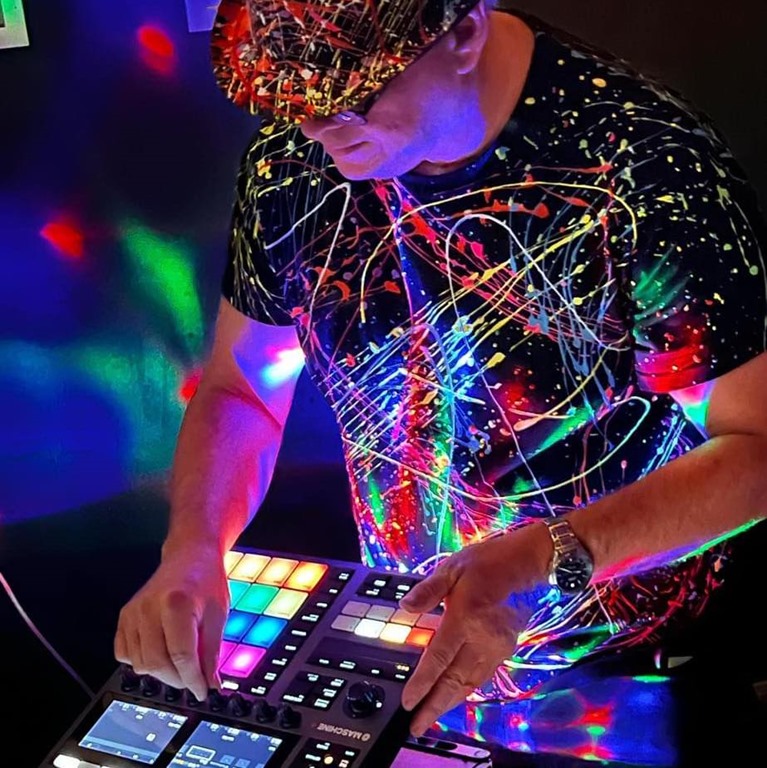
Mho – that’s ohm backwards, and pronounced ‘mo’ – is the musical vehicle of Dave Walker, who’s been a regular face at the EMOM scene, and has become established as being instantly recognisable for his stagewear, with neon-splatter t-shirt and hat. Obviously, these visual props don’t translate to the recordings, which must stand on their own merits – and they very much do.

Over the course of ten tracks, Walker showcases a broad span of styles and sounds, and the compositions are all accomplished and considered. As his bio states, he ‘began his foray into making electronic music at school when he built a Transcendent 2000 synthesiser and a ETI String Synth, as the Polymoog synth cost as much as a house back then’. He’s since switched to more contemporary kit, but his years of experience have led to a nuanced approach to musicmaking: there’s a lot of detail, but nothing’s overdone. Every drop, every time the beats bang back in, every layer, every stutter, every new sound and sample, is perfectly placed – but not in such a way that the precision leads to sterility. Walker’s tunes flow with a rare naturalness, and there are no jarring jolts or awkward lurches between segments.

Predominantly, these pieces are built around conventional piano sounds and broad strokes of synth which fill out broad spaces, and there’s a lot of analogue-style pulsations, too, cut from the cloth of Mike Oldfield and Tangerine Dream.

There’s something familiar that I just can’t quite place about the melody of ‘Nie Rozumiem’ (which will undoubtedly annoy me for days), and elsewhere, ‘Chorale’ brings ambience with low-key beats that washes along nicely, being largely undemanding but pleasant. ‘Eternal’ brings a hint of Eastern promise and a vaguely operatic vocal carried on a soft breeze of shuffling beats and rippling piano.

‘Contact’ and ‘Moon’ appear to be thematically linked, the former bursting with samples and laser-beam bleeps, and it does have quite an 80s feel to it. This, though, is true of much contemporary electronic music which isn’t overtly dance – or EDM and the encroaching Americanism would have it. The latter is a seven—minute sonic exploration that expands through time and space with crackling radio transmissions from the lunar landing of 69.

‘Take it Easy’ is pure 80s retro tootling melting into 90s euphoric trance, and while well-executed, it’s perhaps the least engaging or enticing tracks on the album, but it’s but a brief weakness in an otherwise solid album which concludes with the surprisingly light and accessible spin of ‘I Am With You’ which practically skips along.

With EMOM sets providing just ten to fifteen minutes for artists to showcase their style (these nights are absolutely bloody packed, to the point that despite being ‘open mic’, all slots are usually taken a full month in advance), it’s good to hear the full span of the elements which feature in an Mho set, and even better to hear that Mho has the material for not only a longer set, but a full album which is at once diverse and cohesive.

AA

333455632_2197845260603259_2646669291313228150_nmho1

Constellation – 12th May 2023

Christopher Nosnibor

Ky Brooks’ solo work is, on the face of things at least, a very far cry from her output with noise-punk trio Lungbutter. This, of course, explains why it’s her solo project rather than the new addition to the Lungbutter catalogue: sometimes things just don’t belong together under the same banner.

That said, there was always a slightly experimental / arty bent to Lungbutter’s work, and it’s this which stands to the fore on Ky’s solo album. The title track is exemplary – and ultimately, fucking weird. Entitled with ‘teeth’ in parenthesis, it features a robotically-delivered monologue about ‘the integrity of the teeth’ and some weird shit over a gently gliding drift of warm, fuzzy synths. Teeth often make me think of Martin Amis, and specifically Dead Babies, but also my late grandmother who had all of her teeth removed when she was nineteen, to be replaced with false teeth she would wash with soap. I suppose you might say I’m easily triggered on account of my randomly-tripping memory which tends not to be my friend. But if it seems like an epic tangent, bear with me: it’s relevant because this is what music does: it sends you places. They’re not always good places, they’re not always or even often the places you expect, but it can open doors to recollections.

I suppose this makes the joy of music something of a double-edged sword, something I hadn’t always appreciated. You want it to open the channels and provide conduits for emotional connection, to evoke and provoke – well, at least some of us do. It’s not always comfortable or easy, but it’s about feeling something, and that emotional resonance simply cannot be found in the oil slick of mainstream middlingness, where everything is processed and pre-digested. Power Is The Pharmacy is anything but.

‘All the Sad and Loving People’ does rippling, pulsating ambience before whappy automated vocal wanders around all over it and things go strange. It’s pinned together by a slow, clacking beat that’s murky and subdued, evoking the spirit of Portishead with a smoky trip—hop vibe, which is in stark contrast to the sharp, stark spoken word of ‘Work that Superficially Looks Like Leisure’ which is unsettling in its Stepford Wives pro-conformity zeal which we instinctively understand to be false long before it turns rabid, both in its vocal delivery and crashing jazz drum explosion that rides in on a swell of expanding noise.

The Dancer’, released as a single is hypnotic, entrancing, and detached, deranged, with a looping synth blip bubbling along through sonorous scrapes and driven by an insistent, impersonal beat. You can probably dance to it, but you’re more likely to feel a growing tension as it cyclically bubbles its way over the course off nearly five minutes.

But then what do you do when immediately presented with a song like ‘Revolving Door’? It’s like Jarboe-era Swans and Big |Brave, with crushing chords providing the backdrop to a breathy, haunting vocal. You certainly don’t find a comfortable category for Ky or her work that’s for certain. ‘Dragons’ brings next-level intensity, and while there numerous comparisons which float into my mind, perhaps it’s better to highlight a unique talent rather than tame it with contextualisation.

There are so many details and textures here that make Power Is The Pharmacy an album that requires repeat listens in order to absorb them. That’s a challenge in itself, because it’s not an immediate album, and it’s a record that leaves you feeling like you need a break, to sit and stare into space for a bit after.

And perhaps that’s the way to approach this: with space, to allow it to breathe, and with no concrete expectations. The spoken word passages are very much akin to David Bowie’s Outside, I realise, and Power Is The Pharmacy could be described as a concept album of sorts. It’s certainly a strange album, but it’s interesting.

AA

cover Ky - Power Is The Pharmacy

Editions Mego – 24th March 2023

Christopher Nosnibor

Editions Mego have since forever released ultra-niche but eternally-fascinating exploratory works. Since their inception in 1994 as MEGO, before transforming into Editions Mego, bearing eMEGO catalogue numbers, the label has given home to pretty much every significant and emerging artist working in the field of electronica given to abstraction, minimalism, glitch, and the more experimental side of things. As such, this release is a very comfortable fit in the catalogue.

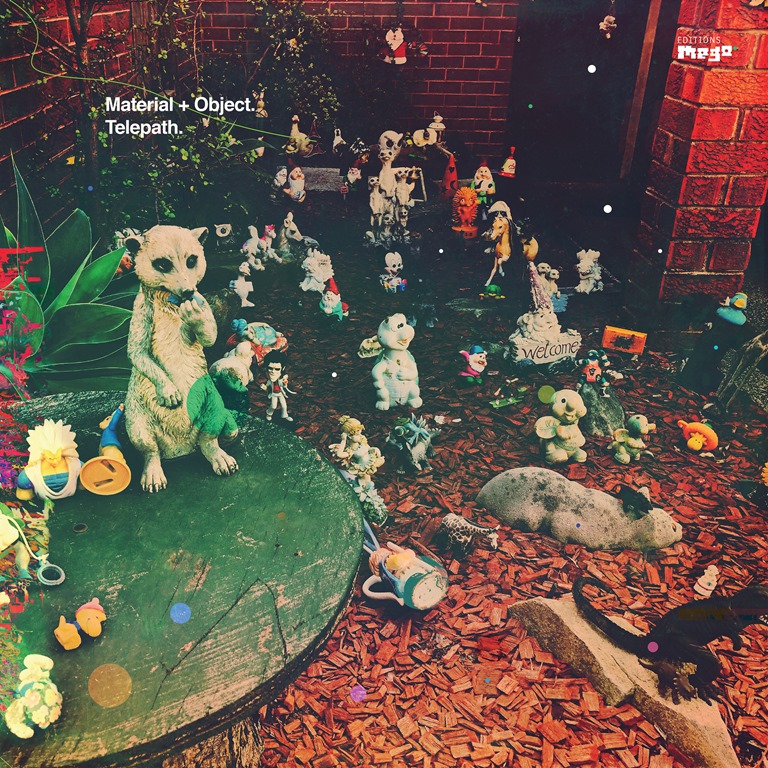
As the bio details, ‘Dismantling the acoustic to feed the electronic, Editions Mego presents Telepath, the new album by Material Object. Born out of a single improvised recording session with a lone Violinist, Telepath is a startling album of future electronic music, resulting in an LP of unique and timeless tracks that reimagine a classic sound for an endless future.’

Nothing about Telepath sounds remotely like a violin in any recognisable sense. Even the long, soaring tones and strong-scrapes which sound like a violin sound, in context, processed, abstract.

It’s all about the process, of course, and it’s the literal processing and manipulation of sound which renders the output so far from the initial input. The results are interesting, to say the least.

To return to the bio for context, Telepath is presented as ‘Boldly departing from his previous canon of largely ‘ambient’ work, Material Object’s Telepath renders itself out as something much stranger, something more spacious, more subtle and gradual. Moments of bouncing minimalism meet moirés of delayed pure tones phasing in and out of resolution, giving way to a series of strobing foreground gestures arranged and offset in disorienting landscapes which scatter themselves asymmetrically amongst crystal pools of reverb.

There are moments of deep, rumbling ambience to be found here, but it’s certainly not the album’s dominant feature.

‘Enter’ isn’t quite microtonal in its focus, but does very much narrow down to an extremely small sonic spectrum in order to interrogate minor changes and the relationship between notes as they resonate and bounce off one another – and that focus is intensely concentrated, remaining fixed for some nine and a half minutes. It sets the stall for Telepath overall: the fifteen-minute ‘Hyphae’ flickers and clicks as sounds bat back and forth at a rate of rapidity that’s tension-inducing, particularly as the click-clack becomes overwhelmed by a bubbling cloud of dense sound yet remains persistently audible.

Structurally, the album alternates between longer works and shorter interludes of a couple of minutes or so: these serve, I suppose, as the sonic equivalent of palate-cleansers, and they’re necessary in breaking up the vast sonic swaths of hyper-focussed detail as interrogated over five minutes or more.

It may seem a contradiction, but while focusing microscopically on the most minute details, Telepath also covers a lot of ground. It’s all about contrast and contradictions, and arguably these are the foundations of this intriguing and often quirky work.

Following the twitchy, processed pings of ‘Thermo’, the eleven-and-a-half-minute ‘Exit’ is the perfect bookend to stand opposite ‘Enter’. And as the album leaves us reflecting the whisps of mist left in its trails, there is a hanging sense that there is something yet to come. From among the shadows, Telepath presents us with an unexpected sense of insight, both outside and in.

AA

eMego299V_front