Posts Tagged ‘Editors’

Christopher Nosnibor

Is it acceptable to wear the band’s T-shirt to their show? It’s a frequent topic of debate amongst my gig-going friends. As a rule, we tend to agree it’s not cool, although we all have our notable exceptions, and I got mine. But IST IST fans would largely disagree, it would seem – unless this is their exception band.

Usually, with the front bar right next to the auditorium, people sit at the tables supping until the bands start, sometimes until the headliners take to the stage. Not tonight. A large cluster of middle-agers in IST IST T-shirts are queueing and actually blocking access to the bar room half an hour before doors.  There’s a guy with an immense beard wearing a sleeveless black denim jacket with Sisters of Mercy and Fields of the Nephilim patches paired with red tartan trees and he’s standing in the queue too. The queue is practically out of the front door by 7:25, but the bar remains almost empty. These people are keen.

The support is an Ian McCulloch wannabe in a knee-length coat doing sub-mid-80s Psychedelic Furs lifts with a goth tinge. The drum machine is nicely up in the mix and the sound is great, even if the songs are only middling at best, and wince at worst. and it’s mostly backing track. But the Jarvis Cocker moves are overdone, suddenly throwing shapes in the most uncool fashion, sometimes going for a power pose or something a shade more aggressive and all the more incongruous, and the shades are off and back on and off and I again and the cringe only increases as the set progresses. It’s one of the longest half hours of music, and probably the most painful since the band supporting A Flock of Seagulls at The Brudenell a few years ago. It’s a rare talent to be this technically competent and so fucking embarrassingly awful at the same time.
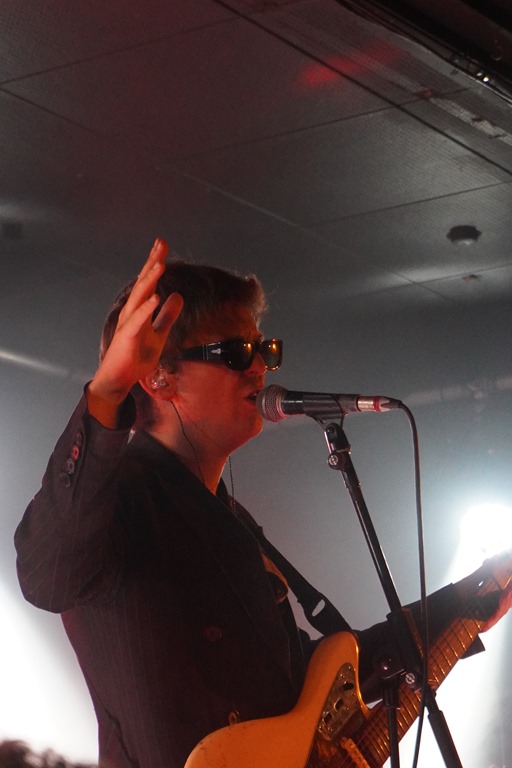
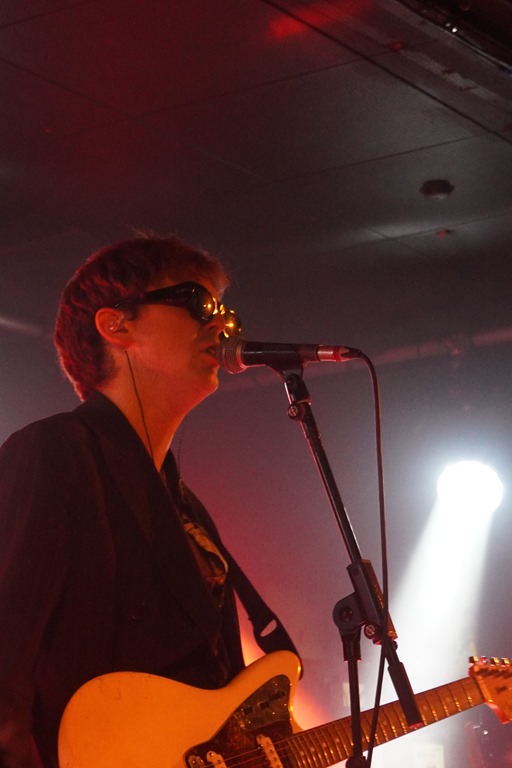
DSC01981DSC01982

Oliver Marson

Having clocked a vintage Sisters T in the gents and emerging to find the front of the stage absolutely rammed, I was reminded just how hardcore – not to mention fucking stubborn – older gig-goers can be. It’s no wonder I learned spot-bagging and elbows when I started going to shows as a teen in the early 90s. And, as then, I’m probably a sound 10-15 years younger than the majority of these buggers. Those clustered in the front row in groups are discussing the set lists placed on the stage. Smoke drifts as Interpol’s ‘Roland’ blasts from the PA.

It’s not hard to comprehend why this band enjoys such devotion from this demographic: they present all of the quintessential post-punk elements, delivered with precision and panache. It is, it must be said, post-punk as viewed through the prism of the 21st Century revival. And there are many who are here for that, too, with plenty of under 30s grooving away behind the first five rows of old sods.

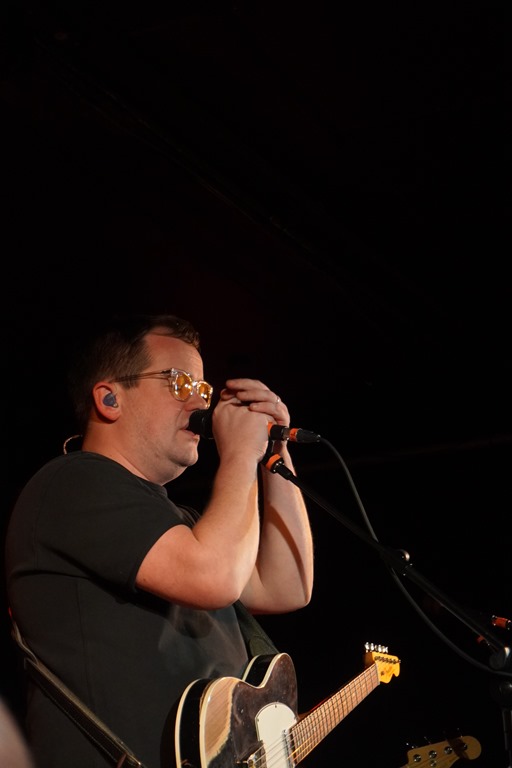
DSC01992DSC01990

IST IST

There has been no shortage of bands doing precisely this since around 2004, but Superlative drumming elevates their Editors /Interpol / White Lies – etc. – sound. The vocals are a flat, monotone and slightly twangy baritone with all the reverb, which take me a while to place, but they land somewhere between I Like Trains and She Wants Revenge. Credit to the sound guy, too, who’s working hard with the reverb and echo, especially on new song ‘Echo’, which has ‘instant classic’ written all over it and goes down a storm. They’re tight as and the sound is outstanding, with some super-solid bass at the pulsating heart of it all – and unlike Oliver Marson, leather jacketed bassist Andy Keating keeps his shades on – although I can’t help but wonder if they’re prescription and he’s doing a Wayne Hussey.
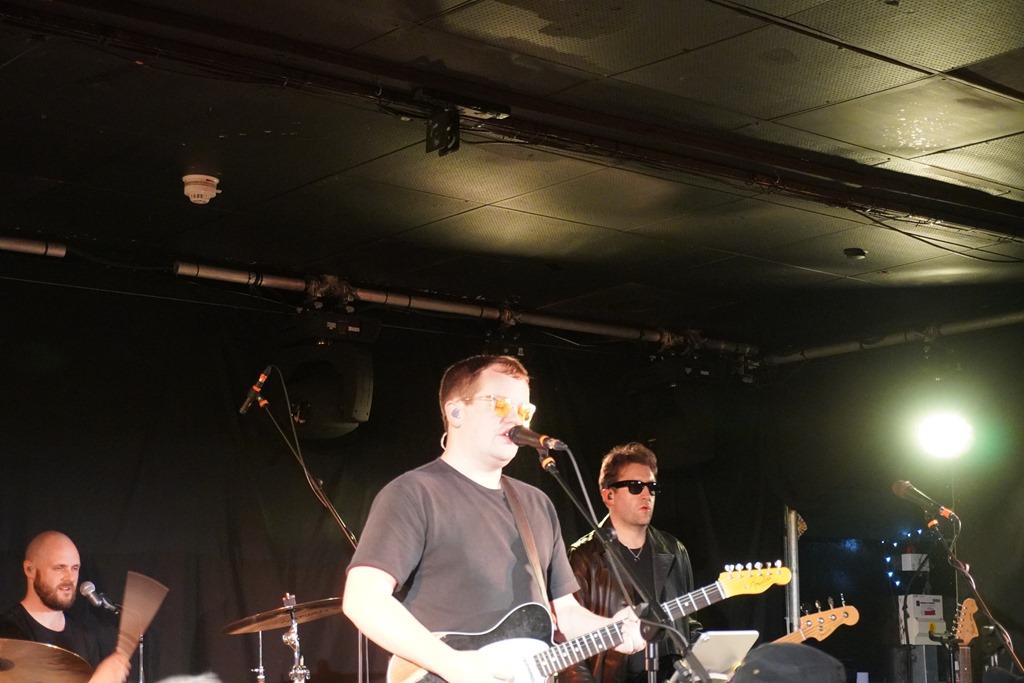
DSC02012DSC01998

IST IST

One of the tracks later in the set – my notes are sketchy as I was a bit engrossed – is pure She Wants Revenge, and it would be easy to shrug that IST IST offer nothing new, and it would be a valid criticism – but the counterpoint to that would be the consistency of the material and sheer quality of the performance, where some nice 12-string action adds some all-essential texture, and there are abundant I Like Trains-style post-rock crescendos along the way – and shshsh, don’t tell the younger fans, but it’s all as goth AF.
17th March 2023

Christopher Nosnibor

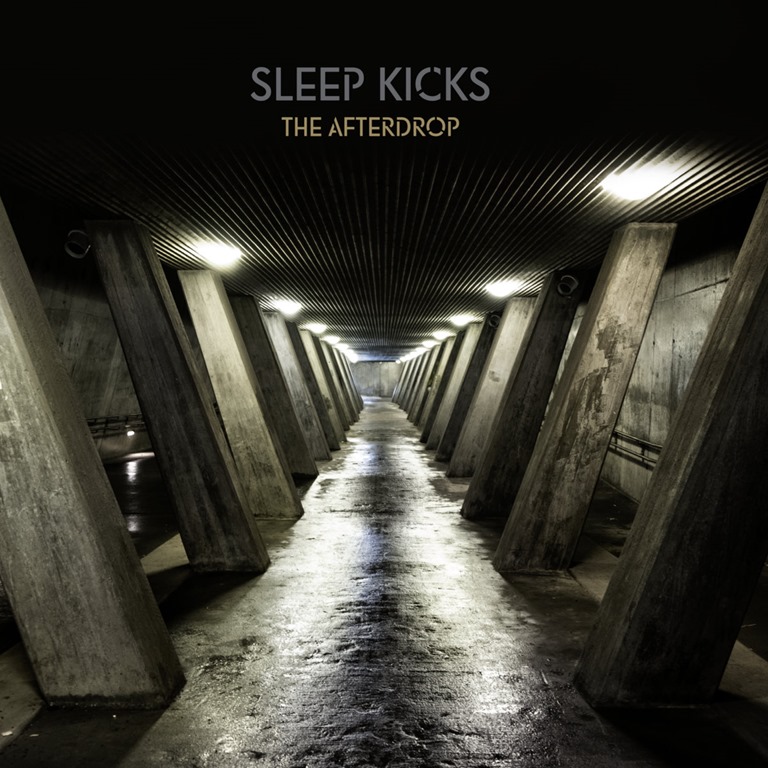
In the feast or famine equation, there’s rarely a true drought when it comes to quality new releases, but this month really does seem to be one for an eye-popping proliferation, and the arrival of Sleep Kicks’ debut album after a succession of singles and EPs is a most welcome arrival along them.

Having previously showcased – and raved about – previous releases, it’s a joy to see The Afterdrop finally land. Most of those previous singles – ‘My On Demon’, ‘No Chains’, ‘Hall of Shame’, ‘Neptune’’, and, most recently, ‘Words in Vain’ are featured here, along with a different recording of ‘Exodus’ from the one that appeared on the Summer EP back in July 2020. It’s marked as an edit, which makes me curious to hear the full-length version performed as a full band.

Having frothed and foamed exuberantly about the band’s melding of dark post-punk with soaring pop aspects with each single release, I’m running low on my reserve of superlatives. But there are four new songs here, and then there’s also the question of how it hangs as an album – whether or not if feels like a padded-out singles compilation or an album proper.

I suppose the first thing to point out is that while all of their previous releases have been digital-only, The Afterdrop is receiving a vinyl pressing, meaning the songs finally feel solid and tangible in a way they perhaps didn’t before, and with the atmospheric instrumental opener, ‘Reflections’ lifting the curtain on the ten-track set, it does very much feel like an album rather than simply a collection of songs. It’s dark and spacious, with robotic drumming driving it along.

It’s then straight into the vaguely gothy post-punk of ‘Words in Vain’, with its stonking bass and fractal guitars, a tune that on its own should have earned the band global domination on a par with Editors and Interpol. ‘Neptune’ is synthier, but its poppiness is countered by dark undercurrents, and it’s a rush, as is ‘Exodous’ – a thunderous bass and brittle guitar that’s pure Interpol circa Turn on the Bright Lights defining the side.

In previous reviews, I’ve also likened Sleep Kicks to fellow Norwegians A-Ha: some of this is down to Terje Kleven’s vocal qualities – rich, varied, and with a knack for inflection, but equally, they’re a band I’ve always returned to because there’s there’s a darkness to their pop that I feel has been largely overlooked, and it’s this amalgamation of darkness with a pop sensibility that is what I’m driving at with Sleep Kicks.

‘Silencer’ – another one of the new songs – is slower, sparser, but brims with brooding and emotional resonance, and, once again, it’s magnificently crafted. This is true of every one of this album’s ten tracks. ‘Orbiting’, another song which hasn’t been released before, is bittersweet bliss and again revises the 80s spirit with a brooding yet accessible slice of guitar-driven desolation.

Again, in a just world, ‘No Chains’ would have been their ‘Pompeii’ and would have seen Sleep Kicks on the same pegging as Bastille – again, there are similarities, but the fact is that Sleep Kicks are by far the better band. It’s an unjust world where it comes down to label backing and pluggers. But then, we know it’s an unjust world, and the music industry sucks. But there’s a world outside the industry, and ‘Hall of Shame’ with its choppy guitars and snaking bass runs is as good a song as you’ll hear all year. But then, so is ‘My Own Demon’. In fact, The Afterdrop is an album without fault, and as good an album as you’ll hear all year, or ever.

a3769329865_10

3rd February 2023

Christopher Nosnibor

Aural Aggro regulars Sleep Kicks make a welcome return with their latest offering, ‘Words in Vain’. With a rumbling bassline and busy, effects-heavy guitars that soar tremulously, the opening bars of ‘Words in Vain’ smashes together The Fall’s take on ‘Jerusalem’ and Editors’ ‘Bullets’ – cathedrals of sound underpinned by an earthy thud, and this is one of those expansive, gut-pulling new-wave revival tunes in the vein of the early 2000s – think Interpol, Editors, White Lies – and it’s taut and evocative. There’s an emotional depth to the vocals, but there’s more than that: everything feels tightly packed and tense. And I can’t deny that I’m a sucker for that.

What is it about the post-punk template that endures? Why do these goth-tinged tunes have so much bite? It’s not simply nostalgia: hell, I was hardly born when this sound emerged in the late 70s and early 80s, and suspect that the turn of the millennium crop – the revivalists – were inspired by listening to their parents’ collections. And what goes around comes around, meaning the new bands emerging, in their twenties, have likely discovered the noughties revivalists via their own parents. But why do these cycles emerge?

I can’t help but suspect thee socio-political landscape has a fair bit to do with it. Rocketing inflation – not to mention strikes, droughts, and floods – mean parallels to the 70s are being drawn in the media, and for obvious and justified reasons. Social and economic troughs bring frustration, despondency, despair – and music which reflects that mood.

As troughs go, this is a deep one; we’re looking as escalating war and nuclear threat – same as in the early 80s – insane inflation and mass deprivation – with extreme climate, flooding, etc., etc, on top. People can’t afford to exist, let alone to live. And when things hit the bottom, art invariably rises to reflect the mood and present the voice of the zeitgeist.

AA

su57784-WiV_1200px

24th September 2021

Christopher Nosnibor

Pink Turns Blue have been around practically forever, having formed in 1985, and while they may not be widely regarded among the first wave of goth acts, they very much emerged from that milieu as a duo with a drum machine, and what they’ve achieved over so many of their peers while lingering on the peripheries is longevity. Having re-emerged in 2003 after an eight-year hiatus, they’ve continued to mine the classic post-punk seam that’s distinctively theirs, due in no small part to Mic Jogwer’s vocals. And of course, what goes around comes around. Their return in the early years of the new millennium was well-timed, coinciding with the point at which the post-punk renaissance bloomed with the likes of Editors and Interpol breaking through. There were of course countless also-rans, and bands who emerged but failed to fulfil their promise, but nevertheless, time has proven that the style has remained current, and the darker the times, the greater the craving for dark tunes, and this is where Pink Turns Blue really prove to be as contemporary and vital as ever.

Their eleventh album was written, recorded, mixed, and mastered during lockdown in their Berlin studio, and the first thing that strikes about Tainted is just how bleak it is. It’s achingly majestic, it’s magnificent, and possesses some wonderful hooks and choruses, but there’s an all-pervading atmosphere of sadness, of melancholy that’s draped over every beat and radiates from every note. Glimmers of positivity are dampened by an air of resignation, optimism doused with defeat. The next thing that soon becomes apparent is just how consistent the album is. It’s not only all killer, but had a remarkable cohesion. It’s true that that for cohesion you might interpret sameness, and they do operate with a fairly limited sonic palette. One suspect this is at least in part the result of the material being the product of three guys in a studio without any external input or interference.

But working within such limitations places the focus on the songwriting, on the tunes, on the delivery, instead of throwing in all sorts of fancy stuff.

The guitar to opener ‘Not Even Trying’ evokes the into to ‘Severina’ by ‘The Mission’, and it’s got that same solid four-four strike on every beat bassline that Craig Adams made his signature back in the early days of The Sisters of Mercy, and which has become something of a defining feature for so many gothy post-punk bands, and it makes the song an instant grab. ‘I’m not even trying’, Jowger admits blankly, as if admitting defeat from the outset, and setting the pessimistic tone that echoes through single cut ‘There Must Be So Much More’. It’s a song of yearning, of questing, and of determinism, and a song Editors would have likely killed to have penned for one of their first two albums.

This isn’t an album of depression, but the sound of downward-facing defeat, of staring at the ground and wondering where it all went wrong. ‘Never Give Up’ encapsulates the conflict, the inner turmoil of staring emptiness and defeat straight in the face and realising there are only two choices. But to never give up is not a positive thing, merely the stubbornness that comes from not knowing what else to do.

The bass and guitar are melded together in a tunnel of chorus and reverb, and tied to a relentless drum track, and it’s gripping and compelling. ‘Why Not Save the World’ has heavy echoes of mid-80s Depeche Mode and would sit comfortably on a She Wants Revenge album, while ‘I’m Gonna Hold You’ comes on like New Order as covered by A Place to Bury Strangers, with a nagging bass and brittle guitar that grips hard.

Just as Robert Smith can make a skippy pop song sound tear-jerkingly sad, so when Jowger sings of the joys of ‘a new day’, it’s with a wistful melancholy that aches deep and you feel something tug in your chest as you swallow it down, that inexplicable sadness. ‘Listen to the bumble bee’ he sings on ‘Summertime’, and it’s carried a way on a chiming jangle of guitars that are so wistful, while the tone is of deep nostalgia. A perfect sunny day can have its joy marred by the realisation that it isn’t quite as perfect as sunny days of a time gone by, happy, carefree times that will forever be trapped in the memory as magical, but now faded and never to be recreated.

The song structures are comparatively simple and straightforward, and built around repetitive chord sequences and guitar motifs, and there’s nothing fancy about any of the playing – which is absolutely key to the success.

Any fan of Interpol or Editors would do well to explore Tainted – but then again, so would any fan of not only post-punk, but anyone with ears and with a heart and soul. It’s a masterful work in music of the mood. The mood is low, the mood is sad, and this is an album of real depth that speaks and resonates beyond the immediate.

133936

30th April 2021

Christopher Nosnibor

Ten months on from last year’s ‘Summer ‘ EP, headed by lead track Recovery, Sleep Kicks return with ‘My Own Demon’, and it’s a solid second single to say the least, putting meat on the bones of the live acoustic version that featured on the EP.

The comparisons I drew to A-Ha and Editors in reference to its predecessor are again applicable here, as the Norwegian foursome spin a hypnotic atmosphere through the medium of strolling bass and chiming, reverby guitar to carve a song that’s a balance of taut 80s pop and brooding new wave, and anthemic is the only word to describe its epic finish. With a wash of guitars and a powerful, uplifting ‘wo-ah-hoh’, you could easily picture this being played in front of a packed arena with several thousand hands waving aloft in time.

Yet, at the same time, the delivery of this big, soaring chorus, is quite a contrast to the lyrical content, which are so striking in their intimacy:

Always feels like someone’s coming after me

Never seem to find a cure for this anxiety

Every day it stays the same, I fear tomorrow’s call

Would be better if it never came at all

We all have our demons and our anxieties, but tend not to talk about them, despite the fact we probably ought: free and open discussion is the only way we will change attitudes to these things, and normalise the topic of mental health, and how it feels to wake up wishing you hadn’t. But we’ve all – or nearly all – been there at some point. It takes real strength to not only commit such lines to paper, but also actually sing them out loud, but it’s that investment of emotion that resonates, and – as I often say – in the personal lies the universal. And this, this reaches out and touches the soul in a special way.

AA

a1052329898_10

12th February 2021

Christopher Nosnibor

Coventry quartet SENSES have had a stuttering journey to bring them here, with the release of ‘Drop Your Arms’ as a taster for their impending debit album – which has been a long time in coming. There is a classic tale of burgeoning progress being stalled and creativity stifled by label wranglings. Throw in a global pandemic and you’ve got the perfect recipe for a stalled career. It’s almost as if some labels are more concerned with contractual constrictions than the nurturing and promotion of creativity and new music.

But you can’t keep a good band down forever, and regrouping after a hiatus to embark in a multi-media project designed to take their music to the masses and to the next level, and ‘Drop Your Arms’ is the opening gambit that prefaces the debut album Little Pictures Without Sound.

Yes, it’s indie at heat, but it’s also so much more: it’s also big, bold and anthemic – and swings between the throbbing anthemic stylings of Doves with the darker post-punk currents of early Editors (whose producer Gavin Monaghan was involved in the early recording work) – I’m specifically thinking ‘Bullets’ here, particularly when it ratchets up around the mid-point. Then again, I’m equally reminded of The Psychedelic Furs’ debut album and their ‘wall of noise’ that really hit hard.

There’s a darkness and a seriousness about ‘Drop Your Arms’, a track that drives and bounces with an effervescence and energy that’s as infectious as it is undeniable. In short, it’s a cracking single, and if the rest of the album is half as good, it’ll be a corker.

AA

SENSES_Drop Your Arms_Single Artwork

12th February 2021

Christopher Nosnibor

Released digitally last autumn, Para Lia’s Gone With The Flow gets a ‘proper’ physical release this month. The second album from the German duo, consisting of René and Cindy Methner, has already drawn comparisons to Dinosaur Jr, Arcade Fire, and The Mission, as well as referencing in the press release – the hearteningly specific – ‘early Editors’.

It all makes sense with the blistering opener, ‘My Muse’ – a post-punk influenced adrenaline shot that showcases some wild soloing that somehow manages not to sound wanky. See, I’m not one for guitar solos myself, but find that J Mascis’ best efforts are enough to reduce me to tears. ‘Kassandra’ hits that spot: it’s a cutty post-punk revival effort that’s got the pomp of The Mission, complete with the wordless backing vocals Julianne Reagan delivered to absolute perfection on songs like ‘Severina’, and topped with an absolutely melting solo that twists, turns and weeps all over it. I should probably be tired of this by now, but when presented with just the right blend of nostalgia and quality

They don’t always pull it off: ‘Riders on the Dike’ is more ramshackle punk-folk with a ragged vocal delivery reminiscent of Shane Macgowan that simply doesn’t quite sit, and ‘Time and Again’ follows a folksier bent that grates a shade, feeling slightly forces and off-track despite some soaring harmonies from Cindy.

But it’s more hit than miss, as the slow-burning ‘Fools’ brings swathes of mournful strings to the post-rock tempest that swells as the song progresses, and the tense jangle of ‘Fire’ evokes the spirit of 1985, not just instrumentally but with its thick production, where the bass and guitar clump together, cut through by a sharp-topped snare sound.

‘Kaleidoscope’ is every bit as shimmeringly layered as the title suggests, and notes of New Model Army and Red Lorry Yellow Lorry are present as they drive a forward trajectory with an insistent rhythm section and some choppy guitars pinned back in the mix. Last track, ‘No Time for Butterflies’ combines psych-hued 60s pop, folk, and 90s alternative to forge a pleasant and exhilarating finale, and if there’s little about Gone With The Flow that’s overtly ‘new’, it’s a unique combination of older forms rendered with real style and some solid songs.

AA

a1263001157_16

Fierce Panda – 13th November 2020

Christopher Nosnibor

Fierce panda will be forever intrinsically linked to the cutting edge of indie in the 90s, emerging as it did in 1994 and immediately making a name for itself with limited edition 7”singles by big-name contemporaries initially including Ash, Supergrass, The Bluetones, and Baby Bird, not to mention Placebo, Keane, Coldplay, Embrace, and that record by Oasis.

More than a quarter of a century on, they retain that certain sense of cool-by-association, but also continue to release damn good indie singles, breaking new talent with astounding frequency. National Service are a perfect example: the label picked up the London quartet National Service from seemingly out of nowhere, releasing their debut single, ‘A Little More Time’ in the year of their formation. Three years on, and here we have their third single, a song that unpicks he seams of the mundane, the everyday, and the introspective pains of self-expectation.

‘I haven’t had a decent sleep in days / I’m overthinking when I should be happy doing something mundane / But I’m too busy thinking about the long run / That I rarely find the time to enjoy today’ laments Fintan Campbell against a welter of shimmering guitars and rolling drums.

Comparisons to The Twilight Sad aren’t unjustified, and the band mine that seam of post-punk revival / indie crossover that dominated 2002-2006 as represented by Editors, Interpol, The Cinematics and myriad others, and the bassline that cuts in at the midpoint is pure Carlos D circa Turn on the Bright Lights. None of this is in any way to suggest that ‘Caving’ is derivative or locked in time: it’s a genuine rush of a tune, and condenses all the emotional resonance into four and a half minutes. It’s taut, hooky, and packs a punch.

AA

Caving Artwork

Cool Thing Records – 7th August 2020

The band – the coalescence of an enigmatic visual artist, a prodigal singer-songwriter and an ambitious beat-maker ‘trapped inside a digital landscape’ describe their debut, ‘Lumbering’ as being ‘about viewing the world with a sense of claustrophobia and dread, as humanity bounces between various financial crashes, wars and climate disasters, whilst continuing to lumber endlessly forwards, seemingly in a wounded state.’

This is, indeed, the world of the now, and as such, I expect it’s broadly relatable to many on its perspective. It’s certainly relatable to me on a personal level, having become attenuated to a sense of perpetual panic and wild upheaval. The only thing you can be sure of is that nothing is certain, and you can’t rely on or trust anything – or anyone. The fact is, no-one is exactly who you think, and we live in an evermore divided and more extremely polarised society, be it Brexit or the wearing of masks.

‘Lumbering’ is pitched as ‘an intriguing soundscape of skeletal guitars, layered angular rhythms and fantastic lyrics’ and a hybrid of Boards Of Canada, 00’s Radiohead and The Cure’s Bloodflowers era.

With clattering drums and a pulsing bassline, I’m reminded more of the early 00s New Wave revival as spearheaded by the likes of Interpol and Editors, as well as The Cinematics. A Cause In Distress capture that tension and sense of urgency and distil it down to a truly gripping three-and-a-half minutes of surging dynamism.

It doesn’t necessarily make me feel better, but articulates my restless tension perfectly.

 AA

thumbnail_Lumbering Cover

Christopher Nosnibor

Daily, I read about how the current situation is affecting bands, and, indeed, every aspect of the music industry. That said, it’s always the grass roots and lower echelons who are hardest hit, as is the case in any kind of crisis. Major-league artists will always be ok as gong as there are radio stations to play their stuff and produce a steady flow of royalties, and their millions of fans continue to stream their songs endlessly online. Beyoncé, Bono, and Ed Sheeran aren’t going to starve under lockdown.

But bands who rely on gigs in pubs alongside other bands who rely on gigs in pubs to find a fanbase and maybe flog enough merchandise to cover their fuel between said gigs have nothing to fall back on.

Sleep Kicks’ story is by no means unique, but they way they tell it as they present their new single really brings it home:

The whole live music scene shut down less than two weeks after our debut single came out. Instead of doing gigs and rehearsals, we just kept going, working on our own with a handful of songs we had recorded. Mixing, videos, artwork – the lot. We suddenly realised that one of the songs happened to describe this weird situation, and the feeling we somehow knew we would have once this whole thing was over. In short, the soundtrack to coming out of urban lockdown. It turned out an epic ode to the city, and at least it helped ourselves keeping the spirits up during the bleak times!

With ‘Recovery’, the Norwegian quartet paint scenes of an empty world springing back to life, and the difficulties of the prospect of readjustment.

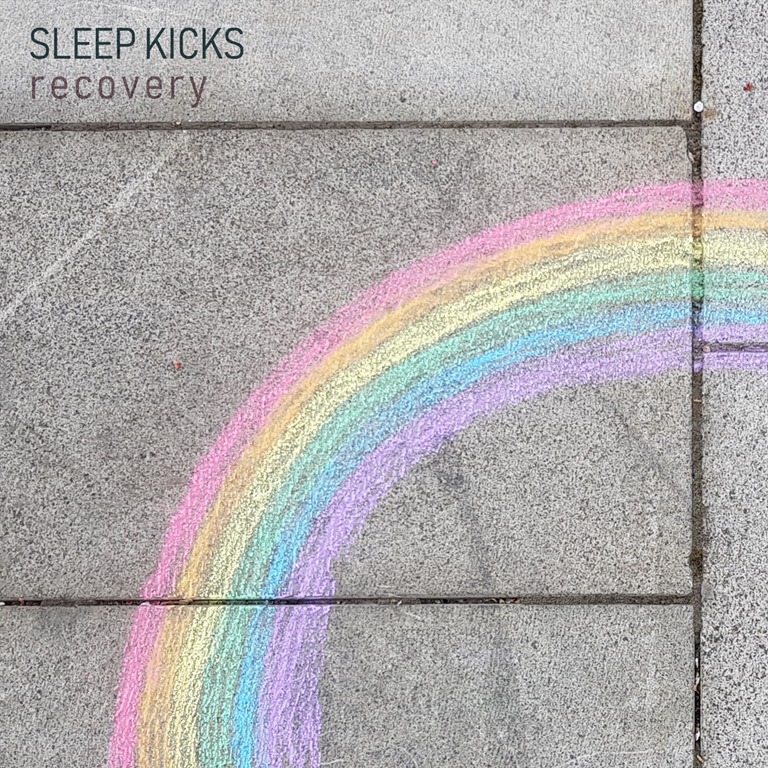
A rolling rhythm and chiming guitar pave the way for a strolling bass motif and they coalesce into a spacious, reflective soundscape that sits between A-Ha, Editors, and mid-80s U2 and Simple Minds. Things kick up a notch and even nod toward anthemic around the mid-point of this six-and-a-half minute epic, before blossoming fully for a mesmerising final minute, where it soars on every level as they cast their eye to a brighter future: not the chalk-drawn rainbow on the pavement featured on the cover art, but a life of fulfilment, a re-emergence from the stasis of the now to actually living, rather than merely existing.

For a ‘little’ band, they have a big, ambitious sound that’s also got big audience potential. Here’s hoping they fulfil it.

AA

a0608442167_10