Posts Tagged ‘Dissonance’

Room40 – 30th June 2023

Christopher Nosnibor

There is no quick way to consider this album. And for many reasons – the first being that it needs to be heard in its entirety before being able to summarise and pass critical comment. The second being that after hearing it, one needs to drag themselves from the wreckage of their psyche and process an experience that is likely akin to a week being subjected to psychological experiments at the hands of the CIA under MK Ultra. Brace yourself…

As his bio points out, ‘Tony Buck is no stranger to the realm of durational performance and composition. As a part of Australian unit The Necks he has been central to defining a reductive, but rich sound language that equally interrogates timbre and time…[and] with Environmental Studies he moves even further into these longitudinal pursuits.’

Longitudinal is one word to describe this album. It’s a single, continuous piece, some two hours in duration, and while there are a couple of five-minute excerpts designed to give potential listeners an indication of what it’s like, it’s simply impossible to convey the experience in snippets. The snippets are lifted from the album’s lighter moments: that doesn’t mean they’re mellow, melodic, but the multi-layered clattering percussion that’s evocative of some kind of space-jungle and brief segment of avant-jazz feedback is nothing in the wider context. And – as I always say – context counts.

While chart music – geared toward snappy three-minute cuts which are 90% chorus – and the inclusion of streams when compiling charts, has effectively killed the album in the mainstream, further afield (and to be fair, you can’t get much further afield than this), the album is still very much a cherished format for both artists and listeners alike. In fact, it’s interesting to observe the rise of the really long album. I will often harp on about Swans releases from the last decade, but they’re not isolated. Frank Rothkkaramm released an album as a 24-hour CD box set – which couldn’t be much more different from Throbbing Gristle’s 24 hours box – as he explored sounds which helped with his tinnitus. Numerous doom, drone, and ambient albums in recent years have really pushed the parameters of an album thanks to digital releases not being subject to the same limitations of physical formats – or the same production costs. Is the medium the message? Perhaps, at least to an extent.

The recorded medium was always an issue: even going back to the height of the classical era, once recording became possible, the media limited what could be released, meaning to hear a full performance of, say, Handel’s Messiah, you had to be there, since even a recording which required a box-set album release required truncation. It also, of course, required the turning of records and the segmentation of the work.

In its day, Earth’s groundbreaking Earth 2 challenged the conventional notion the ‘the album’ – more even than any monster prog releases like Yes’ eighty-one minute Tales from Topographic Oceans and the two-hour plus, sprawling triple YesSongs. Because what differentiates these is the fact that Yes was a lot of noodling wank, while Earth did something different, with a specific desired effect intended, and its duration was in fact integral to its cumulative effect, namely that of a sonic blanket of suffocation. Anyway: the point is that Environmental Studies is an absolutely immense album, and it’s a work that needs to be heard as an album. You may find yourself drifting in and out, but it feels as if this is part of the experience: better to drift than experience in fragments.

The accompanying notes describe Environmental Studies as ‘An incredibly dense matrix of interwoven voices and layers, each occupying and exploiting a unique space within the fabric of the sound-environment, co-existing to slowly reveal themselves in multiple interconnected relationships.’

Immediately from the start, the listener is assailed by a deluge of discord and dissonance and streams of noise. It gradually drifts through an ever-evolving, eternally-shifting journey, where mellow jazz piano and slow-melting notes emerge and drip slowly over cascading cymbals and an infinite array of extraneous sounds which wash in and out. There are passages of supple, strummed acoustic guitar – which get harder and more challenging at times but also explore mellow passages –– and gurgling extraneous nose, straining, clattering. There are sections which so tense, straining and submerged by noise that as feedback twists and turns and groans and hums, that the enormity of Environmental Studies finally hits.

There are infinite layers of percussion rattling shakes and clangerous curiousness, with errant twangs and all kinds of shades of strange, with dingy distortion crashing in heavy amidst the a maelstrom of noise that sounds like a hundred pianos being thrown down a hundred flights of stairs at the same time while someone in the top floor flat blasts a Sunn O))) album at wall-cracking volume and there’s a fire broken out in the basement and it’s rapidly escalating upwards.

An hour in, we’re in sonic purgatory – and it’s absolutely magnificent. The polytonal percussion builds and builds; industrial, tribal, everything all at once, with sonorous drones and crushing distortion and noise and wailing feedback whistling and screaming all the while, it’s a relentless barrage of sound – but not noise, and that’s an important distinction here. There are noises, and they’re collaged into something immense, with the rattling of cages and furious beating of skins.

When it does simmer down, some time further in, we find ourselves in an alien landscape, that’s strangely spacey and tense before the next round of percussion barrels in. Environmental Studies is big on beats, but not all of the beats are big: insectoid skittering and scratchy flickers are as integral to the complex interweaving as the thunderous floor toms and reverberating timpanis, and everything melts together to weave a thick sonic tapestry.

While there is nothing about Environmental Studies which is overtly heavy in the conventional sense, to immerse yourself in the album is an exhausting experience, both physically and mentally. But if art doesn’t challenge, what is it for? It’s merely entertainment. This is not entertainment. But it is an incredible work of art.

AA
a1038790420_10

Kohlhaas Records – 22nd April 2022

Christopher Nosnibor

Simon Whetham’s notes which accompany (II)ntolerance – the sequel to his 2017 collection, InTolerance – are informative, albeit perhaps more so when reading between the lines: ‘InTolerance consisted of a selection of combined scenes and activities in various global locations. Through the process of constructing the piece, it became clear that it was as much about my ability and fortune to be able to travel and cross borders with relative ease as it was about the situations I was able to document. (II)nTolerance is a sequel and a response to InTolerance. It is a personal reaction to the global pandemic and its wide-reaching effects through suffering, fear, misinformation as much as confinement and curfews. It is a personal response to the (somewhat incorrectly named) United Kingdom leaving the European Union and all the resulting events that are continually unravelling.’ He continues: ‘Travel has been limited when not impossible. Cultural exchange is only possible through mobile, online, remote communication. Tactile contact is feared. Families and friends have been divided physically, mentally, politically.’

The pandemic but a block on everyone’s lives, but everyone was affected differently, and while I struggle to find sympathy for those bemoaning their inability to take their 204 kids on their half-term skiing holidays and the like, touring artists who depends on mobility for their livelihood, it’s a different matter, especially as that transit and a shifting geography is integral to the creative process. Reading Whetham’s notes, it’s clear that his obstacles have not been purely pandemic-related: The ‘United’ Kingdom has degenerated into a cesspit of division where not only ‘tactile contact’ is feared, but so is anything from ‘outside’. Never has this felt like a smaller, more isolated, island, and not just geographically.

Tolerance is something many of us – mostly those of us who wanted to remain – can now only dream of, as we hide our faces behind our hands as we peep at Twitter and Facebook, where it’s bordering on a virtual civil war.

Whetham describes (II)ntolerance as a personal response to all of this, and ultimately, that’s the only real response any artist can make. The idea that we’re all in the same boat has been proven untrue, for while we all endured the pandemic, everyone experienced it so very differently: home schooling while working from home was, for example, in no way comparable to living alone or in a shared house while on furlough. Similarly, the effect of Brexit for a container driver, versus that of, say, a hedge fund manager is simply not comparable. But this in itself is an issue: increasingly, it seems people have become unable to relate to experiences and situations which differ from their own.

As an artist, of course, one can really only represent oneself, and hope that through the personal there is an element of universal therein, and on this level, (II)ntolerance succeeds, containing as it does fourteen abstract compositions that state nothing explicitly, and yet convey so much implicitly.

There are a number of pieces that form sequences, namely the ‘Angry Earth’ pieces and the three ‘Kinetic Readymade’ pieces, which give the album a sense of cohesion and thematic unity (while making a small nod to avant-garde greats like Marcel Duchamp). And (II)ntolerance is an album of movement, of turbulence: the first piece, ‘Angry Earth Seething 1’ sounds like a harsh deluge of rain, and the lashing precipitation sets the tone for a stormy sonic journey, riven with growls and gulps and crashes of static and ominous drones and clicks and stammers.

(II)ntolerance marks a shift from field recordings and a focus on geography to shift the focus inward in a response to a shrinking environment, and the result is claustrophobic and uncomfortable. ‘Moving Sentry 2 – Angry Earth Seething 3’ is a gurgling mess of abrasion, while ‘Reception – Windpipes’ whips and gurgles in a fog of phase. Oftentimes, such as on ‘Angry Earth Seething 4’, Whetham conjures a dark, gravel-shunting grind of uncomfortable noise, while ‘Kinetic Readymade (Turbine)’ embraces all shades of difficult, dominated by churning, scraping noise – and as a whole, (II)ntolerance is not an ‘easy’ album. It’s noisy, with serrated edges and low-end growlings that unsettle the intestines. A difficult album for difficult times.

A

Simon W

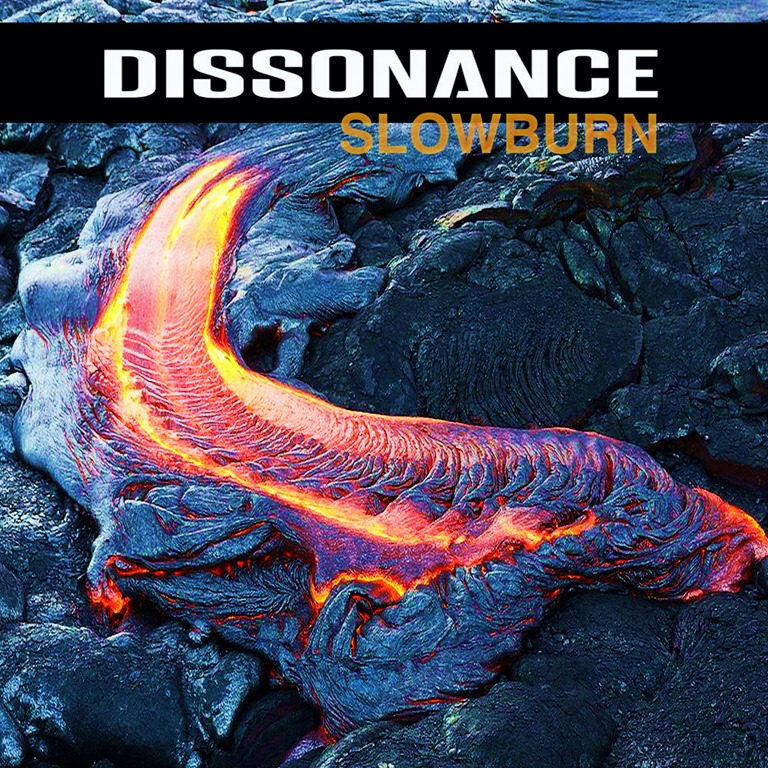
Lifted from their recent AA-approved Slowburn EP, Dissonance have released a lyric video to accompany the Smoke and Mirrors Mix courtesy of James Reyna, aka Melodywhore.

It’s a slowburn indeed, and you can watch it here:

http://a%20href=

AA

a3299441169_10

21st January 2022

Christopher Nosnibor

‘Slowburn’ is, true to the title’s promise, a slow-burner, and as a single, it’s solid – not immediate, but appreciation evolves with repeat plays. The track itself is, in many respects, very much in the darkwave tradition, with cold synths and equally cold, almost monotone vocals that also carry an ethereal quality.

There’s a mesmerising, hypnotic quality to the original song, which, we learn is ‘a song about passion; passion- a deep love/emotion that consumes body and soul. It is about depth of feeling for a person, place, process or thing.’ Against brooding piano and backed-off beat, it calls to mind Jarboe-era Swans and some of her solo work, in no small part due to Cat Hall’s powerful but understated vocal.

Cat explains the origins of the song as follows: “I wrote this as I was considering the many all-consuming passions of my life. Passion to write. Passion for art. Passion for nature, for the planet. Passion for science. Passion for humanity. Passion for the individuals I love. Also, the painful realization that despite my intense feeling, actions and orchestrations, these things, places, people, and processes come to an end. I come to an end. My passions die with me.”

Our passions drive us and keep us alive, and without passions, what have we and what is life? And what passion is there in a set of remixes?

My standard complaints around remix EPs are that they’re essentially lazy and eke out the smallest amount of material for the most physical space, and that they’re something of a short-change for fans; then there’s the fact they’re often really, really tedious, with the same track or tracks piled back to back and mostly sounding not very different apart from either being more dancy or dubby. This set is a rare success, in that the remixes are so eclectic and diverse half of them don’t sound like the same song, but without doing that whole thing of deconstructing it so hard with ambient / techno / dub versions that there’s nothing left of the original in the versions – another bugbear.

The Von Herman Lava Lamp Mix piles on the soul and sounds like Depeche Mode circa Ultra, while the Kirchner Charred Mix is a straight-ahead, thumping electrogoth dancefloor-ready banger. The Haze Void Mix cranks up the grind, with oscillating electronics more akin to Suicide than any contemporary act. This is the biggest, densest, and most transformative reworking of the lot, venturing into space rock territory as it thuds an d rattles, twisting the vocals against an urgent, throbbing sonic backdrop and throwing in some hints of Eastern mysticism for good measure. It’s an intense experience. The Hiereth Lonely to a Cinder mix brings some brooding piano and even harder hammering beats, landing it somewhere between the Floodland-era sound of The Sisters of Mercy and that quintessential Wax Trax! technoindustrial sound.

It’s a corking single, and as remix sets go, this is a good one.

AA

a3299441169_10

SIGE Records – SIGE103 – 25th June 2021

Christopher Nosnibor

It was The Decline Effect, a full decade ago, which provided my introduction to the work of Jim Haynes. It was an album I described as ‘bleak’, commenting on the way it reminded me of ‘Robert Burton’s 17th Century text The Anatomy of Melancholy, which detailed in the richest language the terrible physical symptoms of melancholy and its effects on the humours of the body. It still stands as a fitting description of a work by an artist whose career is devoted to ‘compositions of corrosion, shortwave radio, and tactile noise’.

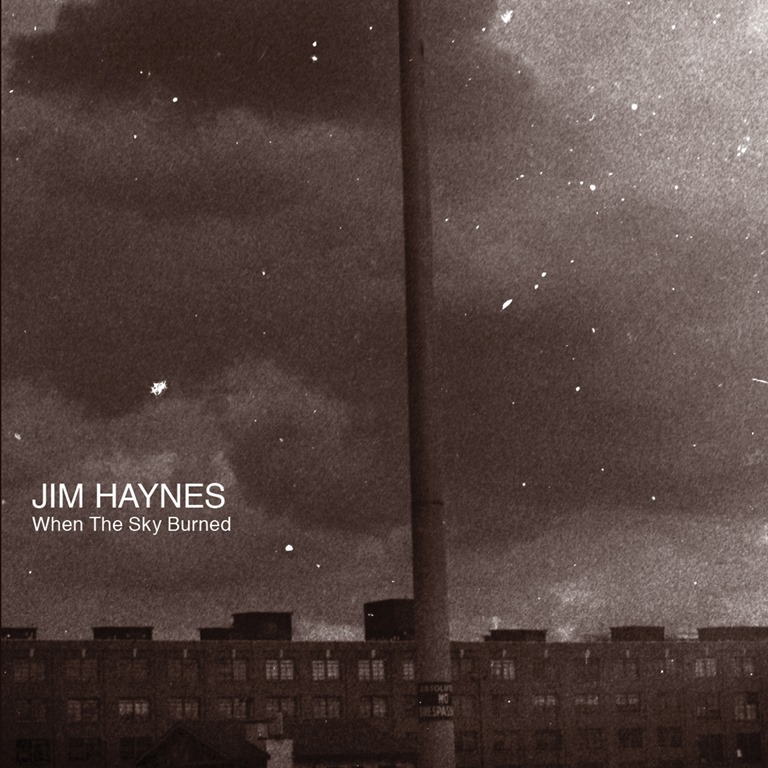
Haynes’ inspiration for this latest offering was environmental, circumstantial, situational, as he recounts: “I completed this record in the fall of 2020. Much of the western states of the US was ablaze for months. The anxiety of the collective American psyche was ubiquitous, also due to the Presidential elections in November of that year. And When The Sky Burned became an appropriate title given the environmental and political climate of that particular time.”

But what’s also fascinating is the more subtle use of reference, of intertext: Haynes explains that When The Sky Burned When The Sky Burned is ‘also a reference to Zbigniew Karkowski’ – before going on to explain his ‘complicated, if distant relationship’ and subsequent hostility from both Karkowski and Andrew McKenzie, aka The Hafler Trio, for what appear to be the most disproportionate of reasons.

Haynes dedicates the album to both McKenzie and Karkowski ‘whether they like it or not’, writing on the latter, ‘After his death, I most certainly felt a sorrow that the world has lost this artist, but I was also very conflicted as I wish there could have been a conversation about what happened. I don’t think he was capable of remorse or reconciliation, but I wonder if I was wrong in that analysis. So this album is a tenuous homage to Karkowki’s early works – with the chest, cavity rattling lows and the shrill sustained high frequencies. The title in fact is a direct translation of the opening piece to that aforementioned Silent CD – "Als der Himmel brannte." But of course, I can never leave anything so static alone, and the heaps of noise, junk, and dissonance were required."

Haynes is an absolute master when it comes to noise, junk, and dissonance, and When The Sky Burned is abrim with all three.

As album openings go, the first few seconds of ‘Multiple Gunshots’, are striking, shocking, even, as blasts of percussion – which slam like gunshots – hit the listener without warning. They arrive a succession of hard blasts – some warping backwards, and Haynes manipulates them to forge an erratic but devastatingly heavy beat. I’m reminded of how Swans sampled a nailgun and pitched it up and down for the punishing rhythm on ‘Time is Money (Bastard)’, and this builds a grind of rapidly oscillating drones that flicker and shudder. Seven minutes in, the drones rise to a shriek, before obliterative distortion decimates any semblance of musicality. Everything combines to forge an intense and oppressive eleven minutes where little happens other than the listener suffering a brutal sonic punishment.

Between this, and the ten-minute ‘Appropriate to a Sad, Frightened Time’, Haynes presents a series of compositions that really test the listener’s capacity for noise and overall endurance. ‘Abruptly Scattered’ sounds like an enormous generator’s throb, occasionally rent with blasts of explosive treble noise as if said generator is bursting into flames. The tonal separation is well-defined: the bass sends the most uncomfortable vibrations through the pit of your gut, while the shrill, harsh treble smash makes you clench your teeth and fear for your hearing. You swallow hard, feeling uncomfortable, wondering if you’re going to suffer tinnitus or diarrhoea first, and pray it’s not both simultaneously.

Haynes’ explorations are brutal and harsh, and the set as a whole is truly relentless. Heavy crunches and grinding, gut-churning growls are suddenly ruptured by unexpected thacks and cracks, detonations, and the kind of heavy impact that makes the car-door slams used for punches in films sound like friendly pats on the shoulder. Swirling vortices of noise on noise howl and shriek, violent sonic tornadoes that inflict devastating levels of damage tear from the speakers, and even the moments of calm are unsettling, uneasy.

When The Sky Burned is not a nice album, but it’s a remarkable one, one that quite literally crackles with intensity, and genuinely hurts in places. But while it is relentlessly abrasive and often excruciating, Haynes’ attention to tone and texture, and the way the utilises these elements to forge a work of immense range isn’t only admirable on the technical, sonic, and compositional levels, but also results in an album that has massive impact, and is an outstanding example of well-crafted and intuitive electronic noise.

AA

BSBT_j-cardfront_double

28th January 2021

James Wells

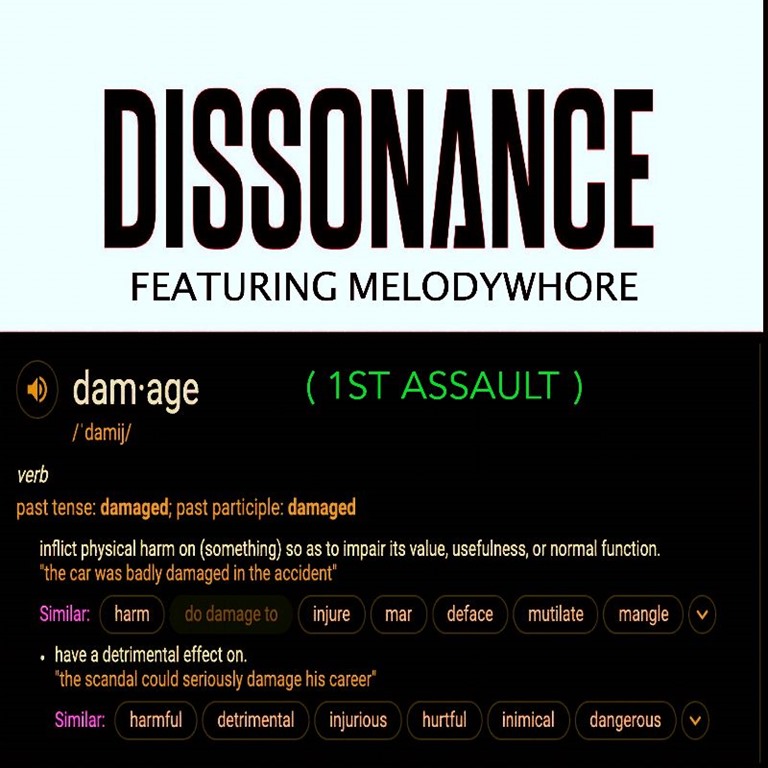
This seven-tracker follows the same format as previous EP releases from the past couple of years, and features Dissonance’s collaborative duel with Melodywhore, ‘Damage: 1st Assault’, augmented with six remixes.

The remix package very much has its roots in the field of dance, from whence the work of Cat Hall – aka Dissonance – has emerged – although, as her bio notes, it ‘incorporates elements from industrial, pop, and alternative rock’ which has seen the project ‘compared to bands like Nine Inch Nails, Curve, This Mortal Coil, and Information Society.’

Coming together with Melodywhore has facilitated the exploration of the darker, harder-edged leanings of the Dissonance sonic palette, which places ‘Damage: 1st Assault’ very firmly in NIN territory, with an erratic stop-start beat dominated by a whipcrack snare driving a bubbling synth bass, which in turn underpins some dark atmospherics. It lands somewhere between Pretty Hate Machine and the electrosleaze of ‘Closer to God’, and it’s solid.

The remixes – being remixes from a selection of guests – accentuate different features, with Joe Haze’s CF2 remix pumping up the bass and beats to create a driving, dense backdrop to the backed-off, breathy vocal (which also highlights the Curve comparison), while the more stripped-back Machines with Human Skin Corrupted remix comes on more like the original Pigface recording of ‘Suck’, but with soulful backing vocals that owe more to Depeche Mode.

Steven Olaf’s remix is dirty but also beholden to 80s robotix synth, and so it goes. The REVillusion Revision Remix is a spaced-out stomper that goes for the slowed-down anthemic vibe.

The one thing that’s conspicuous is how the remixes stay fairly true to the original form and structure: there isn’t one reworking that takes the song somewhere entirely different, and there’s nothing as daring or brain-mangling as, say, JG Thirlwell’s radical remixes of Reznor’s cuts, and there’s nothing wrong with that by any means – it all just feels a little safe and reverent. And without any of the versions doing anything particularly radical, it does get a shade monotonous listening to the remixes back-to-back.

Still, it’s a decent enough tune, and if you’re prone to playing songs on a loop, this will save you hitting repeat.

AA

173106