Posts Tagged ‘Digital’

12th November 2025

Christopher Nosnibor

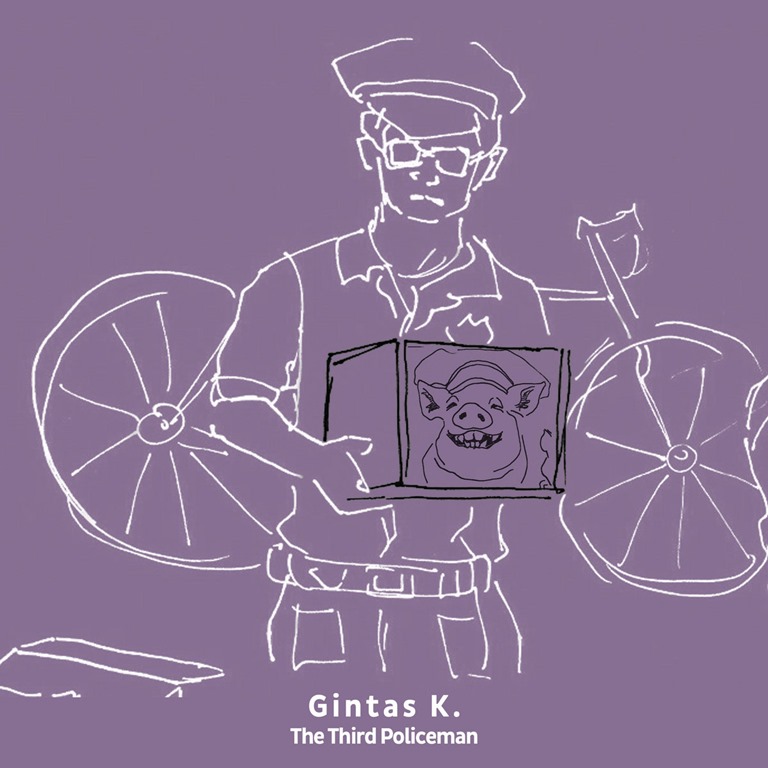
While the approach to recording his latest album is pretty much standard for Lithuanian sound artist Gintas K – that is to say, ‘recorded live, without any overdubs, using computer, MIDI keyboard, and controller’, the inspiration and overall concept is a little different this time around, with Gintas explaining that ‘The album is a subtle allusion to Flann O’Brien’s absurdist novel The Third Policeman, reflecting its surreal and enigmatic atmosphere through sound. In itself, this is quite ambitious – not quite the musical equivalent of interpretive dance, but nevertheless.

And, in contrast with many of his other albums, which tend to be relatively concise and often contain some shorter, almost fragmentary pieces, this one is a whopper, with thirty-one tracks and a running time of over two hours.

Initially, it’s display of K at his most manic, with ‘black box#1’leading the first four-track suite more frenzied and kinetic than ever, the sound of an angry hornet the size of a cat trapped in a giant Tupperware container. There aren’t always discernible spaces between the individual pieces, and after just the first eight minutes of wild bleeps and buzzes, I’m already feeling giddy. ‘black box#1 – 4’ is a quintessential Gintas K blizzard of noise which starts out like trickling digital water tinkling over the rim of a virtual glass bottle and rapidly evolves into an effervescent froth of immolating circuitry.

The second suite of pieces, ‘black box inside#2 Dog Hoots’ is made up of eight chapters – compositions feels like a bit of a stretch – and while there are a couple of sub-two-minute blasts, the fifth is a colossal nine minutes and forty in duration. This marks distinct segment of the album, in that it sounds a little more structured, like the sounds of a toy keyboard or a mellotron, rewired and then tortured mercilessly. It grinds and drones, hums and yawns, it bubbles and glitches and whirrs and it fucking screams. Before long, your brain will be, too.

The third segment, a set of six pieces labelled ‘black box inside… Calmness’ is anything but calm: in fact, it’s more likely to induce a seizure, being more of the same, only with more mid-range and muffled, grainy-sounding murk. There are more saw-like buzzes and crackles and pops and lasers misfiring in all directions. It’s not quite the soundtrack which played in my head as I read the book, but the joy of any art is that it affords room for the audience to engage and interpret on a personal, individual level.

The nine-part ‘rolling’ (or, to give it’s full title ‘black box iside#4 Rolling’ is more fragmented, more distorted, more fucked-up and broken. The pace is slower, the tones are lower, and it’s the sound of a protracted digital collapse. It’s unexpected to feel any kind of emotional reaction to messy noise, but this conveys a sense of sadness. By ‘Rolling – 4’ it feels like the machine is dying, a breathless wheeze of a thick, low-end drone, an attempts to refire the energy after this are reminiscent to trying to start a car with a flat battery. It’d messy and increasingly uncomfortable and wrong-sounding as it descends into gnarly distorted mess. ‘Rolling 7’ is creaking bleats, woodpecker-like rattles. and warping distortion, with additional hum and twang. The last of these is no more than roiling, lurching distortion, without shape or form.

Arriving at the four pieces tagged as ‘omnium – The Fourth Policeman’, its feels like you’re surrounded by collapsing buildings and the exhaustion is not just physical. Gintas K has really pushed the limits with this one. The is an arc, a trajectory here, which can be summarised as ‘gets messier and more horrible as it progresses’. Artistically, this is a huge work, a work of patience, and a work of commitment and focus. As a listening experience, it’s intense, and will likely leave even the most adventurous listener feeling like their head’s been used as a cocktail shaker and that their brain has been churned to a pulp. Outstanding.

AA

a3200436950_10

16th June 2025

Christopher Nosnibor

Gintas K’s latest offering was recorded live, using computer, midi keyboard and controller in January 2025, and first released by Japanese label Static Disc in May.

It’s worth perhaps mentioning that ‘Breakcore’ is – and I shall shamefully quote from Wikipedia here – ‘is a style of electronic dance music that emerged from jungle, hardcore, and drum and bass in the mid-to-late 1990s. It is characterized by very complex and intricate breakbeats and a wide palette of sampling sources played at high tempos.’ In the main, not really my personal field of expertise, or particularly within the remit of Aural Aggravation.

But this is a Gintas K album, and the nine pieces are typical of his style, combining experimentalism and the application of software and midi / laptop setup, producing a range of glitchy, frothy, gurgly sounds which stop and start intermittently, unpredictably. His live and improvised works always come with a sense of unpredictability, of spontaneity, while bearing his distinctive sounds. One of the key focuses within K’s work is on detail, zooming in on microtonality, granularity. When I say it sounds ‘bubbly’ or ‘frothy’, I mean it’s the sound one might consider the equivalent of the visual experience of slowly swirling a latte or a pint of ale, or hyperfixating on the bubbles in a bath. This is not, however, the gentle swill and flow of currents, but a frenzied effervescence, like the reaction between bicarbonate of soda and vinegar. And look long enough and hard enough, and patterns begin to emerge.

Listening to the bubbling blitzkrieg of digital clicks, beeps, and fizzing of any work by Gintas K can be stimulating to the point of eye-popping discombobulation. It’s almost too much – and this is nevermore true than the experience that is Breakcore. There are beats present – but they’re composed not of beats in the conventional sense, being neither rhythmic nor percussive, either from an analogue source or a digital sampled source or emulation. These are flickers, pulses, rapidfire stutters, hard sounds which replicate the essence of a beat without being a beat, per se. For example, those of a certain age may recall the successive ‘pink-pink-pink’ chattering digital babble of dial-up. Few would necessarily consider those sounds beats in context, but… yes, they have a certain beat-like quality. And this is how the beats often emerge from the clicks and pops, moans and drones or another quintessential Gintas K demonstration of circuit meltdown as an artform.

I had never considered his work in a ‘dance’ context before, and still wouldn’t: one feels as if the title is perhaps a shade ironic. But the tempo is certainly high and the beats are complex and intimate, emerging as they do from the thrum of what sounds like a revving engine, the whirr of an old hard-drive, the click of a CD driver whirring into action. Every second of this release sounds like some kind of digital or mechanical malfunction, as tempos whirl and blur, drawl and slow. Scrunching, crunching, twanging, springing, stammering and stuck, it’s a relentless attack of wrong sounds. But emerging from all of it, there are erratic beats, like a succession of deliberately jarring jazz fills and simply wild judders.

It is relentless, and it’s complete overload. The nine tracks run for a total of twenty-nine minutes: its intensity is such that you feel as if your brain is starting to melt after the first ten. In short, Breakcore is truly wild, and it’s not remotely easy or accessible – but it absolutely encapsulates everything that defines what Gintas K’s does.

AA

AA

cover

the Jesus Lizard have just wrapped up their wonderfully received UK and Irish live dates in support of Rack, and it won’t be long before they hit the road again.

The band share a brand new track, ‘Westside’ and the single is only available digitally.

About the track, Duane Denison comments; “’Westside’ goes along with the previous single ‘Cost of Living’ — which was subconsciously influenced by Leonard Bernstein’s "West Side Story" and hence the name. Really."

David Yow adds; "There is a part in ‘Westside’ where the lyrics say, “…give him back his arm”. That was inspired by David Lynch’s Lost Highway, when Robert Blake’s character says, “Give me back my phone.”

Listen to ‘Westside’ here:

AA

TJL0520-DuaneYow-990b6d079e05143c

22nd December 2023

Christopher Nosnibor

We live in strange times – times which have gone beyond the established expectations of what defines postmodernism into a period which is something else. Something else we’re yet to come to terms with, let alone define. Postmodernism heralded the arrival of what one might call ‘the nostalgia schtick’ by meshing together past, present, and future to conjure something of a liminal territory in which all times exist simultaneously. But if postmodernism, as defined by the likes of Francois Lyotard and Frederik Jameson is primarily defined by an accelerated pace of communication and an overwhelming blizzard of media, one thing which no critics or theorists could have readily anticipated when defining the term was the rush to cling to the recent past, or that the next big boom in industry would be nostalgia and revivalism.

The advent of the Internet heralded a revolution in terms of all things archival. Back in 1996 or thereabouts, when I first got online – with AOL on a floppy disc and a 14k dial-up modem plugged into a second-hand IBM 486 ­ it seemed like a new dawn. It was basic, but text from obscure zines from the 60s, 70s, and 80s and pretty much anything you could ever wish for from the depths of the most subterranean archives was suddenly available, as was anything else. By the early 00s, Warren Ellis’ Crooked Little Vein was the world as it was: if it existed, it was on the Internet. But then the Internet got hijacked by big business, MySpace ceased to be the anarchic free virtual world that it had been, and everything turned to shit. Because capitalism ruins everything.

Amidst all of this, postmodernism is – or was – characterised by a celebration of depthlessness, of rejoicing in its own disposability, what Stewart Home referred to as ‘radical inauthenticity’. Postmodernism was laced with irony, knowingness, self-awareness. We seem to have lost the sense of irony and humourous knowingness somewhere along the way, and as we grapple with AI, deep fakes, and music industry plants, we have come to return to the question of authenticity as something which should perhaps be valued. Admittedly, these debates are perhaps minority issues, because for the most part society is split between those who believe everything they’re told and those who believe nothing, and there is only limited space for nuanced critical debate. It is, of course, hard to have a nuanced, critical debate in segments of 140 characters or so, and this compression, coupled with an ever-decreasing collective attention span has, undoubtedly been damaging in many ways.

The tug-o-war regarding the value of authenticity has been particularly apparent in music, as fellow musicians and critics alike have descended on punk and ‘indie’ bands to challenge their authenticity as exponents of punk and indie. With the rise of the ‘industry plant’ threatening the integrity of the DIY and indie music scene, it does make sense, but the point I suppose I’m ultimately making is that nothing really makes sense anymore, and that everything is a contradiction.

So, at the same time as AI has surged forwards to recalibrate the means of production, we’ve also witnessed a sustained boom in all things nostalgia. As much as it would pain many to admit it, it’s that same pining for the past that has driven the demand for vinyl, cassettes, grunge, tribute bands, as brought us Brexit. Admittedly, a yearning to return to the days of the Empire and when England resembled a Hovis advert is more socially damaging than basking in the glory days of Britpop, but it’s a pretty close call. A significant portion of the success of Stranger Things, for example, is its retro context, which has seen many hailing it as bearing parallels with The Goonies. I can’t help but wonder if this passion for the not-so-distant past is a means of escaping the absolutely hellish present and the utterly-fucked-up future we’re hurtling headlong into.

Conflux Coldwell’s latest project is one which plunges deep and direct into nostalgia, and as such resonates with the zeitgeist which has been simmering for a few years now. We’ve all seen it: the ersatz recreation of scratchy recordings, crackles and pops of old vinyl and the warps and snow of videotapes. And now everyone’s back to buying vinyl and audiotapes… how long before the VHS renaissance? And at the same time, it raises the question of ‘the archive’, of the (im)permanence of documents. We have always believed that documenting and recording events was the route to immortality, and that the advent of modern media would solidify our legacy in the same way as The Anglo-Saxon Chronicle or The Bayeux Tapestry. It was not so long ago that the Internet was supposed to be an eternal archive of everything ever. Only now, it’s apparent that modern technology is as ephemeral and disposable as our very culture, and that online archives vanish the moment their owners stop paying for the domain.

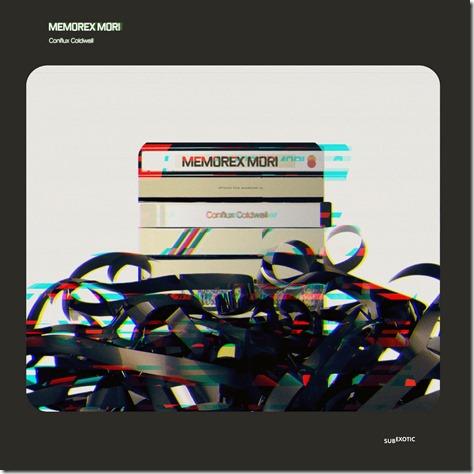
Memorex Mori is an unusually authentic work, born out of an excavation of -personal archives, as Coldwell explains: ‘Last year I found a dusty box of old unlabelled VHS tapes at my parent’s house, including some early work of my own I’d long forgotten about. Unfortunately the tapes were all in very poor condition and I only managed to recover some of the material. Despite the bad quality I decided to sample the videos anyway and make something new out of the various noisy remnants – the final result of that extended process is Memorex Mori.

Coldwell himself isn’t outside the frame of nostalgia with this ambitious project, either, as he continues: ‘VHS was the medium of my childhood in the 80s and 90s, and was still routinely used for budget productions by the time I started making films and music of my own. Looking through the old tapes made me realise the ultimate fragility of all our recordings and the memories they hold. These analogue tapes only have an estimated lifespan of 25 years, and this artificial life is only granted to the videos we actually decide to keep. The vast majority ended up in landfill when the world went digital – what was lost in the waste? In contrast, we might think that current digitisation and cloud storage allows our memories to live forever, but they are still fallible. The major difference is that with digital archives this mortality is hidden – with analogue media we can potentially witness that death happening in slow motion before our eyes.’

It’s an interesting and valid distinction between analogue and digital: growing up in the 80s and 90s myself, I remember being told not to vacuum clean near any video tapes, and so on, while toward the turn of the millennium the emerging digital future was presented as eternal. But now, it’s clear, that there is no such thing as permanence, or the eternal, and that any archive is as fragile as life itself.

And so, Memorex Mori is a multi-faceted, multi-dimensional, multi-media project, where past, present, and future collide, and postmodernism melts into the as-yet-to-be-defined present. It’s a film and it’s a soundtrack, and both can be appreciated independently of one another, as intended.

Coldwell expands on his notes, explaining ‘This project continues a lineage started by William Basinski and The Caretaker, exploring themes of memory loss, entropy and spectrality, through the sampling of destroyed recordings. But Memorex Mori extends this idea into the visual realm, presenting a feature-length music video alongside the music. As well as sampling early Conflux works from tape (Traveller, Glitch, Machinedance and Trainboy) various other unknown recordings were appropriated from the video box – all sorts of forgotten cultural detritus including my Mum’s 30 year old Open University programmes. A few modest pieces of equipment were used to add extra sonic layers – including the Korg NTS-1 and a home-made Marantz tape delay – then all bounced back to VHS.’

The video is a disorientating barrage of film clips, from train journeys to clouds, via small aircraft lifting off and droplets of water rippling out. Everything flickers and fades , glitches and warps. At times, we’re simply submerged in a snow of magnetic degradation and ruination, and it’s not always easy to discern what we’re actually being shown. But, often devoid of context, these detached, fragmentary scenes take on a sense of significance. The effect is an uncanny emotional response, a pull in the lower intestine as something unexplained and inexplicable evokes something within. There’s a comparison to be drawn with Memorex Mori and the experimental works created by William Burroughs and Brion Gysin in the late 50s and early 60s – in the soundtrack, the tape experiments, perhaps, but more so the whole audiovisual project, which calls to mind films such as Towers Open Fire, produced in the mid-60s with Anthony Balch, and a step closer to what Gysin’s quest to realise ‘a derangement of the senses’.

The soundtrack is the perfect soundtrack to this endlessly unsettling sequence, an eternally shifting sonic drift that’s at times noisy, even harsh, while at other altogether more ambient. Like the visuals, it draws you in, but it also stands independently as a purely sonic experience, and it’s also a smooth, expansive scene for reflection, and perhaps it’s to be expected that the soundtrack has greater impact when experienced in isolation, without the distraction of the visuals.

As a whole, or in part, Memorex Mori is quite an unsettling experience: visually compelling, and aurally challenging. It demonstrates the fragility of any documentation, any archive, and of life itself. Nothing lasts forever. And it speaks of how, as memory fades, so the documents diminish in value: moments captured in moving or still images which seem so essential at the time lose meaning over time: where was that picture taken? What was I doing there? Why did I think that would be worth filming / photographing? Who even is that?

I feel a weight descend as I reflect on all of these things while immersing myself in Memorex Mori. I can’t even begin to imagine the experience of assembling it. Then again, I can’t really assimilate the experience of other viewers or listeners, either. What’s intensely personal to an artist is likely to hit a spot with the audience, but for each, the reception will differ, based on their own experiences, their own immediate headspace.

But, regardless of individual interpretation, the vast ambition of Memorex Mori is matched by its accomplishment. THIS is a document. A powerful work, which will stay with you long after the silence descends.

AA
a2043088135_10

1st May 2023

Christopher Nosnibor

Argonaut are a band who have certainly embraced the potentials of the Internet, making the most of the ability to take ownership of their release schedule and optimising the possibilities for their DIY aesthetic, not limited to home recordings released within a week via Bandcamp and no-fi videos posted to YouTube.

Nathan and Lorna kept things flowing through lockdown with their homespun ‘Videostore’ project, and now they’ve reconvened, the band are making the absolute most of the limitless options of streaming formats.

Historically, an album had to be no more than around forty-five minutes to fit on a 33rpm record: CDs expanded it to seventy-two minutes, which was probably the length of most double albums, only much cheaper. Tapes provided greater duration but less durability, especially over longer formats: the old C120s were dangerously fine, meaning double-play cassettes were things to be handled with care (as the three copies of The Cure’s Concert and Curiosity I lost proved, although however carefully you might handle a cassette, the heads on your tape deck just stropped and chewed stuff out of spite). More recently, CD capacity has expanded to eighty minutes. Every medium has its limitations: digital streaming has limits to quality and you never know if a track or site will remain, and streaming when your Internet connection drops every three minutes is a massive pain the fucking arse. And it perhaps goes without saying that downloading a track just doesn’t have the same buzz as owning something physical like a 7” or even a CD. That’s something that’s difficult to explain to anyone under thirty, who considers physical ‘stuff’ just so much clutter and the prospect of going to a shop an inconvenience. I get it, but I guess it’s hard to feel you’re missing out on something you’ve never experienced.

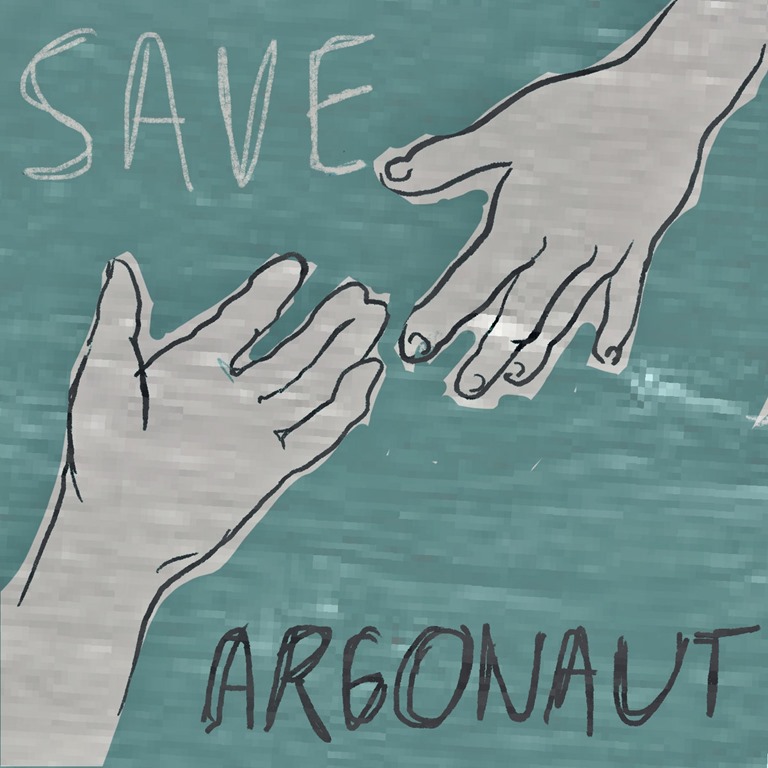
But what Argonaut have realised is that an album doesn’t have to be a completed article on release, and this is where their latest project is really interesting. Songs from the Black Hat is probably the first ‘open-ended’ album, whereby they just keep adding songs to it with a new song released on the first of each month. Whereas The Wedding Present’s ‘Hit Parade’ project also saw the release of a new single each month, it had a fixed end, on the premise of there being a 7” single released each month – the album, a compilation, was seemingly an afterthought and its parameters were always going to be finite. Songs from the Black Hat as it stands has no parameters, and ‘Save’ is the sixth song and something of a departure, not just in terms of the album, but for Argonaut more broadly.

They’ve built a career on punchy post-punk tunes which are often concise to the sub-three-minute mark. But as they write of ‘Save’, ‘Clocking in at six and a half minutes, ‘Save’ is Argonaut chanelling [sic] nineties indie anthem 12 inch remixes a la MBV and the Telescopes.’ And it is indeed a beast. As they also explain, ‘The lyrics were inspired by the Thai cave rescue and a genuine primary school comprehension test answer to the question ‘why didn’t Grace Darling save everyone at the same time?’

It’s a reverb-soaked behemoth where the echoing drums soon become overtaken by a chubby bass and a yawning synth drone, with multi-layered bubble-gum pop vocals, reminding us that ‘You can’t save everyone’. No doubt our government will be playing this at the airport in Sudan as they turn away citizens with work visas and the like but no physical passport. But facetiousness aside, this is a beautiful and sad song that also bursts with fuzz and reverb, and spins vintage and contemporary together with a rare deftness of craft.

Let’s see what they pull out of the hat next month…

AA

a0955958083_10

gk. rec. – 13th August 2022

Christopher Nosnibor

Since taking control of his own release schedule – in addition to various releases via various labels – Gintas K’s output has shifted from rivulets to cascades, with this nature-themed album being just one among countless releases, live performances, exhibitions. soundtrack and compilation appearances so far this year, and, not least of all, Lėti in May, released on venerable experimental label Crónica.

There’s little explanation behind Mountains, runlets, caves & cascades, beyond a selection of quotes from HP Lovecraft and the detail that the album’s six pieces were ‘played, recorded live, at once without any overdub; using computer, midi keyboard & controller’ in 2020, and one suspects Gintas has a hard drive bursting with such recordings just waiting to be edited and mastered to form unified documents of his tireless output.

The first five pieces form the larger work that sits under the album’s overarching title, numbered one to five. They’re sparse, minimal, echo-heavy, like wandering around in a vast cavern while droplets fall into the subterranean lake that occupies the bottom, and who knows how deep it may be, how many tunnels are filled with millions of gallons of water that have run down through the ground and into this naturally-carved warren of rock-lined corridors beneath the ground.

In places, barely perceptible glimmers of sound, like bat sonar, jangle in the upper reaches of the audio spectrum. I’m reminded of the cat repellent device in my back yard, and I wonder if to some, these passages would actually appear as silence – or if for others, like my ten-year-old daughter, they would find the pitch unbearable and have to run from the room covering their ears. Quiet gurgles and trickles are the primary sounds on ‘Mountains, runlets, caves & cascades #3’ and I find myself feeling altogether calmer, picturing myself in a pine woodland with steep banks. I picture in my mind’s eye local scenery like Aysgarth Falls and Ingleton Falls and find myself at ease – but this being Gintas K, there’s disruption afoot, and blips and squelches zap in seemingly at random to remind us that this is digital art, and the fourteen-minute ‘#4’ marks the full transition into digital froth and sluices of laptop-generated foam.

And so it trickles into ‘#5’ which brings more bleeps and blips and jangling and some high-pitched rattling that for some reason makes me think of seeing footage of milk bottling plants in the 80s – back when milk came in glass bottles, and I trip on this trajectory of nostalgic reverie until the arrival oof the unsettling final track, the eight-minute ‘eastern bells’ that’s a slowed-down yawn of sound, metallic reverberations ringing out into the silence, echoing in the dark emptiness in ebbs and flows, like a conglomeration of sounds, drifting in a breeze.

Mountains, runlets, caves & cascades is a supremely abstract work, and while it’s not a huge departure for Gintas K, it does represent one of his softer, gentler, sparser and less frenetic works. It’s by no means an album to mediate to. But it is overall fairly sedate, and it not only allows, but encourages a certain quiet reflection.

AA

a3599404171_10

Powdered Hearts – 25th December 2021

Christopher Nosnibor

I vowed not to cover anything Christmas-related, simply because, well, because, and also because fuck it. Christmas releases tend to be mawkish, and / or shitty cash-ins, which I have simply no time for, and even a general distain. Charity fundraisers are laudable, although in a just world there should be no need for them because ultimately the state should be supporting the needy and vulnerable without musicians, most of who make next to nothing from their art, having to donate their small royalty fees to food banks and the like. Christmas sucks on so many levels that it’s an essay or even a book in its own right, but this perhaps isn’t the place to begin expounding any of that.

But here we are, and here I am making an exception, and for what I feel to be the right reasons, with the additional bonus that this is no crappy cash-in, and no motive beyond itself.

The prodigiously prolific Gintas K celebrated Christmas unconventionally with yet another release, this time in the form of a Christmas treat entitled Christmas Till The End. With five tracks in all, which are mostly shorter pieces, apart from the twelve-minute title track, it’s quite a departure from much of his back-catalogue, not least of all some of his experimental digital explosions of recent years which have seen him move from microtonal explorations to squelch-laden sonic chaos delivered by means of some nifty software run though an ancient Lenovo Thinkpad (something I have infinite respect for: so many musos have state of the art hardware, while I’ve discovered for myself that reconditioned corporate laptops even from a decade ago have better specs and are built more sturdily than the majority of consumer-orientated laptops). Whatever the sonic differences, though, he’s maintained the same process, namely recording each track live in a single take with no overdubs.

Christmas Till The End may not be the frenzied digitised froth of recent releases, whereby GK simply blasts out various strains of laptop-generated whirring, blooping, crackling noise, and you couldn’t exactly call it a conventional Christmas album, or a celebration of the festive season, either. It’s more of an assemblage of elements of Christmas collaged, crossed out, crunched together.

If the first track, ‘Bah’, perhaps speaks for itself, ‘Für Elise’ presents a picture that highlights the complexities of Gintas’ work. It features Beethoven’s ‘Bagatelle No. 25 in A Minor’ (aka ‘Für Elise’) and mangles the absolute fuck out of it, because it’s a Gintas K digital mess mash-up. There’s no overt or explicit statement here but trashing the piece feels more like a desecration of the Christmas spirit than a celebration, an act of destruction that feels wonderfully irreverent and more than just a little cathartic in context. It is, also, an ultimately avant-garde act of destruction, in keeping with the principle of destroying the old to build anew. Here, Gintas renders that destruction performative, integral to the form and content.

‘Hymn Lithuania’, at first, does sound overtly Christmassy: a rendition of the Lithuanian national anthem on a glockenspiel, the notes ring out, chiming, bell-like and charming. But after about a minute, it begins to degrade and disintegrate as extraneous noise, feedback and bleeping whistles begin to disrupt the tranquillity, while the delicate piano of ‘vivaLIDL spring’ is ruptured by bomb-like detonations and the clatter and thud of descending rubble. If I’m not mistaken (and I may well be), a corruption of Vivaldi’s ‘Spring’ played at about a quarter pace provides the backdrop to this grim scene; you can almost picture the pianist playing, the film in slow motion, while the building collapses in flame around him. The wordplay is also worth noting – I’m assuming LIDL is bigger in Lithuania than Aldi, as VivALDI would have been the most seamless pun by which to highlight the commercialism of the season.

The title track wraps it all up nicely, and ventures closer to K’s whiplash blizzard off whirrs and bleeps, although in a relatively restrained form, whereby the discombobulating discord whirs and warps over delicately chiming tones. As things slowly disintegrate – both on the album and in the real world, it feels more like Christmas for the end: this is the soundtrack to the decline. May the end come soon.

AA

a3680885656_10

The Sublunar Society 053 – 11th May 2018

James Wells

Just as Facebook advertising and Amazon recommendations prove that algorithms can be applied usefully but are no substitute for human input.

Of course, The Rosenberg Algorithmic Music Generator is subject to human input, in that it was created by Mick Sussman himself. A programme is designed to ‘compose’ ‘unique’ music, by ‘making decisions based on a sequence of randomised processes.’ The nineteen compositions collected here seem to suggest a greater leaning toward the random than the musical. There are notes and there are rhythms, but none of them seem to coordinate with one another, and the sounds are trebly synthetic, 80s computer gamey. The cover art has obvious ‘matrix’ connotations, and tells much of the story of what The Rosenberg Algorithmic Music Generator is about. Only, this is the sound of the matrix collapsing, of being stretched and pulled in all directions, twisted and tossed.

Sussman observes in the liner notes that in programming terms, Rosenberg is a primitive piece of coding, but is sufficiently versatile to enable him to vary musical phrasings and tempos – to the extent that one option enables the user to allocate a different tempo to each instrument. Why would anyone do this? Because, I suppose. It’s an indication of Sussman’s adoption of avant-garde principles, to disassemble and reconfigure that which has gone before, to build anew. It may well be that no-one has done this before not because they haven’t thought of it, but because they didn’t want to, but that’s every reason for Sussman to be the first.

The result is a disorientating, bleepy, bloopy clamour of sound, with digital notes flying in all directions in an exercise where the concept is considerably more appealing than the experience of the end product.

AA

Mick Sussman – The Rosenberg Algorithmic Music Generator

Editions Mego – EMEGO226 – 24th February 2017

Christopher Nosnibor

The latest work from Florian Hecker, A Script for Machine Synthesis is described as ‘an experimental auditory drama and a model of abstraction’. The press release continues, explaining that ‘A Script for Machine Synthesis presents a complex simplicity that spirals in an unending manner as an audio image of the uncanny valley. It is the third chapter in the trilogy of text-sound pieces Hecker has collaborated with the philosopher Reza Negarestani. A resynthesized voice outlines procedure as procedure itself unfolds… The suggestive encounter with a pink ice cube is a conceptual point of departure for a scene in which linguistic chimeras of descriptors are materialized through synthetic trophies, mental props and auditory objects. Exeunt all human actors, A Script for Machine Synthesis is an experiment in putting synthetic emptiness back into synthetic thought.’

I’m reminded of a number of theory-based text works centred around automation and abstraction, ranging from William Burroughs’ cut-ups and Brion Gysin’s permutations, to Philippe Vasset’s 2005 novella, ScriptGenerator©®™, via Stewart Home’s experimental audio piece, ‘Divvy’, which used computer-generated voices to read the two simultaneous narratives. The concept of the removal of the author from the creative process is nothing new, and while a robotic takeover may have been more greatly feared in science fiction works of the 1970s and 1980s, the fact of the matter is that the threat is greater now than ever before – but people are generally too wrapped up in reality TV or killing themselves just to make ends meet and to pay the bills that the technological developments of the last decade or so have gone largely unnoticed: instead of a seismic shift, the takeover has been gradual and insidious.

A Script for Machine Synthesis exists in a strange territory between territories, or, more specifically, times. While drawing heavily on the paranoias – and, by its sound, technologies – of preceding decades, it’s very much a contemporary work in terms of its concept if not so much its rather retro-sounding execution.

A Script For Machine Synthesis is not an album one listens to for its textual content: it is a drab, monotonous work which centres – aside from the introduction and credits – around a single track some fifty-seven and a half minutes in duration. Slightly fuzzy monotone voices narrate the process of the process in the style of technical manuals, and lecturing a highly complex theory in the driest, dullest of styles, while bubbling synths and electronic scratches and bleeps provide distracting incidentals which aren’t quite distracting enough to break the monotony. It’s hardly riveting from a sonic perspective, either. At points, the words become practically inaudible as digital distortion and file corruption disrupt the audio. Skittering, warping interference do more than interfere with the audio flow, but create a certain cognitive dissonance which engenders a sort of subliminal tension: I find myself growing twitchy and jittery, manifesting in increasingly awkward head-scratching, and a difficulty in sitting still. It could just be a unique individual response, ad of course, any experiment will produce different results with different subjects, but sitting by candlelight with a relaxing pint, I can’t readily identify any other factor which may explain my growing discomfort.

This is, of course, the ultimate synthesis of theory and practice, and more than anything, the experience of listening to A Script For Machine Synthesis bears strong parallels to the digitally-generated screeds of text published by Kenji Siratori in the late 90s and early years of the new millennium. That is to say, it’s a concept work which, while far from enjoyable, is undeniably admirable in its audacity and its absolute commitment to explore the concept at its core to its absolute end. This is art.


Hecker - Script