17th December 2024
Christopher Nosnibor
It’s inevitable that with the sheer volume of music in existence, there will be a fair bit which bypasses even the keenest enthusiast of the obscure. Trek and Quintronic is a pairing I feel I really ought to be familiar with. Emerging in 1980 Paul Wilcox (Trek) and David Kane (Quintronic) recorded two albums, noted for pioneering ‘electronic rock’, with Landing in from 1980, and the self-titled follow-up Trek w/ Quintronic LP the following year, created using an array of synths, plus pedals and six- and twelve-string electric guitars. There was a reissue, entitled Landing Plus, released in Europe in 2012 and the US a couple of years later, which featured the entirety of Trek w/ Quintronic and a couple of additional cuts by way of the ‘plus’, but twelve years on, it’s not exactly easy to come by, and this new release offers something quite different, featuring as it does ‘9 of the original Tw/Q tracks plus 11 new, never released songs written by Paul Wilcox, spanning a period of 40 plus years, all remixed and remastered.’
This means that some of the material was recorded after their second album, without seeing the light of day, while some of the contemporaneous recordings have been flaking away on old tapes since 1980 or thereabouts, and their restoration and repair has been quite an undertaking, achieved quite remarkably by David Lawrie of The Royal Ritual. The aim, as they state on the website, was to ‘present the definitive collection of the best of Trek with Quintronic’, and containing some twenty tracks, this is a wide-ranging, and in-depth summary of their work – and it’s often the case that musical careers consist of considerably more than the material that was released at the time, for whatever reasons.
That ‘You Might be Lonely’ and ‘As We Sing’ first appeared on Landing makes this a truly career-spanning document, which showcases the full span of their musical vision and innovation. It’s often easy to forget just how new to the market (affordable) synths were at this point in time. The advent of 80s synthpop and industrial music came about as a result of the emerging technology, which also, notably, included drum machines. It was a revolution.
There’s a gothic, church organ feel to the introduction, and its grandeur also makes a nod to the prog past of the pair, but it’s listening to ‘You Might be Lonely’ that the span of their influences coupled with the use of the kit at their disposal becomes apparent: it’s like Hawkwind but with synths, both rumbling and swirling and with additional laser blasts and primitive drum machine knocking out a metronomic rhythm, all coalescing to provide a backdrop to a vocal delivery that’s an overt Bowie rip.
The Bowie influence looms equally large on the glammy ‘All the Rave’, only here with the addition of sweeping string sounds. It sounds remarkably fresh, as well as prefacing – by a long way – the trend for orchestral flourishes which would be a big thing in the late 90s with, and winding up with a big, flashy guitar solo. It’s visionary stuff, and the execution is remarkably sophisticated, particularly for the time.
Some of the songs sound more of the era: ‘Zolian Space’ lands somewhere in the region of OMD and Ure-era Ultravox, but it’s a nifty enough pop song. There are a fair few of those on offer here, not least of all the bouncy Suicide-meets-Bowie ‘White Hoods’, and the hyperactive twitch of ‘Twin Forces’.
The guitars are to the fore on the previously unreleased ‘Built to Average’, hinting perhaps at one of the many directions they could have veered. It’s a solid tune, but coming on like a collision between Bauhaus and Mr Mister, it’s dated more than some of the other material, whereas, in contrast, the spiky ‘Wally And The Rich Kid’ is pure vintage yet still more impactful in its stark, dramatic stylings.
Some of – what at least I assume to be – the later material stands out because it sounds different: ‘Religion’ is slicker, the drum machine in particular more ‘real’ sounding, and in a way it tells a story of technological advancement and its effect on music-making. Objectively, it sounds better, in terms of clarity, fidelity, separation, but for everything that’s been gained, something has been lost, and it’s something that using emulators or even vintage gear can never fully recapture. There was an unmistakeable zeitgeist about the ‘79-’82 spell, which was unique, and Trek with Quintronic were right there and probably didn’t even realise at the time. No-one did, really.
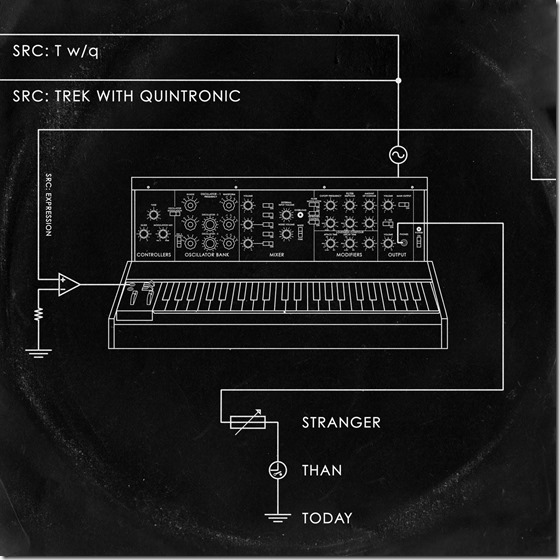
Hindsight really is everything. Stranger Than Today is an outstanding compilation which goes beyond in providing a hitherto unseen insight into the context of their groundbreaking second album and beyond.
AA








 Aural Aggravation