Posts Tagged ‘Dave Procter’

Dret Skivor – 4th April 2025

Christopher Nosnibor

This latest release on Swedish microlabel devoted to the most underground of underground music, Dret Skivor, may be form an act we’ve not heard of before, but something about it has all the hallmarks of the eternally prolific Dave Procter all over it. The man behind Legion of Swine (noisy) and Fibonacci Drone Organ (droney) and myriad other projects and collaborations – some occasional, some one-off – has a distinctive North of England drollness and a penchant for pissing about making noise of all shades, after all.

Released on CD in a hand-painted edition of just two, the notes on the Bandcamp page for the release are typically minimal: ‘Is it dungeon synth? Is it just spooky music? Is there torture afoot?’ I would say I will be the judge of that, but dungeon synth is a genre I’m yet to fully get to grips with, although it does for all the world seem as if it’s a genre distinction that’s come to be applied to spooky music, and seems to have grown in both popularity and usage comparatively recently, despite its roots going back rather further.

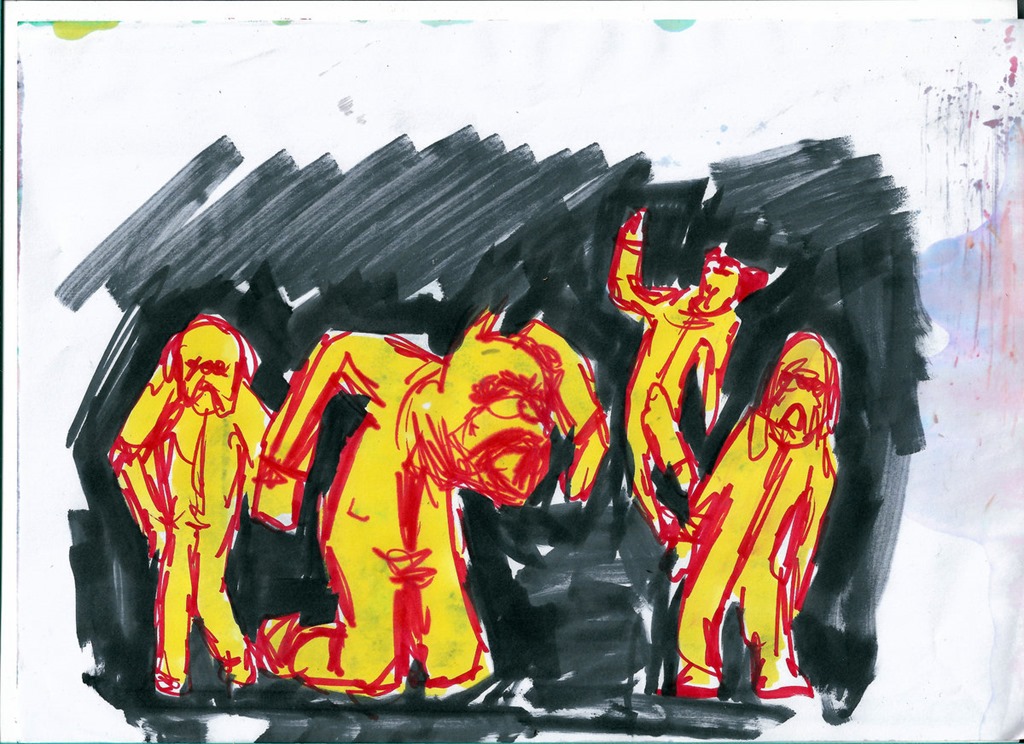
The cover art doesn’t give much – anything away, and in fact, I might have hoped for something more… graphic. But perhaps less is more here. However, the titles of the two tracks –‘the shithouses’ shithouse’ and ‘the festering flesh of the neoliberal’ are classic Procter and could as easily be titles for poems by Dale Prudent, another of his alter-egos.

The first begins with a swelling thrum of what sounds like a chorus of voices, possibly some monastic indentation, layered and looped and multitracked to create a torturous cacophony. For the first twenty, thirty, forty seconds, you wait for a change to come, for something to happen. After a minute that expectation is diminishing, and by the three-minute mark it’s impossible to be certain if there really are keyboard stabs swirling in the mix in the midst of it all, or if your ears and mind are deceiving you and you’re losing the plot. For some reason, I’m reminded of the Paris catacombs – not because it’s actually creepy, but because, just as seeing rows and rows of bones stacked up for quite literally miles becomes both overwhelming and desensitising after a time, so hearing the same sound bubbling away for ten minutes is pretty much guaranteed to fuck with your head. Near the eight-minute mark, there are most definitely additional layers of buzzing drone and there are some tonal slips and slows, like listening to a tape that’s become stretched or is slipping on its spool, but by this time your brain’s already half-melted, and I find myself contemplating the fact that while visiting the catacombs on a sixth-form art trip, one of my fellow students accepted the challenge to lick a skull for eight Francs – which was about a quid at the time. I was less appalled by the fact it was a human skull than the fact the bones looked dusty and mossy, and had probably been touched by even more unwashed hands than the handle of the gents lavs at a busy gig venue.

And so we arrive at the twenty-two-minute ‘the festering flesh of the neoliberal’. It begins with a distant clattering percussion – like someone bashing a car bonnet with a broken fence post heard from a quarter of a mile away, but with a gauze of reverb, as if echoing from the other side of a valley – or, put another way, like listening to early Test Dept through your neighbour’s wall – while a pulsing, pulsating electronic beat, like a palpating heartbeat, thuds erratically beneath it. And that’s pretty much it. But there are leaps and lurches in volume, and the cumulative effect of this monotonous loop is brain-bending. There are gradual shifts, and seemingly from nowhere rises a will of croaks and groans which grow in intensity, and it may well be an auditory confusion, but regardless, the experience is unsettling. Twenty-two minutes is a long time to listen to a continuous rumbling babble that sounds like droning ululations and a barrage of didgeridoos all sustaining a note, simultaneously, for all time.

Is it dungeon synth? Probably not. Is it spooky? Not really. It is torturous? Without doubt. This is a tough listen, with dark babbling repetitions rendered more challenging by the cruelly long track durations. The torture afoot is right here.

AA

a2009823040_10

skoghall rekordings – 10th January 2025

Christopher Nosnibor

The notes which accompany this release are more of an anti-pitch than a promotion: ‘depression, dourness, gloom, sex, drinking, drugs and male anxiety – some of it true, some made up.’ I had been warned. Should this maybe even come with a trigger warning?

Hell no. Art is life., and life doesn’t come with a rigger warning. If you truly want to avoid anything that’s a potential trigger, you probably just need to die right now, because there is no other way to avoid everything.

But my misery is your reward is pretty fucking bleak. It’s not Dave Procter’s first foray into acoustic-based musical work, and by no means the first release to feature his first spoken word works, although it is perhaps his first to present both these and an array of other styles with the purpose of exploring a core theme, namely of being fucking miserable.

I should make the up-front presentation of the fact that I am absolutely by no means being critical of the album’s miserabilism. For years, the theme of much dialogue has been ‘we need to talk more about mental health! We need to destigmatise mental health! We need to talk about mental health more openly!’ And I agree without reservation… but… It seems that the limit of most conversations – and this is perpetuated, sadly, by sufferers, and by artists, and by bosses (especially bosses) and by social media –remains at ‘I’m having trouble with my mental health’/ ‘Oh dear’. That is not talking about mental health. But people are not comfortable discussing the details, the way those troubles manifest, what it really means. Tell someone what that really means and oftentimes it will likely be a very brief and one-sided conversation. Male anxiety: are we even close to a place where blokes can sit and talk about their disturbed sleep and panic attacks down the pub with their mates? Are we hell.

The spoken-word pieces – succinct and pithy – are impactful partly because they say so much with so little verbiage, but equally because of the monotone delivery recorded close to the mic, with no studio slickness, no compression or reverb, but dry, as if Procter is leaning forward to confess in low tones the unutterable darkness. ‘no sleep no peace’ is exemplary:

I get no sleep at night

No peace in the day

There’s shit in the kitchen

There’s shit on the floor

There’s shit all on my life

Since you walked through the door.

So many of us will have lived with some squalid fucker at some point, and what may on paper appear trivial can in fact become a living hell.

The majority of the songs are sparse acoustic guitar and vocal works which sit between bedroom gloom and neofolk, with similarly direct and downcast lyrics: ‘the choices are stark enough / between dope / and a rope / it doesn’t take much these days’, he sings on ‘not much’. They’re simple and super lo-fi, and wouldn’t work any other way, because the nature of the recordings imbues them with an intimacy which brings a lump to the throat on many occasions. Even the bits that are made up, because it’s all interwoven and ultimately inseparable.

Elsewhere, ‘the visitor’ has the haunting reverb-drenched melancholy of Leonard Cohen, while ‘his face, my place’ is like a demo for a goth take on the kitchen sink non-drama of The Wedding Present, and ‘when you want her back’ sounds like David Gedge in collaboration with Stereolab.

As the label’s Bandcamp page states, Skoghall exists to present ‘a collection of past and present work involving Dave Procter’, and my misery is your reward is very much a work mines from the archives, ‘originally recorded during several periods of the above in Leeds and Stockholm in 2007 and 2008, although the ideas have been around since late 2005…’ Procter adds, ‘I think they call it catharsis. This LP is meant to be listened to in one sitting.’

Almost twenty years since conception and seventeen or so years since its recording, some may consider it curious that an (extremely) active artist would serve up these somewhat primitive and one might even say juvenile recordings now. But there does come a point in life when, perhaps we make peace with our discomfort and awkwardness and with the distance of time, can appreciate the merits of those works which were necessary in the evolutionary journey to the artists we become. To finally release it… yes, there must be an element of catharsis in casting out those thorny thoughts, the kind of twisty, churny recollections that insist on needling away, years after the fact.

my misery is your reward is a world away from Procter’s work as Legion of Swine or Fibonacci Drone Organ, and even the no-nonsense spoken word of Dale Prudent, and there’s a touching humanity, and the lack of sophistication is an asset when it comes to conveying difficult emotional states in a relatable fashion. Yes, we need to talk about mental health, and what we also need is for documents of unflinching honesty and for artists to take the lead. This is what we need.

AA

AA

a2113781565_10

Dret Skivor – 1st November 2024

Christopher Nosnibor

Procter’s been at it again. The only artist I know who can go on tour and play under different guides doing different music – or ‘music’ – depending on the booking. Not that anything he does is commercial or has any kind of mass appeal: it comes down the question of if you’re on the market for harsh noise or something a bit gentler. And how he’s back from one of his excursions, here we have new studio work, which clearly didn’t make the merch table – released in a limited physical edition of just three hand-painted CDs.

One might wonder just how far it might be possible to push the concept of Fibonacci Drone Organ, but since the mathematical Fibonacci sequence is endless, so it would seem are the limits of this project. This particular outing, with a title inspired by Ken Loach, does mark something of a departure for FDO, being less droney and more barrelling bassy murky noise. It’s also more overtly political – nothing new for Dave Procter, but usually something reserved for his other projects.

‘Disenchanted with the state of the fucking world? You’re not alone’ he writes. ‘This is a synthesised reflection of the current state of my brain. I hope it brings you some peace.’

How much peace one can expect from longform tracks entitled ‘war war death death’ and ‘american client state’ it’s hard to really know, but I for one can relate to Proctor finding solace in the cathartic release of creating dense noise. Because there comes a point where words are not enough: indeed, there are no words. In fact, I derive some comfort – small as it is – from this release. It does indicate that the state of Dave’s brain isn’t the best, but with the US election looming and the very real possibility that Trump could become president again, I can’t help but feel a combination of gloom and outright terror. In recent months, as the war in Ukraine has rumbled on, and the hell on earth in Gaza has escalated, and escalated, and escalated, and Israel’s nauseating genocidal mission continues to be funded by the West, it’s felt like a growing weight in the atmosphere. I’ve found myself tense and on edge. Everything is wrong. ‘I find no peace,’ as Thomas Wyatt wrote.

It feels as if the world was waiting for the pandemic to pass, and as if during the successive lockdowns, world leaders were simmering, festering, building their fury to unleash the moment restrictions were listed. Recent years have been painful, and as Procter’s brief notes indicate, there are many of us who are struggling, powerless, as our governments continue to push the line of Israel’s ‘right to defend itself’. No-one would deny that right, but no rational person would agree that a death toll of almost 44,000 – with many tens of thousands of women and children, not to mention other civilians in that figure – is proportional, or merely self-defence. While news outlets do report these figures – which are, it has to be said – beyond nauseating – there is no compassion in the reporting. Deaths are but numbers, the words ‘humanitarian crisis’ but words. The images of smoke and dust and devastation are horrifying, but to actually be in the midst of it, with no safe places to go, as schools and hospitals are targeted, is beyond imagination.

It’s in this context that Procter has created two grey, grating, heaving and ugly tracks, one fifteen minutes in duration, the other over twenty-three.

‘war war death death’ is bleak, and dense. There’s the heavy whip of helicopter blades at the hesitant start of the track, which gradually emerges as a long, wheezing, churning drone, resembling the rumble at the low end of the mechanical grind of the first Suicide album. And this is pretty much all there is. And from this minimal piece emerges a sense of desolation, particularly as the end, which concludes with just rumbling static – and nothing. Devastation. Dust. Annihilation.

‘american client state’ is again, heavy a serrated edged, humming drone that hovers, panning and circulating like a malevolent drone. It’s pitched in the range that really gets under your skin and penetrates the skull, not in an exhilarating way, but instead slowly wears down the spirit, dissolving any sense of motivation. The monotone hum seems to somehow articulate, in ways that words cannot, the sense of powerless I personally feel, and suspect others do, too. There’s something empty in the monotony, not to mention a squirming discomfiture. What can we do?

All digital sales money from this release will go to the Palestinian Medical Relief Society, and while it may be a drop in the ocean, and while what needs to happen is for aid to actually be allowed to be delivered – something which will require an intervention which is long overdue – something, anything, is better than nothing.

Often, there’s a droll humour to Dave Procter’s work, but apart from the title, the higher the monkey climbs, the more you see of his arse is a bleak work, and a depressingly droney as it gets. But it provides an outlet, an expression through which to focus that release, and reminds us that we must hope against hope for better ahead.

AA

a1192190513_10

Dret Skivor – 3rd May 2024

Christopher Nosnibor

Dret Skivor seem to have managed to sync their release schedule to Bandcamp Fridays pretty neatly. Meanwhile, the man behind the label, Dave Procter, has enough different musical projects to fill the entire label’s roster single-handedly.

Not content with pumping out harsh noise as Legion of Swine and ambient drone with mathematical divination as Fibonacci Drone Organ, and spoken word ramblings backed with dark noise as Trowser Carrier, or collaborating with countless other artists, notably Claus Poulsen with whom he (ir)regularly convenes for a release, and a brief excursion as twAt clAxon, Procter has also been operating as Klôvhôvve, a vehicle for ambient / glitch weirdness.

Following on from Is it? It is, an album containing two longform tracks which offered their own call and response, released in March, Live at JT Soar feels on one hand like a bit of a stop-gap, but on the other, a reasonable consolidation. More than reasonable, in fact, considering that Procter devotes a considerable amount of time to performing live – and is perhaps the only artist I can think of who will book a tour and not play under the same guise more than a couple of times, or for two consecutive shows. It is, undoubtedly, easier to get bookings if you have a broad range of styles to offer promoters, even if that range does sit under the wider umbrella of obscure electronic weirdy shit.

Before we ger to the obscure electronic weirdy shit of the recording, it’s worth a brief acknowledgement of the cover art, which is truly classic Procter (the photographs which grace the covers of his two collections of poetry / rants as Dale Prudent are strong cases in point). Gritty, unpretty, urban, and a bit off kilter, snapshots of the everyday strange. Here was have a shot of the outside of the venue, still with its signage for JT Soar, Wholesale Fruit and Potato Merchants, from which it takes its name. Unassuming is an understatement for this building, with graffiti on one door, and a piece of street art depicting Nottingham’s best-known polemicists, Sleaford Mods, replicating the artwork for their most recent and widely-acclaimed album, UK Grim on the garage door. The shot is some real-life documentary, its relevance heightened because the vocally socialist Procter departed the UK for Sweden post-Brexit because… well, Brexit.

Klôvhôvve’s set, which lasts twenty-four minutes, is mellow and mellifluous to begin with, but soon swerves into a melting together of soft tones with scratched, warping drones, the glitching eating into the surface of the looping tapes affected at first. Vocal snippets, fractured, fragmented, distorted, cut in and out, as the music ebbs in and out unpredictably.

There is a sense of nostalgia about this, but the overarching sensation is more that of a post-apocalyptic narrative, a bleak dystopia of degradation, of societal collapse whereby only damaged recordings and fragments of past technologies remain, twisted, rusted, malfunctioning. The set does have distinct segments, although they do flow together to form a continuous set, and as such, it makes sense that it’s released here as one single track. It’s not as if anyone is going to be skipping to hear the hit or their favourite song of the set, and it’s structured around transitions between evermore haunting atmospheres. It’s pretty unsettling stuff, dank and grumbling with thunderous rumblings away off in the background while a continuous slow of babbling and sharp scrapes cut into the foreground. But then there’s something resembling a trilling, twisted rendition of ‘Silent Night’ which crackles and stutters through static, and it warps and crackles its way to a slow fade.

There is some strong tonal separation here, and the interjections which appear unexpectedly are almost enough to make you jump But for the most part, it makes your skin crawl – slowly, in a state of curiosity and ponderous hesitation – as you winder where it may be heading.

Procter understands the importance of music which makes you feel uncomfortable, which tests your limits, and this release captures a live set which really teases at the tenterhooks.

AA

a3905712960_10

Skoghall Recordings – 5th April 2024

Christopher Nosnibor

I don’t really know too much about this release. It came my way via one inbox or another, with a download, but no cover art, no press release. And for some reason, I had expected it to be longer. But it’s a Skoghall release, and features Dave Procter (Legion of Swine, Dale prudent, Wharf Street Galaxy Band, etc ad infinitum) and some mates.

We’re looking at a couple of tracks, both short of five minutes. Nothing wrong with that – there’s a lot to be said for keeping things simple, and keeping things concise. Do I need the backstory, an essay on the contributors and their backgrounds? No, no I don’t. No-one does, really.

I do feel we’ve become altogether excessively invested in the wrong details in recent years. Time was when an act could release a record, it would be reviewed on its merits, or it’d slip under the radar and all we’d have would be the music. There would often be no mention of who did what on the record., and there would of course be no website, no source by which to obtain details of personnel or a bio. Nowadays, journos – people like me, although I don’t consider myself a music journalist by any means – get picked up on the slightest inaccuracy, we get asked to change spellings and correct who played bass, amend the cover art and the release date… This is not right. The press’ purpose is to independently proffer opinion, to critique, and where facts are missing, perhaps plug the gaps with assumptions, why not? While reviews are a part of the promotional cycle, it’s important – at least for me – to be apart from it all. In short, press is not PR, and should on no way feel obliged to give frothingly enthusiastic reviews simply because they’ve received an advance copy.

I digress, and admit that I tend to provide positive coverage of the releases which come my way which I like, rather than slapping down the releases I’m less keen on. When you get fifty or more submissions a day, you can afford to be selective, and besides, life is short and I’m not going to spend mine squandering energy on stuff I have no interest in.

I have a strong interest in this, though.

What’s on offer are two slices of minimalist electropop with a keen late seventies / early eighties feel. A single droning note hangs throughout the first track and a drum machine clips and clops away recreating the sound of early Young Marble Giants – only here, Procter drones and stutters a blank, low vocal delivery, half-robotic, half crooning, and drifting astray in a swamp of reverb.

The (virtual) flipside is dronier, noisier, a serrated-edged grating drone providing the backdrop to a challenging piece where a clanking percussion saws away and Procter rants -away in the background, again, immersed in reverb and low in the mix – about control and its uses and abuses. Now you’ve got control… what are you going to do with it? He asks, antagonistically.

The answer, well, it depends on who you’re asking. Power is a difficult thing, and – so hark back to an early SWANS track, what we see is power for power’s sake – use and abuse, but more of the latter. Show me – when was power last used for benevolence? I don’t want to be dragged down in this now, and there is plenty of mainstream outrage in circulation, so let’s get back to the release.

It’s succinct, it’s tense, it’s uncomfortable. Bring on ‘Two’.

AA

a4206158382_10

skoghall rekordings – 4th August 2023

Christopher Nosnibor

This one feels like it’s had more build-up than any previous releases on either of Dave Procter’s labels, the recently-founded skoghall rekordings,, or the more established noise-orientated Dret Skivor: there have been numerous one-line quotes, snippets of lyrics from the album posted on social media in the last month – and it’s certainly piqued my interest as to just how far this latest project will take things.

Not that far, my notes suggests, but that’s no slight. You see, Procter’s output is copious and widely varied, from the abrasive noise of Legion of Swine to the recently-released acoustic protest songs of Guerrilla Miner. In between, there’s the grumpy spoken-word-with-noise of Trowser Carrier and the technical experimentalism of Fibonacci Drone Organ. But – and this is something I can say from personal experience – Procter is also a strong collaborator, one who’s open-minded and intuitive, but at the same time always retaining his own unique style as a clear element.

Loaf of Beard’s debut, Dog, features ‘2 British immigrants in Sweden point the finger at the state of politics in their home and former home countries, in a number of musical styles’. When they say ‘a number of musical styles’, it’s like listening to Joh Peel in the 90s, where baggy indie and experimental stuff would be crammed back to back with trance and grindcore. It’s all good, but it’s like a musical fancy dress party, with the pair tossing on different outfits and doing a different genre to go with it. And sometimes, it’s as if they’ve thrown on flares and a biker jacket, or a cocktail dress and a gimp mask by way of a combo.

‘Zippy Was a Blairite’ raises the curtain on the album in a post-punk style, and harks back to arguably one of Procter’s most popular and cherished musical vehicles, The Wharf Street Galaxy Band, with a nagging, elastic bassline pinned to insistent drums. Here, they’re programmed rather than acoustic, but that crisp, cracking vintage snare sound serves the purpose well of (re)creating the sound of the early 80s – but it’s the sound of the 80s as reimagined by Sleaford Mods, a primitive loop providing the musical accompaniment to the lyrics… and those lyrics are bitter. And at the risk of sounding like a crackling piece of overplayed 80s vinyl with a scratch, the current renaissance of the sound of the dark days of Thatcher in Britain is no coincidence. After thirteen years of austerity and the quality of life of the average worker being eroded faster than the world’s glaciers are receding, the mood is gloomy, angry, nihilistic. We can’t even think about protesting without risking being arrested. ‘The middle of the road is sitting on the fence’, Proc half-sings, half-speaks, reminding us of something many of us knew at the time, but chose to overlook because it meant getting the Tories out: New Labour was a long way off left in real terms: ‘pseudo-left credentials, politics so central’, as they summarise, chucking in a well-placed ‘motherfucker’ for essential emphasis.

Following ‘No Puffins for You, Lad,’ and Dale Prudent’s piece about pigeons, ‘Birds’ revisits the avian fascination that’s been a long-running theme in Procter’s work, and it’s a semi-ambient, spoken-word piece, which collides with the gritty chug and hyper-energised pumping of ‘Hund’, which comes on like Metal Urbain. ‘It’s a man in a frock!’ It’s a succinct summary of the indignation of the culture wars that obfuscate the real issues that are crippling the country.

That snarling glammy stomp of ‘Boothroyd Every Time’ is pure quality, and celebrates both a strong woman and a fellow Yorkshire person, and if ‘The Atrocity of it All’ is a less than subtle hectoring rant about the fucking state of everything it’s entirely justified, and the mangled, frenetic groove of ‘Cock’ may not be sophisticated, but it drives to the heart of the way the rich are milking the country dry while blaming increasing wages for inflation. Funny how wages are going down but profits aren’t isn’t it? No, it’s not remotely funny. Cock. Yes, Richboi Sunk, we’re looking at you.

‘Vote your life shitter / get your life shitter!’ Procter repeats over and over on ‘Lagom Murder Diaries’ and it doesn’t matter if he’s preaching to the converted here. Fuck. Just tell it to anyone who will listen: vote tory, get fucked. ‘Shithouse’ is comedically loose slacker funk, which finds Dave having a stab at rap. It’s not really his forte, but there’s a nice bassline and nagging guitar that’s a bit Orange Juice. It’s an odd mess of a tune that sounds a bit like a more tongue-in-cheek Yard Act.

‘Good’ sounds like Chris and Cosey but with that classic Northern flat vowel delivery in the vocals adding to the gritty groove as they sneer at the cuntiness of greedy capitalists. As if there are any other kinds.

Dog is fun, challenging, and tells it like it is. Fuck the Tories.

AA

364206108_807680231081653_4479751087162176766_n

Dret Skivor – 5th May 2023

Christopher Nosnibor

The liner notes to Trowser Carrier’s A Flower For My Hoonoo, originally released in some form or another back in 2013, say everything you need to know about Trowser Carrier – the duo consisting of Dave Procter (Voice) and Java Delle (Noise) – and their purpose.

‘Noise and vocal delivery tend to occasionally focus on edgelord taboo subjects. Trowser Carrier are not like that. After 10 years, Trowser Carrier once more ask the following question – why can’t noise be nice? Find the answers amongst harsh noise and insipid words.’

Procter in particular is no stranger to the noise scene, performing as Legion of Swine and Fibonacci Drone Organ, among others, not to mention countless collaborations. and he’s no doubt encountered more than his fare share of edgelords along the way. Like many makers of noise, he’s also a fan, but not incapable of critique and criticism, and not without humour. And as such, A Flower For My Hoonoo is something that you could describe as a humorous act of rebellion – and since noise and all of the serial killer and pervo shit that is often the subject matter of noise that’s designed to shock ‘normal’ society – this is a rebellion against rebellion, an attack on cack cliché, a parody of po-faced posturing.

The result is a collection of pieces that resemble Alan Bennett fronting Whitehouse, and the track titles largely speak for themselves: ‘a nice cup of tea’; ‘this ketchup is nice’; thanks for hoovering’; and ‘I remain you humble servant’ are all representative – and it’s perhaps as well the titles do speak for themselves since most of the actual words are, in true noise fashion, largely inaudible for blasts of intense pink, white, and brown noise layered up with distortion and overloading synth meldown. ‘sausages for supper’ extols the virtues of vegetarian sausages, with lines like ‘my body is a temple… and I don’t eat The Lord’s creatures.’

From the words it is possible to make out, ‘nice’ is probably the word which appears with the most frequency after ‘the’, and the bland lyrical niceness, a porridge-slick spill of pleasantry worse than saccharine sweetness in that it’s a world of magnolia in word form. It’s like being forced to sit in a corporate ‘wellbeing’ room plastered posters of motivational quotes, only instead of pictures of beaches and sunrises as the backdrop, there are images of crashed cars and slaughterhouses as the ear-shredding electronic racket blasts relentlessly. The fact that they’re short bursts – most around the minute mark – doesn’t make it any easier on the ear: if anything, it’s worse, as the stop-start nature of the sonic assault has the same effect as various methods of torture. The ear-shredding blasts are of the bubbling crackling fucked-up analogue kind.

The ‘mix’ versions of the tracks – which double up the sixteen tracks to thirty-two place the vocals up to the fore and back off the noise (which is different), meaning Dave’s sappy words are nauseatingly clear as he gushes gratitude for tine spent washing dishes together and courteous manners.

The contrast between the aural punishment and the fist-clenchingly pleasant banalities of the lyrics is amusing and frustrating in equal measure. Procter utters these grovelingly insipid lines in a blank monotone, often repeating a singe verse twice to fill the minute of noise as it froths and sloshes and foams and bubbles and drives the meter needles to the upper limits of the red.

It’s overtly silly, but does make serious points about the genre trappings and songs lyrics and musical forms more broadly.

AA

a0863767941_10

Dret Skivor – 4th March 2020

Christopher Nosnibor

Swedish DIY microlabel Dret Skivor continue their steady programme of a release a month – and while the number of physical copies of releases are minuscule, it makes for a sustainable model, and those who obtain them have a bona fide rarity. The noise scene loves this kind of thing, but then, so does the market of the arts more broadly: limited editions are certainly nothing new as a selling point, but here it’s also a practical consideration.

Consequently, Dret 13, Fern’s Illustration of Sound Waves, which was released early February, is sold out now in physical format – but then there were only eight cassettes dubbed, so it’s hardly surprising.

Dret 14 sees Claus Poulsen and Dave Procter reunited once again, with experimental duo PP creating sound both indoors and outdoors last autumn to celebrate the imminent onset of winter. Being in Sweden, they have proper winters worthy of celebration. The release features two versions of ‘Drone for Autumn’ – a studio and a live take, with the latter being edited to 14:49 to fit on one side of a C30 cassette. It’s a nice detail for trainspotters (and as someone who has obsessively collected ‘versions’ from back when multiple formats was the cash-cow of choice for record labels, I consider myself among them).

It’s droney, alright. It’s a thick, quivering, mid-range oscillation that shudders away at the heart of the composition, and it rings out solidly on the studio version, while murky wisps and whirls and vaporous incidentals intersect and bisect the continuous stream of rough-edged sound. It creates a certain tension, but mostly, it creates a rich atmosphere: not overtly dark, but more shadowy, twilit. The drone wheezes on and on. Stars shoot across the darkening sky – or are they lasers or satellites falling out of orbit? There is some loose semblance of linearity, through a succession of, if not specifically crescendos, then swells and ebbs, and the arrival of a grinding organ amidst the whistling winds adds further texture. It may not evoke any specific seasonality, but in adhering to a core drone and building around it, P and P imbue the work with a bleak monotony that reflects the slow passage of time.

The live ‘version’ is less a performance of the same piece and more of a further exploration of a theme, starting with a looped vocal snippet that fades into a slow, rolling electric piano. The notes decay into crackle and there’s much more by way of extraneous noise, distant radios and chatter and rumbling here – not to mention the absence of that central continuous drone that defines and dominates the studio piece. With so many random sounds fading in and out, it’s more or less a cut-up / collage piece (some well-known 80s tunes drift through before being swallowed by a churning noise like a toilet flushing), and it’s quite bewildering in its effect on the senses and general orientation. There’s even some gentle acoustic folk guitar near the end. It’s hard to draw anything solid from it, or even really define the experience, but as an experimental electroacoustic work, it’s nicely done, with a clear sense that the artists are revelling in the process of working together to draw this array of source materials together, and it works well.

0027884458_25

Dret Skivor – 1st October 2021

Christopher Nosnibor

Dret Skivor continue to provide an outlet for the weird and wonderful, not to mention the obscure and droney with the eponymous release from the enigmatic but somewhat amusingly-monikered twAt klaxon. All we know of twAt klAxon is that they’re a Finnish sound artist – but then, so we really need more (beyond the advice to ‘Play through decent speakers/headphones for best results’)? Sometimes, it’s preferable to engage simply with the music than to become side-tracked by biography and theory.

Being a Dret release, twAt klAxon is an album of two halves, created very much with the cassette format in mind (with just four copies of the limited C45 physical edition produced), and each side contains a single longform track. The first of these, the inspirationally-titled ‘twAt’ manifests as a single, thrumming, humming drone. It hovers predominantly in the midrange, and not a lot happens for a long time. Fleetingly, it stammers and stalls, before pulsing back with a stronger, more overtly rhythmic phase. While the variations are minimal, the sonic ripples yield some good vibrations – not just metaphonically, but literally, sending waved through my elbows and forearms as they west on the surface of my desk as I listen. And listen I do. Sometimes, to focus intently on a single sound can be a quite remarkable experience, one that’s both relaxing and liberating. The sound thickens and sticks, and slowly it creeps over you. It’s a frequency that doesn’t drill into your skull, but instead wraps your head tightly and squeezes, a smothering compression of emptiness.

As a child, I had a recurring dream in which pencil-drawn planes crashed and scrumpled in succession. This dream was soundtracked by a deafening silence. This is not that sound, but it reminds me of it, and in doing do, recalls the anguish caused by that dream, and it’s not pleasant. Even without that association, the tension of that single note that hovers from around the fourteen minute mark and on and on and on for all eternity is challenging. The reason I admire this as a work of sonic art because of the level of patience that must have been required to produce it – unless, of course, they left the room and made a cuppa while the sound continued, in which case I would feel somewhat cheated, and making them a twAt of the highest order.

‘klAxon’ is more drone: there are more vibrations, the sound is thicker, denser, buzzier, and there are intimations of beats of at least regular pulsations that thump rhythmically low in the mix. This slides into some heavy phase and throbs endlessly hard. It’s primitive, with undertones of early Whitehouse, mining that analogue seam minus the pink and white noise. twenty-one minutes of that undulating, slow-shifting bubbling almost inevitably has an effect, and it’s deeply disorientating. Perhaps less klAxon and simply more twAt.

Quippage aside, this album is certainly no accident: it is designed to register physically, while torturing psychologically. And no, torture is not too extreme a word: that isn’t to say that twAt klAxon is intended to inflict any kind of trauma, but it does employ the methods of torture within an artistic context to create a work that’s perverse and purposefully challenging – and it succeeds.

AA

a3994329484_10

DRET Skivor // Bad Tapes – 5th November 2021

Christopher Nosnibor

There’s niche, and then there’s microniche. Swedish cassette label Dret Skivor, this time in collaboration with Bad Tapes, present a split release that on paper doubles the audience, meaning they could probably shift a larger run. So is the run of just twelve copies of the cassette an act of wilful obscurantism? Or is it simply an awareness of market reach for what is, by all accounts, an obscure and difficult release?

Housed in some particularly (out of character) tranquil fine art depicting a rustic scene worthy of Turner, created by the ubiquitous one-man noise scene that is Theo Gowans, this collaborative effort was recorded to celebrate the midsummer of 2021 – released, appropriately just days after the end of British summertime, and also coincidental with November’s Bandcamp Friday.

Side A is occupied by ‘midsommar’, a celebration Scandinavian style. It’s not exactly a celebration in the sense of a carnival atmosphere, but it is a celebration of a momentary pause, the point at which the year hangs at its apex before its gradual retreat back towards darkness and autumn.

It manifests as fourteen minutes of ominously hovering drone during which almost precisely nothing happens. It’s ominous, and its power lies in its commitment. That is to say, it’s the Waiting for Godot of drones. Practically nothing happens. There is no discernible variation. There’s not even much to listen to for change; the texture is flat, the tone is flat. So many releases are referred to as exponents of drone, but this, this is the definition of drone. It’s not doomy, it’s not dark: it’s almost completely blank. Not so much sound pouring into a sonic void, but fourteen minutes whereby sound creates a sonic void.

Flipside ‘midsummer’ is typically Gowans; midsummer English style – some chatter over the setting up of mics and the loke, some field recording ambience, birdsong and a small choir starts things off gently if there’s a lot going on at once, and then a barrage of feedback and churning noise that obliterates everything. It gradually slides into a morass of interweaving drones that undulate and twist, with all sorts of extraneous fizzes and scrapes intersecting throughout. If ‘midsommar’ is a smooth drone, an endless stretch to a clear horizon ‘midsummer’ is an unsettled and unsettling experience dominated by disruption, there is discord and discontinuity, and a pervading air of discomfort.

Taken together, the two pieces provide contrasting perspectives which illustrate that experience is not fixed, but something which comes from perception.

AA

a1635961788_10