Posts Tagged ‘Cyberpunk’

British industrial techno/gabba artist JUNKIE KUT is excited to reveal his new single ‘OutPSYders,’ available on the main digital streaming platforms.

Following the release of last year’s ekstasis album, JUNKIE KUT returns more fierce than ever with his blistering new anthem for the outcasts:

“So many of us struggle to live in mainstream culture, so I wanted to make a track of optimistic rage, dedicated to the people who don’t fit in; the goths, the ravers, the punks, the geeks, the freaks – its a battle-cry for individuality in a painfully homogenous world.”

AA

Junkie Kut fuses industrial, punk and metal with the sounds of speedcore, gabba, techno & trance. Fresh from opening the main stage at both Resistanz Festival and Infest this year, Junkie Kutis bringing a wake up call to our ‘culture of despair’ with his fierce energy, raw passion and psalms of freedom.

Destroying traditional genre boundaries, he is recognised for confrontational live shows in both the industrial / alternative world and the digital hardcore / speedcore network – performing at hardcore raves and cybergoth festivals worldwide. Playing on stages with the likes of Aesthetic Perfection, Zardonic, Deviant UK and Ayria, as well as countless iconic hardcore festivals such as Hardshock, Pokkie Herrie, Terrordrang and Berlin’s F*ckParade – it has built a loyal fan base in Germany, Netherlands, and the UK.

Inspired by radical counterculture and neo-shamanic visions of a future utopia, JUNKIE KUT brings a refreshingly optimistic battle-cry to our lost society and summons the magick of our collective emancipation. This is music for the outPSYders!

AA

'OutPSYDers' Single Cover

13th August 2025

Christopher Nosnibor

Re:O’s ninth single is a song of frustration, of dissatisfaction, about giving everything and receiving underwhelming returns. It’s a song about life’s struggles. And it takes the form of musical hybridity taken to another level. And when it comes to taking things far out, Japan has a long history of it. Only Japan could have given us Merzbow and Masonna, Mono and Melt-Banana, Shonen Knife and Baby Metal – acts which couldn’t be more different, or more wildly inventive. J-Pop may not be my bag, but on reading that Re:O take ‘the best of Japanese alternative music and combin[e] western metal and rock… Re:O has been described by fans as “Japancore” a mix of Metalcore, industrial metal, J-Pop, Darkpop, cyberpunk inspired symphonic layers with high energy and heavy guitar.” It’s a tantalising combination on which I’m immediately sold.

Hybridity in the arts emerged from the avant-garde, before becoming one of the defining features of postmodernity: the second half of the twentieth century can be seen as a veritable melting-pot, as creatives grappled with the notion that everything truly original had already been done, and so the only way to create something new was to plunder that which had gone before and twist it, smash it, reformulate it, alchemise new permutations. If the zeal – not to mention any sense of irony or knowingness – of such an approach to creativity seems to have been largely drained in the first quarter of the twenty-first century, Re:O prove that there’s life in art still after all.

With ‘Crimson Desire’ they pack more ideas into three and a half minutes than seems humanly feasible, starting out with snarling synths, meaty beats, and churning bass – a combination of technoiundustrial and nu-metal – before brain-shredding, overloaded industrial guitar chords blast in over Rio Suyama’s blistering vocal. And it blossoms into an epic chorus that’s an instant hook but still powered by a weighty instrumental backing. The mid-section is simply eye-popping, with hints of progressive metal in the mix.

The only other act doing anything remotely comparable right now is Eville, who have totally mastered the art of ball-busting nu-metal riffery paired with powerfully melodic choruses rendered all the more potent for strong female vocals, but Re:O bring something different again, ad quite unique to the party. It’s all in the delivery, of course, but they have succeeded in creating a sound that is theirs, and theirs alone. No two ways about it, they’re prime for Academy size venues, and given a fair wind, they could – and deserve to be – there this time next year.

AA

AA

a0408141558_10

Tokyo-based Noise-Rockers, MELT-BANANA have released  ‘Flipside,’ the first single from 3 + 5, their long-awaited ninth studio album. The album is being released August 23rd on 12” LP vinyl, CD, digital download and streaming platforms on their own A-Zap label.

The album showcases the duo’s visionary musical approach and extraordinary abilities as performers: Yako’s giddy, hyperactive vocalizing and Agata’s glitchy, cyberpunk guitar, delivered at dizzying speed, bathed in a whirlwind of aggressive electronics. As on previous releases, the music on 3 + 5 is unpredictable, always filled with surprises and excitement.

Their aesthetic approach is exultant and experimental, fusing diverse genres, awash in chaotic energy.

3 + 5 synthesizes elements of a variety of Extreme Musics, Hyper-Pop, classic Punk, vintage Metal, and Noise. It’s informed by Japanese culture in general, and the subcultures of gaming, anime and homegrown underground music in particular. The album’s nine tracks have been crafted to maximize the independent appeal of each song (since so many listeners will be streaming and playlisting these songs). Each selection boasts its own unique charm and ideas that beg for repeated listening.

Besides making their music, MELT-BANANA hope to empower and encourage their fans and fellow musicians by example. They’ve foregone the convention of a full band line-up for over a decade and recorded and toured as a two piece since 2012. Yako’s wildly careening, staccato vocals ignore every convention of Pop and Alternative singing, guided solely by her own unique artistic vision. For 25 years, they’ve been in the vanguard of bedroom players and Egg Punks facing challenge of mixing homespun digital creations with live instrumentation head on with consistently brilliant results.

While Melt-Banana hasn’t explicitly explained the meaning behind the album’s title, 3 + 5, prime numbers symbolize mathematical integrity and independence, which could represent MELT-BANANA’s uniqueness and freedom. Why "3 + 5" and not "1 + 7"? That’s left for you to ponder.

Check ‘Flipside’ here:

AA

MB 3 5

Not so much light relief as weird relief…

Industrial rock band, FLEISCHKRIEG has just unleashed their new single, ‘I Believe In Gnomes’.

‘I Believe In Gnomes’ is a song about our beliefs, who shapes them, and why. Many things that were too absurd to believe in (such as UFOs) have now been proven to be true. The crackpots have been vindicated. Now the gnomes ask us to consider what else have we been lied to about, and why. They ask us to examine our beliefs.  Are they really ours to begin with or did we inherit them from a society bent on hiding the truth from us?

The single was Produced/Mixed/Mastered by Logan Mader who has produced and mixed acts such as Fear Factory, Divine Heresy, and Five Finger Death Punch.
’I Believe In Gnomes’ is available on all major digital outlets including Spotify and Bandcamp.

Check the video here:

FLEISCHKRIEG is the result of a chance encounter between an Uber driver and a drunk passenger partying in Seattle. The driver, Richard Cranor, and the passenger, Thomas Crawford, found themselves kindred spirits through a mutual love of Rammstein and industrial metal. When the opening act dropped out of Thomas’s solo ‘Ceraphym’ show, he invited Richard to perform in their place. Richard agreed with the caveat that Thomas play guitars. FLEISCHKRIEG was formed.

The group, currently based in L.A., cite Rammstein, DK-Zero, Die Krupps, and Lord of the Lost as musical influences. Their moody electronic sound melds industrial metal with darkwave undertones, creating the genre of ‘Brutalwave’: a blend of new wave, metal guitars, and crushing industrial dance beats and vocals. Now with the addition of Nick Mason on drums and Kaylie Cortez on synth/keyboards, FLEISCHKRIEG’s live shows are a force to be reckoned with.

AA

a531106d-5443-971b-04b4-aa52ead7de4d

12th June 2021

Christopher Nosnibor

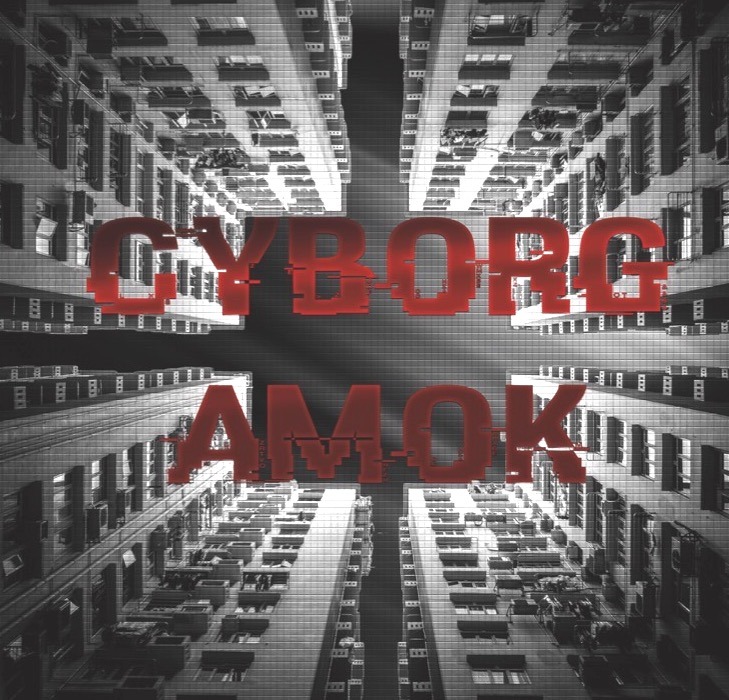
I wasn’t entirely sure what to expect from Cyborg Amok’s eponymous debut. Sure, there’s the press release, and no, it’s not lazy journalism to take cribs and pointers from press releases. This one forewarns that Cyborg Amok ‘resides somewhere between the brilliance of twilight and the apocalyptic darkness. Their gothic infused synth-rock sound delivers the listener to a panorama of synthetic waves, twisted organic tones and a slightly pop crust … the language angels speak in the darkness.’

I don’t entirely compute the implications of this, can’t even really unravel them, not least of all because I can’t always grasp what passes for ‘gothic’ these days having lost the thread some time in the mid to late 90s with the emergence of cybergoth, which sounded just like so much bad techno to me, and a million miles from the post-punk origins of the genre, and the subsequent ‘waves’ of goth which coincided with myriad hybrid mutant strains. Perhaps I am something of a pursuit in my personal tastes, but as a critic, I try to be more accommodating. But sometimes, you just have to accept that music is music and it’s either good or bad, because your audience are unlikely to share your prejudicial quirks.

Cyborg Amok is Greg Bullock (formerly the keyboardist with RealEyes and Shamen) and drummer Brydon Bullock (no relation as far as is obvious), and their debut album is in fact bringing together their first two (now deleted) EPs, so, if I’m being picky it’s not really a debut album but a compilation (which is also true of The March Violets’ Natural History among others. Not that it detracts from the force of these seven songs pulled together in one place. Oh no. Cyborg Amok kicks.

‘Burden Away’ brings bulldozing bass and stuttering mechanised drums. The rhythm guitar trudges and grinds, while Greg’s brooding baritone vocals registers in the ribcage – but while it’s so much industrial grind, the lead guitars are warped country, and there’s a twangy inflection in the vocals to match. It’s solid, but if you’re looking for a pigeonhole, you’re going to struggle. Things get even more complicated with ‘Still Too Far Out’, which straddles Nightbreed-flavoured second/third wave goth with its organ synth sounds evoking sepulchral gloom against guitars that fizz in a swathe of chorus and flange… and then there’s a fuck-off keyboard solo that’s B-Movie and Ultravox and it may be incongruous by 2020s standards, but perfectly in place in context of those precursors.

With its space-themed title and snarling, bulbous, electronics, ‘Dancing on the Floor of the Sea of Tranquillity’ provides more of the vibes the moniker and title perhaps evoke, and if it suggests extravagant prog enormity, it’s no criticism to say that after its dark, stark intro, it slips towards 80s electropop in the vein of A-Ha.

There are some Cure-esque moments scattered about the album, too, but then this is an album, that assimilated huge swathes of 80s that’s not exactly band-specific, but the zeitgeist.

There’s some overblown prog guitar that’s Yngwie Malmsteen overdone, but once they’re done with the moments of indulgence (‘Choice Not Taken’ is perhaps the greatest showcase of guilt), they deliver some impressive musical moments, where the ambition is equalled by the ability.

They’re at their best when they keep it minimal, sparse, nailed down: last track ‘Another Turn’ bears solid – and favourable – comparisons to Red Lorry Yellow Lorry, with its steely beats and grey, steely guitars backing a gruff, ragged vocal delivery. It’s a style that works well, and while this compilation must provide a point at which to assess the trajectory of their career, the evidence here is that they’re doing everything right and need to forge ahead and capitalise on their work so far, because this is a strong dark album.

AA

240381

Oracle Rouge – 28th April 2017

Christopher Nosnibor

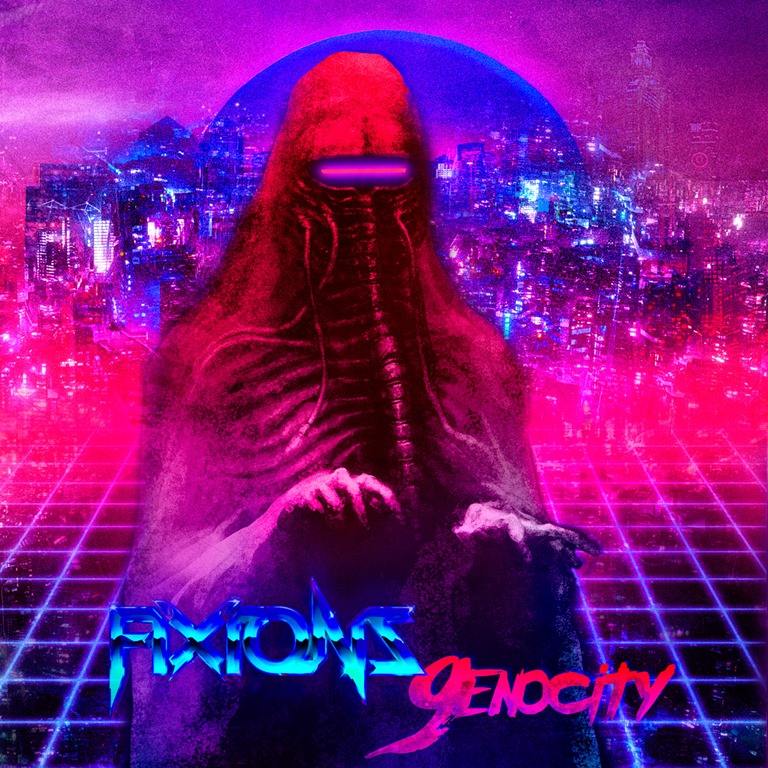
French cyberpunk / dark-wave project Fixions are, they say, influenced by ‘classic movies such as Blade Runner, Akira, Ghost in the Shell, the extreme metal scene from the 90s, Amiga video games, Fixions evolves in a style mixing dark and surrealistic elements, bombastic, powerful production, and a solid 80/90s dystopic science-fiction aura.’ With this, their fourth album, they threaten ‘the most extreme and deep release they ever produced’ in the form of ‘a concept album inspired by classic cyberpunk fiction tales, where every track depicts one of the thousand dangers the “Edgerunners” will encounter when visiting the city at night [and] sees Fixions merging futuristic urban ambiances with dark epic elements and heavy, abrasive sounds’.

While the concept might not be rendered entirely explicit through the album’s 16 instrumental tracks, but themes emerge both from the audio content and the titles (not to mention the cover art) applied to the compositions: ‘Crimeware’; ‘Terrorwave’; ‘Black Chrome Riot’ all contrive to summarise the intent of Genocity, which to all intents and purposes does come across as a sort of reimagining of Neuromancer in audio form.

Jittery, skittery, interloping lead lines weave their way over thumping basslines that wow and drag, melded to stomping, insistent, industrial-strength disco beats. It’s all about the imposing soundscapes and minor chords, the tension and the relentlessly restive digital flittering. There are grooves aplenty – hard, driving eurodisco grooves packed back to back, interspersed with more contemplative Kraftwerk-inspired tracks.

Does it sound futuristic? Not really. The ‘80/90s dystopic science-fiction aura’ is all-encompassing. The sonic elements are all tried and tested, well-worn tropes which evoke the spirit of ‘the future’ as it looked in those line-green neon-hued imaginings from the 1980s. As such, it’s possible – and indeed hard to resist – viewing Genocity as a sort of nostalgia piece, in which the time and space being yearned for is a golden age in which the future – a future which ultimately failed to become the reality in the present in which we now find ourselves – offered exciting and near-infinite potentials. Perhaps the realisation of that failure is the thread which ties the fictional technological dystopias of the 80s and 90s to the bleak cyberreality of the Internet and the digital age as we now experience it. At least the dystopian digital futures depicted in fiction were, and are, just that – fiction. Artificial Intelligence and automation, a reality in which everyone carries a computer which pinpoints their precise location 24/7 have not given us more leisure time, or more freedom, but has instead overtaken and occupied every inch of everyone’s lives and resulted in the erosion of freedoms at a pace which perhaps even outstrips the technological advances themselves.

When faced with incalculable progress and its effects on the psyche, it’s only natural to regress to safe times. There is, beneath the tension and amidst the dark currents which flow through Genocity, a certain sense of a regressive channelling. And so while it may not be the sound of the future, it does provide a perfectly serviceable recreation of futures past.

fixions_genocity