Posts Tagged ‘Collage’

29th November 2025

Christopher Nosnibor

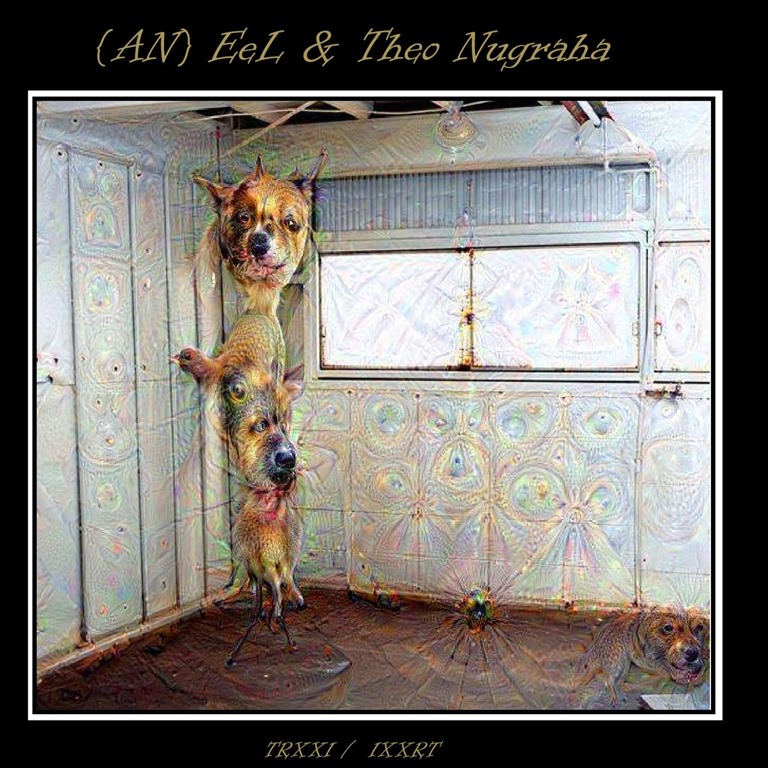
It’s not a good thing to feel nostalgia for something from the recent past which wasn’t even any good to begin with. But on seeing the cover for this split release by Theo Nugraha and {AN} EeL, I’m reminded that Google DeepDream was actually quite fun for about five minutes in 2015. Ah, hindsight… The results DeepDream produced were weird, psychedelic, trippy, and resembled no dream or subconscious thoughts I’ve ever known, its hallucinatory aspects were oft said to share qualities with LSD. But this was part of the appeal: it was novel, silly, with dog faces emerging from inanimate objects, whappy wallpaper, and the like. How many of us knew that it would be a precursor to the AI hell we now find ourselves in? Ten years is not such a long time in the scheme of things, but in the context of the now, it feels like another lifetime. A lifetime when doing daft stuff with digital tools wasn’t annihilating the environment, when it wasn’t stealing the work of writers and artists, when it wasn’t rendering jobs obsolete while creating billionaires at the expense of those losing their livelihood. Arguably, the golden age of The Internet was in the first years post-millennium, when applet-based chatrooms first made it possible to connect in real-time with people around the globe and MySpace was a wild melting pot where people came together through shared interest and communities evolved. This isn’t just some nostalgia wank: these were exciting times, and the world truly began to open up in ways hitherto unseen. These were times when The Internet offered freedom, where, as Warren Ellis’ novel Crooked Little Vein expounded, anything goes and if you could imagine it, you’d find it online. Godzilla Bukkake? You got it.

Everything changed when major corporations realised that they could really, really make on this. But major corporations being major corporations, they didn’t want to participate – they wanted to take over and own it, to wring every penny of profit from every last keystroke. And so now, while Napster and Soulseek were the equivalent of home taping, which didn’t kill music, Spotify and most other major streaming services really are damaging artists’ livelihoods – because unlike small-time peer-to-peer file sharing, this is a multi-billion dollar industry which siphons off pretty much all of the money for owners and shareholders rather than artist – and then you have scums like Daniel Ek using those proceeds to fund war. Something has gone seriously wrong.

Theo Nugraha’s contribution, 1XXTR is a longform work – seconds short of thirty minutes – and while it’s perhaps not quite Harsh Noise Wall, it’s most definitely harsh noise, and there’s not a lot of variation. It may even be that any variation is in the imagination as the mind struggles to process the relentless barrage of sound and seeks tonal changes, details within the texture. It doesn’t so much sound like a cement mixer – more like being in a cement mixer with half a ton of rocks, at the heart of an atomic blast. There are squalls of feedback and mutterings beneath the blitzkrieg, and around ten minutes in, the tempest suddenly begins to rage even harder and it’s like being hit by a train. Twenty minutes in, the relentless roar drops to merely the blast of a jet engine and the sensation is like huge pressure drop, or a fall. It’s impossible to discern what’s going on inside this swirling vortex of noise (there does sound like a vast amount of collaging and random things floating in and out), but it’s a full-on physical assault that vibrates every cell in the body. By the end of this most brutal half hour, you feel battered, bruised, damaged.

‘TRXX1’ by {AN} EeL, which runs for a second over the half-hour mark, is altogether less abrasive, but it’s no more comfortable. At first, it’s a clattering, metallic rattle, like an aluminium dustbin rolling down the street in a gale, accompanied by rattles and chimes. Extraneous noises – twangs and scrapes – enter the mix, and the sound starts to build, like the wind growing stronger at the front-end of a storm. But soon, from nowhere, a squall of static – or rainfall – begins to swell and while off-tune notes reverberate in the background, and a scan of radio stations yields alternately cut-up fragments and random noise, and while it may not possess the same physical force as Nugraha’s piece, ‘TRXX1’presents a disturbing array of frequencies and makes for a particularly tense listen. There’s a thunderous ripple like a freight train a mile long barrelling along, while disjointed voices echo here and there, and as bhangra and old-time brass fade in and out, the collage approach to the track’s creation, harking back to William Burroughs’ tape experiments, and early Throbbing Gristle become increasingly apparent. The Police’s ‘Can’t Stand Losing You’ cuts through what sounds like a snippet from lecture or interview. The repetition of the same fragments becomes difficult to deal with after a time, and you begin to feel like you’re cracking up. The it’s back to the sound of metal buckets being dragged down a cobbled street, with random busts of discordant noise jabbing in for extra discomfort. The final segment is a cacophony of abstract drones and crashing, calamitous racketry – a combination which is uncomfortable and unsettling.

The two pieces are quite different, but equally difficult in their own ways, and as such compliment one another. And if you’re seeking an album that really tests your capacity for abrasion and nauseating noise, 1XXTR / TRXX1 hits the spot like a fist to the stomach.

AA
a2950925012_10

Mortality Tables – 17th October 2025

Christopher Nosnibor

Among their ever-expanding catalogue, Mortality Tables have put out a number of releases which are essentially singles or EPs, with this being one of them: with a running time of just over eleven and a half minutes, this single longform composition is only marginally longer than its title, but its creator, Michael Evill, has condensed a considerable amount of material and experience into this space.

As he writes, ‘I have created a movement which includes the last breaths of my beloved dog Watson. It also includes the last time I recorded with my most talented and wonderful best friend Gustaf in 2001, which I have slowed down so I (and you) can spend more time with him. There are the sounds of new stars being born – my own interpretation and ones ripped off from NASA through this modern internet connection we all have. Surely we own the stars still?

‘We have Aztecs having fun with drums. These were recorded live in Mexico, sadly not from the 14th century before we invaded. We have the hourglass from our kitchen, which Mat inspired me to sample. This was the first idea of this piece and everything else fell in to place very quickly as it’s been swimming in the back of my mind for a while.’

Clearly, some of these elements have deep emotional significance for Michael, but this isn’t conveyed – at least not overtly or explicitly – in the work itself. It’s a collage-type sonic stew, where all of the myriad elements bubble and roil together to form a dense soup, in which none of the flavours are distinct, but in combination, what he serves up is unique, and provided much to chew on. That this protracted food-orientated metaphor may not be entirely coherent is apposite, but should by no means be considered a criticism.

As Evill goes on to write, ‘this was the beginning, and I didn’t spend much time thinking about it and just coalesced those ideas.’ Sometimes, when seeking to articulate life experience, it doesn’t serve to overthink it. Life rarely happens that way: life is what happens when you’re busy thinking and planning. And just as our experiences aren’t strictly linear, neither are our thoughts and recollections. Indeed, our thoughts and memories trip over one another in an endless jumble of perpetual confusion, and the more life we live, the more time we spend accumulating experience – and absorbing books, films, TV, online media, overheard conversations and dreams, the more everything becomes intertwined, overlayed, building to a constant mental babble.

William Burrroughs utilised the cut-up technique specifically to bring writing closer to real life, contending that ‘life is a cut-up… every time you walk down the street, your stream of consciousness is cut by random factors… take a walk down a city street… you have seen half a person cut in two by a car, bits and pieces of street signs and advertisements, reflections from shop windows – a montage of fragments.’

This encapsulates the artist’s quest: to create something which conveys the thoughts in one’s head, to recreate in some tangible form the intangible nebulous inner life, if only to help to make sense of it for oneself.

‘Even Though It Was The Blink Of An Eye’ is a woozy, disorientating churn of noise, which is, at times, dizzying, unsettling, nausea-inducing. But then again, at other times, it’s gentle, even melodic, reflective, contemplative. There are some passages where it’s all of these things all at once. It very much does feel like a scan of the artist’s memory banks, the human brain equivalent of skipping through the RAM files and pulling items seemingly at random. It does feel somewhat strange, even awkward, being granted access in such a way, but at the same time, it feels like ‘Even Though It Was The Blink Of An Eye’ is more than an insight into the mind of one individual, but an exploration of the human psyche.

AA

a0518044244_10

Dret Skivor – 3rd October 2023

Christopher Nosnibor

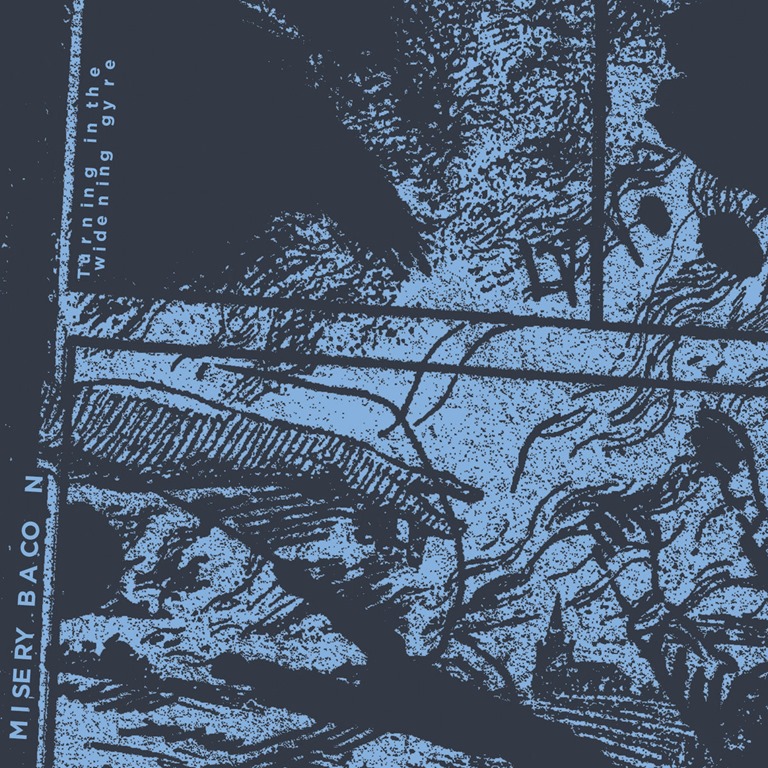
This is proving to be a particularly good week in the world of noise, what with Foldhead’s Paris Braille and this being released on the same day. There’s more information given about this release than most to slip out from Swedish underground label Dret Skivor – in that there is actually some. We learn that the work was ‘Recorded and assembled on residency at Bergen Centre for Electronic Arts, Leveld AIR and Gallery ASK, Norway 2025’, and that the ‘Album and song titles taken from / inspired by WB Yeats ‘The Second Coming’’. We also learn that Misery Bacon is the vehicle of Bergen’s Luke Drozd. It’s not clear if this is one of those monikers that’s amusing because translation, or if it’s a case of humour that doesn’t translate geographically, like Die Toten Hosen. I’m sure dead trousers are a massive wheeze in Germany, but here it’s vaguely surreal but mostly a bit odd. Then again, ‘Misery bacon’ makes me think of all the moaning gammons we have here in the UK, red-faced and chuntering into their Carling about ‘immagrunts’ and how everything’s ‘bloody woke’ nowadays.

It contains two longform pieces, each filling a side of the cassette release – of which there are just six copies – ‘Every finger double crossed as things fall apart’, and ‘Shambling onwards in the shadows of indignant birds’, and neither literary allusions or social commentary are apparent in the work itself.

‘Every finger double crossed as things fall apart’ starts with some sampled dialogue and an array of pops, clicks, whirrs and glops, a swampy collage of seemingly random elements layered across one another. It’s atmospheric, but also difficult to get a handle on any idea of where it’s headed, if there’s any theme or concept that connects the diverse sources. But soon, serrated drones and distortion build to a sustained whorl of noise atop a quivering bass judder. Five minutes in, and it’s an all-out assault worthy of Merzbow or Kevin Drumm. It’s noise, and it’s harsh, but it’s an ever-shifting, seething mass of tinnitus-inducing tones and textures, at time fizzing and crackling in such a way as to give the impression that the sound is actually inside your own head, rather than reaching the brain from an external source. There’s a niggling crackle of static that sounds like there might be a problem withy your equipment. This is most pronounced and unsettling during a quieter spell of jangling metal which sounds like a light metallic object being rattled against a metal fence, or the clattering of cutlery. It’s a piece that slides and slithers hither and thither, and sits well against Throbbing Gristle’s most experimental, abstract works. Towards the end, it does feel like it could be the soundtrack to the collapse of everything. Listening to it while the US government is in shutdown, Israel seemingly continues to level Gaza despite a supposed ceasefire, hundreds of people are arrested in London and other cities for protesting against genocide, and Russia continues to expand its campaign of interference across Europe, it’s hard to feel much positivity.

On a personal level, the present feels overwhelming. The world is at war. The world is on fire, and at the same time that we have drought, we have flooding. But instead of coming together collectively to address this global crisis, as a species, we’d rather bomb the fuck out of one another. And with shootings, mass knife attacks and all manner of savagery taking place daily, it really does feel as if humanity has descended into a spiral of insanity and self-destruction. And there are really no words to articulate the panic and anguish of all of this. Music and literature may provide a certain comfort and distraction, but it’s in sound alone – more specifically, sense-shattering noise – that I find something which articulates the experience of living in these torturous times.

And so it is that ‘Shambling onwards in the shadows of indignant birds’ returns to the sampled dialogue which opens ‘Every finger double crossed as things fall apart’, before plunging into a mess of static cackles and hiss. It’s a Bladerunner world of rust and robotics gone wrong. It’s murky and it’s unsettling. A blast like the roar of a jet engine momentarily hampers the hearing, and we sit, dazed, in the comparative quiet of crackles and pops. There’s a mid-track lull, which feels uncomfortable as whistles of feedback and laser bleeps criss-cross before collapsing into a broken wall of noise on noise.

Turning in the widening gyre is harsh, heavy, bursting with uncomfortable frequencies. The final minutes are nothing short of punishing. And yet, at the same time, that punishment offers vital release. This is where you get to let go. At last.

AA

a2298054435_10

The Helen Scarsdale Agency – 8th August 2025

Christopher Nosnibor

When the accompanying notes and press release which replicates them describes a release as ‘dire’, you know you’re in for an uncomfortable ride. In the world of noise, such a choice of adjective doesn’t carry quite the same negative connotations as is the majority of musical spheres. When it comes to noise, and certain strains of metal, the objective is to make it as unpleasant as possible. It will alienate most people, and that’s precisely the objective: those who can withstand the torture are the right people.

And so it is that Mutual Consuming is described as ‘a dire piece of isolationist thrum, spectral caterwaul, and heavy gloom through an oblique and abstracted coupling of electronics, noise, and ominous field recordings.’

To quote further from the accompanying notes, Roxann and Rachal Spikula, the twins who make up Relay for Death’, offered the consideration that “Mutual Consuming comes from a concept in the philosophies that underpin traditional Chinese medicine theory, where the two opposing states (yin and yang) are 2 states on a continuum and their interactions produce an infinite possible number of states of aggregation. Within this interplay, there is a dynamic balance that is maintained by a constant adjustment of their relative levels. So an excess of yin consumes yang and vice versa.” We asked if this has anything to do with the concept of the Ouroboros, to which they responded, “We hadn’t thought about Ouroboros, but the eternal cycle of things makes sense too. The gorge fest of existence.” Does this relate to previous works? The twins concisely respond to that question in a rare interview in Untitled, “No.”

The album features but two pieces, each clocking in around the seventeen minute mark. An awkward length, but plenty of time to make for an uncomfortable, unsettling, and even torturous experience. And it is.

‘intone the morph orb’ is a darkly unsettling expanse of dark ambient, the sounds of thunder and cavernous growls from the pits of hell are collaged with scrawling metallic drones. Distant detonations reverberate, like volcanic eruptions beyond the horizon, as wispy ominousness lingers in the air. Very little tangible takes place, but the tension grows. There is a dark thriller / horror aspect to this: the hairs on the back of your neck prickle and you fear whatever may lie around the corner. The second half of the track is less precipitous, given to a protracted mid-to-high-end drones that swirls and eddies, cut through with occasional whistles of feedback.

There’s something vaguely Ballardian about the title ‘terminal ice wind’, and it is, indeed, a cold atmosphere which runs forth from the speakers, churning an ever denser sonic murk as the first few minute pass. It’s a seeping morass of dark discordance which takes cues from Throbbing Gristle. Three minutes in, thunderous explosions register, and all is noise, albeit for a brief time. In time, dissonant drones, thrumming reverberations and low rumbles emerge and come to dominate the mix in what is an ever-shifting soundscape, where light is in limited supply. This is, indeed, dark, and oppressive.

Everything about Mutual Consuming is as it should be. A collage of challenging sound on sound, any underlying concept fades to insignificance as the sounds assail the ears without apology. Mutual Consuming is not harsh, and on the noise spectrum, it’s fairly gentle, but it’s by no means accessible or easy on the ear.

AA

AA

RFD Promo

Cruel Nature Records – 27 June 2025

Christopher Nosnibor

The cover within a cover artwork is only the first example of near infinite layers when it comes to this complex and inventive work from the truly demented experimentalist who records under the moniker of Cumsleg Borenail.

This latest effort promises ‘a collision of methods—part LLM-based sampling, part MPC assembly, part human lyrics—stitched together into something fluid and unpredictable. AI scavenges random prompts, returning garbled errors and fractured phrases, while voices and instruments drift in from nowhere, guided by no fixed direction. Each track begins as one idea and mutates into another, warping its original design into something unrecognizable yet strangely intentional.’

Oh, and it delivers on that promise, alright. This is truly a derangement of the senses, a collaged cut-up, an uncompromising mash-up, a smash-up, if you will, where absolutely nothing is off limit, and it all gets tossed, unceremoniously and indiscriminately, into the blender and churned up into a mess of the most mind-blowing chaos imaginable.

To provide a detailed analysis of this would be to unpick the threads in a way which would reduce the album to less than the sum of its parts. 10mg Citalopram works precisely because it’s an exercise in brain-pulping loop-heavy derangement.

‘You mean nothing me!’ a female voice repeats, and repeats, against a clattering, springing backdrop of twangs and poings throughout ‘You Mean Something To Me’. My head’s a shed by the time we’re midway through the second track, ‘Denizen Invocation Via Lunar Phase’ – because this is a work that goes off in all directions, all at once, and it’s really not pretty. It is, however, weird and frantic. It’s a mess of noise and samples and glitchy electronic samples and frantic breakbeats. Later in the album, there’s a companion piece of sorts, ‘Now I Know I Am Nothing Because You Said’.

AA

In some respects, I’m reminded of early Foetus, JG Thirlwell’s crazed tape loops and cacophonous noise bursts, and the way Cabaret Voltaire took the tape experiments conducted by William Burroughs and Brion Gysin and the ideas outlined in The Electronic Revolution as their starting point – but it’s also a bit Trout Mask Replica, in that it’s like listening to several songs being played at the same time, only it’s got bust-up techno beats exploding all over the shop and frankly, it’s impossible to know what the fuck’s going on most of the time. Too much, for sure. But that’s the point.

For context, Citalopram is a widely-prescribed antidepressant, described on the NHS website as ‘a medicine that can help treat depression and panic attacks’. This album, however, sounds more like a prolonged panic attack or all of the listed possible side-effects being experienced at once, while the numerous references to being ‘nothing’ appear to allude to the inner voice of low mood. Then again, there are other medical matters of an altogether different sort which provide the reference points for tracks like ‘Clostridium Difficile’ (a bacteria which causes diarrhoea) and ‘Snifflers, Nostril Pickers and Dribblers’. All of it is utterly batshit wonky and wildly arrhythmic, and certainly not for anyone who’s feeling tense or jittery or suffering from any kind of psychosis. For anyone else… proceed with caution. May have unwelcome and unpleasant side effects.

AA

a1363557647_10

Room40 – 9th May 2025

Christopher Nosnibor

Merzbow is an artist who requires little to no introduction, and one with a catalogue so immense – with in excess of five hundred releases credited – it’s beyond daunting for not only a beginner, but even a keen noise-lover. This is the reasons I personally own very few releases, and have only picked up a few incidentally along the way.

As Masami Akita approaches seventy, and Merzbow marks forty-five years of noise, this output shows little sign of abating, but it does seem an appropriate time to reflect on some previous releases which may be considered either ‘classic’ or ‘pivotal’. 1994s Venereology has been receiving some retrospective coverage of late, revered largely on account of its reputation for being the loudest, harshest thing ever, ever.

But here we have a reissue of The Prosperity Of Vice, The Misfortune Of Virtue, released a couple of years later, a much lesser-known work, but still during what’s broadly considered to be the golden era of the 90s, and, as the accompanying notes suggest, it’s ‘one of a series of unique editions from his vast catalogue that reveals a side of his practice often under represented.’

During the late 1980s and into the 1990s, Masami Akita was sometimes working on film and theatre music. In this space he created a series of recordings that capture the full scope of his sound worlds.

Given the nature of these settings, his compositional approaches were varied, seeking to create both intensely crushing walls of sound and more spatial, and at times rhythmic, pieces that plot out an approach to sound making which atomises his universe of sound, and uncovered the singular detail that is often consumed in the whole.

The Prosperity Of Vice, The Misfortune Of Virtue is the soundtrack to the theatre piece Akutoku no Sakae/Bitoku no Fuko by Romantica. Based on Marquis de Sades’s Historie de Juliette ou les Prosperités du vice & Les Infortunes de la vertu, this recording was originally released with limited distribution and remains one of the lesser available Merzbow recordings.

Completely remastered and contains an additional cut from those original sessions, this reissue of The Prosperity Of Vice, The Misfortune Of Virtue presents nineteen blasts of noise and rumbling and shrieking, scraping discord and dissonance. Many of the pieces are brief – a couple of minutes or so – and there is so much texture and tonal rage here, its sonic vision is remarkable. To many, of course, it will just ne noise – horrible, nasty, uncoordinated noise. But listen closer, and there is a lot happening here. The noise is, indeed, nasty, and the output is, brain-blasting chaos, for sure. But what these untitled pieces showcase is an intense focus and an attention to detail which is so much more than brutal noise. The Prosperity Of Vice, The Misfortune Of Virtue is, comparatively speaking, not that harsh – although when it is harsh, it’s absolutely next-level brutal with shards of treble exploding in walls of ear-shredding punishment. It contains a lot of clattering and crashing, like bin lids being dropped, and cyclical, thrumming rhythmic pulsations. There are tweets and flutters, bird-like chirrups flittering above cement-mixer churning grind with gnawing low-end and splintering treble, overloading grind and would oscillations.

The Prosperity Of Vice, The Misfortune Of Virtue is the sound of a man pushing all the buttons and turning all the dials at once and seeing just how far he can tweak them. There are moments of minimalism, of slow, stuttering beats, of mere crackles, passages one might even describe as ambient – a word not commonly associated with Merzbow. But the way in which The Prosperity Of Vice, The Misfortune Of Virtue explores these dynamics, and contains quieter more delicate segments, not to mention some bleepy electronica that borders on beat-free dance in places, is remarkable: while so much noise is simply repellent to anyone who isn’t attuned to it, The Prosperity Of Vice, The Misfortune Of Virtue offers engagement and offers openings to listeners with a broader interest in experimental music.

Eclectic is the word: we hear a chamver orchestra at the same time we hear strings being bent out of shape and what sounds like a Theremin in distress. While a fire alarm squawks in the background. This is everything including the kitchen sink. Imaginative and experimental, it’s noise with infinite dimensions.

AA

RM4195 front

‘Mars On A Half Moon Rising’ is the first video from The Sound, the solo debut of much-travelled musician / producer / arranger / painter Knox Chandler. This project is a musical / visual memoir depicting the shift in his surroundings from the urban to the rural, specifically the Connecticut shoreline off the Long Island Sound and the impact of this dramatic change of environment on his consciousness and the art-work that leads to.

At The Sound’s core is Chandler’s “Soundribbon” style of meditative, powerfully cinematic instrumental performance on guitar, accompanied by upright bass and percussion which comprises the audio component of the release. The visual portion is a book of paintings, photographs, sketches and written meditations, interpreting nature through technology. The blending of these mediums is Knox’s attempt to make the diaristic intent of his music explicit. The Sound is being released on Knox’s new label Blue Elastic on May 30. The album is available on digital download and on streaming platforms on its own, or the book comes with a download code. I hope you’ll consider covering Knox with an interview, feature, news story or album review.

Knox Chandler’s career has spanned for over four decades including long stints as a member of The Psychedelic Furs, Siouxsie and the Banshees and the Cyndi Lauper band, extraordinary experiences in recording and performing live around the world. Chandler’s also performed, recorded, arranged and produced, working with acts such as REM, Depeche Mode, Grace Jones, Marianne Faithful, Natalie Merchant, Tricky, The Creatures, Dave Gahan Paper Monsters and The Golden Palominos etc.

Knox spent a decade residing in Berlin, Germany, while he explored sound-scaping. He developed a technique he calls “Soundribbons”, which he recorded and performed in its own right as well as applying it to different genres and mediums . He composed, recorded, toured, produced, and wrote string arrangements for Herbert Grönemeyer, Jesper Munk, Pure Reason Revolution,The Still, TAU, Miss Kenichi and the Sun, Mars William’s Albert Ayler Xmas, Rita Redshoes, Them There, The Night, etc. While living in Germany received a Post Graduate certification in education and was the head of the guitar department at BIMM College.

AA

Knox Chandler

Cruel Nature Records – 4th April 2025

Christopher Nosnibor

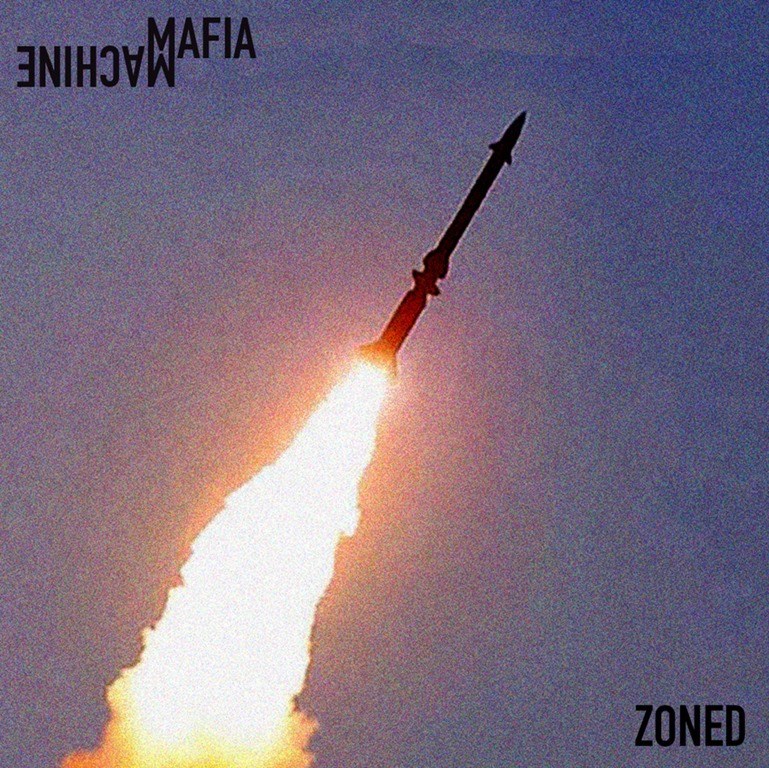
Machine Mafia may be largely unknown, but the duo’s members have some pedigree, being Adam Stone of Pound Land and Jase Kester (Omnibadger/Omnibael/Don’t Try/Plan Pony), all regulars at Aural Aggravation. Jase joined Pound Land’s ever-shifting lineup as the (then) sixth member in 2023 for a handful of live shows, and contributing additional noise to Mugged (because it needed more noise). Deciding to collaborate in early 2024, they slipped out a couple of self-released EPs, which as the notes which accompany Zoned observe, ‘more or less went under the radar at the time’ – which is why they’re getting a second go here, with Zoned being a compilation of those EPs plus four new tracks, or a new EP packaged with the previous ones, depending on your perspective. The tracks aren’t in their original order of release, and have bene resequenced, presumably for the purpose of creating a flow that’s sonic rather than chronological. And so it is that the album starts with ‘Killzones’, arguably the most overtly Pound land-like track on the album, which eases fans of Pound Land into the world of Machine Mafia nicely, or will otherwise alienate pretty much everyone else, unless they’re on the market for something that sounds like Sleaford Mods in collaboration with PiL while monged on Ketamine.

They describe themselves as ‘a voice/electronics duo in the grand tradition of Suicide, Silver Apples, Soft Cell, Pet Shop Boys etc.’ And it is indeed a grand tradition, to which one would reasonably add Sparks, Air, and Erasure, and even the final incarnation of Whitehouse, although what this list ultimately achieves is to demonstrate just how wide-ranging the electronic duo format stretches in terms of style. I very much doubt you’d find these guys donning big hats or flamboyant costumes and kicking out a set of brassy dancefloor-friendly pop bangers, at least on the evidence of the thirteen tracks on offer here. They recount that their first gig was ‘in a small craft ale bar in the Staffordshire town of Leek, receiving a ban for high decibel levels and foul language’. This sets the bar of expectation, and in this context, Zoned does not disappoint.

As I suggested in my write-up of the Killzones EP, the electronic duo they share the most common ground with is Cabaret Voltaire in their early years, mashing up samples and noise in a Burroughsian cut-up style, and churning out gnarly noise that sits between Suicide and Throbbing Gristle. This is particularly true of the collage chaos of ‘Lecture 0.3B’,

But then, ‘F.O.S’, is a blast of uptempo, lo-fi, bass driven drum-machine propelled hardcore punk strewn with feedback and snarling aggression, and ‘Where’s The Money Gone?’, from the Money Gone EP is a filthy racket with massive blasting beats which lands in the space between The Fall and Big Black, powering away at a motorik groove for the best part of six minutes while Stone hollers thickly and ever-more desperately ‘where’s the money gone?’ Well, we know it’s not gone into public services, but there some mega-rich cunts swanning around and jetting into space. And has anyone seen Michelle Mone since she sailed off on her multi-million quid yacht?

‘England’, originally released on Industrial Coast’s ‘Rock Against Racism’ compilation is very Throbbing Gristle, in the (pulsating) vein of ‘Very Friendly’.

Of the four new cuts, ‘Crabclaw’ invites comparisons to Selfish Cunt’s ‘Britain is Shit’, and this may not be entirely accidental, a stinking snarling assault on culture and the senses, with an overloading gritty bass and vitriolic vocals ranting in a mess of distortion and reverb over the murky morass of a musical backing. It’s the sound of frustration, it’s the sound of anger mashed together with despair. ‘Jackpot’, meanwhile, is like John Cooper Clarke spouting over a segment of Metal Machine Music. All the while, a drum machine and throbbing bass pulse away relentlessly: this is Sleaford Mods for real punks. ‘Human Like’ revisits the dubby tendencies first explored with ‘Killzones’, and it’s a dark, sprawling cavernous hell of reverb atop an organ-shaking bass, again bringing together PiL (think ‘Theme’) and Throbbing Gristle (think ‘What a Day’). It’s meaty, and then some, and crunches and grinds away for a full six echo-soaked minutes. Closing with the eight-and-a-half-minute megalith that is ‘Outside My House’, they go full Whitehouse, with a booming bass that’s positively weapons-grade density, over which Stone delivers a rabid, drawling rant from the perspective of a crabby right-wing old-timer while electronic extranea bubble and eddy around. It’s utterly brutal, and completely uncomfortable, and this is the brilliance of Machine Mafia. Gnarly, nasty, uncompromising, Zoned is not friendly, and it will leave you feeling drained, harrowed, punished. Mission accomplished. You’re not supposed to like this.

AA

a2183471837_10

Editions Mego – 21st February 2025

Christopher Nosnibor

Russell Haswell and Florian Hecker are both prolific as solo artists, each with numerous collaborations with other artists to their respective credits, Haswell also having been a contributor to and touring member of Consumer Electronics. The UPIC Diffusion Sessions are a long-running collaborative project which began in the early 2000s, exploring Iannis Xenakis’ UPIC system as the sole instrument.

As the accompanying notes outline, ‘The UPIC is a computer music system that generates sound from visual input. The original intention of the system developed by Xenakis was to make a utopian tool for producing new sounds accessible to all, independent of formal training. One can locate footage of Xenakis and a group of children making drawings for the system in the 70’s.’ They continue, ‘The duo set off experimenting with a diverse array of hand-drawn images to feed the UPIC system including news photographs of disasters and atrocities, “food porn” through to depictions of the natural world and microscopic images of molecular structures (including ‘the blackest ever black’). The resulting eccentric audio from these images is claimed by the artists to heighten synaesthesia and is as mysterious as it is baffling.

I suppose the potential outputs for the UPIC are as infinite as the inputs, and this alone makes for a fascinating project, and the results here are, indeed, mysterious and baffling. The recording from this session is represented by a single track, just over half an hour in length.

Immediately, trilling oscillator tones rise in pitch – and keep rising, until you feel the pressure build inside your skull. There are glitching spasms of sound which flash across like subliminal messages. The pressure drops and the siren wails fade out, before scuttering blasts of seemingly random noise collage and intersect across one another, buzzing and fizzing, humming and thrumming… the forms move quickly, and shift from dark to light, hard to soft instantaneously. Shimmering sprays of abstract sound burst like fireworks, short interludes of harsh noise wall, microtonal bubbles and ZX Spectrum like babbles and bleeps all intersect or pass within mere seconds of one another. It is, very much, a sonic collage, the audio equivalent of William Burroughs’ cut-ups, an aural articulation of the simultaneity of experience of life in the world. Burroughs’ contention was that linear narrative is wholly inadequate when it comes to representing the real-world, real-time lived experience, whereby overheard conversations, snippets of TV and radio, and all the rest, not to mention our thoughts and internal monologues, overlap, and to present them sequentially is not true to life.

Leaping disjointedly from one fragment to the next at a bewilderingly rapid pace, listening to this is rather like the way the mind, and often conversations, skip from topic to topic without ever seeing any single train of thought to a defined conclusion, bouncing hither and thither in response to triggers and associations which often seem to bear no logic whatsoever.

There are thick, farting sounds, buzzes like giant hornets, choruses of angry bees, weird sonic mists and transcendental illuminations… of course, these are all conjured in the mind in response to these strange, sometimes otherworldly, sci-fi sounds, part BBC Radiophonic Workshop, part tinnitus and nightmare of imagination. Unpredictable isn’t even half of it as alien engines and spurs of 80s laser guns crossfire against earthworks, roaring jets, explosive robotics, skin-crawling doom drone, whispers and whistles, proto-industrial throbs…it’s a relentless blizzard of sound.

‘Experimental’ has become something of a catch-all for music that draws on eclectic elements or perhaps incorporates a certain randomness: this, however, is truly experimental, given that there is no way of knowing how the programme will interpret the input provided. And as much as the output involves oscillatory drones and the kind of synthy sounds associated with analogue, and with woozy, warping tape experiments, it evokes the drones of collapsing organs, wild sampling and everything else your brain could possibly conjure.

At once exhilarating and exhausting, UPIC Diffusion Session #23 is… an experience.

AA

eMego316V front

Futura Resistenza – 27th January 2025

Christopher Nosnibor

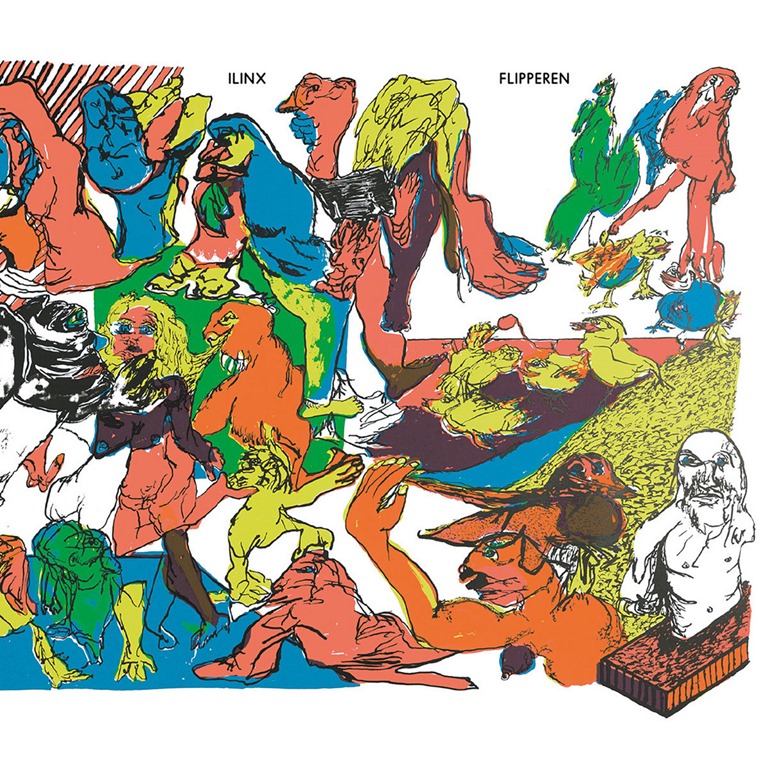
Some years ago (like about seventeen years ago), when I embarked on my reviewing journey proper, I was introduced to whacky experimental work and the world of microtonality. It was an absolute revelation. Just as, growing up in the 80s and raised on the Top 40 singles and Now That’s What I Call Music, discovering goth, alternative, John Peel, and Melody Maker completely changed my head, so did entering this new world. Onje thing that completely spun me was the way in which some artists extrapolated and academicized some pretty stupid or mundane stuff. This is a reasonable example. To quote: ‘Flipperen takes the randomness of pinball and turns it into music. Using recordings from old pinball machines, the music mixes chaos and structure, reflecting the Fluxus spirit of play and chance. It’s a wild ride through sound, where things don’t always make sense–but that’s the fun of it.’

Flipperen began as a lockdown / COVID project, of course. As they detail, ‘During the quiet and strange Covid days, Suzana Lașcu, Robert Kroos, and Reinier van Houdt began a recording project based on the soundbites of pinball machines. They visited the empty Dutch Pinball Museum in Rotterdam and captured field recordings of machines from the 1960s to the 1990s. From these, they selected 28 samples to serve as thematic starting points for what they called ‘game pieces,’ recorded in two sessions at Sonology Studios in The Hague. The recordings were then shaped into sound collages using cut-up techniques and probabilistic processes.’

These processes mean that the end product is a very long way removed from the actual sounds of metal balls pinging and rolling about inside a glass-covered case. Instead, landing between Brion Gysin and John Cage, we get a collection of weird and woozy fragmentary pieces – compositions would be something of a stretch – ranging from awkward ambience to crashing and banging that sounds like a prepared piano fitted with lump hammers. There’s playful, whimsical sighing and trilling, psychedelic trippery and some fairly straight jazz-flavoured piano in the mix. There’s Clangers-like whistling and clattering and clanking, pops and thuds, explosive industrial noise and frenzied country. There are moments which sound like someone grunting through a comb with greaseproof paper, others which sound like the strumming of an egg-slicer, others still which create the impression of a piano being dropped down a flight of stairs.

The final cut features twenty-six tracks, the majority of which are around a couple of minutes long, or even significantly shorter. But there are a couple which run to around six and a half minutes of uncoordinated chaos, and it’s a lot to take in.

The appeal from a sonic and experimental perspective is that ‘Pinball is a game that combines control and randomness—each action leads to an unpredictable result, and the outcome is always uncertain’, and as such, the patterns which provide the material for these pieces are erratic, unpredictable, and ultimately, not really patterns at all. And so it is that Flipperen shunts forwards and backwards, crackles and pops with zany snippets of this, that, and everything, conjuring a wild collage of disparate elements and all kinds of discord.

As much as pinball machines lie at the heart of Flipperen, it’s really a wide-ranging collage work with randomness at its heart. It’s fun, it’s fascinating, it’s brain-bending – and one might say it’s a work of Flipperen genius – but you definitely have to be in the mood for something quite this far out.

AA

a2489366009_10