Posts Tagged ‘Classical’

Christopher Nosnibor

It doesn’t get much more goth than a gig in a graveyard. Through the wrought iron gates, the approach to the chapel, the venue for tonight’s performance, is set either side and as far as the eye can see with headstones. Fulford cemetery is immense. The chapel is an appropriately imposing building: designed by James Pigott Pritchett and completed in 1838, it’s a grand neoclassical structure and considered possibly one of the greatest cemetery chapels in the country, with huge doric columns outside, while its interior, white with gilt trimmed faux-pillars which only accentuate the incredibly high ceiling is spectacular to behold.

The room – a neat oblong – is packed out with a broad array of people, but there’s a strong showing of what I’d call Whitby goths, that is to say, the kind who dress to impress rather than your biker jacket and boots type. There’s a lot of lace, silk, and taffeta to be seen, meaning that for once I feel rather less conspicuous sporting a knee-length velvet coat. But equally, the audience is notable for its broad spectrum and diverse demographic, and while details of the event in advance had been purposefully scant, there is clearly a keen interest for something different, and not specifically in York. There are people who have travelled to be here tonight.

The bar, such as it is, is offering red and white wine, bottles of Stella, and Coke, and taking a seat toward the back – the front ten rows were full and by the time the lights go down, leaving the space illuminated by mellow candlelight, the seats are pretty much all occupied. It’s pleasing to see, especially knowing that this event coincides with the annual nighttime walk for cancer, and a metal gig not five minutes up the road.

First, we were treated to some operatic vocal accompanied by piano. It’s not only exquisitely performed, but it’s absolutely perfect for the setting. And in this moment, it becomes crystal clear that this is going to be an event like no other. To describe it as an evening of culture would be to downplay all of the other music events and spoken word nights and more on offer, but when it comes to high culture, there’s most certainly a gap – but the greatest gap is in events which bridge the divide between your regular gig and a night at the theatre or the opera or a night at the proms. This, however, is a superbly curated event which achieves precisely that.

Immediately after this introduction, host and co-ordinator Stephen Kennedy leads an ensemble consisting of bass guitar and percussion through a set of three songs, starting with a brace of deep cuts from Fields of the Nephilim’s catalogue, with ‘Celebrate’, and then ‘Requiem’ from Mourning Sun, with the trio joined for the second two songs of their set by a cellist who remains on stage to play a solo set after. Kennedy’s vocal is strong, and he really does a remarkable job of reproducing Carl McCoy’s gravel-heavy growl.

DSC00069

After a handful of cello instrumentals, Kennedy returns to the stage – although technically it’s the floor, but wonderfully lit – to provide vocal accompaniment to her graceful strings.

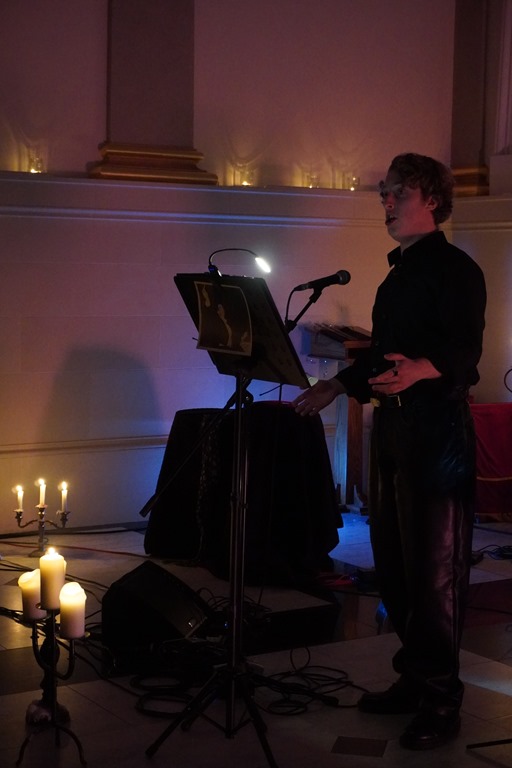
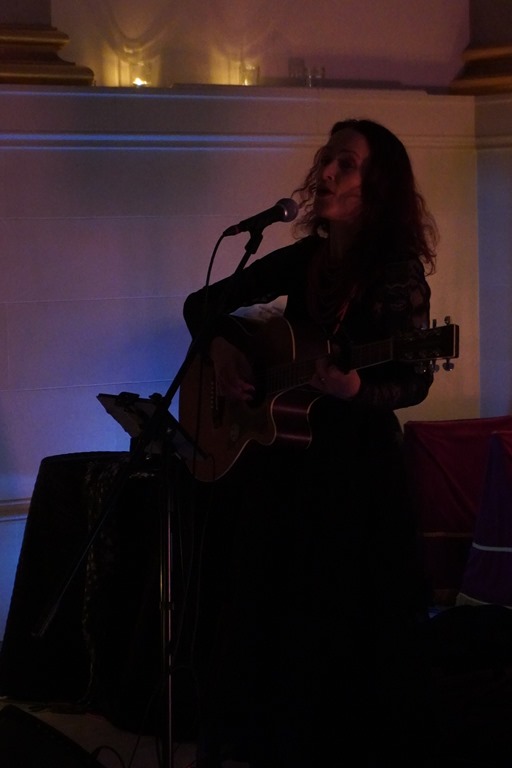
The switches between performers are near-instantaneous, with no announcements as to who’s who and no-one informing us who they are. There is a programme available at the merch table, but in a way, the individual credits feel of little import: this is very much a collective work, an ambitiously grand collaboration, striving to create a unique experience of an ever-shifting sonic smorgasbord. Individual names and egos are put aside in the name of this being Gothic Moth. There’s harp – moving – and powerful, and an emotive vocal while makes for a stirring performance, which is rapturously received, a solo acoustic-guitar led performance with folk-hued vocals, before the first half of the evening is rounded off with a piano and tenor recital, Benjamin Staniforth’s impressive voice matched only by his impressively voluminous leather trews.
DSC00093

If the second half offered more of the same, with some of the performers getting a second set, it also gave us a while lot more. During a longer harp and voice set, the rendition of Metallica’s ‘Nothing Else Matters’ was a clear standout of the night, but then again, Iryna Muha’s Ukrainian folk performance, with acoustic guitar – with some effects to really fill out the sound – and hurdy-gurdy was mesmerising, and was equally well received.
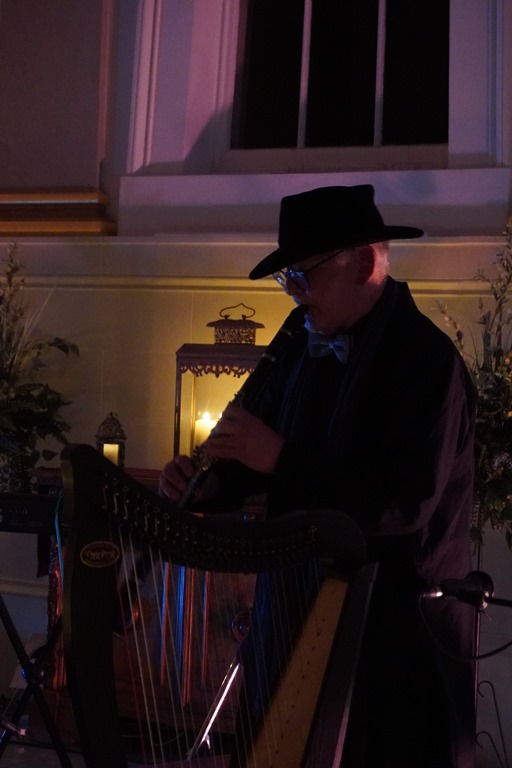
DSC00094DSC00108

After a clarinet interlude from a man in a hat and long coat (there are a fair few of those this evening) who turns out to be Ian Karlheinz Taylor from Skeletal Family, Taylor moves to the keyboard and the full band return for a magnificent and moving rendition of The Mission’s ‘Sweet Bird of Passage’ followed by ‘Island in a Stream’. Close your eyes and it could be Wayne Hussey dinging: Kennedy, it seems, is truly a vocal chameleon, bringing the night to a close with a remarkably close approximation of Ian Curtis on an impressive version of Joy Division’s ‘Atmosphere’ – something this event had in copious amounts.
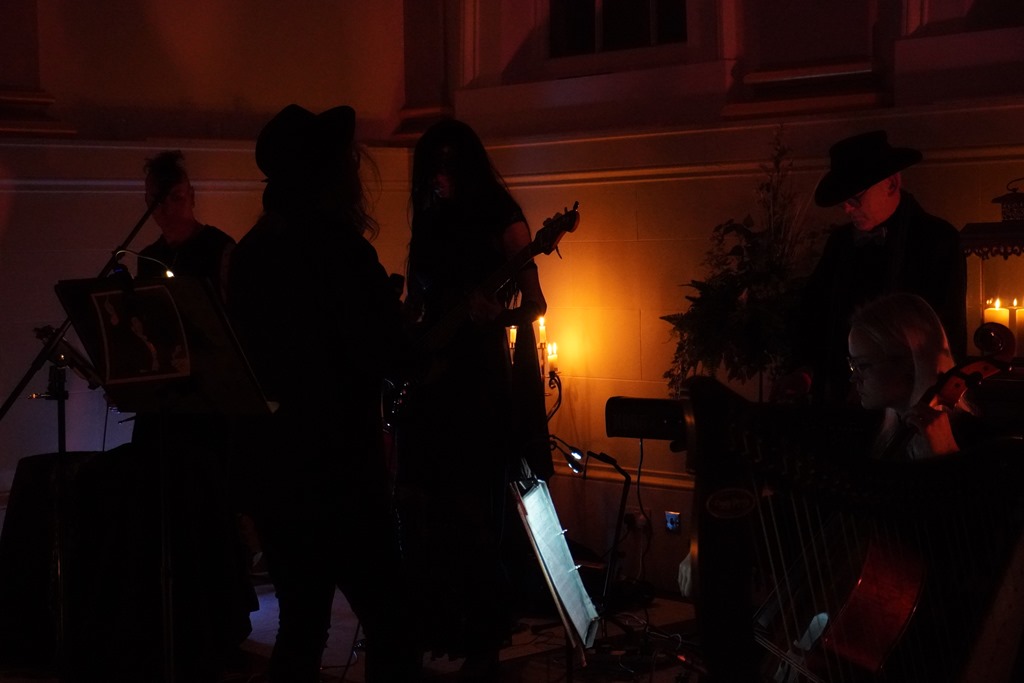
DSC00121

Stephen Kennedy needs to take a bow: this, the first Gothic Moth event, was an incredibly ambitious coming together of a staggeringly eclectic range of artists, and many of those collaborating hadn’t even met one another until the day. This is unquestionably testament to their individual and collective talent, but also to Kennedy’s aptitude as a curator in bringing them together. Everything about this evening was stunning, and it’s pleasing to see future events are already being booked, filling a niche few knew even existed.
Discus Music – 27th September 2024

Christopher Nosnibor

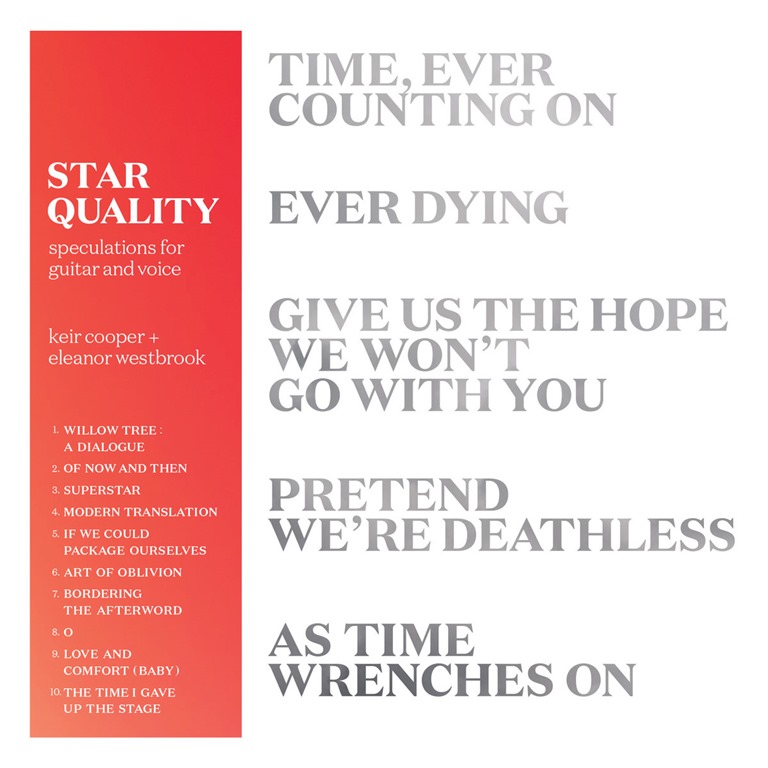
One way to tell an avant-garde musical work from its title alone is when the title provides a quite precise statement relating to its compositional nature. And so it is that this collaborative set of songs by Keir Cooper and Eleanor Westbrook are structured around guitar and voice.

‘Willow Tree – A Dialogue’ takes the interesting form of – perhaps not surprisingly – a dialogue of sorts, in which Westbrook’s adopts two contrasting modes of delivery, with a spectacular operatic aria juxtaposed with a spoken-word interrogation as a counterpoint. The effect is closer to a simultaneous internal monologue running across the song itself rather than a dialogue in the conventional sense. Meanwhile, the delicately picked neoclassical guitar is subject to interruption by clunks and distortion and occasional whirs and bleeps and the operatic vocal strays off kilter and the dream which drifted in twists and flickers with darker shades: not pronounced enough to be truly nightmarish, but unsettling.

The pair continue to explore the contrasts of melody and disharmony as Westbrook squeaks, squawks, trills, and purrs an infinite array of vocal gymnastics and Cooper’s guitar work, which chimes and treads delicately from folk to flamenco via classical streams, stamps on its own beauty with sudden and unexpected stops and stutters and forays into wrongness with stray notes and dissonance.

‘Superstar’ strays into the space which soundtracks a sense of derangement, the territory where things make no sense, and that place of incomprehension instils an unsettling confusion that borders on anxiety. ‘Modern Translation’ follows a similar trajectory: it’s a piece of magical neoclassical chamber music that’s twisted as if performed in an auditory hall of mirrors. Everything is wrong: something that should be soothing and beautiful is warped in a that it becomes unheimlich, eerie.

It’s hard to locate a touchstone or reference point for this: perhaps there are elements of later Scott Walker present, blended with hints of The Ex with its more avant-jazz leanings. One can only muse as to how they came to create this work: despite its clear foundations in the realms of classical and opera, Star Quality ventures so far from this path that it often bears little resemblance to any given style. The pieces evidently do have quite detailed and complex structures, as there’s nothing haphazard or uncoordinated about the way the two play together, but it’s impossible to decipher them from an outside perspective.

There’s a grand yet ethereal theatricality to ‘Bordering the Afterworld’, and ‘O’ soars and swoops and squeaks and whoops its way theatrically – and somewhat crazily – across some sprightly, if vaguely gothic-sounding guitar picking that suddenly, from nowhere, begins to buzz and thump. ‘The Time I Gave Up the Stage’ draws the curtain on an incredibly curious and as far off the wall as is imaginable.

Star Quality clearly has theatrical inspirations and aspirations, but shows two artists who are more interested in exploring their outer limits than taking the limelight in a mainstream setting – and for that, I applaud them.

AA

a1210959813_10

Gizeh Records – 3rd November 2023

Christopher Nosnibor

While Christine Ott has maintained a steady flow of works over recent years – her fifth album arrives just two years after Time to Die – her latest offering has been a long time in the making. For example, we learn that ‘Die Jagd nach dem Glück’ (The Pursuit of Happiness) is an extract from her original composition for Lotte, mon amour, a film-concert created in 2014 based on 4 short films by Lotte Reiniger, a German director from the first half of the 20th century.’

It’s pitched as ‘a collection of twelve pieces for solo piano, twelve impressionistic miniatures, instrumental and cinematic fractals celebrating the beauty of life…

Éclats (Piano Works) is a kind of mirror image to Chimères (pour Ondes Martenot) (2020, Nahal Recordings).

‘Pluie d’arbres’ introduces the album with magnificently weighted, perfectly paces, rolling notes which balance grace and tension, and it’s a beautiful and engaging composition that comfortably slots into the ‘classical’ bracket not simply by virtue of its being a piano piece, but the delicacy of it all, and the way it articulates changing moods intuitively and with a depth of spirit.

The individual pieces follow one another in such a way as to create the impression of their being written to flow together, and while the tempo and tone may shift during the course of a single piece – there are flurries and flutters, moments of airy levity like the morning sun filtering through a curtain wafting on a gentle early summer breeze, notes coming suddenly in tinkling cascades – the album as a whole feels like a single, continuous piece. Rather than any one track being ‘dark’ or ‘light’, they each run through a succession of sensations, turning on a pinhead from brooding to playful, uplifting to reflective.

There’s an honesty about this, which speaks to the human condition. Yes, you may have good days and bad days, but most days are a series of peaks and troughs, highs and lows, unexpected and near-immediate switches that some about as the result of various but specific interactions – or, indeed, sometimes, a lack thereof. Éclats feels real because it doesn’t try to be any one thing, but more taps into the unpredictability of life. And Ott plays in such a way as to bring all of this out through the music, through her connection with the keys.

At times sad, at times uplifting, at times, it simply is… and this is the real joy of the experience of listening to Éclats. At its lightest, it carries you on rippling sonic clouds and pokes at the sky: at its darkest, it hangs heavy in your stomach. It’s hard not to be drawn in and fully engaged with this set of pieces, and it will take you anywhere if you let it.

AA

Eclats_DIGITAL_Artwork

zeitkratzer productions / Karlrecords – 22nd September 2023

Christopher Nosnibor

SCARLATTI represents something of a departure for zeitkratzer, the neoclassical collective headed by Reinhold Friedl, master of the prepared piano and a renowned avant-garde composer in his own right. While their performance and recordings usually focus on modern composers and avant-gardists spanning Stockhausen and John Cage via Whitehouse and Lou Reed, with a reinterpretation of Metal Machine Music, here they turn their attention to the altogether more historical figure of Domenico Scarlatti (1685-1757). He is best known – although this is relative – for composing some five hundred and fifty-five keyboard sonatas, and his being a progenitor of classical music. But a large portion of his work went unpublished in huis lifetime, and much has only been available sporadically since.

As the notes which accompany the album explain, ‘Little is known about Domenico Scarlatti… His music is, so to speak, left to its own devices: free, cheeky, playful, sonorous, surprising… Harmonically strolling again and again into unforeseen regions, the ear leads, not the theory; and also the fingers get their right: playful and haptic it goes. Scarlatti explained, “since nature has given me ten fingers and my instrument provides employment for all, I see no reason why I should not use all ten of them.”

But Scarlatti does not contain music by Scarlatti. Instead, the six tracks presented here are all composed by Friedl in response to Scarlatti’s work.

As such, this is much a celebration of Scarlatti’s ideas and approach to composition and so the explanation of the process and thinking behind it bears quoting: ‘Freedom, friction and listening pleasure instead of convention: “He knew quite well that he had disregarded all the rules of composition in his piano pieces, but asked whether his deviation from the rules offended the ear? He believes there is almost no other rule than that of not offending the only sense whose object is music – the ear.”

‘Reinhold Friedl applied this principle and composed the music for a choreography by dance company Rubato. Dance music drawn from Scarlatti, who was so inspired by dance music. The material of the piano sonata F-minor K.466 is twisted anew in all its richness, shifted back and forth, declined, frozen, noisified, sound structures extracted, floating. Those who know the sonata, will more than smell it’s [sic] shadows.’

The six pieces are indeed varied, in terms of mood and form. ‘lias’ is booming, droning, woozy, slow discordant jazz, low, slow, and with lengthy pauses. It’s not something anyone can dance to, and rather than light and playful, it feels dark and sombre. This is less true of the altogether sparser, but stealthily atmospheric ‘muget’.

‘pissenlit’ blasts in with churning industrial noise, a snarling blast that lurches and thunders, crashes and pounds withy relentless brutality. It’s clearly as far removed from the music of the seventeenth century as is conceivable, but beside the lilting piano and quivering, droning strings and subsequent stop-start levity of ‘reine des prés’ the sequencing of the pieces serves to highlight Scarlatti’s versatility, if not necessarily his predilection for playfulness. The playfulness manifests differently and unexpectedly here: ‘pissenlit’ is in fact the French word for ‘dandelion’, a plant often associated with a certain element of fun, of lightness, so the fact that this piece is three and a half minutes of gut-punching abrasive noise worthy of Prurient or Consumer Electronics is illustrative of the disparity between expectation and actuality.

Discord and discomfort abounds as drones and strings tangle amongst one another, heaving and wheezing and occasionally offering glorious, sun-hued vistas through the breaks in the widely varied forms, which feel elastic, and as if Friedl and co are stretching the fabric of the material to see just how much it will give. And it turns out, there is a fair bit of room. ‘reine des prés’ explores space, the gaps and pauses between the notes, and feels like a sort of musical cat-and-mouse which would equally work as soundtrack piece, but it has a cartoonish quality which means it’s more Tom and Jerry than anything else. But it is by no means flippant, throwaway. Entertainment is serious business, after all.

‘violette des marais’ brings pomp and drama… while the final track, ‘astis’, is skittish, playful but also frustrating in its hesitant, halting structure.

Scarlatti is interesting, entertaining, and bold, going out on a limb to present such an unconventional interpretation of a historical artist’s career. But this is largely the purpose of zeitkratzer: together, they re-present music, excavating the archives but presenting them through a prism of contemporary and avant-gardism, with jazz leanings but without being jazz in the way most would interpret it. In short, zeitkratzer continue to push and redefine musical boundaries, and long may they do so.

AA

a1585066167_10

Ici d’ailleurs – 31st March 2023

Christopher Nosnibor

Matt Elliott, since breaking out from the Third Eye Blind moniker, has maintained a fairly steady flow of output, with an album every three years or so, with this being his ninth.

Farewell To All We Know (2020) and The Calm Before (2016) were just the most recent, with the former bring a dark, lugubrious affair: the title carried connotations of facing finality, something that doesn’t really sit comfortably in Western culture outside of the realms of art – and it seems that death has become an even greater taboo in recent years, with anything which references death, and particularly suicide – requiring a trigger warning.

Given that suicide is the single most common cause of death in males under the age of forty-five in the UK and a high on the tables in the US and many other countries, and that death is the sole inevitability in life, I feel it’s something to be faced up to, not shied away from. It may be a contentious view, but we don’t get to choose whether to leave the room in real life, so why in art? Perhaps bringing these subjects out into the open – in the same way as mental health has finally become accepted as being something we can discuss – would render them less triggering. Herein lies something of a contradiction, in that we now discuss mental health, but not the effects or consequences. And have we really broken the barrier on mental heath? I often hear or see people saying they’re not having a good day or week because ‘mental health’. It’s progress, in that historically people would have rather said they had the shits than were struggling – but there’s further to go, especially if we’re to be sure that ‘mental health’ doesn’t become the new ‘upset stomach’ that gets a pass from disclosing what’s really wrong. Not because prying is to be encouraged, but there’s talking and there’s talking, and if we’re really going to talk about mental health, then shutting a conversation down by using the phrase isn’t going to make that happen.

The press release suggests that Farewell To All We Know was ‘a harbinger of the collapsological crisis that was COVID 19. What can be built when everything is down, when everything has crumbled, ideals and beliefs, a sense of commonality and community?’ Of the new album, it poses further questions: ‘What is left when you are without words? What is left? Death, perhaps, but also life… What is left? A form of awe that dulls? An enthusiasm that dries up? A curiosity that no longer makes sense?’

As the title suggests, with The End Of Days, Elliott once again has his focus placed firmly on finality. And just fifteen minutes surveying the news suggests that we really are living at the end of days: plague, natural disasters… it’s not a question of if, but when, and how? Will climate change bring about the end of days for humanity, or will we wipe ourselves out with nuclear apocalypse before we reach that point?

‘All life’s wasted time’, he intimates on the title track which opens this delicate six-song suite – a sparse acoustic folk tune that has a lilting quality that’s easy on the ear. It sounds like he could be singing this sitting in a rocking chair by the fire, but brings a tear to the eye as he articulates the parental worries many of us – myself most acutely – feel.

And even all the smiles on children’s faces bring you pain

When you think of what they’ll face

And if they’ll even come of age

A world resigned to flame

Because we’ve burned it all away

You – I – feel so helpless. Turning down the heating, turning off the lights – you tell yourself you’re saving the environment, but you’re only making your life more difficult while industrial complexes around the globe churn out more pollution in a minute than any household will in a lifetime.

‘We need to wind time back to the eighteenth century before the industrial revolution and show them now’, my daughter told me over dinner this evening. She’s eleven, and she’s right, and I feel the anguish flow through me as the horns swell in a rising tide of warped brass atop the flamenco guitar in the closing minutes of this ten-minute epic.

It’s not the last, either. ‘Healing A Wound Will Often Begin with a Bruise’ is over eight minutes in length, and ‘Flowers for Bea’ is an immense twelve and a half. ‘Song of Consolation’ sits between folk and neoclassical and is achingly beautiful, but offers little consolation. Because what consolation is there?

Incorporating jazz and baroque, The End Of Days feels less darkly oppressive than its predecessor, sliding perhaps into bleak resignation to provide the soundtrack to the drinks in the basement bar on the last night on earth. Yes, tonight we’re going to party like it’s goodbye forever. This is the album to which to clink glasses and hug and cry and share final gratitude for those who have been there for us, made our lives worth living as we swallow hard and brace ourselves for the inevitable.

AA

IDA158_front

‘2072’ is the new single from Kety Fusco’s album The Harp, Chapter I, due for release on 3 March 2023. The composition of this track is based on a live granulation of Kety’s electric harp, combined with drone sounds created with a pulsating massager on the soundbox of the 47-string classical harp, and vocal reminiscences emitted by Kety with scratchy screams inside the harp soundboard, which decorate this post- classical sound.

On the single & accompanying video, Kety says, “On 13 January 2072 I will die: this video is a reminder of what it was. My melody will accompany me in my passing, reminding me that the world was beautiful before I arrived. I did not love the world I was living in and that is why he did not allow me to stay any longer. Forests precede civilizations, deserts follow them. It’s not my phrase, but I like it”.

All sounds on ‘2072’ are produced by an 80-kilo wooden harp, a carbon electric harp and live electronic manipulation. Kety Fusco and the harp met when she was six years old, and they have never left each other since. After years of studying and perfecting with the classical harp, Kety embarked on an exploration of non-traditional harp sounds, made from objects such as hairpins, scotch tape, wax, stones, hairpins, and so she says: "The harp was born in the 7th century, when the air was different, the tastes and experiences had nothing to do with today’s world and to this day I cannot think that there is no evolution: that is why I am designing a new harp instrument, it will still be the same, but contemporary and everyone will have the opportunity to approach it; in the meantime, welcome to THE HARP”.

Kety Fusco launches new album The Harp, Chapter I at London’s prestigious Royal Albert Hall on 3rd March 2023.

Watch ‘2072’ here:

AA

image002

It is no wonder that the experimental string duo Lueenas often work with film music. In their recent collaboration with animator and video artist Jonas Bentzen, their affinity for the magic that can happen moving image and moving music is highly apparent. From the p.o.v of a solo traveler, the camera takes us hauntingly through underground tunnels and fantastical sci-fy spaces of ancient aesthetics while the violent track ‘Nyx’ is carrying us through it all. For Lueenas darkness and beauty are two beautifully intertwined sensations and this duality is a driving force in their video collaboration with Jonas Bentzen, creating an eerie yet alluring and sensual journey.

For fans of Tarkovsky’s Stalker and Mica Levi’s soundtrack to Under The Skin, this music video from Lueenas and Jonas Bentzen is one to watch. “Nyx” conjures the story of Hemera’s mother, the Goddess of Night, born from Chaos and feared by all, even Zeus. Through distorted and shrieking layers of violin, and the mammoth double bass figures, she carries at once a brutal wrath and conciliatory power. Transforming into

upward blazing howls, we are reminded that there is beauty in darkness. Nyx is part of the self-titled album by Lueenas, released November 4th, 2022.  Cinematic, strings & electronics duo, LUEENAS, announce self-titled debut album, out Nov. 4. Intuition and acceptance are at the core of the debut album from Danish electrified string duo, Lueenas. Exploring the complex spaces between typical emotional dichotomies, their language emerges brimming with imaginative uses of form and texture. Born over a year of improvised sessions, and informed by their involvement in other projects across pop, jazz, electronic, experimental and post-classical music, Maria Jagd and Ida Duelund then set out to puzzle together the luring soundscapes that make up their self-titled debut. Experimenting with the limits imposed by their stringed instruments, and pushing the boundaries between acoustic, amplified and electronic sources allowed them to draw on a much broader and expressive colour palette of sounds.

Taking inspiration from ancient sacred practices, the album encompasses millennia of storytelling from distinctly female perspectives. Lueenas’ fully-cast debut album is at once the evocative score for a lauded expressionist film yet to be made, and a sermon for the fluidity of the emotional experience across time and space. As an ode to the communicative power of strings, it tells us what would otherwise remain untold. Lueenas is an experimental string duo formed in 2019 by Ida Duelund and Maria Jagd, and based in Copenhagen, DK. With violin, double bass, effects and amplifiers, they create violent and beautiful soundscapes full of panoramic grandeur. Their cinematic aesthetic has roots in both classical minimalism and improvisational rock music.

Watch the video here (click image to play):

Nyx 2

Southern Lord (CD/DL) | Pomperipossa Records (LP – Europe) – 14th January 2022

Christopher Nosnibor

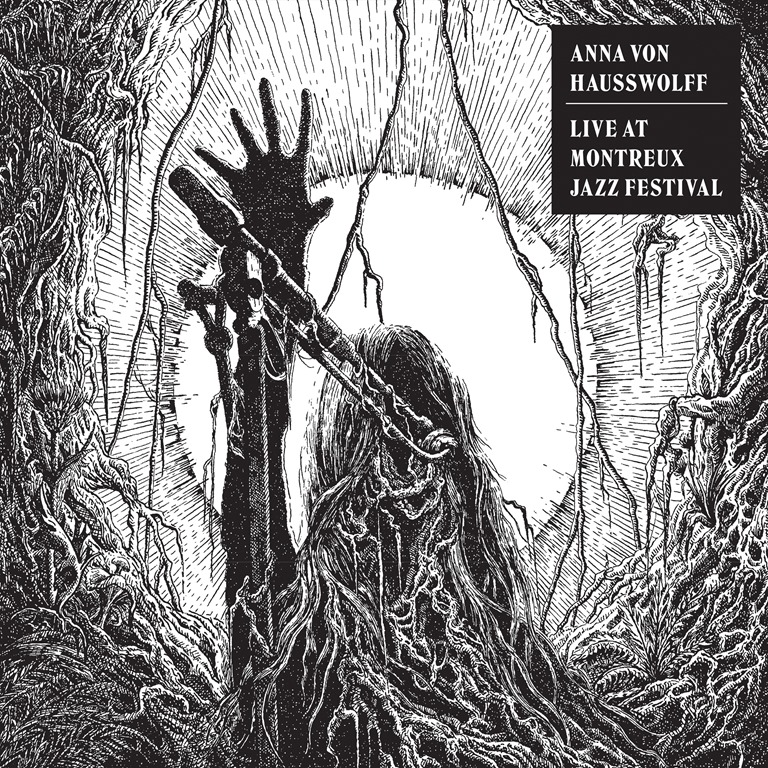
Perhaps the last thing one would expect to find being released on Southern Lord is a live jazz album. The label is, after all, home to much to the rawest, loudest, harshest metal and hardcore punk, not to mention, of course, the doom drone legends that are Sunn O))). But then, if Anna von Hausswolff seems like something of a roster misfit, it’s fair to say that her catalogue doesn’t conform to any obvious jazz tropes either.

The performance, from 2018, as the notes advise, features six fan-favourites from the two beloved albums; The Miraculous and Dead Magic, with the backing of a full band including additional vocals from her sister / cinematographer Maria von Hausswolff, and it’s ‘The Truth, The Glow, The Fall’ from Dead Magic, which opens the set in mesmerizingly hypnotic style. Against widescreen drones and rumbles, von Hausswolff’s vocal soar and swoop operatically. It’s a powerful and compelling start which paves the way for the grandiose expanse of creeping fear that is ‘Pomperipossa’ from The Miraculous.

‘The Mysterious Vanishing of Electra’ slows to a crawl with a Swans-like dirge centred around a simple, trudging repetition of bass and drum, and it’s here that things really take a turn for the heavy and the intensity builds. This rendition reminds me of the epic take on ‘Your Salvation’ by Foetus on the Male live album, grinding away at a single chord and hammering it into the ground before blossoming into something jaw-droppingly magnificent, and there simply are no words.

From hereon in, things only become more intense, more spectacular, with the brooding atmospheric ‘Ugly and Vengeful’ stretching out to almost twenty minutes, and leads the listener through an epic journey through a succession of sonic terrains. It’s a clear centrepiece within a set of vast sonic and emotional scale. It’s far, far beyond the domains of jazz, and even beyond the domain of ‘mere’ music: this is transportation and transcendental, taking you beyond the physical world and out of your own space to one beyond imagination. What’s perhaps most impressive is that this is all live; there’s no studio tweaking or trickery, but musicians conjuring pure aural alchemy in real-time.

After the delicate respite of ‘Källans återuppståndelse’, the fifteen-minute ‘Come Wander With Me Deliverance’ brings a suitably epic finale. The backing may be sparse at first, but the understated, almost wispy drones place von Hausswolff spectacular vocals to the fore. Then, when the drums and megalithic guitars crash in, they really do bring the weight. Yet the vocals remain the dominant force, and it builds – and builds, and builds – to a monumental crescendo. To have actually been there! The recording does a superb job of conveying just how gargantuan that finish would have been, and while there truly is no substitute for being in close proximity to a band working together, witnessing that connection and intuition as it flickers like electricity across the stage, and nothing can touch the experience of hearing, and feeling, music at gig volume as it vibrates the bones, Live at Montreux Jazz Festival comes very, very close.

We’re days into January, but it’s unlikely there’ll be a better live album this year.

AA

752975

zeitkratzer productions – zkr0027 – 23RD October 2020

Christopher Nosnibor

As the founder of one of Europe’s leading avant-garde orchestral ensembles in the form of zeitkratzer, whose releases include recordings of Metal Machine Music, works by Stockhausen, and two collections of Whitehouse ‘covers’, Reinhold Friedl is very much at the forefront of contemporary classical. Formed in 1997 with Friedl on piano (sometimes a ‘prepared’ piano, a la John Cage), they’ve established themselves a formidable force, incorporating elements of free experimentalism and drone.

For the recording of KRAFFT, the nine-piece ensemble came together with another respected musical collective, Ensemble 2e2m, a chamber group from Paris dating back to 1972, known for their unique sound and the first recordings of Giacinto Scelsi’s music.

As the press release recounts, KRAFFT for orchestra was composed in 2016 as a commission from the French State and premiered in Paris and Marseille. It was also the first meeting of the two ensembles – and yet the come together perfectly to create four immense, drone-orientated passages.

Being Friedl, there is a great deal of detail and precision behind the methodology: this is certainly not random stop-start hums and thrums or elongated notes played with varying – and usually increasing – intensity, and for this reason I shall quite at length: ‘KRAFFT is a minimalist maximal composition: all instruments play in rhythmic unison throughout. Only the sounds and their combinations change relentlessly throughout the piece. KRAFFT is spelt wrong on purpose to create an ironic-onomatopoetic rendition of the German term “Kraft”, meaning “power” or “force”. The listener is exposed to a sonic undertow. The notion of huge power and force is connected here to clandestine and unknown rules controlling the progression of sound; something is happening, but we do not exactly know what, when or how. KRAFFT is composed with the help of the computer program TTM (Textural Transformation Machine), developed by Reinhold Friedl to sculpture multiple random processes.’

The TTM formed part of Friedl’s Ph.D. at Goldsmiths University London, and was developed by the composer to sculpture texture transformations with the help of sophisticated random processes. As such, Friedl’s compositional methodology develops way in which John Cage incorporated random determiners within his work, and in using a ‘machine’ to make those random selections, he distances the ‘composer’ from the composition and increases the likelihood of true randomisation.

Returning to KRAFFT, there is a clear trajectory to the composition as a whole, namely an intensity and volume which increases incrementally as it progresses over the course of half an hour. The first part is soft, light, even playful, moving into somewhat darker, more discordant territory onto the second.

By part 4, immense booming low-end notes surge and rumble with such density as to have an almost physical force. Atop of this, the smaller strings scrape, squawk and twitter like birdsong and feedback. It’s an eleven-minute tidal wave of sound that swells and surges to a crescendo of truly enormous proportions. While it’s safe to say it’s unlikely to be aired on Classic FM, KRAFFT is as accomplished and powerful orchestral work as you’ll hear all year.

AA

zkr0027_front

Christopher Nosnibor

This one’s been languishing in the vaults for a while now, but one of the things about recording prolifically is that sometimes it takes time to catch up on the release schedule. And so Gintas K’s variations in a-moll for a granular synthesis gets to see the light of day in the middle of a solid and steady release schedule which has seen the release of one or two albums a year for the last three.

Of the six sequentially-numbered tracks, all but one are well over the ten-minute mark, and the shortest is over eight minutes in duration.

Not a lot happens, at least initially: repetitive synth stabs on a single note with varying levels of force shift into different notes. They begin to overlap, and a fuzz of distortion decays the edges. Gradually it slides into a mess of overloading noise: the synths crackle and burn among a billowing walls of darkness.

Across the album, scraping granularity and stuttering dominate the foreground. It difficult to settle to a constant flickering, a crackling distortion of interrupting signals, and the sensation is disorientating, dissonant, disruptive. By the third piece, the sounds has degraded to a rumbling crackle. This sonic disintegration could likely be taken as a metaphor for something. But for what? Well, from a reception theory perspective, you can insert your own metaphor as appropriate. To me, it feels like a sort of glitched-out panic attack, a mental collapse as a response to the crumbling culture at the tail-end of 2019. A decade slumping to its bitter end in an amorphous mass of fragmentation, with rhythms reduced to swampy surges back and forth, and fractal notes dance skittishly.

The fifth piece introduces some softer tones, an ambient wash that’s cracked and damaged, bur nevertheless hints at something mellow… and then it tears apart from the seams as a heavy fog of noise descends, and the final composition splinters and breaks, the shards bursting apart in slow-motion to leave rubble and dust.

AA

Gintas K – variations in a-moll for a granular synthesis