Posts Tagged ‘Ambient’

Room40 – RM4130 – 13th August 2021

Christopher Nosnibor

I’m still recovering from the last Celer release I covered – the four-disc Future Predictions, released only last summer. It wasn’t harsh or sonically challenging: it was just really, really long. This one, however, is rather shorter, comprising twelve tracks with a running time of just twenty-nine minutes.

It is, notably a departure. As the press notes detail, with In Light Of Blues, ‘[Will] Long pivots away from long-form works to create a series of vignettes that capture the essence of his aesthetics interests. The record condenses and refines his compositional methodologies forming each piece as an acoustic miniature speckled in hazy harmony and evocative tonality’.

As such, as much as In Light Of Blues is a departure, it is also very much a continuation of his previous work, while concentrating it down to shorter snippets – but with no loss of power or depth. Long’s comments on the reason for this departure are illuminating:

‘It was months ago, but it could have been weeks, days, or even hours since then. I stopped wanting to hear loops, I wanted to stop it. I added brass; trumpets, trombones, and more horns. I cut it out like words from a book, and sewed it back together. Burroughs. These movements are merely to stay alive, to stay moving.’

In citing [William] Burroughs, Long’s observation that ‘You wake up from a truck horn passing in the early morning hours on the nearby freeway, or from a dream that you can’t tell was a nightmare or a loving memory… Someone walks by on the street wearing the same perfume. I drew out each place, each scene, and put the story there. It might have been with you, or without you. All I know is that you were there somehow the whole time, even if you weren’t’ marks a striking parallel with some of Burroughs’ statements on the way the cut-up technique was an attempt to being art closer to life: “every time you walk down the street, your stream of consciousness is cut by random factors… take a walk down a city street… you have seen half a person cut in two by a car, bits and pieces of street signs and advertisements, reflections from shop windows – a montage of fragments”.

While the pieces on In Light Of Blues are composed from a montage of fragments, instead of jarring against one another and crossing over one another to replicate the blizzard of simultaneity that is life, they blur together to create a slow-creeping sonic mist. The details are obscured, the edges indistinct, the definition vague to almost absent. Some of the pieces are fragments in themselves: the second of the three ‘Melancholy Movement’ compositions is only fractionally over a minute long, and there are a number of pieces of similarly brief duration.

Time appears to be something of a leading preoccupation on In Light Of Blues, as titles including ‘Days Before the Change’, ‘In the Intimate Hours’, ‘After All Time’, and ‘Precious Past Hours’ indicate. The titles suggest a certain urgency, an anxiety, even, over the passing of time that’s not necessarily apparent in the music itself. But as is so often the case, with ambient / abstract musical forms, the music conveys only some aspects of the full meaning or intention, and beneath comparatively tranquil surfaces often lie more trouble currents, and there are numerous billows of darker, denser sound which rumble and stir, evoking brewing storms amidst the soft layers of the pieces here.

Perhaps this is the real pleasure – and perhaps also the purpose – of In Light Of Blues. It’s an album that can simply be allowed to drift along in the background, the darker clouds occasionally tugging the attention while, in the main, it may pass largely without the demand for focus. But closer attention yields greater rewards, in the sonic depths and subtle textures that reveal themselves through that engagement, and to seek the space beneath the surface, to explore its context and origins and consider what it may mean beyond the surface yields more still.

AA

RM4130_front

Ventil Records – V026 – 4th August 2021

Christopher Nosnibor

Ultimately, it’s apparent now that social media changed everything. But one thing specific was the relationship between artist and audience. Historically, the distance between the two was clear and also integral. The last, ten to fifteen years hasn’t only seen that separation eroded, but a certain expectation that the artist should engage directly with the audience via online platforms, be it social media or a blog maintained as a part of their website. As a marketing tool, it makes sense, but it’s hard not to feel that something has been lost along the way. Is it right that the artist should be made accessible, or that there should be an expectation of there being some kind of quite direct interaction? It’s not even necessarily about maintaining a persona or a degree of enigma: many artists are introverts by nature, and don’t create art to stand in the limelight in front of it. Many artists create to escape something, or simply to expel or have an outlet for that which they cannot convey by any other means.

I’m often not particularly communicative myself. I don’t want to talk about it, whatever it is – assuming I even know. I simply want to write or make ‘music’. But I did, recently post on Facebook about how I often berate myself for not being as productive as I would like to be. People were largely sympathetic, but few, it would seem, truly ‘got it.’

One artist who truly does understand that eternal restlessness is polyartist Maja Osojnik, and her quest for creativity is unstinting. Having been involved in several visual exhibitions, a live stream, and various compositions in recent months, she’s also recorded an album with collaborator Matija Schellander to deliver the debut Rdeča Raketa (Red Rocket) album.

This album is both very ‘now’ and also very much an expiration of the human condition, specifically its failings and how communication is key, but very much prone to failure.

As the liner notes outline, ‘…and cannot reach the silence deals with the current world of misunderstandings, communicating past each other, willingly and unwillingly overlooking or ignoring each other’s meanings via various fast-paced forms and platforms of communication; and, with that, the tightening of incompatible parallel “realities.” It explores forms of violence; physical and verbal, external and self-inflicted. It explores forms of power; the dangerous thin line between giving power to and giving power over oneself, and forms of subjugation and addiction on both societal and, more significantly, on interpersonal levels. “… Look at us! Beasts, bottomless pits, never to be full! To be fulfilled. Glued onto each other in sweat, a never-ending pain and evenly spread, at all times…”

They go on to ask, ‘In those dark, dystopian lyrics, full of questions, such as “What is being said and what stays unspoken? Who does it refer to? Who is protecting whom? For what reasons? Who is being addressed or what needs to be considered?” the wish, the need and the struggle for self-empowerment, honesty, love and reconciliation is exposed or, at the very least, nourished.’

All of this resonates, and deeply. Only yesterday, I had been considering how depth of conversation seems to have evaporated. People have neither the time more the attention. Conversations were often cut short or curtailed or otherwise hurried back in the days of the office, but that was nothing compared to thee standard one- or two-line text exchanges, comments shared by Skype or Teams. We – collectively – don’t really ‘talk’ anymore. We’re paranoid, time-deprived, stressed. We’re also so polarised and entrenched in our oppositional viewpoints that there is no debate, only division. And with social media, 24/7 scrolling news and infinite notifications from apps, there is no respite – ever. There is no silence, wherever you may seek it.

The three longform compositions on …and cannot reach the silence are heavy and rich with atmosphere. The first, the ten-minute ‘the night is spilling across the room…’ approaches by stealth. A low, slow, ominous drone, intercut with aberrant thuds and squelches. An artisanal, wordless voice drifts in, and it’s haunting, ghostly, otherworldly. What does it mean? The lyrics, sung in a detached tone, are stark, bleak: ‘You were unspoken / She was born already broken….’ Eventually, the words drift out into a wordless undulating hum and the world slowly disintegrates.

The disintegration continues through the lumbering lurch of counterpart composition ‘…like gasoline’. Its slow, yawning rhythmic intonations evoke the heavy grind of SWANS circa 1986, relentless, booming, droning, and it’s the perfect backdrop to Maja’s semi—spoken vocal delivery. She’s robotic, inhuman, empty, even when articulating human emotions – ‘I want to you so bad, I want you so bad,’ she repeats at one point. But is it want, or is it need? Something less about choice or desire, and more about emotional survival? ‘I am tired’ she repeats, over and over, in tones ranging from weary to frustrated, defeated to angry, and you feel it – you know it. The articulation is comparable to one of Bruin Gysin’s permutational poems: only, instead if rearranging the words, the emphasis changes in order to find different meanings of the same words. This one resonates. The tiredness saps your life and saps your soul, and you feel the differences between ‘I’m tired, please leave me be,’ and ‘I’M TIRED! FUCK OFF AND LEAVE ME ALONE!’

The third and final composition, ‘waiting it out’, is fifteen and a half minutes of ominousness. The vocals are all but submerged, a babble beneath the undulating drone and trilling. Synths crank up and head for take-off as they stray into the heavily phased world of early industrial and power electronics, a wheezing wall of wailing synths puffing and groaning and bleeping and whirring and all converging in a seething sonic mound. Towards the end, it ventures skywards in a succession of laser-guided rockets arcing into the sky.

…and cannot reach the silence is an album with an immense range, and an understated intensity – and a magnificent artistic achievement.

AA
KT.eps

Dret Skivor – DRET008 – 6th August 2021

Christopher Nosnibor

The latest offering from Dret Skivor, a Swedish tape label specialising in drone and various shades of experimental noise, is the new album from Danish maker of electronic noise Thomas Li, who, as Li, has self-released almost a dozen works digitally. Biographical details are less than minimal, and that’s cool. Why do we need to know about the artist, their background or their back catalogue? Do we really need to know the context or the intent, the theory behind a work? Sometimes, when it’s an experimental work informed by theory or a certain concept, it helps, because the concept and theory are integral to both the process and the end product. Then again, there’s a danger that sometimes said theory or concept can impinge on one’s appreciation of the work. Sometimes, it’s best to just be able to listen, and allow oneself to be immersed in the sound, without pouring over lengthy liner notes, researching myriad avenues presented by the references, and straining one’s brain over concepts. This is particularly true of many works of a more ambient persuasion. I’m not remotely anti-academic or anti-intellectual – quite the opposite. But sometimes, you just need a break, and music can be the perfect conduit to vital headspace. An overemphasis on context can detract from the often underrated pleasure of simply listening, and enjoying.

Admittedly, enjoyment of an album like this is the preserve of a small minority: it doesn’t contain any ‘tunes’, it’s beatless, and it’s not always entirely mellow either. But it does have a great deal of texture, and this is something you can really lose yourself in.

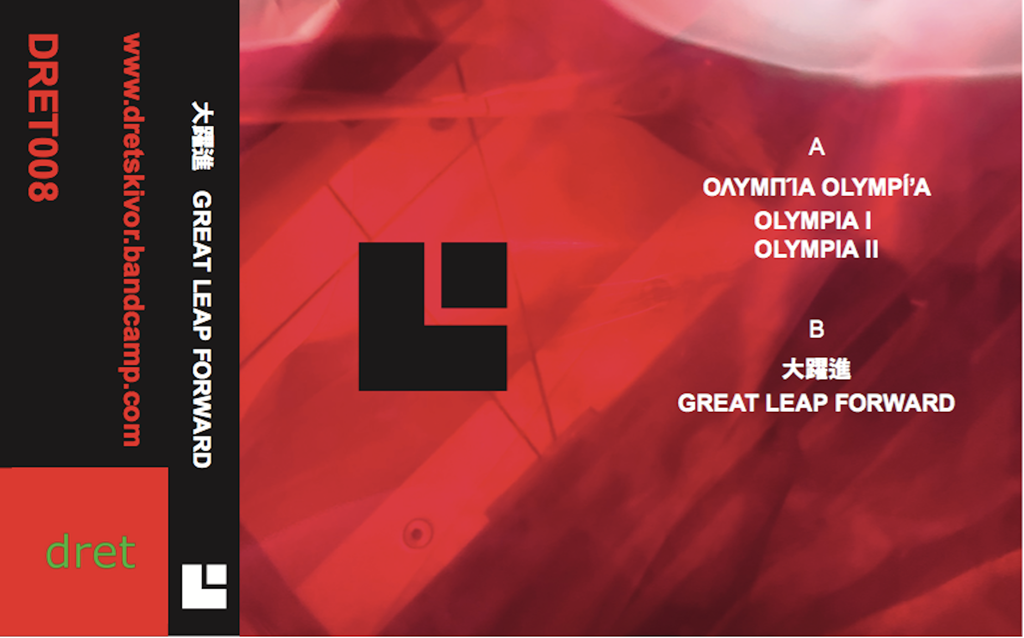
Great Leap Forward contains three tracks, with side one occupied with the two-part ‘Olympia’ and the second side containing the eighteen-minute monster title track.

‘Olympia I’ is nine minutes of dense, churning drones, billowing sonic clouds that choke and smother, while counterpart ‘Olympia II’ gurgles and churns a dark whirling cyclone of sound. The latter is more interesting, sonically, with a lot more going on – meaning it’s also more challenging and more tense, as crackles and hums fizz and spin from the dank depths of bubbling noise.

The title track is altogether less tumultuous and more background ambient by comparison. Being eighteen minutes in duration, on the face of it, not a lot happens: there are no climactic blasts of noise, there’s nothing explosive or even overtly disruptive. And yet for all its subtlety, it is engaging, and there is movement, there are shifts and distract and divert. Howling winds blast over barren landscapes of drifting sand and strains of treble and whines of feedback emerge from the eternal mid-range rumble that drones on, and on, and on.

In the context of his output to date, this may not really be quite such a great leap forward, but it does clearly mark an evolution and an expansion on the soundscapes sculpted on previous works. And, played with the accompaniment of a candle and some CBD-infused beer, Great Leap Forward is a well-executed soundtrack to mental recuperation.

AA

tape label grab for bandcamp

Hallow Ground – HG2104 – 13th August 2021

Christopher Nosnibor

There are few things in life you can really rely on, but Hallow Ground is one of them, if you’re seeking music from the darker side. The clue’s pretty much in the name here: this is pretty dark. Of course it is. It’s also quite an interesting and unusual blend of styles and sounds, for while this forty-minute, seven-track work is predominantly instrumental and ambient in its leanings, it pushes wider and deeper than that, to span a range of territories, with often quite unsettling results.

DarkSonicTales is a project by Rolf Gisler, who was granted an artist residency in a 300-year-old farmhouse in the Swiss countryside in autumn 2019, by the label. How this sort of thing comes about, I’m not really sure, but there it is. I am a shade covetous of artists who get dedicated time and space to work on their art in whatever medium, because the simple fact is that in ordinary life there never seems to be enough time. For anything. And creativity requires headspace and time, both of which are rare and precious commodities.

Rolf seems to have made the most of his time, and the result is an album that’s varied in terms of form and tonality, which makes for a fascinating listening experience. From the mellow chiming of the short intro piece, ‘Info Pandemie’, to the eight-minute drone-swirl of ‘Best Buddies’ that drags the album to a slow-simmering conclusion in a bilious fog of sonic drift, DarkSonicTales is a deeply exploratory piece.

‘I Still Believe’ is a long, slow-burning, low-key, low-tempo gothy tune, where Gisler whispers in a baritone croon over a delicately picked guitar that’s hauntingly atmospheric and pinned down by a distant but insistent drum machine, its cracking snare cutting through the sonic haze.

‘Best Buddies’ brings the finale, and there’s a stuttering heartbeat drum flickering like a palpitation against the slow, majestic musical backdrop.

In some respects, it’s a challenge, simply because however much the album leans towards electronics, the way the instrumentation is used is so widely varied this feels like an album that’s harder to accommodate far more than it actually is. Somehow, the pieces of the jigsaw fit together.

AA

a4220900238_10

Fabrique Records – 18th June 2021

Christopher Nosnibor

Berlin-based composer and sound artist Jana Irmert has approached her third album for Fabrique with a view to exploring the way in which sounds have a certain sensory aspect. There’s a way in which music touches us, not just aurally, nor emotionally: some music you really do feel. Beyond music at the louder, harsher end of the spectrum – be it electronic or more conventional in its instrumentation, this is something that is perhaps more common to experimental forms, where contrasting sounds and the shapes and textures of those sounds are more the focus than the unity of a collection of instruments for create ‘songs’.

Articulating how music makes you feel is one challenge, but articulating how music itself feels – or moreover, how the sounds themselves feel – is an immense challenge. Because writing, like any other art, can often reveal its authors limitations, however well they’re working. Every artist has their own personal limitation. Francis Bacon was unable to paint feet, for example. The greatest limitation is invariably the disparity between concept and execution, and often, for musicians, it’s articulating the sound in their head using actual instruments – or, if not articulating the sound, conveying complex emotions through the medium of sound.

Jana Irmert’s challenge here was to render one sensation through another. “I felt I wanted to get closer to the sounds, feel their structure and surface and how they contrast each other,” she says. And, during the process, her recordings yielded some quite unexpected results: “It turned out the processed sounds resulting from hard materials would often have soft and tonal qualities whereas those made from ‘soft’ materials like water or air would ultimately be of percussive or harsh and noisy character.”

The opening bars of the first piece, ‘Lament’, are unexpectedly dense and heavy, a rugged, grainy tone that grinds from the speakers before slowly tapering down to something rather more tranquil, yet draped with the weight of melancholy. Moving into ‘Against Light’, Irmert creates a much more upbeat ambience, a shimmering, shuffling stuttering of sound, and it’s gentle, but not entirely calming or comforting, like being stuck in a tractor beam, a glitching loop that affords no forward trajectory.

With the sounds of the sea, the title track initially seems like it will fulfil the description, offering something soft, soothing, immersive. But as layers build, darker sounds clunk and rumble and loom and lurk in thickening shadows.

There is a certain sense of progression over the course of the eight compositions, with more percussive sounds coming increasingly to the fore. In doing so, the album gradually moves from intangible to something altogether more substantial, its physicality developing an almost corporeal tangibility.

Listening to The Soft Bit, one feel as though one is somehow in nature, and surrounded by nature, from the clouds, and the air – invisible, yet capable of substantial force when moving as a wind – to solid objects – stones, trees, the ground beneath the feet. Listen, inhale it all in, and feel it flow.

AA

FAB088_front

Misanthropic Agenda – MAR057 – 7th July 2021

Christopher Nosnibor

The title of Dave Phillips’ new album is quite explicit: it’s an album dedicated to death. He explains this in the liner notes, ‘not death the spectre that installs horror and fear in many (in the western world), nor death the enemy of the (western) for-profit medical system, but death as part of a cycle, like birth. death the only certainty in life. dying, like living, as something that can be done well – or not. death also something that can be a release, a relief, a liberation, the end of suffering, a freedom.’

The album, which he directs the listener to play as one continuous session, was inspired by his father’s illness, deterioration and death, and being his carer for the 15 last months of his life, and was, poignantly, sent off to press in early June 2021, when his father died. This clearly makes To Death an incredibly personal work.

Perhaps predictably, To Death is a dark album. Predictably, not primarily because of the subject matter, but because my last encounter with Phillips’ work – 2014’s Homo Animalis – was pretty dark, too, although he’s done a hell of a lot since then. And for Phillips’ observation that death can be ‘a relief, a liberation, the end of suffering, a freedom’, death is rarely seen as a cause for elation or celebration in the human psyche, particularly in the west, where there is a deep-rooted fear of death, and a culture that promotes prolonging and preserving life at all costs, regardless of quality. Death is perceived as a loss, something devastating, and to be avoided at all costs, and I’m forever presented with news items and comments on social media about people who have died in their 70s or 80s – particularly during the pandemic – having been ‘taken before their time’. But when is their time? Everyone has a time, and everyone has to die of something, and the state of denial about the inevitability of death is psychologically detrimental.

But as the title of the album’s second track says it so succinctly, ‘fear of death = fear of life’. A life lived in fear of death is no life at all. Of course, an awareness of death is something else entirely. You have to take some risks to know you’re actually alive. How many people say on their death bed that they were glad they did nothing in case it killed them? There’s a clear theme to this album, both sonically and in the tiles: ‘everyone dies, not everyone lives’ is the perfect encapsulation of Phillips’ ethos. It also manifests as a dolorous booming drone like a ship’s horn juxtaposed with maniacal shouting, distorted and raw, and very much in the vein of Prurient. As such, Phillips articulates beyond words and reaches into the very core of the psyche.

Ominous drones that hum and buzz hover unsettlingly and uncomfortably, eddying around whispered words, barely audible during the ten-minute first track, ‘a cycle completed’. What is it about whispers in darkness that we find so unnerving? Gradually, ponderous bass notes and dubious creaking sounds enter the mix as the drones become more tense and eerie.

The third piece, ‘to death we all go, the sooner the better’ is filled with agonised shrieks and howls and pain and anguish – and the title conveys a sentiment I can truly buy into. Humanity is a scourge, and the worst of all plagues on the planet.

Listening to the album in a single sitting is certainly a powerful experience, and there is some dense, challenging noise, and things grow darker and doomier as the album progresses: a stark piano note chinks out and is quickly submerged in a wheezing drone and more muttered narrative on ‘real catastrophe’ which plunges deep into underground rumblings. ‘We are the virus…’ he whispers amidst a soup of spectral voices. ‘The real catastrophe is that humanity continues.’ Phillips’ apparent misanthropy is hardly unjustified: in the scheme of all eternity, it’s taken us but the blink of an eye to render countless species extinct and decimate countless ecosystems. In nature, other species don’t destroy their own habitat. Even viruses and parasites evolve to achieve maximum replication without destroying their hosts. It’s simply not in their interests. The common cold is the most successful virus of all time because it’s highly contagious but rarely kills its host, other than by complications. The more hosts available, the times it can reinfect, the less work it has to do to propagate itself.

Siren-wailing undulations lead us to ‘the other side’, a groaning, wheezing croak of a composition built on repetition before finally, the title track crawls to the finish – and having made it, I can die happy.

Some speculate that death is not the end, but the likelihood is that it is, and regardless of spiritual belief, physically, it is. And why should that be such a bad thing? All things must end, and it’s a matter of when, rather than if. Live life: accept death.

AA

dp to death digi w newest corrections

Editions Mego – EMEGO305 – 28th June 2021

Christopher Nosnibor

BJ Nilsen’s focus has long been the ‘sound of nature, the nature of sound and the effects these have on humans’, and his exploratory collages and soundscapes tend to draw of field recordings and myriad other sources to create often contrasting, and dissonant works, and Irreal is very much dissonant and contrasting, with moments of tranquillity and subtle, quivering elongated drones disrupted by battering blasts of difficult noise.

The liner notes outline how ‘Irreal is a selection of recordings from different situations encountered in Austria, Russia, South Korea and The Benelux. The range of sound is as wide as is the emotional impact which slides from the unnerving to the shimmering and gor- geous. Doors, bells, birds, wet snow falling from a tree, hacking of wood, water dripping in a cave are all exquisitely captured and moulded into vast landscapes of sound. Human voices, string instruments, descending trains, oceans, winds, grass, trees. These diverse sonic elements are grafted around and upon each other to create a rich tapestry of sound. Electronic embellishments harness the whole to create a singular expressive canvas. The 3 part suite concludes with the Beyond pebbles, rubble and dust, a grand glacial work which serves as a masterclass in extraordinary transcendental drone.’

I’m instantly primed for some challenging scraping drones as the first few seconds of ‘Short Circuit of the Conscious Thought’ build tense, treble scratches, and am immediately puzzled when it halts and there are just clicks in silence. It’s as if the file has inexplicably glitched. From the quiet, a trilling, rippling drone emerges and hangs like a haze – but that smooth stillness carries a tension, which ruptures with distortion and bands like a dozen car doors slamming simultaneously, and at the most unexpected of times. In the final minutes, it evolves into a slow-pulsing minimal ambient Krautrock sequence reminiscent of Tangerine Dream.

Rumbling thunder cracks and crackles all around at the start of ‘Motif Mekanik’, and it booms and grumbles all around a low, ominous drone, and the track is a tumbling tempest of amorphous noise like a raging storm circling and hovering, drifting back and forth, and it’s unsettling. The contrast of the sounds of the elements and the metallic scrape of the eternal drone is perhaps the most obvious way in which Nilsen highlights the relationship between nature and humans, the man-made and the organic. It also intimates the tensions at the heart of that relationship, as strains of ear-splitting feedback cut through the murk and mumble, and it segues quietly into the expansive final composition, the monumental thirty-eight minute ‘Beyond Pebbles, Rubble, and Rust’ – and I know ‘immersive’ is a word I probably use excessively, but it’s entirely appropriate as I find myself swimming amidst the thick, slow—moving sounds of the piece.

Lazy bleeps, like R2D2 on a low battery or the Clangers on ketamine bibble into the mix, before fading out to a drifting mist of dark rumblings that present not immediate routes into the heart of dark mass, only an impenetrable mass of sound, like a mountain rising to the heavens, its summit hidden by a low cloud base. A low bass registers almost subliminally, a single note repeated slow and regular, booming out dolorously. Not a lot happens over a very long time, but the effect is cumulative, and as you sit and stare while the drones and spectral wails of ambience envelop, you find yourself in contemplation and searching for the meaning.

There are all shades of reality, spanning the unreal and the hyperreal. But the irreal is not real. However, where the irreal is distinct from unreal lies in the perception – not just something unreal, but estranged and otherly. In drawing on so many found sounds and field recordings, Nilsen’s album is in fact rooted in the tangibly real, bur recontextualises it, shifting the axes so as to present that reality through the filter of human intervention and incongruity, and as such, distorts that reality to present an interpretation which in turn becomes a fiction and therefore not real, or irreal.

As the rain hammers outside on this early July night, following a day of heavy storms, it occurs to me that what Nilsen articulates through his sonic juxtapositions, is that the relationship between human and nature is precarious: we, as a species, are not nature’s friends, and that progress is disruptive and often damaging – and it’s the human way to command, control, and harness nature for our own ends. But that superiority is an illusion, a delusion, and humanity will always be at nature’s mercy. The relationship is not interdependent or symbiotic, and we need the natural world , whereas it does not need us. In time, we may reach a point where our planet is uninhabitable to us, and to many other species, but it will exist long after we have ceased to, just as it did before. Darkness descends, and at the close, the album tapers to silence – and this is as it will be.

AA

eMEGO305_front

Panurus Productions – 4th August 2021

Christopher Nosnibor

Fading Tapes: a moniker that casts allusions to degradation, the wear and fade through the passage of time, the notion of impermanence and the significance of medium – because the medium isn’t only the message, it’s the determining factor in the lifespan of a record, whereby digital is supposedly forever, but analogue corrodes, deteriorates, and ultimately becomes unusable.

A Cartographer is one who draws or makes maps, and Fading Tapes’ latest work is, ins ways, both map and territory. The titles of the four tracks sketch out the features of the locations in the most minimal of forms – and these aren’t necessarily natural geographical landforms or biomes, but remains of human activity left marking the landscape.

The sequencing of the four compositions, each of which span around fifteen minutes apiece, very much create the sensation that the listener is being guided on a journey, and there is a clear linearity to Cartographer.

Opener ‘East Valley’ calls us to the ritual with an insistent tribal drumming and wailing pipe before… actually, before what the fuck? It’s not so much a building of layers of sound as it is a jet plane flying overhead, devastating the image of a hidden tribe enacting an ancient, esoteric ritual. And this is the dynamic of the piece – ancient collides with modern, and as immense gongs and cymbals crash, ringing out into an expansive desert, unchanged for centuries, hidden from the march of technology and evoking a deep-seated spirituality, the disruptions are deep incisions that disrupt without care for the existing habitat. But over time it’s the soft, supple droning ambience and wordless vocal tones that ring out into a spacious echo that come to dominate. For once, nature, and the old world, wins out as so-called progress falls by the wayside: the valley remains unconquered.

‘Bones’ is a more contemporary-sounding drone work, with conventional western percussion propelling a deep, dark surge of slow-burning desert rock that’s slowed to a the pace of drifting dunes, and the sound is dense. The snare rings out into a cavern of reverb – it’s almost dubby, but it’s accompanied by wailing feedback, that does on, and on, and endless mid-range drones. We learn little, if anything, of the bones themselves, or their origins, but there is a sense that there is little interest in the real detail of the past, and that a sketched narrative is all that there is an appetite for. Instead, to the present, and the future.

The cymbals grow in dominance on the tempestuous ‘Boats’, but again, echoes and shadows dominate, and this very much feels like a window on an historical event, the soundtrack to a battle or other catastrophe at sea where boats were lost beneath the waves. To all intents and purposes, this is a spacious post-rock piece, but it possesses a richness, a level of detail, and a degree of ambience, that is so much more.

The final track, ‘Red Dry Land’ is a hypnotic piece that drifts without real movement, a nagging motif backed by a thrum that simply thumps on unchanging for what feels like an eternity. There’s a scratchy guitar that’s reminiscent of Andy Moor, and mines a more avant-jazz seam, but retains that expansive post-rock vibe, too.

The map charts a route, and as it progresses, it leads the listener back to themselves. This all feels highly evocative, and conjures images in the mind’s eye – but every perception is different. Perhaps that difference ultimately does come down to the map, and one’s experience of the territory – for while the former is fixed, factual, the latter is not, and will always be coloured by individual realities, the eye of the explorer. You may know exactly where you are, and still be lost. With Cartographer, Fading Tapes point the way but provide no real answers. But perhaps that’s ok: the enjoyment is in the journey rather than the destination.

AA

cover

Dret Skivor – 18th June 2021

Christopher Nosnibor

Swedish cassette label Dret Skivor continue to expand their catalogue at pace with another made-for-tape two-tracker in the shape of Hammarö Stickning Kubb’s Storbror Ser Dig. As is customary, biographical information for the label’s seventh release is nil, and technical information is sparse, the accompanying notes simply stating ‘Six oscillators, reverbs, psychoacoustics, voices in your head, chance methods.’

Methodologically, this evokes the spirit of John Cage – substitute eight or twelve radios with six oscillators, retain the random, and, well, there you have it. The fascination of the random – particularly where there are multiple operatives or machines involved – is the way it can yield moments of unanticipated interplay. It’s not just about the overlaps and intersections, either, but the spaces where one or more of those elements is not participating or contributing. It’s here where the potentials of permutation present themselves. Maths, I‘ll freely admit, isn’t one of my greatest strengths, but the permutations of six clearly offer significant numbers of variations. And on the one hand, while it is mathematical, there is also a strong musical and literary lineage of permutational work, with Brion Gysin’s permutational poems being a strong example of how a simple phrase consisting of maybe four, five, or six words can yield a substantial array of variants through the process of permutation. Then, of course, there is Dret label founder Dave Procter’s own Fibonacci Drone Organ project, which is – as the name suggests – mathematically based.

The permutational aspect of Storbror Ser Dig – split across two twenty-minute pieces, ‘Storbror.’ (side one) and ‘…Ser Dig’(side two) aren’t really apparent, but on the former, a minimalist drone swells to a filler drone that continues to expand in density over time.

‘…Ser Dig’ occupies a lower mid-range register and subtly wavers through slow oscillations. Not a lot happens, but this is a work that demands a certain level of focus – or otherwise, no attention whatsoever, by which I mean that close listening will reveal minute details, and that intent, alert state of scrutinising the sound brings with it a different state of mind, a certain clarity. Contrastingly, allowing oneself to become one with the drone is a deeply relaxing experience: headphones, dark room and candle, a smoky scotch all contrive to a certain slow fade in and out of the continuum, which is different altogether. It encourages you to empty your mind and instead of reflecting on any sense of trajectory, simply immersing oneself in the slow, subtle ripples of sound that reveal themselves over time. No drone is ever just a drone: there is always movement, shapes, undulations, ripples, waves. They are all present in this subtly-shifting, rippling dronescape that evolves over the course of its forty-minute duration. And the details are nice, but nicer still is just to sit back and let it play out, because life is stressful and demanding enough and sometimes, details simply don’t matter. With this, it’s time to go with the flow.

AA

DRET007 tape inlay card

Kranky Records – 28th May 2021

Christopher Nosnibor

Over the course of two decades and fourteen albums, Scott Morgan, under his Loscil moniker, has created a body of work which has probed myriad different directions within the electronic / ambient field. While his previous works have explored minimal arrangements and the application of difference source materials such as field recordings, none has been so intently focused on rendering a limited range of course materials in the most varied ways possible – which is precisely what Clara does, taking the same source material and seeing just how far it can be taken in different directions.

The accompanying text explains the process in detail, describing the album as ‘a stunning meditation on light, shade, and decay, sourced from a single three-minute composition performed by a 22-piece string orchestra in Budapest. The subsequent recording was lathe-cut on to a 7-inch, then “scratched and abused to add texture and colour,” from which the entirety of Clara was sampled, shape-shifted, and sculpted. Despite their limited palette, the compositions summon a sense of the infinite, swelling and swimming through luminous depths. Certain tracks percolate over narcoleptic metronomes while others slowdive in shimmering shadowplay, sounding at times like some noir music of the spheres’.

In some respects, then, Clara is a remix album, in the sense that some remix albums stretch and deviate so far from the original material that the song being remixes becomes unrecognisable, and one begins to question the extent to which the track is the work of the original artist and the extent to which the credit for its creation belongs more to the remixer. This may all be Morgan’s ‘own’ work but at what point does the source material become buries beneath the reworking? Perhaps what’s most remarkable about the album, considering its origins, is just how…. Normal, how smooth it sounds, as opposed to being a fucked-up mess of crackle and pop, hiss and static. I had anticipated scratches, abrasion, mangled noise, clicks, pops, something approximating the sound of a Brillo pad being applied directly to the microphone. But no.

‘Lux’ introduces the album in what feels like familiar territory: long, slow swells of strings flattened out into partial abstraction, smudging the definitions that stand between orchestral and ambience to forge sounds that have become almost the standard form in contemporary ambient. And this indeed the form for the album as a whole.

It’s no criticism to observe that Clara sounds like Loscil: Morgan is a master in the field of contemporary ambient, and has a supreme ability to sculpt slow-shifting soundscapes that are eternally intangible, unreachable, yet immersive in their soft clouds and vaporous drifts. ‘Lumina’ has some softly bouncing bubbles rising and eddying around in a soothing sonic foam that’s slow and gentle, while the ten-minute ‘Stella’ floats past almost imperceptibly.

Nothing about Clara is going to raise the blood pressure.

The track titles all refer to light and luminosity, and instead of scouring the ears and the soul, Clara recreates the warm glow of a log fire burning down to embers, or a dimmed bulb late on a summer’s evening after the sun has faded from the sky, leaving a purple-hued sky in its wake. ‘Sol’ slows and dissolves down to a low, pulped-down pulsation, from which in its mist emerges a rippling loop of rippling mellowness that hints at the abstracted ambience of Tangerine Dream.

Even in the face of the most broken, damaged of source sounds, Loscil smooths the edges and renders them something else, and something other, by a process of softening, of melting into abstraction. Clara is a magnificent work of transformation, of distancing, whereby the end product emerges in an entirely different sphere from that which begat it.

AA

457773