Posts Tagged ‘Ambient’

Room40 – 2nd September 2022

Christopher Nosnibor

It’s a sign of the times that this is being released only as a download: labels – especially niche labels like Room 40 – know their audience and know their budget. The time has now passed when a connection with a label with ensure a physical release, and theres something sad about this. Still, better a virtual release with a label’s backing than no release and / or no label backing, and ROOM40 have some respect in their field.

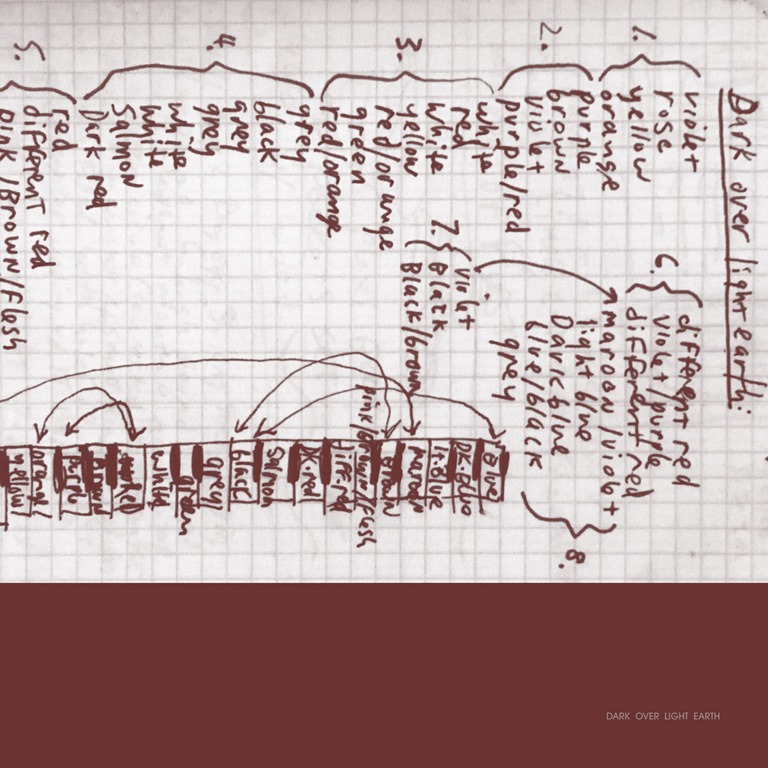
Dark Over Light Earth is very much a release that highlights the intersection of different media, specifically visual art and music. As Steve Roden explains of the album’s origins, ‘dark over light earth was created for the final weekend of the exhibition moca’s mark rothko, which featured 8 rothko paintings from the museum of contemporary art los angeles’s permanent collection… i initially made a list of every color in each of the 8 paintings, to generate a score. i recorded myself playing the score on harmonium and glockenspiel – the notes and their order pre-determined by my color notations; and the tempo, duration, and overall feel, improvised. some of these recordings were then processed electronically with filters.’

It’s fair to say, then, that this is a quite specific, technical, and theory-based work, and it’s not immensely accessible either. Granted, it features violin and amorphous synth drone, both of which are fairly familiar aspects of contemporary experimental music, and there are moments which are genuinely magical, and musical, as they skip from here to there with a lightness and ease that’s magnificent.

But so much of the album – which consists of a single track with a running time of nearly thirty-five minutes – is discordant, difficult, atonal, and it’s hard to get a handle on. The individual elements are comparatively tuneful, but when placed together… Picked dissonance flits over dolorous droning synths and mournful strings – the violin so often sounds sad, but all the sadder when it scrapes sinuously, against the note, against the grain.

The sparser passages are minimal to the max; stuttering scrapes and picked notes forge tension against not drones, but tense scrapes and scratches while notes drape in fatigue across the rough and barren soundscapes.

Listening to Dark Over Light Earth prompts me to revisit not only Rothko’s catalogue, but his biography, which reminds me that he committed suicide at the age of 66. So much is made of the ‘27’ club, that the suicide rate among older people, particularly artists, tends to be overlooked. Hunter S. Thompson, age 67; Ernest Hemingway, age 61; Robin Williams, age 63; Tony Hancock, age 44: it’s all to easy to bracket the psychology of suicide as an affliction oof young males, but this masks the broader issue.

Just as there is nothing in Rothko’s work which indicated darker underlying issues, so Dark Over Light Earth isn’t anywhere near as dark as all that; it’s simply a work of quiet, but troubled, contemplation.

It is, unquestionably, a fitting soundtrack to accompany the viewing of Mark Rothko’s work abstract, overheated, yet austere, simple yet confrontational in their stark minimalism, and in that capacity, it’s magnificently realised.

AA

a3413973115_10

Cruel Nature Records – 6th September 2022

Christopher Nosnibor

These are interesting times for Nadja, the ‘ambient / experimental / doom metal’ duo comprising Leah Buckareff and Aidan Baker. Luminous Rot was recorded during lockdown, and found a home on the legendary Southern Lord label. Released in the spring of 2021, it’s a veritable beast of a work, which combined metal with post-punk, cold-wave, shoegaze, and industrial.

Lockdown feels like something of not so much a distant memory as an unreality, and if by May 2021 it felt like life was returning to normal, the truth is that the wounds were still raw, and any attempt to move on as if life was back as it was before was simply a wilful act of delusion to stave off the effects of the trauma.

And with every trauma, there is some residual hangover, and you might say that Labyrinthine is the product of that. As the accompanying notes detail, the material was recorded during the pandemic and concurrently with Luminous Rot, and ‘explores themes of identity and loss, monstrosity and regret, extreme aesceticism, the differences between labyrinthes and mazes, taking inspiration from Haruki Murakami’s Killing Commendatore, Ursula K. LeGuin’s The Tombs of Atuan, and Victor Pelevin’s reinterpretation of the story of the minotaur and Ariadne, The Helmet of Horror.’

When a band chooses to self-release an album, it’s no longer an indication that it’s substandard or not worthy of a label release, and the case here is that Labyrinthine, which ‘this might be Nadja’s heaviest, doomiest album to date’, it’s clear that rather than consisting of session offcuts, it stands alone as a separate project from Luminous Rot, featuring as it does, a different guest vocalist on each track, and it’s worth listing them here:

Alan Dubin – legendary American vocalist from O.L.D. and Khanate and, currently, Gnaw

Rachel Davies – vocalist and bassist from the British band, Esben & The Witch

Lane Shi Otayanii – is a Chinese multi-media artist and vocalist in Elizabeth Colour Wheel

Dylan Walker – American vocalist from grindcore/noise band Full of Hell

With such a roll-call of contributors, it’s in no way possible to fee short-changed by the fact there are only four tracks, and ‘only’ is somewhat redundant when the shortest of these is almost thirteen minutes in duration. This is an album alright, and it’s an absolute fucking monster at that.

And while the CD release is on the band’s own label, Broken Spine, there are limited cassette versions by several different indie labels from around the world: Katuktu Collective (US), Cruel Nature Recordings (UK), Bad Moon Rising (Taiwan), Adagio830 (Germany), Muzan Editions (Japan), WV Sorcerer (France/China), Pale Ghoul (Australia), and UR Audio Visual (Canada) – and it’s perhaps noting that the running order differs between formats,  and I’m going by the Cruel Nature tape sequence here rather than the CD. It may be more intuitive from a listening perspective, but limitations off format and all…

This co-operative approach to releasing music is highly commendable, and seems to offer solutions to numerous problems, not least of all surrounding distribution in the post-pandemic, post-Brexit era where everything seems on the face of it to be fucked for any band not on a major label with global distribution and access to pressing plants and warehouses worldwide.

The title track is a lugubrious droning crawl: imagine Sunn O))) with drums crashing a beat every twenty seconds in time with each pulverising power chord that vibrates your very lungs. And those beats are muffled, murky, and everything hits with a rib-crushing density, that’s only intensified by the squawking, anguished vocals that shred a blasted treble in contrast to the thick billows of booming bass sludge, and it’s a truly purgatorial experience.

And then, here it comes, and it all comes crashing down hard over the course of the most punishing nineteen minutes in the shape of the brutal behemoth that is ‘Necroausterity’. In a sense, the title speaks for itself in context of a world in lockdown, and it’s sometimes easy to forget just what terrifying times we endured, watching news reports of bodies piling up in New York and elsewhere while governments and news agencies fed a constant stream of statistics around cases and deaths. It felt truly apocalyptic. And ‘Necroausterity’ is the sound of the apocalypse, tuned up to eleven and slowed to a crawl, the writhing torture of a slow, suffocating death soundtracked by guitar and drums do dense and dark as so feel like a bag over the head and a tightening grip on the throat. The recording is overloaded, distorting, and it’s a simply excruciating experience. And it simply goes on, chord after chord, bar after bar, slugging away… and on in a fashion that makes SWANS feel lightweight in comparison. It’s relentless, unforgiving, brutal, and punishing.

‘Rue’ broods hard with dark, thick strings and a heavy atmosphere, but it’s light in comparison. It’s dense, and weighty, but Rachel Davies’ ethereal vocal drifts gloriously within the claustrophobic confines and conjures another level of melody that transforms the thick, sluggish drones into something altogether more enchanting. It builds to a throbbing crescendo that is – perhaps not entirely surprisingly – reminiscent of Esben And the Witch or Big | Brave.

Wolves howl into the groaning drone of ‘Blurred’ and the guitars slowly simmer and burn: no notes, just an endless am-bleeding distortion before the power chords crash in and drive hard, so low and slow and heavy so as to shift tectonic plates and shatter mountains. Amidst the raging tempest, Lane Shi Otayanii brings an otherworldly aspect that transcends mere words, making for a listening experience with a different kind of intensity as it trudges and churns fir what feels like a magical eternity.

The sum total is the sound of hellish desperation, and while Labyrinthine may offer absolutely no solace in the bleakest pits of deathly despair, you’ll be hard-pressed to find an album that better articulates perpetual pain and anguish better than this.

AA

cover

gk. rec. – 13th August 2022

Christopher Nosnibor

Since taking control of his own release schedule – in addition to various releases via various labels – Gintas K’s output has shifted from rivulets to cascades, with this nature-themed album being just one among countless releases, live performances, exhibitions. soundtrack and compilation appearances so far this year, and, not least of all, Lėti in May, released on venerable experimental label Crónica.

There’s little explanation behind Mountains, runlets, caves & cascades, beyond a selection of quotes from HP Lovecraft and the detail that the album’s six pieces were ‘played, recorded live, at once without any overdub; using computer, midi keyboard & controller’ in 2020, and one suspects Gintas has a hard drive bursting with such recordings just waiting to be edited and mastered to form unified documents of his tireless output.

The first five pieces form the larger work that sits under the album’s overarching title, numbered one to five. They’re sparse, minimal, echo-heavy, like wandering around in a vast cavern while droplets fall into the subterranean lake that occupies the bottom, and who knows how deep it may be, how many tunnels are filled with millions of gallons of water that have run down through the ground and into this naturally-carved warren of rock-lined corridors beneath the ground.

In places, barely perceptible glimmers of sound, like bat sonar, jangle in the upper reaches of the audio spectrum. I’m reminded of the cat repellent device in my back yard, and I wonder if to some, these passages would actually appear as silence – or if for others, like my ten-year-old daughter, they would find the pitch unbearable and have to run from the room covering their ears. Quiet gurgles and trickles are the primary sounds on ‘Mountains, runlets, caves & cascades #3’ and I find myself feeling altogether calmer, picturing myself in a pine woodland with steep banks. I picture in my mind’s eye local scenery like Aysgarth Falls and Ingleton Falls and find myself at ease – but this being Gintas K, there’s disruption afoot, and blips and squelches zap in seemingly at random to remind us that this is digital art, and the fourteen-minute ‘#4’ marks the full transition into digital froth and sluices of laptop-generated foam.

And so it trickles into ‘#5’ which brings more bleeps and blips and jangling and some high-pitched rattling that for some reason makes me think of seeing footage of milk bottling plants in the 80s – back when milk came in glass bottles, and I trip on this trajectory of nostalgic reverie until the arrival oof the unsettling final track, the eight-minute ‘eastern bells’ that’s a slowed-down yawn of sound, metallic reverberations ringing out into the silence, echoing in the dark emptiness in ebbs and flows, like a conglomeration of sounds, drifting in a breeze.

Mountains, runlets, caves & cascades is a supremely abstract work, and while it’s not a huge departure for Gintas K, it does represent one of his softer, gentler, sparser and less frenetic works. It’s by no means an album to mediate to. But it is overall fairly sedate, and it not only allows, but encourages a certain quiet reflection.

AA

a3599404171_10

Expert Sleepers – 25th August 2022

Christopher Nosnibor

Fallout 4 is, as the title suggests, the fourth album in Darkroom’s Fallout trilogy.

Darkroom have been going for more than twenty years now, and have built up an extensive catalogue centred around fluid ambient work, which they’re keen to point out ‘stretches the definition of the genre to its limits in many directions: from quiet, introspective and naturalistic through celestial and melodic to intense, abrasive and synthetic.’

In presenting three longform compositions, Fallout 4 affords the collective to fully explore all of these elements.

As the accompanying notes explain, ‘Darkroom’s music has always been played not programmed, with a focus on human interaction and capturing the magic of live performance’, and the first two pieces hark back to the last performance of their 2012 tour. ‘It’s Clear from the Air’ is hypnotic, rippling, mesmerising, low, undulating drones providing a subtle low end to the textured interweaving synths that overlay subtle yet complex rhythms.

It bleeds into the twenty-five minute ‘Qaanaak (Parts 1 & 2)’ and immediately the tone is darker, denser, with a grumbling low and needling pulsations that create tension within the suffocatingly thick, beatless smoggy atmosphere. You find yourself lost, in suspension, somewhat bewildered as the tones twist and change. Electronic flares whip and lash as stuttering beats emerge through the relentlessly nagging pulsations, and continue to shift and mutate to a broiling, bubbling larva as booming bass tones surge and swell. The rhythm grows in urgency, but it’s muffled, constrained, which heightens the experience of a sense of airlessness and entrapment and as much as the throbbing oscillations are indebted to Can and Tangerine Dream, their abrasive edge hints at the uneasy, wheezing synth grind of Suicide.

The third piece, ‘Tuesday’s Ghost’ is perhaps the most conventionally ambient’ of the three, and is certainly the most overtly ‘background’ as is swims and floats and chimes along fuzzy lines of slow decay and loose, vague forms that have no shape, rise and fall. There is a discreet linearity to it, as it gradually, and subtly builds in depth and density, and it’s here that it become clear just how essential that human element is to Darkroom’s work – that sense of musicians bouncing off one another and understanding one another through intuition. There is no substitute for it, and you simply can’t programme the dynamics of form. It’s this intuitive, natural fluidity that breathes life into the compositions, and in turn, it’s this sense of life that the listener connects to and engages with. Fallout 4 may be ambient at heart or by genre… but it’s also far beyond the frontier of ambient.

AA

a2945227307_10

Lo Bit Landscapes – 7th July 2022

Christopher Nosnibor

Life has felt somewhat relentless of late. I do mean this on a personal level, although this is perhaps as much a result off external factors as anything else. The pandemic turned me into an addict. An addict of 24/7 steaming news, of doomscrolling, of relentless checking of social media. When things are constantly happening constantly evolving, it’s easy to find yourself dragged into the whirlwind, and ultimately to depend on the maelstrom. Silence becomes scary. You’re overwhelmed by the volume of emails, texts, FaceBook messages and WhatsApps and find yourself begging for them to stop, but when they do, you panic that something is wrong, that there’s something more sinister afoot, something isn’t working, or that perhaps you’ve died and haven’t realised.

Lately, there’s been a tidal wave of music that’s been created as a reaction to life in lockdown, to social tension, to the mental health pressures of contemporary living. And I’ve been lapping it up, I’ve been loving it. Because people are bringing issues out into the open, and speaking in their own voice about the difficulties we’ve all been facing, relaying those relatable traumas. But I’ve started to feel more like a silent counsellor rather than a music critic. It’s a truism that a problem shared is a problem halved, unless you’re the recipient of all of the sharing. Sometimes, you need a break. Sometimes, you need to let all the tension go, and to simply float.

Nihiti’s Sustained is the perfect antidote to all the tension. It consists of three slow-moving ambient works, extensive in their duration. The shortest, ‘Tetrachrome’ is almost ten minutes long, and it opens with the immense, twenty-one-and-a-half-minute soft soundscape of ‘Stellar Observer’. I sit back by candlelight and close my eyes, and feel my jaw slowly unclench, and my shoulder blades gradually begin to loosen. It’s soporific, deep ambience that washes over you and with washing waves of sound and soft, elongated mollifies drones that drift like vapour. It isn’t without turbulence, but said distortion and treble waves crash a way in the distance and charge against a backdrop of slow undulations. The broad, textured sounds are indeed sustained, for what feels like eternities, and the yawn that swells in my jaws is one of relaxation rather than boredom.

There are glitches and switches in ‘If the Colour’ that disturb the flow, and you almost feel yourself tripping momentarily, like a sleep twitch, but things soon right themselves again, and you resume your calmness, despite scratchy samples and moments of dissonance, because in the overall sensory experience, Sustained is slow and gentle.

Breathe it in, absorb the vapours. Ignore the distant voices as they whisper and echo, and assume they mean no harm, despite the darkening sky toward the end. Let it simply hang in the air: sit back, turn down the lights, and tune in to your inner voice instead of the inaudible mutters. Trust your instruct. Trust the space. Absorb the calm.

AA

a0264725976_10

ROOM40 – June 2022

Christopher Nosnibor

I feel like I’ m forever playing catchup. The simple fact is, there are more new releases – and remarkably good ones at that – than there are hours in the day to listen to them all. I can’t bee the only one who sees friends on FaceBook posting about how they’re loving the new album by X, Y. and Z, and who gets asked if they’ve head / what they think to this, that, or the other and wonder ‘how the hell do you actually listen to all this?’ These people must listen to music 24/7 and possess three pairs of ears by which to listen to all of this music simultaneously, or something.

Admittedly, it doesn’t help that my dayjob doesn’t really afford much opportunity for listening while I work, so I really only have a spell while cooking dinner, and evening, which, after everything else, tend to start around 10pm.

And so, presented with anything up to thirty new releases a day in my inbox, I simply can’t listen to everything, and I deeply envy those who can, and seemingly do.

One particular source of guilt, for wont of a better word, is my inability to keep up with ROOM40 releases. They may only be number three or four a months, but they’re invariably interesting, exploratory, intriguing. And tend to warrant for more detailed analysis than I can reasonably offer. Hence a summarising catch-up for the label’s June releases, on the day July’s have just landed with me.

Alberto Boccardi’s Petra (released on tape) is a comparatively short album of intense electronic drones: consisting of just five tracks spanning around thirty-two minutes, is sparse, ominous, sonorous, predominantly mid-range but with some stealthy bass and sonorous, trilling organs. Recorded over several years and partly inspired and assembled while Boccardi was resident in Cairo, it’s both chilling and soporific, it’s an intriguing minimal work.

RM4165_front

Blue Waves, Green Waves by Alexandra Spence isn’t receiving a physical release, and is an altogether different proposition. As the tile suggests, the ocean provides the primary inspiration, and sure enough, it begins with the sound of crashing waves, but this soon recedes to the background, while analogue organ sounds ebb and flow as the backdrop to low-key spoken word pieces. Noters drip and drop and hover in suspension like droplets of water hanging from leaves before their inevitable yielding to gravity, sliding off and into a puddle. ‘Air Pockets’ sloshes and sploshes, reverberating against empty plastic pipes. The flatness of sound and the shifting of tones as they bubble and sploosh is the aural equivalent of close reading, interrogating a source to microcosmic levels.

DRM4143_art

‘All intensive purposes’ is one of those (many) misspeaks that drive me fucking crackers. And this release by there inexplicably—monikered ‘Pinkcourtesyphone’ is an album likely to frustrate and bend the brain, albeit for different reasons. With the exception of the final mid-album interlude, ‘Out of an Abundance’, these are darkly mellifluous drones that stretch well beyond the five-minute mark, and ebb and flow slowly amidst rumbles and reverberating snippets of conversation and radio. The mood is tense, unsettling; not creepy, so much as just uncomfortable, spine-tingling, ominous, and at times, other-wordly.

BW RM#4188_pinkcourtesyphone_sleeve_final

Some will likely find something in one or another of these, while others will doubtless find all three of these releases to be of interest and collectively, they do very much provide a broad, wide-ranging view of matters experimental and ambient, presenting different perspectives of found sound and field recording. It’s credit to ROOM40 for giving space to these artists, and showcasing such a range of music from within what may, on the surface, appear a narrow field, and demonstrating otherwise.

Preston Capes – PCT001 – 1st July 2022

Christopher Nosnibor

The Front & Follow label may have reverted to mothballed status (at least for the time being), but that doesn’t mean that Justin Watson is doing nothing these days, despite the title of the latest release from three-way collective The Incidental Crack, who we’ve been following – and covering – for some time here at Aural Aggravation. For this outing, they’ve found a new home on newly-established cassette label – and these seem to be springing up all over now – Preston Capes (and I’m guessing no relation to Geoff).

As the notes explain, ‘The Incidental Crack began with Rob [Spencer] recording himself wandering around in the woods and finding a ‘cave’ – Justin put some weird noises to it, and then Simon joined in. The rest is history. The Incidental Crack are joined again by Dolly Dolly / David Yates on this album.’ Indeed, however much The Incidental Crack may evolve, they remain fundamentally unchanged, their albums assemblages of random field recordings and strangeness melted and melded into awkwardly-shaped sonic sculptures that unsettle the mind and by turns ease and tense the body.

The Incidental Crack Does Nothing follows the two albums they released in 2021, the second of which, Detail, was a challenging and expansive work, and this very much continues in the same vein.

With The Incidental Crack, it very much feels as if anything goes, and reflecting on the name of the collective, this seems entirely appropriate. What their works represent is a crack, a fissure, in time, in continuity. Their methodology may not be specifically influenced by William Burroughs and Brion Gysin’s cut-ups, but are, very much, open to, of not specifically channelling and incorporating, the assimilation of random elements, and have a collage aspect to their construction.

‘Shitload of Rocks’ is comparatively airy, and serves as a brief introductory passage before the dank, gloomy ambience of ‘The Worst Party’. It’s a dark, ominous piece that hovers and hums, echoes, clanks, and rumbles on for a quarter of an hour; it’s cold, clammy, and unsettling. But is it the worst party ever? While it does sound like hiding in a cave while an armed search party charged with the task of your erasure stomp around in adjacent tunnels off in the distance, I don’t actually hear any people, laughing drunkenly or loving the sound of their own voices while holding court with tedious anecdotes, so I don’t think so.

‘Hair falling from our bodies clogs up the sewers,’ we learn as a clattering beat clacks in and rattles away on the industrial chop-up churn of ‘Hair’, featuring Dolly Dolly, who’s clearly no sheep. It’s the album’s most percussive cut, the monotone spoken-word narrative somewhat surreal, and looping eighties synths bubble in around the midpoint, although it’s probably too weird for the Stranger Things retro adopters.

‘Couch Advantage’ is the album’s second longer piece, a sinuous, clattering workout almost nine minutes in duration. It’s minimal, yet somehow, there’s enough stuff going on as to render it all a blur: is that jazz drumming, a groove of sorts off in the distance? Or is it simply some clattering chaos, the sound of bacon sizzling? What is going on? And following the brief interlude that is ‘Belting’, the final piece, the ten-minute ‘Photography’ with more lyrical abstraction from Dolly Dolly depicting random fragmentary images against a backdrop of clicking sparks and evolving, supple sweeps of drifting clouds of sound. It’s all incidental, every second of it: fleeting, ephemeral – and in the cracks, is where it happens. As they open wider, you peer in, and observe. There is movement. There is life. Because life is what happens between the events, among the random incidents and accidents.

The Incidental Crack Does Nothing may be confusing, bewildering, difficult to grasp – but it is, without doubt, a slice of life. You can do with that what you will.

AA

cover

Rocket Recordings – 10th June 2022

Christopher Nosnibor

International Treasure is the second album from the ‘collaborative collision’ of Steve Davis, Kavus Torabi, and Mike York. And, of course, much has – and will – be made of the Steve Davis factor: he may have kept his musical interests largely under wraps during the lengthy heyday of his snooker career, but the fact is that he’s long been a fan and supporter of ‘interesting; music, and this is a musical unit that stands on the strength of its work – and its work is (utopia) strong.

As the accompanying notes explain about the origins of International Treasure, ‘All three musicians here found themselves operating outside of their comfort zones – Torabi’s purchase of a guzheng (a Chinese plucked zither) led to Shepherdess’s lambent allure and York’s spectacular and evolving array of pipes and wind instruments contributed just as much as his ruthless editing. Davis meanwhile, whose speciality lies in rich tapestries of modular electronics, sums up their relationship in characteristically self-effacing fashion: “I see myself as a strong midfielder, or a centre back. Kavus and Mike are like the Lionel Messi or Ronaldo of the equation, and I’m setting situations up for them”.

Davis’ application of an extended football analogy is amusing in context, and one suspects it’s an intentional slice of drollery. The music itself is not amusing – as in, there are no chuckles to be found here – but instead is intensely focused, with magnificent results. There’s a tangible sense of an intuition flowing between the three of them on this album as the sounds ebb and flow and weave and quaver, the elongated drones and meandering organs melting together like a stream of butter.

There are some odd samples – probably animal, rather than vegetable or mineral – flow together into a soft mass, with no hard boundaries, no distinct edges… ‘Shepherdess’ is spacious, meditative, but shifts over time to emerge as a more pulse-based modular synth work, and ‘Disaster 2’ brings all of the various elements together perfectly, as well as bringing together ambient, post-rock, and folk. It’s a beautiful and uplifting experience, and one which acknowledges the pains, trials, and tribulations of life, how it may not be possible to function all day every day.

There’s something soothing, even soporific, about the slow, mellifluous tones that drift together smoothly, seemingly effortlessly, to coalesce into some form, however cloud-like and abstract, to create International Treasure. Even when deep, resonant notes hang like the slow decay of a chimed gong, as on the title track, the darkness is always tempered, by light.

It’s not ambient and it’s not Krautrock – but International Treasure finds the three musicians drawing on elements of both to conjure something magical, something mystical. The final track, ‘Castalia’ is a calypso party party, and if it at first feels somewhat at odds with the rest of the album, it’s worth bearing in mind that the album exists at all because the players are keen to explore different terrains and territories. And explore they do: International Treasure mines many seams, and excavates a wealth of listening pleasure.

AA

525397

3rd June 2022

Christopher Nosnibor

My partner in power electronics, the man behind the white noise aspect of the ‘white noised and shouting’ equation that is …(something) ruined, Paul Thingumy (he has more pseudonyms and variant monikers than the devil himself, or even JG Thirlwell), has gone and self-released another EP. Well, less of an EP than an LP: it may only contain four tracks, but with a duration of almost an hour, it’s a very long play.

Residing in Mirfield, Kirklees, West Yorkshire – or, objectively, the arse-end of nowhere, where trains are infrequent and tend not to visit after 9pm – is probably very like any other Little Britain backwater with a Tory MP. And it’s so often from our immediate environs we draw our inspiration, as the album’s title indicates. For reasons I can’t fathom, the title reminds me of Peter York’s strange book Dictators’ Homes and some TV show I can’t quite recall – probably because I never watched it – about celebrity pads. Or perhaps I’m confusing it with Pimp My Ride or some other wank. Because it all blurs, and fast. Mirfield Pads is blurry, but in a different way: everything melts together to create an ambient wash.

In something of a departure from much of Paul’s previous work – and there’s a lot of it – Mirfield Pads is surprisingly mellow, melodic, accessible. There’s a hypnotic Krautrock vibe about the shuffling oscillations, with sampled vocal snippets buried low in the mix in places. It’s an overtly synth work with a vintage leaning that’s strongly rooted in the late 70s and early 80s. If there’s a debt to Kraftwerk here with elements of Mike Oldfield and Harold Faltermeyer, then equally, Mirfield Pads is Paul’s nod to Tangerine Dream, perhaps in part spurred by the recent passing of Klaus Schulze. You wouldn’t necessarily call it a tribute, but an inspiration, almost certainly.

Tapering tones interweave and turn, glistening, fractal, kaleidoscopic, like beams of light dancing on an illuminated surface, dancing lightly across a millpond or flickering on a wall. Not a lot happens, and it doesn’t need to: the sounds turn slowly on an axis that exists in a space of its own.

‘Crystal Airfield’ – a title that evokes the spirit of JG Ballard – hits the numerical sweet spot of 23:23, and with additional guitar work courtesy of Neil Campbell, longtime collaborator and one half of another project, Early Hominids, it’s a richly atmospheric piece that rounds off the experience nicely in a wash of elongated droning feedback paired with bubbling analogue sounds.

It’s the attention to detail, to the vibe and sensation that really makes Mirfield Pads intriguing. It feels more like a document from a past time more than a nostalgia piece, and this is a good thing, because nostalgia has become dreary and weary very quickly indeed – probably because the smell of cash is so unappealing.

AA

a3443859683_10

Constellation – 20th May 2022

Christopher Nosnibor

The first collaborative full-length album by Automatisme (the Canadian musician and conceptual artist William Jourdain) and Swiss field recordist, ambient musician, visual artist and writer/academic Stefan Paulus, Gap/Void is nothing if not a deep, immersive sonic experience.

While the origins of many albums are largely unremarkable and barely worthy of reading, let alone comment, Gap/Void is a strong exception, and for that reason, it feels appropriate to quote at length:

Paulus approached Jourdain with a proposal based on his field recordings made during numerous mountain expeditions in the Swiss Alps, the Caucasus, and north of the Arctic Circle—documenting stormy weather, high alpine winds, avalanches, and sounds emanating from glaciers and from the insides of crevices and caves. Paulus created ambient noisescapes from these recordings by splicing and folding them into hundreds of layers of sound: an analog to the geological strata of their geographic sources. The resulting audio mixes, compounding a multiplicity of spatio-temporal excursions, were then further encased in drones using the natural tone series (the traditional zäuerli or wordless yodels of northeastern Switzerland), the monotonic standing drone of Lamonte Young’s Dream Syndicate, and the mass chords of early 1970s Kosmische Musik as points of reference. Paulus sent these extended ambient/noise pieces to Jourdain as source material for the latter’s bespoke Automatisme techniques, where variable tempo and glitch systems forge more overt minimal techno/IDM works.

‘Hey, how about an Arctic trek?’ doesn’t really sound like a pitch for a musical collaboration, and pitched to a TV producer, it would probably have been a series with its own self-made soundtrack – although for TV they’d have probably wanted some celebrities slogging across the barren wastes lugging audio gear or something stupid.

The first of the album’s ten tracks is the twelve-minute ‘Säntis’, where an insistent and overtly synthesised loop thrums against a slow ambient swirl before an insistent uptempo kick drum beat thumps in and for a spell things go techno… before becoming derailed. The tempos are all over, the ebbs and flows run in different times and tempos and before long it becomes quite overwhelming, disorientating as the layers build… and then everything falls away and you’re left with the rumbling sound of the wind scouring the bleak, barren ground. It sounds harsh and inhospitable, it sounds dark and unsettling, and yet it feels less tense and is somehow less agitating than the preceding pulse-quickening sensory overload.

Things do settle a little as the album progresses, and by the arrival of the third track, ‘Uble Schlucht’, we’re into something of a more straightforward Krautrock style, dominated by bubbling synths and motorik grooves. But, at the same time, it’s a soundscape of shifting terrain, of snowdrifts and undulations, crags and cervices.

There’s a restlessness about Gap/Void that means it’s impossible to settle, that keeps you on edge in a way. The compositions – particularly the way the percussion is eternally evolving, in a continual flux, more a series of palpitations and panic attacks than a pulsating heartbeat – are tense, ever-moving, with a flicker-filled urgency that offers little respite.

‘Blau Schnee’ goes all out on the deep bass and low-end murkiness, the beats and bass melting into one another, while ‘Stoos’ goes ultra-sparse and is so minimal it borders on the microtonal, before an off-tempo beat bounds in and trips the wire.

The pieces on the second half of the album are rather shorter, with none over the six-minute mark, but the sound and sensation remain similar, with crackling electronics dominating and beats that poke at the innards – sometimes subtly, others less so. But it never really lets up, and while very little of Gap/Void gives even the vaguest hint of its source and origins, it does convey a certain sense off desolation, of isolation. Soon, we will all live in desert, and it will sound like this.

AA

cover Automatisme Stefan Paulus - Gap Void