Posts Tagged ‘AI’

29th November 2025

Christopher Nosnibor

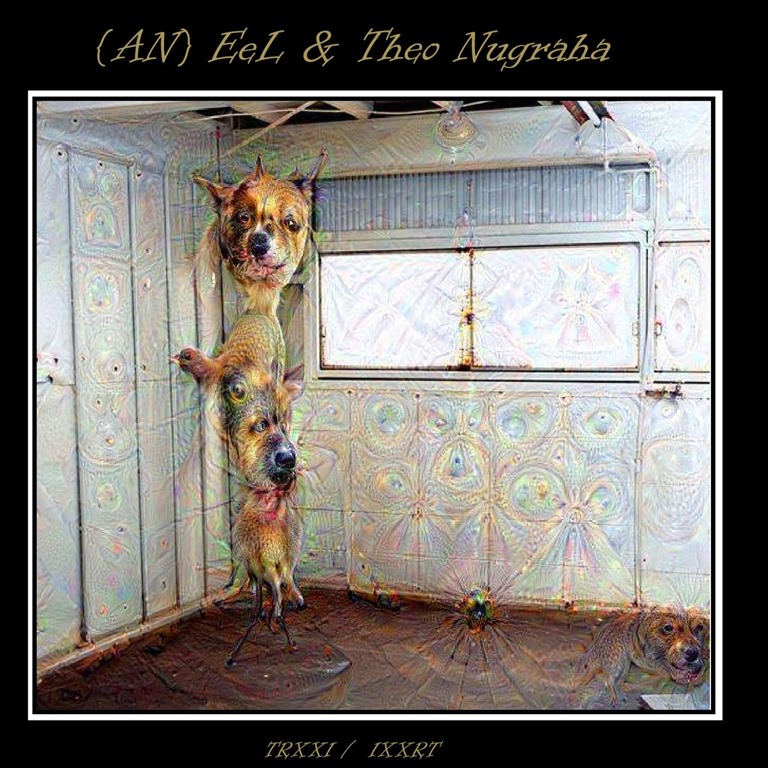
It’s not a good thing to feel nostalgia for something from the recent past which wasn’t even any good to begin with. But on seeing the cover for this split release by Theo Nugraha and {AN} EeL, I’m reminded that Google DeepDream was actually quite fun for about five minutes in 2015. Ah, hindsight… The results DeepDream produced were weird, psychedelic, trippy, and resembled no dream or subconscious thoughts I’ve ever known, its hallucinatory aspects were oft said to share qualities with LSD. But this was part of the appeal: it was novel, silly, with dog faces emerging from inanimate objects, whappy wallpaper, and the like. How many of us knew that it would be a precursor to the AI hell we now find ourselves in? Ten years is not such a long time in the scheme of things, but in the context of the now, it feels like another lifetime. A lifetime when doing daft stuff with digital tools wasn’t annihilating the environment, when it wasn’t stealing the work of writers and artists, when it wasn’t rendering jobs obsolete while creating billionaires at the expense of those losing their livelihood. Arguably, the golden age of The Internet was in the first years post-millennium, when applet-based chatrooms first made it possible to connect in real-time with people around the globe and MySpace was a wild melting pot where people came together through shared interest and communities evolved. This isn’t just some nostalgia wank: these were exciting times, and the world truly began to open up in ways hitherto unseen. These were times when The Internet offered freedom, where, as Warren Ellis’ novel Crooked Little Vein expounded, anything goes and if you could imagine it, you’d find it online. Godzilla Bukkake? You got it.

Everything changed when major corporations realised that they could really, really make on this. But major corporations being major corporations, they didn’t want to participate – they wanted to take over and own it, to wring every penny of profit from every last keystroke. And so now, while Napster and Soulseek were the equivalent of home taping, which didn’t kill music, Spotify and most other major streaming services really are damaging artists’ livelihoods – because unlike small-time peer-to-peer file sharing, this is a multi-billion dollar industry which siphons off pretty much all of the money for owners and shareholders rather than artist – and then you have scums like Daniel Ek using those proceeds to fund war. Something has gone seriously wrong.

Theo Nugraha’s contribution, 1XXTR is a longform work – seconds short of thirty minutes – and while it’s perhaps not quite Harsh Noise Wall, it’s most definitely harsh noise, and there’s not a lot of variation. It may even be that any variation is in the imagination as the mind struggles to process the relentless barrage of sound and seeks tonal changes, details within the texture. It doesn’t so much sound like a cement mixer – more like being in a cement mixer with half a ton of rocks, at the heart of an atomic blast. There are squalls of feedback and mutterings beneath the blitzkrieg, and around ten minutes in, the tempest suddenly begins to rage even harder and it’s like being hit by a train. Twenty minutes in, the relentless roar drops to merely the blast of a jet engine and the sensation is like huge pressure drop, or a fall. It’s impossible to discern what’s going on inside this swirling vortex of noise (there does sound like a vast amount of collaging and random things floating in and out), but it’s a full-on physical assault that vibrates every cell in the body. By the end of this most brutal half hour, you feel battered, bruised, damaged.

‘TRXX1’ by {AN} EeL, which runs for a second over the half-hour mark, is altogether less abrasive, but it’s no more comfortable. At first, it’s a clattering, metallic rattle, like an aluminium dustbin rolling down the street in a gale, accompanied by rattles and chimes. Extraneous noises – twangs and scrapes – enter the mix, and the sound starts to build, like the wind growing stronger at the front-end of a storm. But soon, from nowhere, a squall of static – or rainfall – begins to swell and while off-tune notes reverberate in the background, and a scan of radio stations yields alternately cut-up fragments and random noise, and while it may not possess the same physical force as Nugraha’s piece, ‘TRXX1’presents a disturbing array of frequencies and makes for a particularly tense listen. There’s a thunderous ripple like a freight train a mile long barrelling along, while disjointed voices echo here and there, and as bhangra and old-time brass fade in and out, the collage approach to the track’s creation, harking back to William Burroughs’ tape experiments, and early Throbbing Gristle become increasingly apparent. The Police’s ‘Can’t Stand Losing You’ cuts through what sounds like a snippet from lecture or interview. The repetition of the same fragments becomes difficult to deal with after a time, and you begin to feel like you’re cracking up. The it’s back to the sound of metal buckets being dragged down a cobbled street, with random busts of discordant noise jabbing in for extra discomfort. The final segment is a cacophony of abstract drones and crashing, calamitous racketry – a combination which is uncomfortable and unsettling.

The two pieces are quite different, but equally difficult in their own ways, and as such compliment one another. And if you’re seeking an album that really tests your capacity for abrasion and nauseating noise, 1XXTR / TRXX1 hits the spot like a fist to the stomach.

AA

a2950925012_10

Not Applicable – 23rd May 2025

Christopher Nosnibor

For about five minutes, AI looked like it may provide some entertaining diversions in terms of creative potentials. It wasn’t so long ago that it produced glitchy, idiosyncratic writing and wild art that was so wrong it was hilarious, and lame synth-loop electronic music which had neither style nor substance. It didn’t look like the threat to humanity that dystopian sci-fi novels had portrayed.

But then more information began to emerge about how AI was ‘learning’ by essentially stealing from all available sources. AI is the worst plagiarist imaginable, and nothing is safe or sacred. Then there came the reports of the vast amounts of energy, and water, required to power it, and it started to look like AI will doom the planet by sapping its resources instead of going rogue and obliterating humanity. But then…AI evolved, and fast. In no time at all, people stopped having additional limbs and appendages, the writing transitioned beyond repetitious babble, and people have begun to use to AI chat as a substitute for expensive therapy, despite reports of rogue AI advocating suicide… and as its usage accelerates and it morphs into the nightmare of sci-fi dystopia we’d dismissed just a few months ago, so the use of energy and water increases exponentially. One way or another, it does now look very much like AI will finish us.

And so there’s a certain discomfort in approaching Put Emojis On My Grave by the spectacularly-monikered Ancient Psychic Triple Hyper Octopus, an album which is sold on the way it ‘boldly explores AI and improvisation on an album of freely improvised, experimental electroacoustic music’.

It features, as the press notes put it, ‘a new lineup of celebrated, British musicians’ (Alex Bonney (trumpet, bass recorder, Strohviol), Will Glaser (drums and percussion) and Isambard Khroustaliov, aka Sam Britton (electronics), and ‘ claims to forges ‘a new musical language’, with an album ‘which eschews traditional musical composition, seeks instead to “adopting the language of AI’s deep learning failures and glitches”, attempts to imagine how AI could make a positive contribution to the creative process’.

It’s hard to know how to really assimilate this. The six compositions which make up Put Emojis On My Grave are fine examples of exploratory jazz, with wandering trumpet tooting in meandering lines across clanking, clattering abstract percussion which sounds like cutlery and wind-chimes being knocked about while bleeps and bubbles interject seemingly at random. It has that avant-jazz, experimental, iprov feel which is in some ways quite familiar in its own strange way. That is to say, while it’s niche, the sonic experience is very much representative of a certain field. A field filled with jackrabbits, apparently.

‘Goats on Helium’ is bubbly, bibbly, scratchy, scrapy, wheezy, groany, a splatter and clatter of sounds piled up and colliding all over, and it gets pretty messy over its six and a half minutes. Warping drones and scratching, gargling abstract drones twist around deranged brass tootlings and crashing cymbals on ‘The Adiabatic Flux Differentials of the Id’, and I would challenge anyone to find a title that’s posier, more wankily intellectual than that this year. And while it’s a bit jazz-jizz in places, it’s certainly better than the title suggests.

This is, in my opinion, a fair summary of the album, a work which is concerned with space and time – not outer space, but inner space, the space which our minds explore in reflection like the clatter of 1,000,000 bongos, the space – or distance – between concept and execution, and virtual space, those our other selves occupy, both in the moment and, subsequently, leaving echoes and traces in infinite corners of the virtual world. It’s impossible to discern where the musicianship cedes to AI intervention here, which is certainly in its favour – and if Put Emojis On My Grave is used to train generative AI, then it could confuse it for a while, making for some interesting results. And Put Emojis On My Grave is certainly interesting.

AA

Ancient Psychic Triple Hyper Octopus – Put Emojis On My Grave cover 4000px

fals.ch – 9th June 2023

Christopher Nosnibor

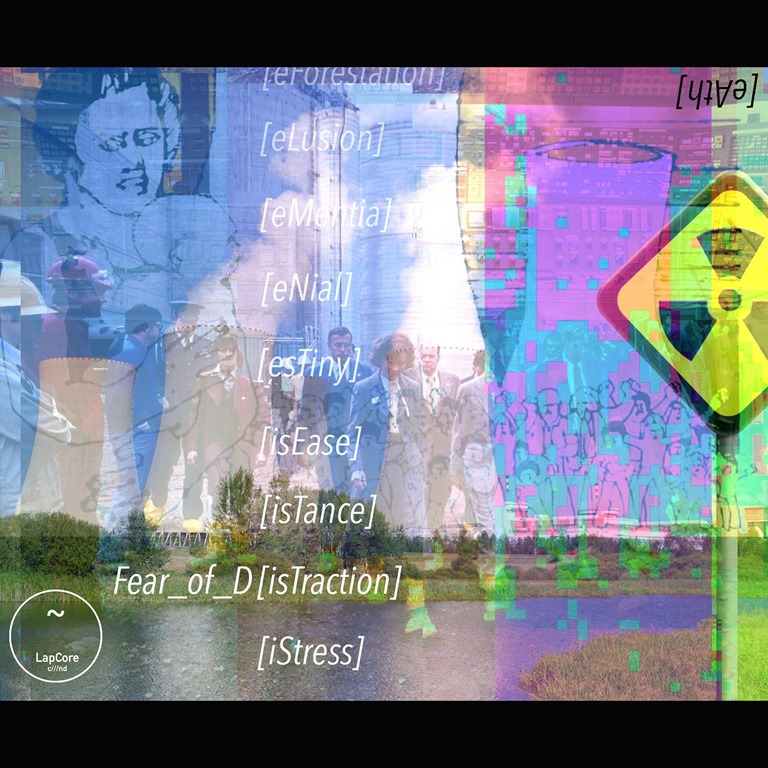
On clocking this in my inbox, I fleetingly felt a flicker of amusement as I recalled a long-lost article I had written over a decade ago about fictitious musical genres, which included LARPcore, where bands inspired by Viking Metal re-enacted historical battles in full costume. (I also mentioned Symphonic Doom before the term appeared as a thing). Then I realised that, as I’m prone to doing when I’m not concentrating, I’d misread, but then on reading the notes which accompany the new album by Kent Clelland, aka LapCore (which makes a lot more sense in context of what he does musically), my amusement was replaced by a certain crackle of excitement.

For this reason, it’s worth quoting: ‘With Fear_of_D[istraction] LapCore continues his exploration of digital audio synthesis and distortion techniques, researching the complex tonal digital structures he affectionately refers to as cTonality. In contrast to the more upbeat and aTonal album LapCore 132 (his 2017 full-length self-published release), Kent Clelland has freed himself to explore the darker, and more cerebral faces of computer music composition. With multi-channel oscillators he brings sonic entrainment into the musical range of frequencies as opposed to the typical sub-audible entrainment frequencies, composing melodic and harmonic parts with the artefacts to create cTonalities.’

But here’s where it gets interesting, and will likely prove divisive:‘Weaving polymetric binaural oscillators with a lopsided bass drum engine, he lulls your senses into a state of receptivity upon which he then sews synthesised tapestries inspired by his hyper-perceptual, cancer-treatment-infuenced dogma adventures in the pre-pandemic delirium. LapCore produces these tracks as an attempt to preserve his brain damaged audio hallucinations, sharing them in a venue larger than the space between his ears.

‘The performance of LapCore’s Fear_of_Di[straction] (2017-2022) is a 48 minute sonic quilt of recordings of AI Musical Agents during training sessions intricately hand-sewn into the fabricated projection of the audio dimension.’

Yes, Fear_of_D[istraction] incorporates elements of AI. ‘Nooo!’ people will likely shriek and no doubt some will be unhappy even with my writing about this album on this basis for propagating the death of the artist. But the death of the artist – if we take ‘the author’ in a broader context – has long been a preoccupation of literary theory and postmodernism, as far back as Roland Barthes’ 1967 essay of the same title. Yet now, as we find ourselves pondering what some are variously referring to as post-postmodernism or metamodernism, there is mass panic over the chimera we have created with speculation that not only artists but most occupations will be obsolete in a matter of years and we will soon be driven to extinction by our errant creation. I’m reminded of numerous sci-fi novels, not least of all Michael Chrichton’s Prey. Published twenty years ago, it feels more relevant now than ever, as is the way with much true science fiction, which takes current science and projects hypothetically forward, but also demonstrates that this fear is nothing new. And yes, of course, we – as a species – have pursued this end. Our demise through AI seems unlikely, but if it does happen, we probably deserve it.

While AI photos and even falsely-attributed Guardian articles are giving great cause for consternation – understandably – overall, it’s still the potential of AI which is scarier than the current capabilities, and this is nowhere more evident in music, where it’s fair to say that most purely AI generated compositions are toss. But also, in more experimental fields, composers have been using algorithms and customised programmes to generate sound since the advent of computers and synths – and I have covered countless of these in the last fifteen years.

LapCore incorporates AI as simply another tool in his kit, and has used this hybrid of man and machine to forge a work that melds Krautrock and minimal techno, microtonal experiments and harsh electronics to eye-opening effect.

The first of the album’s seven compositions, ‘Stuck Like a Magnet in Switzerland’ is built around grating oscillators and some extreme stereo panning, which is well-executed, and immediately grips both sides of your cranium and squeezes. The flow of blooping synthesised rhythms is rent with a buzzing distortion the like of which some of us will remember as the way a mobile phone signal would interfere with the TV – and at three times the volume of the busy bubbling track, it comes as an uncomfortable moment of shock. All kinds of feedback and interference disrupt the musical melange thereafter, dial-up tones and all kinds of electrical chaos collide and crackle unpleasantly. But being unpleasant doesn’t make it bad: this is one of those works that is relentlessly challenging in its pursuit of ‘difficult’ tones, textures, and frequencies, often simultaneously.

‘Microdose’ feels more like an overdose, as an angry hornet the size of a lion takes residence in the space at the front of your skull, right in the sinuses, and vibrates your brain without mercy against a backdrop of disjointed techno. This is some brutal synth torture, and elsewhere, there are drones and whistles reminiscent of early Whitehouse and Throbbing Gristle, atop dome very DAF-like electronica. ‘Americium’ is busy, a constant drip and froth of watery notes bouncing against one another – and it sounds experimental. And this is the key to appreciating Fear_of_D[istraction]: it’s not a work that tries to pretend to be a human creator hiding behind AI for a laugh, and nor is it the sound of AI running wild. Instead, it’s an album which sees its creator consider the challenge ‘how can we use this?’

If it sounds somehow ‘impersonal’, the same is true of much electronica; by the same token, Fear_of_D[istraction] very much sounds like a guy pressing buttons and twiddling knobs and looking to see just how much disruptive, disturbing synthy noise he can throw over a sequenced beat. The artist isn’t dead yet.

Christopher Nosnibor

I get a lot of weird shit come my way. I guess it’s to be expected: I review a fair amount of weird shit and it just snowballs: weird shit finds me. And this is very much weird shit. Despite some serious deliberation, I can’t decide where the emphasis lies in that statement.

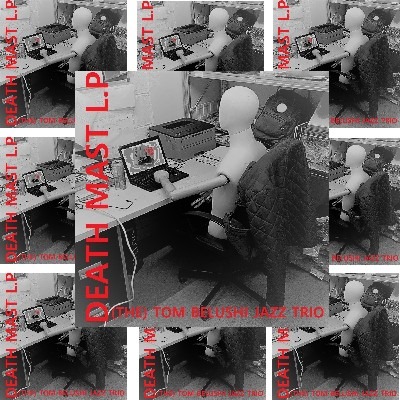
Details about the artist or the release are practically non-existent, but it doesn’t take too much digging to establish that the Tom Belushi Jazz Trio aren’t a trio and they don’t play jazz.

Having released an EP (also entitled Death Mast) and deleted it almost instantaneously, Tom Belushi Jazz Trio seem determined to render themselves as evasive frustratingly obscure as is conceivably possible. But this is clearly not simply a musical project, so much as an exercise in postmodernism that revels in ephemerality. With CD copies of this release being limited to single figures, I’m reminded of various crackers projects by Bill Drummond and The KLF, among others, whereby the objective seems to be to create an objet d’art that’s so scarce it’s beyond reach even before it’s released, essentially only existing in legend.

Slapping synths, gloopy stuttering beats, warping irregularities and groaning keys redefine the sound, along with snippets of robotic, autotuned vocals. Oriental motifs are dominant in this instrumental album’s ten exploratory tracks, which appear to be largely AI in origin. Because yes, it’s taking over the world. Think you can hide or linger on the peripheries now? You’re simply deluding yourself.

There are some nice sounds – and some naff ones – all balled together in an eclectic hotchpotch of ersatz electronic collaging. ‘Traitor’s Gate’ is a droning shanty that’s actually got human vocals; it’s woozy, disorientating in an uncanny sort of a way.

The titles are daft, absurdist, Dadaist or abstract, and littered with references, many of which are obscure – ‘Luke Haines. I Have Your Hat’; ‘No Mark Wynn’;(a particularly cheesy and overly synthetic slice of r ‘n’ b); ‘Stairwell Crooks Shutterstock Dust Jacket’ but ultimately seem to present as little true meaning as the music itself (and I can’t ever recall having experienced any dilemmas over purchasing avocados).

Death Mast is one of those albums that was probably more fun to produce thana it is to listen to. It does have considerable novelty value, and it does have lots of ideas, but few seem to be explored in any real depth or fully realised, and as such, the main idea seems to be the concept for the creative process – or should that be ‘creative’ process?- rather than the end product. But with the ideas and even the passages within the tracks being as fleeting and as ephemeral and impossible to locate as copies of the album itself, what are we really left with? Ultimately, Death Mast presents more questions than answers, a point of discussion more than a musical project. But, if there is one conclusion we can draw from this it’s that there is no need to worry that AI will bring about the end of music as we know it. At least, not this week. Welcome to the post-postmodern age.

AA

54d90880-c561-48af-aa9e-fda70c47391e_thumb_400