Archive for the ‘Albums’ Category

Play Loud! Productions – 13th April 2018

Christopher Nosnibor

My first thought on hearing the opening bars of the album’s first track, ‘Light & Grace’ is ‘wow, this sounds just like Dinosaur Jr!’ My second thought, on the vocals starting is ‘No way, this really sounds like Dinosaur Jr!’ Sure enough, J. Mascis is listed among the long list of collaborators on this, the first Locus Fudge album in 20 years. Mascis has nothing if not a unique signature sound, often aped but never replicated. The track in question rumbles along for over eleven minutes, the singing soon giving up for the guitar solo to do the talking. Less characteristic of Dinosaur Jr is the way in which the solo comes to battle against a rising tide of extraneous noise, and the song itself finally collapses to a churn of dark ambience and feedback. As it happens, large chunks of Oscillations sound very Dinosaur Jr, and the overall vibe is very much late 80s / early 90s US alternative rock.

This is also very much the sphere to which Locust Fudge belong: their two previous albums, Flush and Royal Flush, released in 1993 and 1995 respectively, were released on Glitterhouse and saw the German duo aligned to the grunge movement. The EP, Business Express (1996), saw them push into more electro/industrial/krautrock territories, and even include overt elements of drum’n’bass in the mix. Those records are almost impossible to find now and the YouTube uploads of the tracks aren’t available in the UK. There’s something strange about the idea of being unable to access something on-line now. Whatever happened to the global village? Marshall McLuhan and Quentin Fiore pitched the global village as the territory of electronic media; with territorial divisions over music rights, it feels much more like a map of war than a plan for peace.

Oscillation reminds of simpler times – but more than that, seems to belong there. It’s not merely a nostalgia work, but a heartfelt return. You can’t exactly criticise a work for being ‘derivative’ when the bulk of the artists it’s derivative of feature.

‘Hormones’ slips into the easy but wonky country vibes of Pavement, while the motoric groove of ‘No Defense’ has some gloriously skewed guitar work. And then…. then there’s a wild frenzy of discordant jazz all over the middle eight. The big sax break on ‘Something’s Wrong’ comes on like The Psychedelic Furs, over a big, crackling valve guitar buzz, a melody reminiscent of Dinosaur Jr’s ‘Turnip Farm’, and lyrics that appear to present a process of self-dismemberment.

It’s a great album – not of its time, but of its spawning era. And now I’m off to revisit You’re Living All Over Me. Just because.

https://playloud.org/archiveandstore/trailers/locustfudge/trailercode.html

AA
locust-fudge-oscillation

Karl Records -20th April 2018

Christopher Nosnibor

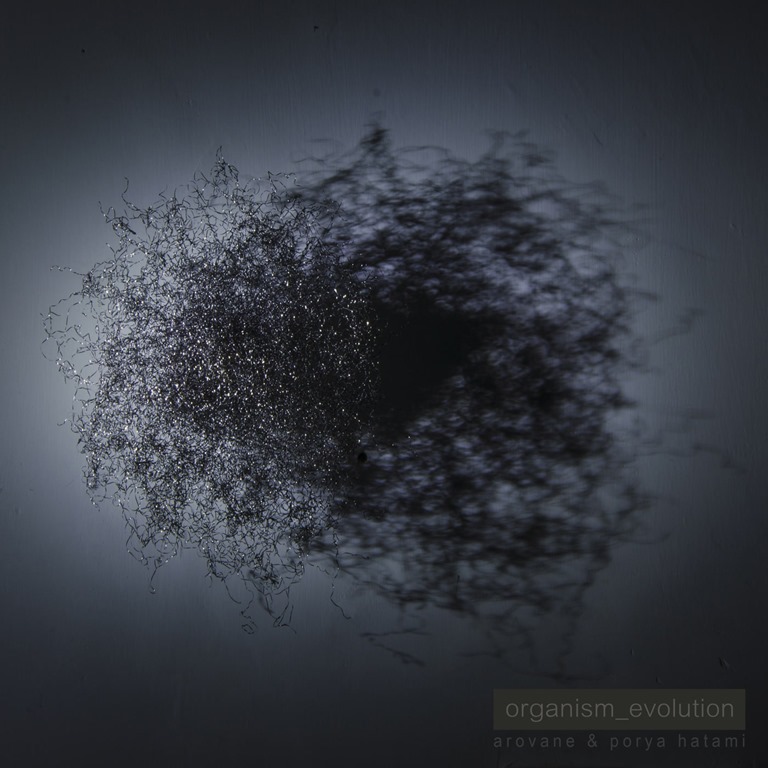
The title is, in many respects, self-explanatory: the successor to last year’s Organism, organism_evolution finds the collaborative pairing of Arovane (the recording alias of Berlinbased electronic artist Uwe Zahn) and Porys Hatami, who, I gather, is a prime mover on the Iranian electronic underground.

The 23 pieces which comprise organism_evolution – and whether or not this number is coincidental or confluent with the 23 enigma is perhaps an extensive aside too far – are sparse, elliptical sliver of minimalist electronica. The rhythms are cyclical, emergent, rather than overtly beat-driven: there’s little to nothing immediately identifiable as percussive.

With the exception of a brace of expansive, seven-minute sprawlers, the pieces are brief, largely sub-two-minute snippets and fragments, which range from undulating swampy miasmas of amorphous, undefined ambient smog, to clicky, crackly sketches of dissonant arrhythmia. Slow, bulbous pulses, gurgles and spiralling buzzes, woody knocks and hushed, wispy undulations weave fractal patterns. It’s a collection of intangibles, sounds in ever-shifting states and perpetual transition, the forms conforming to no distinct shape or structure.

The pieces aren’t only brief, but adopt a microscopic focus – the accompanying blurb lists among the processes involved in the album’s formulation ‘modular and granular synthesis, spectral processing, resonator/modal synthesis’. The technicalities of synthesiser work are beyond my ken: ultimately, I’m interested in the output rather than the input, and its effects as a listening experience.

At times, the experience is discomfiting, the eerie atmospherics creating unsettling disharmony as ominous low notes hover, hum and scrape against jittering skitters of treble that set the teeth on edge. The extreme use of stereo in places creates an immersive – if disorientating – three-dimensionality. But for all of the perpetual movement and the speed of the sonic transitions – sounds and ideas pass before they’ve even registered, giving organism_evolution an air or ephemerality – the overall effect is one of a work which flows.

AA

arovane-porya-hatami-organism-evolution

Acte – Acte 002

Christopher Nosnibor

The press release provides previous little detail about the release, or the artist, beyond a brief summary of his broad interdisciplinary pursuits which include dance, theatre, live electronics improvisations and audiovisual performances and installations. It’s quite an expansion on his biography last time I encountered his work, back in 2011, when he simply described himself as a ‘sound artist’. That was when he released the ambient-orientated exploration usure.paysage.

Transfert/Futur is a long way from ambient. Heavy on the synths, it’s a beaty work that packs some considerable attack amidst the airy pulses and breezy blossoms of effervescence. It contains two tracks, the first of which, ‘transfert (299 792 458 m/s)’ is the audio element of a touring sound/light installation from 2017. On CD, it’s simply sound without the light, and clearly, the interactive and multisensory aspect of the project is nowhere near fully represented. Nevertheless, musically, it works. Over the course of some eighteen minutes, Bernier builds the atmosphere but above all, builds the beats. Scratchy, stuttering, synthetic, exploding in all directions, the rhythms pop and thrum, marching surges halting abruptly to change direction before powering forwards once more embarking on a propellant trajectory. The surround synths glide, pop and bubble, but mostly click and bleep and elongate, morphing and stretching longways, occasionally plunging into expansive, oceanic depths and venturing into eerie subaquatic territories. With so many false starts, false ends, twists, turns and unpredictable stammers, it’s anything but linear.

The second composition, ‘synthèse (299 792 458 m/s)’ has no such obvious context attached, but again is centred around warping synths and woozy bass tones wrapped around bold beats. Over the course of twelve minutes, it swerves from oblique bleeps and minimalist electronic squiggles and arabesques, via slow-building crescendos, to passages approximating straight-ahead dance music that you can actually get down to. As the track progresses, its form gradually dissolves. The soundscape is increasingly rent with bleeps and whispers and tranquillity always gives way to tension after a few uncountable bars. Microbeats and circuit spasms come to dominate the swell of hyperenergetic electrodes in synaptic collapse. Finally, nothing is left but a quivering whistle which slowly decays to nothing.

What does it all mean? Probably precious little. Transfert / Futur is about the journey, and the algorithms, rather than the meaning. It’s not a journey that traverses from A to B, but burrows its way into its own unique space.

AA

Nicolas Bernier

Nakama Records – NKM014 – 23rd March 2018

Christopher Nosnibor

The title sounds like a Radio 4 quiz, or perhaps some selections for ‘Call my Bluff’. The accompanying blurb outlines how the album consists of three nonsensical musical conversations between Malaysian nylon guitar player Goh Lee Kwang and Norwegian bass player Christian Meaas Svendson, and describes it as ‘the story of the first encounter between two different mindsets, nationalities and generations trying – and totally failing at – making any sensible dialogue with their respective musical languages.

Success and failure are relative, of course, and one may contend that there’s no success like failure. It’s in the disconnect between artistic vision and the material realisation that unexpected creative outcomes emerge. The three pieces – I would probably hesitate to describe them as ‘compositions’ given that they are, in effect, haphazard jumbles of notes played over and across one another – are indeed sonic babble. But it’s still just freeform jazz to my ears. And for once, this isn’t a complaint or criticism.

The description reminds me of those days when every conversation feels like a misfire, and you miscommunicate with everyone you encounter. Try as you might, you never connect as intended. A jovial quip lands as an insult, a reply to a simple question leaves your interlocutor nonplussed and you realise you’ve misunderstood or misspoken, or otherwise just gabbled a stream of random bollocks for no apparent reason. You question whether the fault lies with you, or the world at large. You burn with shame. You want to hide away, an avoid people for a while. I say ‘you’; I mean me, of course, and as usual.

It takes a certain – nay, special – ability to separate and absorb any shame or embarrassment to place a document of those misfires and disconnects out into the public arena with the free admission of failure. But then again, failure in intent does not necessarily equate to artistic failure. And the disjointed, discordant jumble of notes on the three pieces – respectively entitled ‘Gibberish’, ‘Balderdash’, and ‘Drivel’ are entertaining and stand as art in the sense that they document a collaborative creative process.

At the heart of Gibberish, Balderdash and Drivel is an exploration of language, and the apparent obstacle of linguistic disparity. I’d long assumed -and believed – that the language of sound transcended linguistic boundaries. But on delving into the development of this skewed collaboration, I realise that while this may be broadly true, it is not a universal truth, and am reminded that context counts for a lot.

But the language itself matters. Dialogue doesn’t have to have explicit meaning or linear cohesion to convey something. It’s as much about interpretation as intention: the receiver / listener will inevitably bring their own perspective and one man’s throwaway nonsense is another’s serious art. The accompanying pencil for the owner to draw their own art into the blank white cover is a nice touch, which adds to the interactivity. The listener is inevitably – and incontrovertibly -implicated in the process, and this inclusion only serves to accentuate this point.

And for all its self-effacing flippancy, Gibberish, Balderdash and Drivel stands as a work of art. The very word selection is telling. In dismissing its very own existence as lesser, it does so using elevated language, indicative of an advanced and expanded vocabulary, while also adhering to the rule of threes. This is not by any means an illiterate work. Quite the contrary, in fact: Gibberish, Balderdash and Drivel is a celebratory work.

AA

AA

Goh Lee Kwang & Christian Meaas Svensen – Gibberish, Balderdash and Drivel

PNL Records – PNL040 – 20th April 2018

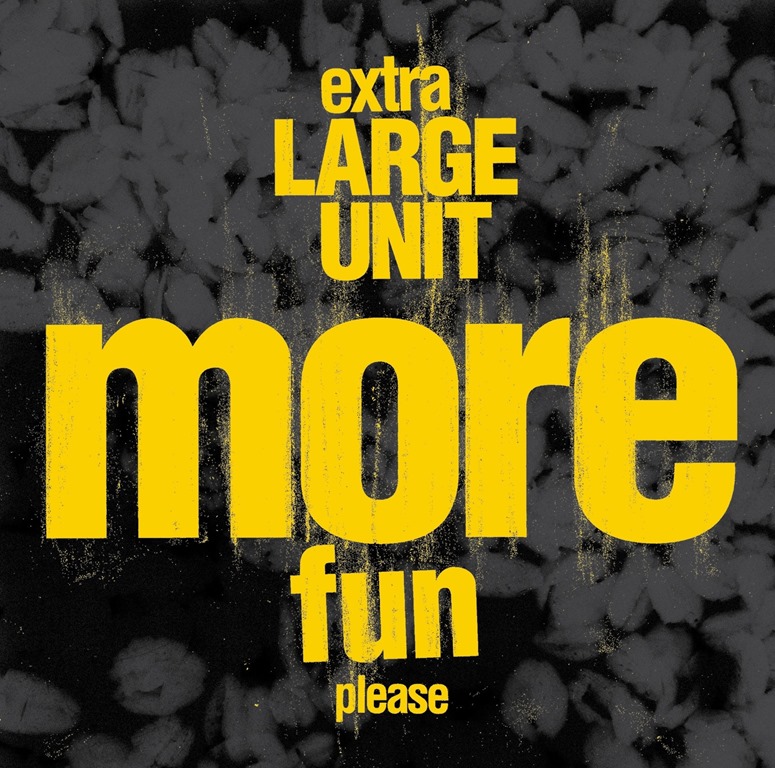
Extra Large Unit is an appropriate collective moniker: More Fun Please! is a live recording of an expanded iteration of Paal Nilssen-Love’s Large Unit ensemble, and features some twenty-seven musicians, in a line-up which features three grand pianos. Yes, three grand pianos. Excessive? Hey, if you’re going to go large, why not go uber-maxi, all-out massive?

The accompanying blurb explains that ‘The challenge of composing for so many musicians, while also maintaining the qualities and identity he had established with Large Unit, pushed Nilssen-Love to new creative levels. This was a monumental task…’ And More Fun, Please! is a monumental album. The question is, how much fun can you handle?

In his liner notes for the album Nilssen-Love writes, ‘When writing music, I search for extremes, pushing boundaries: physical, dynamic, instrumental limitations, if any, how fast and how slow can one play, how loud and how quiet. I search for unusual ways of thinking. I want to give the musicians trust and have them take initiative and to feel the responsibility of what it is to be an individual player in a group context’.

More Fun Please! is a thirty-minute aural rollercoaster, half an hour of highs and lows. At times, it sounds like a classic cartoon soundtrack, parping brass and sudden bursts of percussion; at others, it’s brimming with oriental exploration and eastern promise, and at others still, it’s utter bloody chaos, discord and cacophonous mayhem. In between, there are passages of trilling, tooting, droning and scraping, brought to abrupt halts by immense orchestral strikes – and I mean immense, earth-shaking, and borderline galactic in scale – and plinking, bibbling xylophone breaks.

The brass is beyond wild. Words simply aren’t enough.

The whole thing is an orchestral frenzy, a riotous ruckus of everything all at once, with sustained crescendos that seem to last forever.

It’s a lot of fun… but half an hour is probably about as much of this kind of fun as anyone can handle.

more_fun_please-42547043-

Ex Records – 23rd March 2018

Christopher Nosnibor

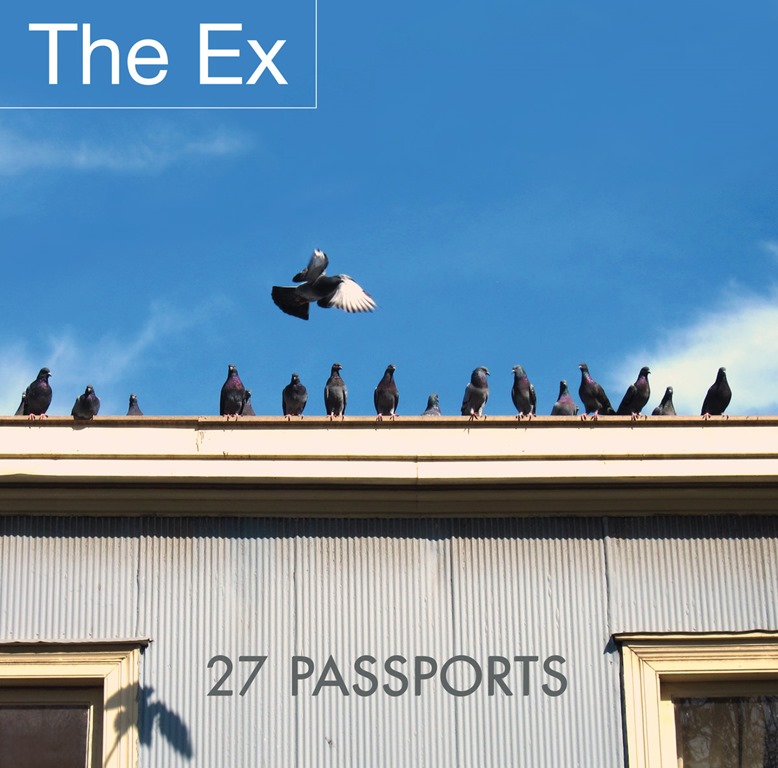
‘We always start from zero when we make a new album,’ the band explain of their creative process. This could well be the essential factor in their enduring nature: in avoiding the trap of becoming predictable to either their audience or themselves, they’ve remained fresh and innovative, continually testing their creative limits. Almost forty years and twenty-odd albums since their formation as an anarcho-punk band, The Ex are noteworthy for their eternal evolution and their refusal to stands still or to retread old ground. Collaborations, side-projects, and shifting lineups have also proven integral to this ethos, and it’s been almost eight years since their last album together as a quartet.

27 Passports sees them return once again reinvigorated, refreshed and ready to reinvent rock once more. And they do, in the way only a band with three guitars (but no bass – Moore’s baritone guitar provides essential tonal range here) and infinite vision likely can.

As the title suggests, this is an album of movement. Or, moreover, perhaps an album that creates the illusion of movement. 27 Passports is accompanied by a 40-page booklet of photos shot by Andy Moor. They’re odd, devoid of context or narrative meaning. Simultaneously eye-catching and mundane, they’re snapshots of life, devoid of perspective or implication: a row of feet on a train; a rusting car; a swan with its head under water; a traffic jam. These images provide an appropriate visual accompaniment to the disjointed, semi-abstract and immensely oblique lyrics and the musical content.

The first track, the six-and-a-half-minute ‘Soon All Cities’ is driven by a loping rhythm and crashing cymbals and builds a hypnotic groove slashed through with angular guitars which clang and scrape and layer up with volume and distortion. More than the choppy guitar work that often strays into the atonal and discordant, as do the vocals, it’s the percussion that really provides the focus of 27 Passports, pinning the loose and purposely obtuse guitar work in place and holding everything together.

If the claim that ‘there are some remnants of their African adventures’ (a reference to their collaborations with Getachew Mekuria) sits at odds with the spiky post-punk schematic, ‘The Sitting Chins’ subtly and strangely weaves ‘world’ music elements into the jolting barrage of chaos. If there was ever an antithesis of Paul Simon or Sting, this is it, and this fact alone makes 27 Passports an essential album.

For the most part, the compositions eschew linearity in favour of locking into a space and pushing away at a single motif for as long as seems reasonable, and sometimes beyond. This is very much a selling point. At to B is overrated: it’s about the journey. And it’s less about the distance than the motion itself. Take a walk: multiple laps of the block will not only achieve the same exercise effect as walking for miles toward a destination, but new details will reveal themselves with each circuit. No two circuits of the same short route will ever be the same. 27 Passports may be transcontinental in intent, but looking the wrong way down the binoculars is what it’s really about.

Barrelling bass scours the lower sonic realms on the robotic, motorik, ‘New Blank Document’; equal parts Gary Numan and early Swans, with heavy hints of The Fall’s ‘Spector vs Rector’ in its messy fabric. Such discord scratches away at the psyche, drills into the cerebellum, and unsettles the equilibrium.

In contrast, ‘Footfall’ deploys the same methodology and the same instrumentation, but against the relentlessly thumping beat, there’s a nagging aspect to the cyclical riff which has an intuitive emotional drag, a certain resonance. There’s something special about a certain descending three-chord sequence… and of course, they almost bury it beneath layers of jagged trebly noise. And that only renders it all the more beautiful and captivating.

There are some wonky pop moments present, too, with the Pavementy ‘The Heart Conductor’ bouncing along nicely, with a catchy vocal melody riding on top of the off-kilter guitars that are reminiscent of early Fall. Of course, when it comes to The Ex, comparisons are vaguely pointless beyond providing guidance for the uninitiated: with such an expansive career, it’s their work which has influenced many of the acts that stand as useful reference points. Of the surviving bands of the period – The Fall being no more and having arguably plateaued a good few years ago and Pere Ubu only offering occasional sparks – it seems like The Ex are the last ones standing who continue to really extend their reach and to challenge themselves and their listeners. 27 Passports is an absolute stormer, and an album which stands up against anything else going – period.

AA

The Ex - 27 Passports

Neurot Recordings – 11th May 2018

Christopher Nosnibor

The band’s biography locates them as ‘standing at a crossroads of light and dark’, and we learn that Chrch create ‘epic, lengthy songs, with a massive low end, and a supernatural vocal presence, in a perfect blend of height and depth’.

Epic is the word: this, their second album contains just three songs, the shortest of which is just shy of ten minutes in length.

It begins with the twenty-two minute behemoth that is the appropriately-titled ‘Infinite’. Slow-picked notes, bathed in chorus and reverb hang in suspension. Dust motes drift in the spaces between them, and time stalls in a freeze-frame. Gradually, the percussion begins for form rhythm in the background, and some semblance of form begins to emerge. It’s around the five-minute mar when the dual vocal – a banshee howl and chthonic growl – tear through a landslide of trudging guitars so slow and low as to be positively subterranean. The mid-section is delicate as a butterfly’s wing, before the second heavyweight segment proffers forth some kind of doom rendition of classic rock, like Clapton on Ketamine, multiple lead guitar lines intertwining at a fraction of the conventional tempo.

‘Portals’ focuses more on the infinite power chords, screeding feedback, bowel-shaking bass and screaming demon vocals. It’s the soundtrack to a descent into the infernal abyss. The trudging riff that dominates the second half is enlivened by a majestic lead part and Eva Rose’s captivating vocals which soar and glide magnificently. I shan’t deny it: I’m a sucker for a shoegaze voice pitched against slabs of guitar as heavy, grey, and grainy as basalt.

The final cut ‘Aether’ is by far the lightest and most uplifting in its tone, and pushes further into shoegaze territory, despite its agonizing 40bpm pace and the anguished screams in the background. It feels like a crawl toward the light at the end of the tunnel, and despite the thunderous weight and the howling agony which permeates every note, it feels somehow redemptive.

The heavy passages – and they’re seriously heavy – are broken by protracted periods of tranquillity, of mesmeric beauty and delicate grace. But, truth be told, the format’s growing tired, the tropes of the dynamics embedded to the point of predictability now. And so it all comes down to execution and the details. On Light Will Consume Us All, Chrch venture – subtly – into different territories, territories which exist beyond the template of what’s now the doom standard. And it’s well executed. Really well executed.

AA

538622

Bearsuit Records – 20th April 2018

Christopher Nosnibor

Try as I might – and I do, I really do – I find it impossible to avoid words like ‘weird’ ‘whacky’, and ‘oddball’ in reviews of anything released on the Edinburgh micro-label Bearsuit Records. This is no reflection of a lack of vocabulary on my part: it’s simply what they do. Every boutique label needs some kind of signature or house style, and a micro-label really needs a niche. Bearsuit specialise in stuff that’s so far out it’s beyond.

Fear of the Horizon is actually pretty conventional by Bearsuit standards – but these things are all relative. ‘Eamon the Destroyer’, the album’s first cut, arrives in a flourish of expansive prog-rock guitar and twittering electronics, all on top of a thumping beat that’s pure dark hip-hop. And then the guitars really takeover and we’re in territory that’s suspiciously close to be being categorizable as ‘rock’. But then ‘The Positive Approach of Talkative Ron’ swings into view in waltz-time and goes all weirdy… and then there’s whistling and another epic guitar solo.

Pancultural influence are infused within the glitching electronic fairground fabric of ‘Woman With the Plastic Hand’, with its stuttering beats and woozy organ sound, while ‘Vandal Schooling’ brings with it a crunch of industrial noise and stabs of bold orchestral brass, taking a sharp turn from abrasive to mellow around the mid-point and locking into a metronomic hard, industrial-disco flavoured groove near the end. For the most part, though, the sounds are soft-edged, mellow, supple, analogue.

‘The Horizon Project’ brings together mellow and woozy, its mellow motifs and nod-along beats cracked with a stylophone break and underlying hiss of distortion. It runs contra to the chilled beats and quite accessible lead melody.

‘Weird’ ‘whacky’, and ‘oddball’… they’re all entirely appropriate adjectives, but fail to account for the depth and range of Fear Of The Horizon. As hard as it may be to take seriously an act going by the name of Bunny & the Invalid Singers, there’s real merit to this work that goes far beyond the superficial quirkiness. ‘Weird’ ‘whacky’, and ‘oddball’ don’t convey the wistfulness, the melancholy, the nostalgia, range of emotions, moods and mindsets.

This is where I should sign off with a suitably witty flourish, or some pun-based punchline, but such flippancy would be to only further undermine the true merits of an album which clearly shows no fear. Fear Of The Horizon is a fun, entertaining, and enjoyable work but don’t let the oddness and goofiness lead you to believe it isn’t serious, or art. Because it’s most definitely both.

AA

Bunny & the Invalid Singers – Fear Of The Horizon

Front & Follow – 6th April 2018

Christopher Nosnibor

As a child in the late 70s and early 80s, I used to play with three fox stoles that belonged to my mother. I was fascinated by their glass eyes and the clips that made ‘mouths’, and didn’t really consider any of it to be strange at the time. As an adult who’s been vegetarian for over twenty years, the very idea of a real fox stole – not to mention the sheepskin rugs that adorned each of the bedrooms in my parents’ house – horrifies me beyond words. Perhaps it was this sense of horror that pushed these recollections out of my mind for quite literally decades. But in the opening scenes of Penny Slinger, the film directed by Richard Kovitch, we see Penny walking down a stately driveway (Lilford Hall), draped in fur coat, accessorised by a fox stole, its beady artificial eyes looking fixedly over her shoulder toward the camera. This is our introduction to both Slinger and An Exorcism, the work which defined her career before her swift disappearance from the public eye for a very long time.

There’s another personal preface I feel a certain obligation to include here: I first encountered Richard Kovitch in around, maybe, 2008, in the days of MySpace. Although now known as an award-wining director, Kovitch is something of a polyartist, and was writing – both fiction and essays – back then, and I had the privilege of including one of his stories, ‘For Reasons Unknown’ in the first Clinical, Brutal anthology in 2009. The story showcased Kovitch’s keen eye for both narrative and visual, something that’s common to much of his work, and the feature-length documentary Penny Slinger – Out Of The Shadows is no exception.

The film is pitched as ‘the incredible, untold story of the British artist Penny Slinger and the traumatic events that led to the creation of her masterpiece, the 1977 photo-romance, An Exorcism’. Much of the story is told by Slinger herself, who proves to be a remarkably cogent and articulate speaker. The documentary notably features contributions from Peter Whitehead (who collaborated with Slinger on the shooting of An Exorcism at Lilford Hall in 1969, and it’s footage from this which opens the film) and Michael Bracewell, amongst others, and the ‘talking heads’ segments are comfortably paced and helpfully cut with pieces of Penny’s work in a way that satisfies both the well-versed and uninitiated. Ultimately, it’s most notable for its well-structured narrative. And its soundtrack.

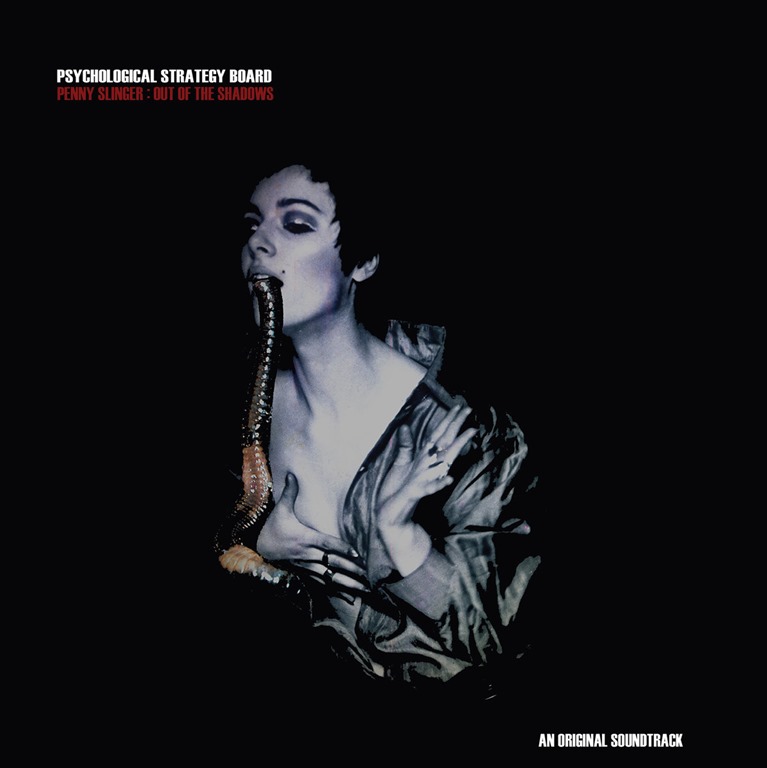
The soundtrack in question is the debut album for Psychological Strategy Board. Taking their name from the committee responsible for overseeing strategies of psychological warfare in the US in the 1950s, it’s perhaps appropriate that biographical details about them is scant, beyond the fact Maybury and Paul Snowdon are perhaps better known as johnny mugwump and Time Attendant respectively, and that their only previous release is an EP, also released on Front & Follow, back in 2012. That. And the fact that the creation of this soundtrack, which began in 2011, was a challenging experience, both musically and personally. In context, it isn’t entirely surprising.

As it transpires, their near-invisibility proves to be something of an asset, as well as an indication of their modus operandi: while the soundtrack – released on vinyl and download split into thirteen tracks – is a continuous presence throughout the film’s one hour and thirty-three-minute duration – and very much steers the mood and accentuates the atmosphere, particularly when accompanying the more dramatic shots or narrative moments, it’s subtle in its delivery. Within the context of the film, it works well.

The measure of a soundtrack’s quality is whether or not it succeeds on its own merit, as a musical work, when separated from the film it was designed to accompany. This does, not least of all because it’s a largely ambient work which conjures image and feelings – often of disquiet -that any ambient work of a darker persuasion might. Dank rumblings and slow churns reminiscent of Throbbing Gristle nudge against hovering dissonance and creeping fear chords.

Spurts of electronic dislocation bubble and fizz over thick ripples of amorphous, atonal synth sound, hissing static and whispering winds. Sonorous low-end notes resonate, hanging in the air before they slowly decay, submerged by tense undulations. The atmosphere is dark, ominous, unsettling, but not oppressive. And while the narrative of the documentary and the creative process which yielded the supremely surreal and highly sexual An Exorcism is not – and never could be – conveyed in musical form, the otherness of the work itself very much is.

AA

Psychological Strategy Board – Penny Slinger Out of the Shadows

Discrepant – CREP53

Christopher Nosnibor

This double album gathers two previous CD-only releases, both of which focus on Laurent Jeanneau’s love/hate relationship with China.

Soundscape China comprises two side-length sound-collages, with long samples of songs and TV shows, including what sounds like an exercise routine, and street bustle and radio, children’s voices, are overlayed with sounds of the sea and myriad extranea. Jeanneau’s work under the Kink Gong guise is often described as ‘surreal’, as collage works so often are, on account of their tendency to collide incongruence. The effect of displacing objects or text (with sound and moving images included in this category… one could argue that anything and everything is text in some form or another) and relocating it to an unfamiliar setting or alien context has the capacity to instil a sense of the uncanny. ‘Soundscape China Part 1’ doesn’t produce this effect, and feels more like reportage, a work which captures something of the flavour of the county without making any inference or comment, and without affecting any discernible change to the material or what it represents.

The Kink Gong website carries the notice that ‘Under the name KINK GONG you find 2 activities, the 1st one is to record ethnic minority music mostly in south-east Asia, the 2nd is to transform, collage, recompose the original recordings into experimental soundscapes’.

The second piece fulfils these both: it is far more intense, with jarring juxtapositions, crashing percussion. The material is more overtly spliced, the collaging nature of the work more apparent, and the overlaid noise louder, more abrasive. Yet there is still no sense of location in either time nor space. Not that this is a criticism, or something that could be considered a failing of the work: it’s simply its nature, and, more likely than not, my personal reception – Jeanneau’s experience of, and relationship with, China is considerably more deeply engaged than my own virtually non-existent experience beyond television.

Destruction of Chinese Pop Songs, on the other hand, is indeed, surreal. In fact, it’s fucking weird. Recorded (?) between 2000 and 2002, made mostly from skipping CDs of Chinese pop songs and further recomposed in Kunming (China), Vientiane (Laos) and Paris.

Why would anyone do this? And then, why would anyone listen to it? I could defend my choice to stick the album’s full duration – and in a single sitting – as research in the line of duty as a critic, but the truth is, these skipping, jitter, scratched-up, fucked up defacements hold a perverse pleasure, and I listen with bemusement.

‘Car crash’ is a phrase that’s been overused to the point of cliché obsolescence, but it’s appropriate here: not only does it convey the awkward compulsion to continue listening despite the discomfort and the knowledge that it will be impossible to unhear this, but it also reflects the mangled musical wreckage that’s wrapping itself around your ears. That said, having driven past two accidents within a short distance of one another on the A1 on Good Friday, noting my wife’s irritation and snappy frustration at all of the cars slowing as they passed, I made a point of not looking to prove that it is possible to resist. I felt a little cheated at denying myself from observing the Ballardian spectacles, but have no such need for restraint in the face of this exercise in avant-garde appropriation and defacement.

And the collisions keep on coming. ‘Hit Qin Qin’ sounds like R2D2 in the middle of a circuitry meltdown in a sea of distortion and static, while plinky-plonky piano lift music rolls on, despite the notes warping and melting. It’s simultaneously comedic and horrific. Elsewhere, ‘Pingtan’ sounds like a string instrument being slowly pulled apart while a radio plays random stations in the background, and ‘Bai Street Dance’ sounds like it was recorded on a condenser mic and played back through a Walkman speaker with a torn cone.

Everything about these songs is difficult and obtuse. Even when the ‘songs’ aren’t devoured by stutters, glitches, sticks and all other kinds of sonic wobble that’s a variant on the digital stutter, or by distortion and static and fast-forwards – yes, even when the form and sound of the song beneath the fiddling is fundamentally intact and discernible – there’s other shit thrown in to interfere and interrupt it. So yes, it is surreal, and continues the lineage of William Burroughs’ audio cut-ups, while revisiting the questions of context, ownership and defacement raised by Duchamp and the Dadaists before.

It’s obscure, awkward, bizarre, messy. It’s disorientating, destructive and really rather silly, both in terms of concept and execution. But these are all the reasons to appreciate Kink Gong’s commitment to forging his own path.

Dian Long: Soundscape China / Destruction of Chinese Pop Songs present two very different – if closely connected in thematic terms – aspects of the artist’s work, and releasing them together as a single document makes perfect sense, so long as you’re amenable to experiencing a total mindfuck.

AA

Kink Gong - Soundscape