We’ve been bigging up York’s mighty riffmongers JUKU since their debut gig in the summer of 2023, because they’re simply fucking awesome, a real force to be reckoned with. Punky, new-wavey, but noisy, full-on, a sonic powerhouse.
Now, you don’t just have to take our word for it if you can’t see them live, as they’ve unveiled a video for ‘What?’ It encapsulates the band, and their sound, perfectly.
They write, ‘As a band, we sit in the place where creativity meets raw chaos. In our world, noise is harnessed as a form of expression. We channel frustration into sound. We take our discontent and transform it into energy. We outright challenge the notion of what it means to be seen and heard in the music industry, which often silences dissent… This track is a prime example of the things that motivate us to do what we do. Question everything and everyone, and do not allow your voice to be pushed into the obscurity of the background.’
Leatherette are back with brand new single ‘Itchy’ to mark the start of their recently announced EU/UK tour. The tour includes a show at London’s The Shacklewell Arms on 13th February.
After testing the song live during their second album Small Talk tour last year, they decided to record it themselves at home in a completely spontaneous manner, in messy rooms and using cheap instruments (including unlikely ones such as mandolin and bouzouki).”Being eternally dissatisfied, but also tireless explorers, we decided to return to our origins, seeking the expressive freedom that can be found in DIY”. The result was then entrusted for mixing to the usual collaborator Chris Fullard (Idles, Boris), and for mastering to Maurizio Baggio (The Soft Moon, Boy Harsher).
‘Itchy’ is a cathartic breakup song, blending the raw energy of post-punk with the angular charm of new wave. Written from the perspective of an inept and creepy protagonist, the track navigates the emotional chaos of a crumbling relationship, where frustration, anger, and reluctant self-realization collide. The song channels a blend of influences—from The Smiths’ melancholy to the frenzied urgency of The Pixies and the romantic nihilism of Tears for Fears. It’s a feverish exploration of love’s end, wrapped in an infectious, almost grotesque sonic landscape. Finally, it all resolves with a delicate, haunting arpeggio—like the quiet after the storm, offering a fleeting sense of clarity amid the wreckage.
Cool.
AA
EU/UK TOUR – FEBRUARY 2025
Thu 06 – Radio Rasa – Schaffhausen, Switzerland
Fri 07 – Le Rockerill – Charleroi, Beglium
Sat 08 – Zero Degree Est – Les Roches-L’Eveque, France
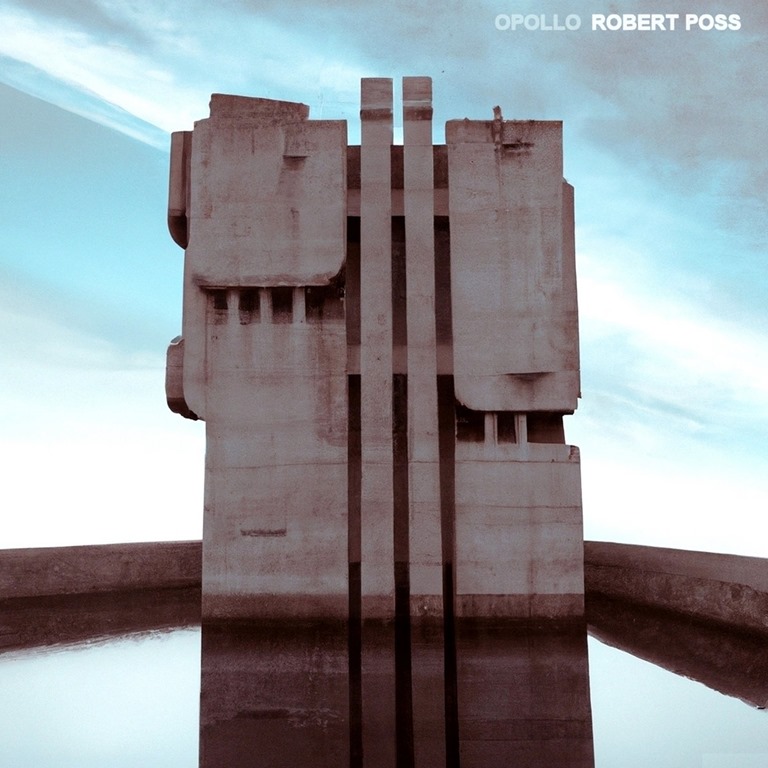
Robert Poss vs. Opollo is a new collaboration between Jarek Leskiewicz and Robert Poss (Band of Susans).
OTAGO is an expansive, textured, semi-ambient guitar work with some bold sounds and brooding atmospheres.
It’s available to stream or download via Bandcamp on a ‘pay what you feel’ basis. Check it here, along with the visual accompaniment to ‘Destroyed Wild Bird’:
It’s perhaps an understatement that Charlemagne Palestine’s body of work is immense, and the range of artists he’s collaborated with quire staggering. Active since the early 70s, it’s likely impossible to give a brief summary of his career or output, and when approaching a work such as this, I find it easier to place career context to one side and evaluate it on its own merits. It may be an admission of failure, a confession to a limited knowledge, but the debates over how a release sits in relation to the other forty or so albums are the place of fan forums.
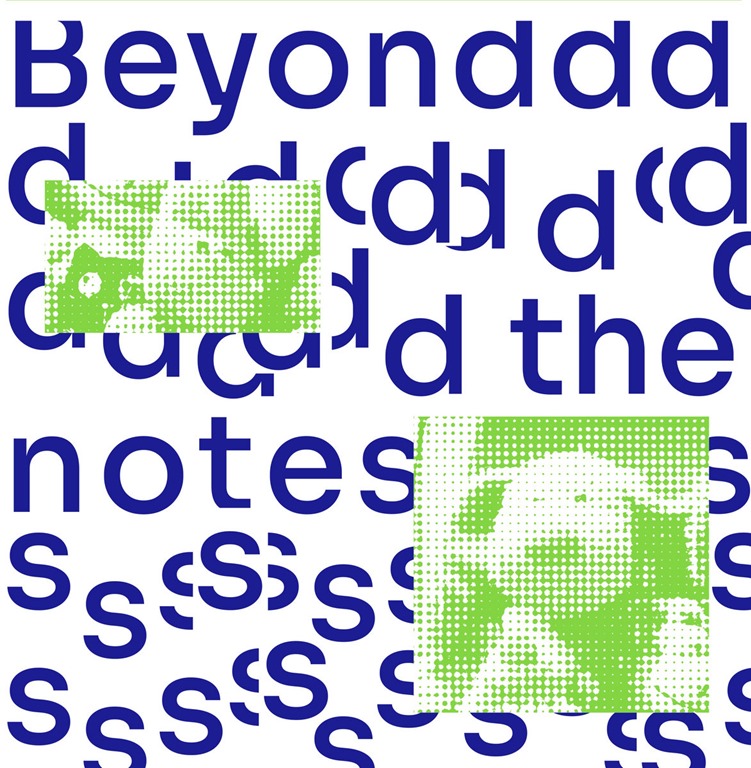
However, in keeping with his habit of adding many repeated letterssssss at the end of words and songgggggggg titlesssss, Beyondddddd The Notessssss, his collaboration with Seppe Gebruers bears a rather daft titleeeee, of which I shall make no more, other than to observe that this suitably sparse, piano-led work does indeed take the listener beyond the notes as it promises.
Over time, I’ve become quite drawn to this type of album, which seems to proliferate in experimental circles, whereby an LP – released on vinyl, too – will contain just two or three tracks, and the compositions seem to be arranged around the fact that each side has the capacity for around twenty minutes of audio. I suppose it’s because I grew up in the 80s, and was raised on vinyl as the dominant format, but in the world of the mainstream, where an album – approximately forty minutes in duration – would consist of ten, or perhaps nine songs, most of which were three or four minutes in length, and could be lifted as a radio-playable single. In the late 80s and 90s, the 12” would provide longer edits of singles, often aimed at clubs, but discovering the two-track album was a revelation, in that it seemed like a revolution of form. I was unfamiliar with the works of Tangerine Dream, Yes, or Pink Floyd beyond their singles at this time, because… well, because.
Side one is occupied by the twenty-one minute ‘Gotcha I’, a sparse composition where discord dominates to render an uncomfortable listening experience. It feel like semi-random plonking on an out of tune piano. In pinks and pings, plongs and tinkles with no time sequence, no key, and no clear sense of form. It simply is. Notes clash and collide, ripple and rush against one another, sometimes holding back, hanging in suspense. In some respects, it bears a resemblance to jazz improv pieces – and perhaps not entirely surprisingly: this album features two pianists ‘passion for unusual tunings and the playing of multiple pianos’. The result of the collaboration is four pianos, played simultaneously, with each piano tuned in a rather less than conventional way.
It would perhaps be beguiling if it wasn’t so far removed from anything we’ve been accustomed to recognising as melodic. But as it is… everything simply sounds wrong. Atonal, uncomfortable, off-key and off-kilter. The effect is quite brain-bending, because everything feels warped, out of step, uncoordinated. It isn’t, of course: it’s simply how our minds have been programmed and attenuated to conventional note sequences and melodies, and Beyondddddd The Notessssss trashes everything with a joyful abandon. Once you come to accept this, and to reattenuate your own listening to accommodate this strangeness, which offsets the balance, sets one lurching and feeling bewildered, it becomes somewhat easier to accept.
‘Gotcha II’ commences side two where ‘Gotcha I’ / side one leaves off, but tumbles slowly into altogether more spartan territory. Each note hangs. There are moments of silence. Deep, rumbling, stomping piano arrives, dinosaur-like. It’s primitive, but strangely magnificent, carrying as it does a simplicity which is rare. And this simplicity brings with it a sort of honesty. I’m fumbling for words, here, for reasons which aren’t even readily explainable. Towards the end, notes cascade and tumble over one another, culminating in a frenzy of clattering, broken notes, and it’s bewildering.
Bewildering is perhaps the most apposite description of Beyondddddd The Notessssss. The title track, which draws the curtain with a five-minute finale, offers something approaching minimal jazz – with the emphasis on minimal. And jazz.
Beyondddddd The Notessssss goes way beyond the notes, and, indeed, way beyond the rational.
While studying English Literature at university, I undertook a module on Anglo-Saxon literature. It was fascinating to learn the etymology of certain words, and the way in which commonplace phrases came to be, and one thing which struck me was the reverence the Anglo-Saxons held for the bear, with not only words like ‘berserk’ deriving from a fierce, angry bear, with armies placing their berserkers at the front of their lines, foaming at the mouth and gnashing their teeth on their shields to strike fear in the hearts of their opponents, but the phrase ‘lick into shape’ came from the belief that bear cubs were born as balls of fur, and their mothers would literally lick them into the shape of a bear. In so many aspects of life, through history, humans have aspired to be like bears.
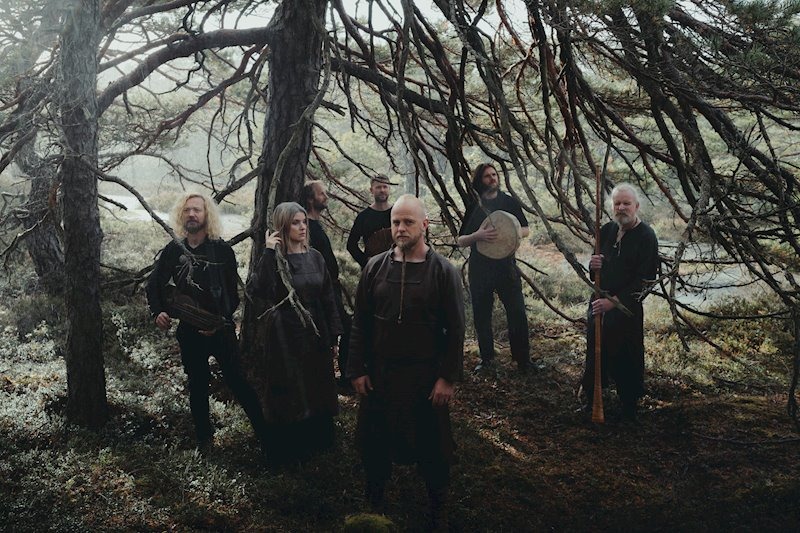
It is this which provides the central theme of Wardruna’s sixth album, as the accompanying notes expand upon:
The bear frequently figures in the oldest myths of mankind in the northern hemisphere, and many indigenous people still regard this animal as a totem, honouring it with rites and songs. It was once our respected guardian, our guide to edible plants and berries, a creature we both feared and admired. Although the bear from the very beginning has constituted a threat to our own lives and those of our livestock, humans have always identified with the bear in various ways. If you skin the animal, its body underneath the fur strongly resembles that of man, which may be a reason legend has it the bear in fact originated from humans, and for thousands of years we have strived for its strength and wit. In some cultures, “treading the path of the bear” means pursuing what you’re truly meant to do in life.
Because this is a Wardruna album, it taps into ancient mythologies on a level which goes far deeper than some kind of conceptual cosplay or superficial skirting around the subject. Wardruna has a way of tapping into a spirituality which resides in our very bones, our DNA. Their music resonates, powerfully, in ways which are hard to articulate beyond the fact it stirs something deep inside. Birna is more than an album, it is a force of nature distilled in musical form.
‘Hertan’ begins with a thudding rhythm like a heartbeat which provides the backdrop to a spoken word introduction and, suddenly, a swelling surge of sound, clattering wooden-sounding percussion and bold choral chants. Immediately, it evokes images of a primal heritage, of rituals performed on moorlands around open fires, animal skins, ceremonies exulting pagan spirits, and a connection with the earth which transcends words alone.
Thetitle track is simply immense, a colossal, powerful blast of sound, which conveys the strength – and also the gentleness – of the she-bear. It’s perhaps here where they most successfully articulate the appeal and fascination of the bear, a creature capable of the most divergent behaviours, so caring to its cubs, but would absolutely annihilate anything when threatened. There’s a reason why you don’t, as they say, poke the bear.
The fifteen-and-a-half-minute ‘Dvaledraumar’ (Dormant Dreams) enters rather more ambient territory, lunging into slow droning darkness after a hooting call like that of a conch shell being blown, or similar. Along with ‘Jord til Ljos’ (Earth to Light), it forms ‘a two-song meditation creates a joint hibernation between animal and listener’. It’s somewhat sad, that we haven’t taken cues from the bear to hibernate. It doesn’t feel natural to drag oneself out of bed and trudge to work in darkness, when it’s often cold, wet (or snowy, depending on geography), and windy. Before industrialisation, before electricity, working hours were limited by daylight, and in feudal times, serfs would effectively hibernate, unable to work the field during the winter months. I’m certainly not saying that this was a golden age of any kind, but capitalism and technology have certainly failed to deliver the lives they promised with a wealth of leisure time.
Sitting and reflecting on this, the rippling, repetitive melodies of these two tracks washing over me, I once again find myself envisaging dense, expansive woodlands, a habitat thick with vegetation, and sparse with population, a world before humans lost touch with nature and even humanity, and fucked everything up so badly. And I suppose it’s this desire to rewind the clock, to unfuck the planet, to undo centuries of mistakes to rediscover that which lies subconsciously in our hearts, which Wardruna connect with so perfectly.
Following this extended hibernative segment, they return first with ‘Himinndotter’ which evolves from being sparse and folksy to a frenetic frenzy of tribal percussion and a powerful choral refrain. ‘Tretale’ presents a haunting rumble with a breathy, hypnotic vocal. It’s built around a low, deep-lunged organ-like drone, but cuts back to some hypnotic passages where the insistent beat stands almost alone.
The eight-and-a-half-minute ‘Lyfjaberg’ brings the album – which is epic in every way – to a close with a slow, hypnotic beat and repetitive instrumentation and vocal chorus. It draws you in in such a way as to suspend time and space: it’s hard not to get lost in the moment, but also, ultimately, in time. I suspect I’ve described Wardruna’s music as ‘transcendental’ before, and more than once… but is the word which most accurately describes their music. Yes, THE word – and perhaps the only one. Because this… this is something else.
Roman Numeral / Machine Tribe Recordings – 24th January 2025
Christopher Nosnibor
Having premiered ‘Opilione’ just over a week ago as a taster for this blackest of black sonic expulsions, I’ve now had some time to digest the album in its entirety. And it’s an acrid, acidic tang of bile which burns the throat and scorches the trachea, and a bilious discomfort which emanates from every noxious moment of this absolutely hellish effort.
The Finnish duo’s Bandcamp simply describes them as ‘BLACK VOID NOISE’, and it’s hard to better that, really. Black Abyss Invocation, which essentially launches Vomitriste phase two, having drawn the curtain on phase one with the Droneworks (2022-2024) compilation.
Black Abyss Invocation is relentlessly dark. In fact, it goes beyond being merely ‘dark’: darkness connotes an absence of light. Here, Vomitriste create a negative balance, subtracting, subtracting, endlessly subtracting, sucking out both light and air, like a black hole which drags the listener into a vortex of perpetual purgatory, while hanging over the smouldering pits of hell.
‘Opilione’ is entirely representative: each of the album’s six compositions last between five and eight minutes, providing ample time for the agonizing atmospherics to wrack every one of the senses in the most torturous fashion, and seeming to manifest in physical ways as you find your skin crawling and your muscles tense.
The album opens with ‘Void Sermon’ – a rumbling blanket of sound that’s between dark ambience and harsh noise wall at first, before vocals – rasping, demonic screams, shit-your-pants inhuman – roar in before the very bowels of hell open wide and drag you down, down, down. Void Sermon? Void bowels would be equally apt.
From here, it’s less about progression, as slow subtraction. Listening to Black Abyss Invocation, I find myself reflecting on various methods of punishment and torture from throughout the ages – rat torture, for instance, or coffin torture, or the breaking wheel. The slow, agonising tortures which almost invariably resulted in a protracted and extremely painful death. Or perhaps, one I discovered on a visit to York dungeons, the ‘blood eagle’, referenced in Norse literature. Certainly, by the arrival of ‘Fleshwards’, on feels as if one’s ribs are being severed from the spine with a sharp tool, and the lungs pulled through the opening to create a pair of “wings” – because this is brutal, cacophonous noise and howls of anguish echo from subterranean caverns without mercy. To survive to the end of the album is to still be awake and alive in the hell that is life on earth in 2025.
Black Abyss Invocation is truly the stuff of nightmares: there is no escape from the abyss, and there is none more black.
UK Progressive Rock group Frost* is pleased to share a new stand-alone single titled ‘Western Atmosphere.’ This song was originally featured as a Japanese-only bonus track on the album ‘Life in the Wires,’ and sees band leader Jem Godfrey joined by Randy McStine (Steven Wilson, Porcupine Tree – live guitarist), Mike Keneally (Devin Townsend) & Nick D’Virgilio (Big Big Train).
Godfrey says this about the track: “I sometimes wonder what would have happened had I stayed in bed 10 minutes longer than I did on Monday 11th of January 2010. Perhaps my life would have gone in a completely different direction and Frost* would have ended up with the lineup of myself on keys, vocals and bass, Mike Keneally on guitar, Nick D’Virgilio on drums and Randy McStine on guitar and vocals. We’ll never know, I guess.”
It begins with a rumbling roar, like a persistent strong wind rushing over moorland, before ripples of piano delicately drift over it to altogether calmer effect – although the roar continues beneath. The juxtaposition brings a balance of sorts.
Just a few days ago, I wrote on Circuits From Soft Frequencies by Jamie Lee, which was recorded among the sound mirrors at RAF Denge, in Kent, and touched on the fascinating nature of these structures, and opined that ‘often, the most alien and seemingly otherworldly creations are, in fact, man-made’.
Lawrence English’s latest work seems to contribute to this dialogue, albeit approaching from a different perspective.
‘I like to think that sound haunts architecture,’ he writes, and goes on to remark, ‘It’s one of the truly magical interactions afforded by sound’s immateriality. It’s also something that has captivated us from the earliest times. It’s not difficult to imagine the exhilaration of our early ancestors calling to one another in the dark cathedral like caves which held wonder, and security, for them.’
English also writes of the relationship between space and place, and how ‘Spaces hold the opportunity for place, which we create moment to moment, shaped by our ways of sense-making… Whilst the architectural and material features of space might remain somewhat constant, the people, objects, atmospheres, and encounters that fill them are forever collapsing into memory.’
The album comprises eight numbered segments, ETHKIB I – VIII, all formed using fundamentally the same sound palette, and which flow into one another seamlessly to create a single, continuous piece, which is best experienced without interruption.
The piano and the undercurrents, which evolve from that initial roar to altogether softer drones which drift, mist-like, develop an interplay whereby the dominant sound switches, sometimes with one or the other fading out completely – but this happens almost imperceptibly… It isn’t that you don’t listen to the music, but the preoccupation of the listening experience is absorbing the atmosphere, and it possesses almost a physicality. By ‘ETHKIB V’ the sounds has built such a density that the sensation is like being buffeted. Amidst the deep drones, there are, in the distant, whirring hums and elongated scrapes which evoke images of disused mills and abandoned factories. Perhaps there’s an element of the power of suggestion, but it’s difficult to contemplate purely abstract visualisations, or nature without some human aspect somewhere in the frame.
The soundscapes English creates are evocative, and in parts, at least, haunting – although ultimately, what haunts us is our own experience, our thoughts, our memories. And in this way, from space, we create our own sense of place, and tie things to them in an attempt to make sense of the world as we experience it.
By ‘ETHKIB VIII’, it’s the piano alone which rings out, in a reversal of the opening, and some of the mid-sections, ending on a single, low note, repeated, held, reverberating, leaving, ultimately silence, and a pause for reflection.
“Golem Mecanique touch[es] upon the ashes and fibres of back metal and the DNA of gothic music, literature, sorcery, and most of all—poetry.” – Stephen O’Malley
The last words that poet and visionary film director Pier Paolo Pasolini said in his final interview were “Siamo tutti in pericolo”; translated: we are all in danger. Pasolini was then brutally murdered on a beach in Italy, a case which is still cold today.
On this album, named after the man’s final public words, Golem Mecanique loses herself on that same Italian beach alongside his body and translates her observations and mourning into a devastating musical landscape. Siamo tutti in pericolo will be released via Stephen O’Malley’s Ideologic Organ label on 14th March.
Siamo tutti in pericolo is dangerous, conveying the darkness and uneasy nature of both the art Pasolini created when he was alive and the circumstances of his murder. In her early teens, Golem taped the Pasolini film Accatone when it was shown on television and watched it the next day after school. In her words, “it was an earthquake!”,
Immediately leaving a great impression on her as it was unlike anything she had ever seen before. She describes the feeling she has when watching a Pasolini film as “silent violence” – a cold and radical response which calls into question her beliefs about the behaviour of people and lies and truth. She hopes to evoke this feeling with her music – a melding of beauty and dread.
Today, she shares the track ‘La Notte’ from the album…
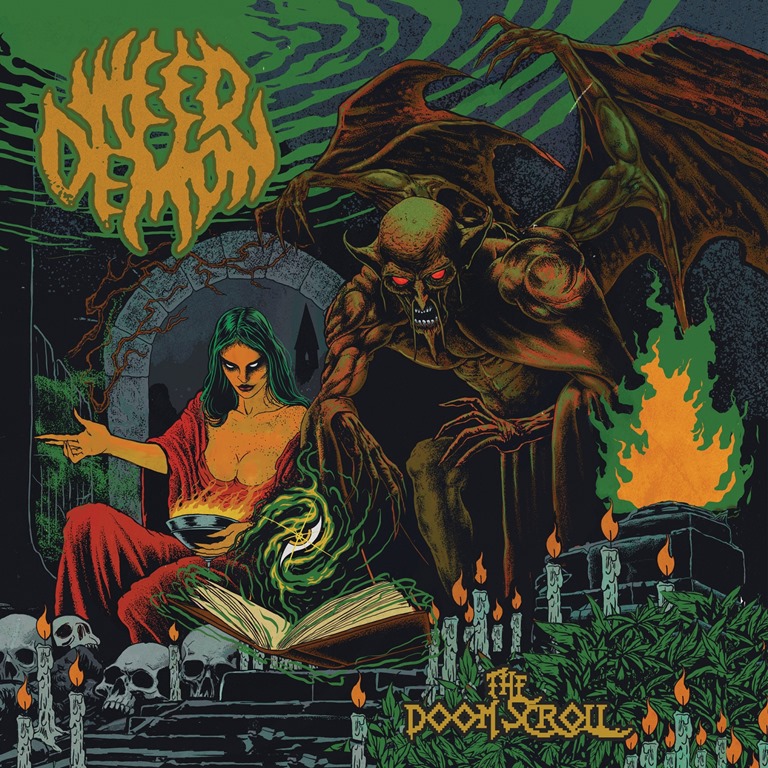
The four-piece ‘sludge ‘n’ roll stoner metal band’ from Columbus, OH, come with the description of being ‘the audio equivalent of bong water spilled on a Ouija board’
The Doom Scroll – such an obvious but well-placed piece of punning – is their third album, and lands a full decade after their debut EP – or as they put it, they ‘exhaled a cloud of riffs over the doom metal scene with their debut EP, Stoned to Death… [and] since then, they’ve consistently delivered a steady dose of sludgy, groove-laden stoner doom potent enough to make Beelzebub himself bang his horns.’
For this outing, they promise ‘a reinvention of their signature sludge ‘n’ roll style of doom. Equal parts unrelenting and crushing, yet infused with heavy blues-inspired riffage, this new chapter sees Weed Demon expanding their sonic horizons like never before… Expect doom, gloom, sludge, thrash, death, blues, and even a dash of dungeon synth for good measure.’
That this is an album which contains just five tracks (six if you get the vinyl, which features a cover of Frank Zappa’s ‘Willy the Pimp’) is a fair indication of its form and the duration of said tracks: apart from a couple of interlude-pieces, they’re all six-plus minute sprawlers, with the colossal ‘Coma Dose’ spreading out over more than nine and a half minutes.
And so it is that after the slightly pretentious and proggy-sounding synth-led instrumental intro that is the woozy, wibbly, ‘Acid Dungeon’, they’re thundering in with the rifftastic ‘Tower of Smoke’. It’s a quintessential stoner-doom effort, a mid-paced slab of thick, distorted riffage with a strong Sabbath via Melvins vibe to it. It’s big on excess – of course it is. It simply wouldn’t work without the widdly flourishes that spin their way up from the dense, grainy overdrive that just keeps on ploughing away. And it keeps going on – and on. As it should, of course. It simply wouldn’t be befitting to batter a leaden riff for three or four minutes – you can’t mong out to that.
‘Coma Dose’ starts out gently with some desert rock twangs and a shuffling beat that’s almost a dance on the beach kind of groove, and there are – finally – some drawling vocals low in the mix. A couple of minutes in, of course, the riff lands, and the vocals switch from spacey prog to growly metal, and just like that, things get dark and they get heavy. But for all the weight, there’s still a floaty trippiness about it, a softer, mellowed-out edge: it’s heavy, but it’s not harsh, or by any means aggressive. There are some flamboyant drum fills and a super-gritty bass break over the song’s protracted duration, and at times, it sounds as if the batteries are starting to run low as it slows to a thick, treacly crawl and Jordan Holland’s vocals sound as if he’s being garrotted – and again, this is all on point.
There are elements of hardcore to the shouted vocals and pummelling power of ‘Roasting the Sacred Bones’, while ‘Dead Planet Blues’ brings a quite delicate blues-rock twist and even a hint of Alice in Chains circa Jar of Flies.
Rather than push hard at the parameters of the genre, Weed Demon nudge at the edges in all directions, and this works in their favour. There’s plenty here to keep diehard fans of all things sludgy, stonery, and doomy content without straying into territories that don’t sit well, but then there’s enough to make it different and interesting.



 Aural Aggravation