London based Progressive Psych Doomsters Morag Tong have a video out for the first single to be released from upcoming sophomore album Grieve.
Grieve is the band’s long-awaited follow-up to 2018’s acclaimed full-length debut Last Knell of Om and marks their first release on Majestic Mountain Records. Regarding the album Vocalist/Drummer Adam Asquith states “we wanted to create something huge and heavy, but also gorgeous, textured and atmospheric. Incorporating both massive, aggressive wall of sound sections and more pensive, stripped back ambient instrumentals I think we have hit that sweet spot – something anguished and anxious, crumbling and dangerous, yet eerily beautiful and oozing with a love for life itself.”
It’s been a while since I attended one of these short Sunday matinee shows, but last time I did – last spring, when Snakerattlers launched their album – I was absolutely sold on the concept of a band or two and a couple of pints after Sunday lunch. Dan Gott – of Snakerattlers, JUKU, and gig promoters Behind the White Door – is one of those people who likes to do something different, and it’s great to see him coming back to this idea.
Since the last time I came to one of these, a lot has happened, and now being a single parent to a primary-school age daughter and with no relatives on the county makes getting out on a night nigh on impossible, so this offered me a rare opportunity to get out for beer and live music. I’m clearly not the only one who digs the short matinee format, with around fifty punters occupying the dark space rather than basking in the beer garden.
Before the show, the partner of one of the guys from Wasted Denim is explaining to their kids, sensibly sporting ear defenders, the process of the soundcheck, and there’s something warming about this kind of environment, and speaks volumes about the bands, the venue, and the organisers.
It’s good for bands, too, opening up the possibility of playing two shows in a day, getting paid twice, and selling merch to two sets of punters. Or simply to get home ein decent time ahead of dayjobs the following morning.
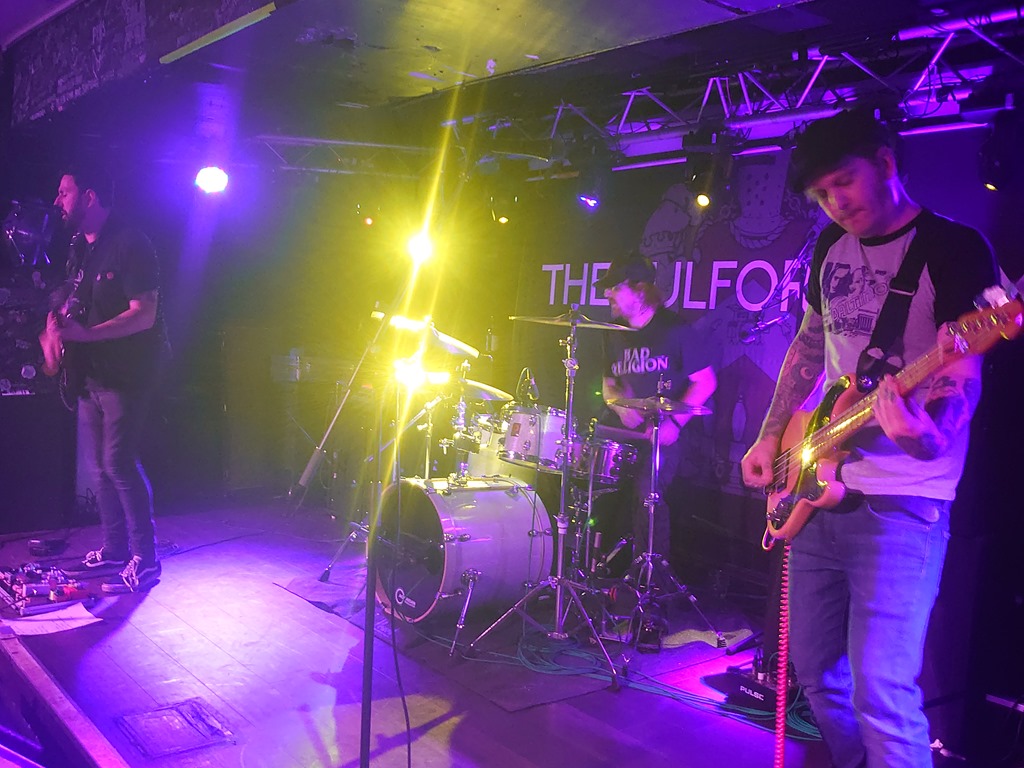
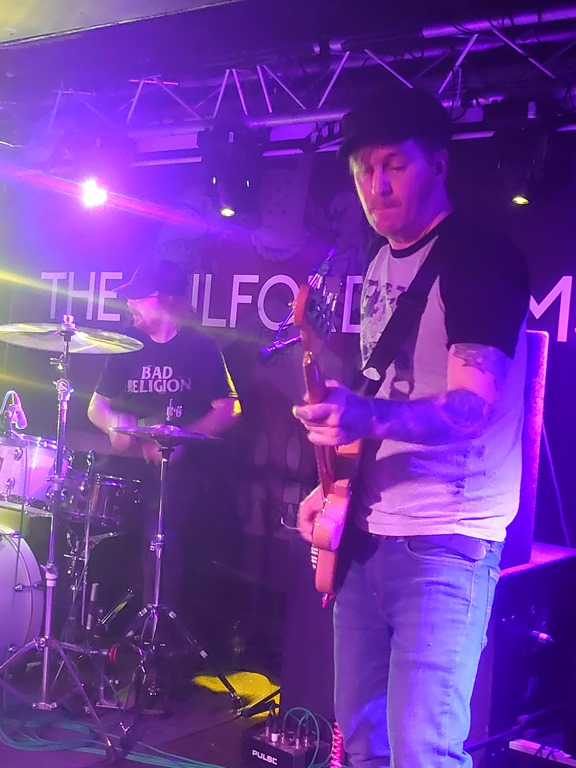
Wasted Denim’s singer has a Black Flag tattoo and the drummer is wearing a Bad Religion T-shirt. The Leeds trip piledrive through the songs – fast, short, Ramones meets The Clash meets The Ruts, all with a gritty hardcore edge – with zeal, blurring together only separated by a call of ‘onetwothreefour!’ Songs like ‘You’re Gross’ and ‘I don’t Wanna be a Dickhead’, introduced as a song about personal wealth, aren’t works of lyrical genius by any stretch, but that’s not what punk’s about. It’s immediate, it’s raw. And they’re as tight as hell. Sure, they only have one tempo – fast – and four chords, but more is just showing off anyway. The set gets faster as it progresses. They’re fun, and seem like decent guys, too.
Wasted Denim
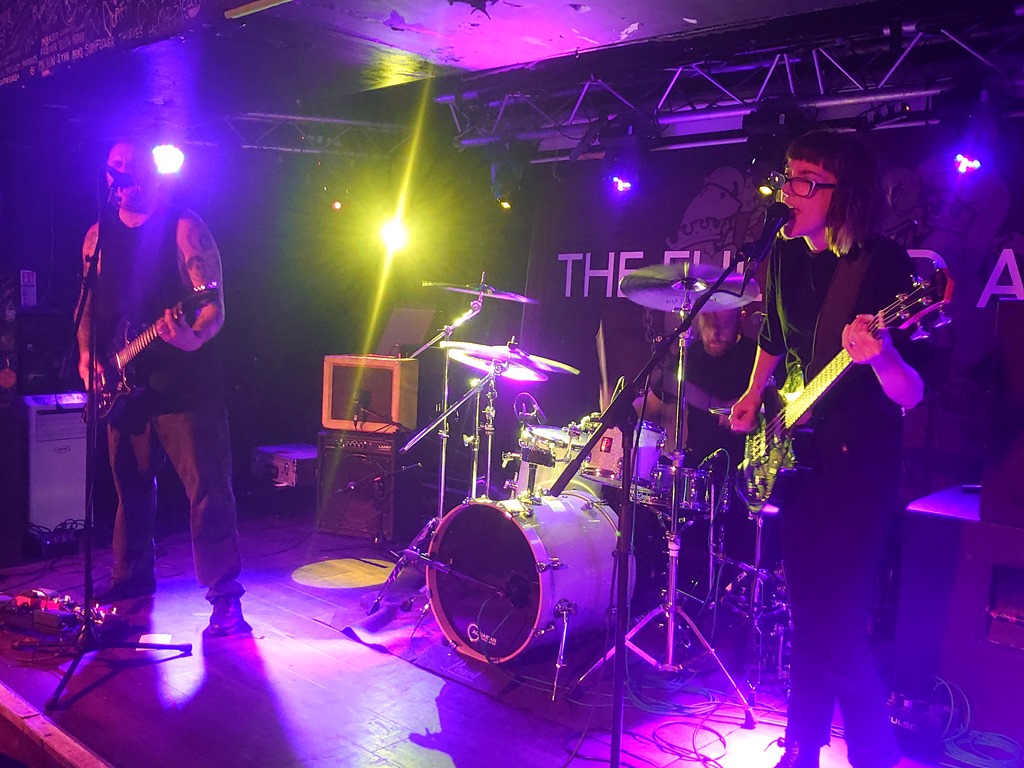
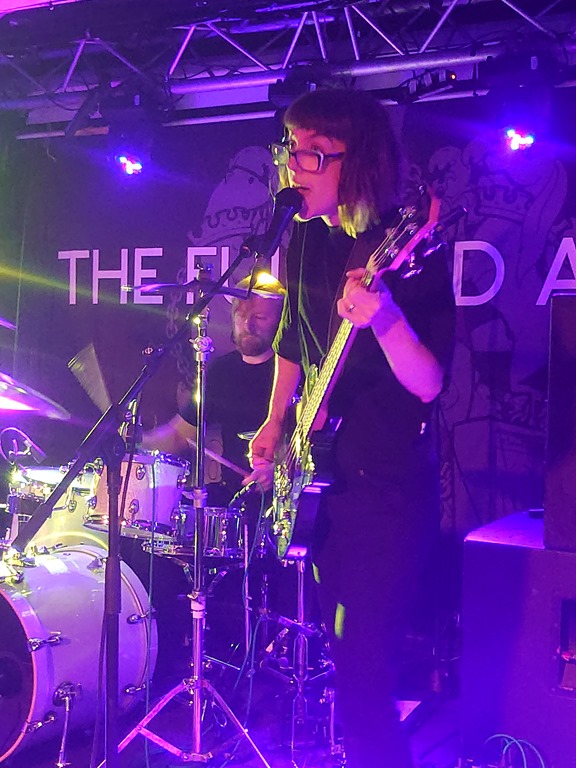
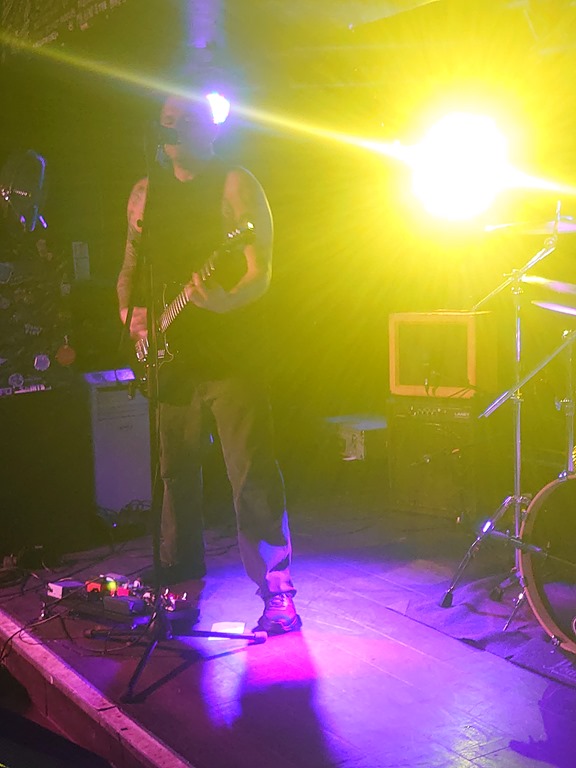
I’d been forewarned that JUKU would be seriously loud, threatening ‘Thunderclap drumming, distorted to holy fuck guitars, massive riffs and a clean feminine vocal cutting through the massive wall of noise.’ With Snakerattlers Dan and Naomi Gott on guitar and bass/vocals respectively, this relatively new quartet are a world away from the duo’s reverb-heavy swamy psychedelic surf-rock. There’s no twang or space to longer here: every second is pure density, the sonic equivalent of driving headlong into a brick wall.
JUKU
And yes, they’re loud as fuck. Opener ‘Hot Mess’ opener is a throbbing stomper of a tune, with monster big balls and massive swagger. ‘Pressure’ ups the pace and the adrenaline. ‘Trigger’ shows a more sensitive side, and more of a pop aesthetic, but it’s still propelled by a monster riff and pulsating rhythm section. Naomi’s vocals are a strong asset – gutsy, but nuanced. ‘I’m no fun’, she sings on ‘No Fun’, which is absolutely storming, and it so happens, a lot of fun. Sharing vocal duties back and forth on ‘We Don’t Belong’, Dan screams his lines adding another layer of dynamics, while ‘Devil Inside’ exploits quiet / loud grunge dynamics to strong effect, before ending the set with the 100mph ‘No No.’
JUKU
At times, New York punk and No Wave leanings come to the fore in a set that’s driving, hard-edged, aggressive. Boasting solid hooks and blistering energy, it’s mint, and Dan taking advantage of being wireless and taking his guitar around the venue as he chugs out beefy chords adds to the energy. They kick out nine songs in twenty-five high-impact minutes. In terms of the set’s structure, it’s faultless: if they record these nine songs and release them in this order, they’ve got a killer album on their hands already. The world needs to hear it.
Since parting ways with Gavin Millar and worriedaboutsatan, Thomas Ragsdale has been incredibly busy recording both as Ffion and Sulk Rooms, as well as playing synths with Mancunian post-rock act Pijn. Looking at his bandcamp, you wonder how he has time to piss, let alone sleep.
The Incidental Crack, meanwhile, are no strangers to these pages either, and Simon Proffitt, Rob Spencer and Justin Watson are hardly idlers when it comes to creativity, with The Incidental Crack Does Nothing, released almost a year ago to the day from this release, following two albums in 2021.
And as the accompanying notes explain, it’s this shared love of the act of creating that brought the two together: ‘Split was created through the desire to collaborate. Thomas Ragsdale and The Incidental Crack spoke about the idea of working on a split release and then all hurried away into their studios to get to work. The split idea soon become a reality as music was exchanged ready to share.’
The title is factual, and gives nothing away, but it’s also descriptive in a way, in that it’s distinctly an album of two halves, complimentary and contrasting.
Sulk Rooms present a single longform composition of some twenty-one-and-a-half minutes in duration: The Incidental Crack’s contribution is of more or less equal length, but spread across three pieces.
Sulk Rooms’ ‘Objects In The Mirror Are Closer Than They Appear’ has no connection to Meat Loaf and his bombastic rock, and is instead a big, slow-moving mass of ambience, which has a density and shade as well as a certain lightness. ‘Vaporous’ and ‘cloud-like’ are terms I often reach for in the face of such works, but this feels more like standing atop a mountain while the cloud thickens to the point that there is no visibility, to the point that you’re unable to even discern the presence of your own body, and so dense as to be suffocating – perhaps more like a smog or smoke. Tim Hecker managed to create such a sensation the time I saw – or, more accurately, was present, when he played in Leeds a few years back. The smoke was so dense and the lighting so minimal as to induce a kind of sensory deprivation. But with the swirling sounds all around, there was, simultaneously, sensory overload. You need balance: many of us are reliant on multiple senses, and those who lack sight, hearing, often experiencing a sharpening of the senses which do function. But his is not an immediate thing, and to suddenly find oneself with restrictions, it’s a shock of sorts. And so while ‘Objects In The Mirror Are Closer Than They Appear’ is soft and tranquil, the experience isn’t entirely soothing as I feel an inner tension grow as the time drifts and dissolves, diffusing in reverberating waves of vocal samples.
The Incidental Crack’s three cuts are descriptively titled and combine elements of the dramatic and the mundane to intercut aspects of pathos with bathos to somewhat comic effect.
‘Rob To Holland Via Köln And Back Again’ sounds like is should have something of a travelogue feel, but is, in fact, a work of dark ambience with deep tensions evoking the chilling fear of The Cold War, while ‘Lawnmower Death And Subsequent Resurrection’ isn’t an homage to the parodic thrash band Lawnmower Deth, but a soundtrack to the trauma of dealing with tools and appliances when they don’t function as intended. Yes, most of us have been there, but to feel it so bluntly and boldly is impactful. This – if I’m not mistaken – the sound of a guy recording his DIY and the like before seeking a narrator. Yet, there are some dark atmospherics too, and thee overall sensation is ominous rather than uplifting. And by that measure, the ‘Bus Stops In Wigan’ must be pretty fucking terrifying: places to avoid in bleak territories.
As split albums go, it’s absolute perfection in that it gives you everything you want. If the two acts operate very differently in formal terms, both have created deep, dark works here that make for a release that’s wide-ranging, interesting, and just a little scary.
UK indie pop-rock outfit JODY AND THE JERMS have a summer surprise for eager ears – their new single ‘Liberation’, which was produced, mixed and mastered by RIDE frontman MARK GARDENER at his OX4 Sound studio. Getting into the summer groove with a 3-minute stomp, the Oxford band ventures beyond their jangle pop roots. With vocals to the fore, buoyed by the addition of new Jerm Salma Craig on backing vocals, the song is awash with Wah, Hammond and shaker.
Now that the dust has settled on April’s release of their third album ‘Wonder’ and latest single ‘Intuition’, the sweet taste of ‘Liberation’ propels the band forward, recalling the killer riffs, sass and harmonies of the B-52s in the embrace of the Jerms’ own trademark twists and warm production. An upbeat and empowering song, ‘Liberation’ is about how the good times make you feel alive and free - and how you want that positivity to last forever.
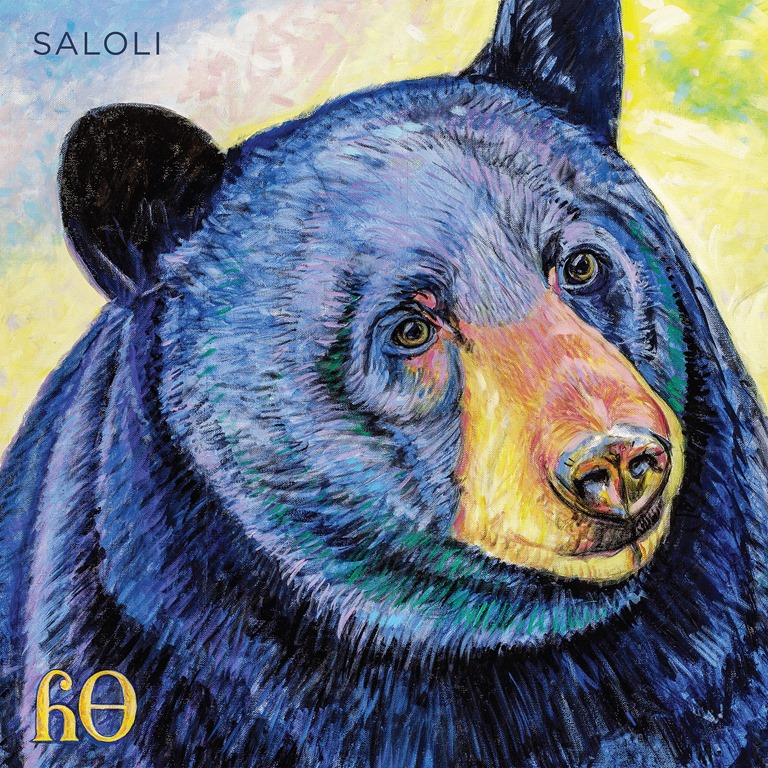
If the prospect of an album from a solo pianist whose recording moniker is the Cherokee word for ‘squirrel’, and which is intended to evoke ‘a day in the life of a bear in a canyon in the Smoky Mountains,’ with each track channeling a different emotion or experience in its daily explorations, sounds as if it may be soft, neoclassical tinkling, Canyon will come as rather a surprise.
As the accompanying notes explain, ‘Canyon was composed and performed live on a Sequential Circuits MultiTrak synthesizer…routed through a delay pedal. This refraction adds a lyrical spatial quality, as though “echoing off canyon walls.” It’s music both gentle and adventurous, curiously rooting through soils and streams, in a sustained state of discovery’.
It’s a proper vintage piece of kit, an analogue synthesizer only produced for a couple of years in the mid-1980s. Described by Vintage Synth Explorer as ‘a six voice analog synth with sophisticated filters, envelopes, modulation capabilities and built-in sequencing’, it’s clearly got versatility in its favour – which means Saloli has a broad range of sounds and effects at her disposal to articulate the range of moods and emotions of her subject. But above all, it has that classic analogue warmth of tone, the rich, organic texture that resonates in a way that’s almost biological. It’s something that’s both affecting and in some way comforting, the fuzzy edges conjuring a sonic blanket, and even when venturing into more abrasive territories, analogue synths very much have the capacity to reach the parts their digital successors somehow can’t.
The album starts strong: ‘Waterfall’ spirals and cascades in a swirl of synth that doesn’t necessarily evoke – at least to me – anything bear-like, but the more ambient end of Krautrock ‘Lillypad’ drifts soft-edged semi-ambience strolling and ‘Snake’ is unexpectedly graceful. But then, if you’ve ever watched a snake move, it is a graceful, supple movement, and snakes have an undeservedly bad reputation among humans. Very few of them are dangerous, and they’re certainly not the only creature to shed its skin. Again, the notes provide an insight which perhaps has a bearing on the tone here, explaining that ‘In Cherokee teachings, humans and animals are considered to have no essential difference – originally, all the creatures of the earth lived together in harmony’, and as such, ‘Canyon captures shades of this Edenic notion across eight elegant pieces, alternately meandering, pensive, playful, and pure. Sutton’s playing, as always, is dexterous and dimensional, mirroring the dazzled senses of its muse. If then, the compositions don’t quite confirm to our expectations, based on our perceptions of the various inspirations, it could well be on account of Saloli approaching them from a very different perspective. Why are we scared of snakes? Some of it is likely biblical in origin, some to popular portrayals in movies and media. But one is not afraid of one’s equal, and living together in harmony means there is no reason for distrust.
Such belief systems may be difficult to comprehend, but how much better, more pleasant, more bearable, would life the world over be if everyone held these views? There would be no social hierarchy, there would be no capitalism, there would be no war. Consider that for a moment.
The beauty of Canyon is that it’s a work which encourages and inspires contemplation.
It’s the playful side of Saloli’s songwriting that comes to the fore on the slowly bouncing ‘Yona’. It’s mellow, light, uplifting, and contrasts significantly with the introspective ‘Silhouette’ which follows, a reflective, melancholy pie, which makes you ache ever so slightly inside: you can’t quite pinpoint the reason, but that’s the power of music. Moreover, it’s the power of Saloli’s music, as the forms shift from string-like elongated notes to shorter, more piano-like sounds, with all of the variables in between.
‘Full Moon’ is positively bloopy and gloopy, trilling tones like synthesized pan pipes echoing out over a bubbling, bass, and it works nicely: there is contrast, there is movement. And in an abstract way, it captures the energy that seems to emanate from a full moon. And there is an energy which affects creatures and humans alike: some if it’s mystical and mythical, but I’ve often felt hyper without even realising it’s a full moon.
There’s something buoyant but also stealthy and predatory and then again, at the same time, increasingly discordant and with shades of darkness, about ‘Nighthawk’, a seven-and-a-quarter-minute monster with transportative qualities, before the true closer, the eight-minute ‘Sunrise’ heralds the arrival of the new. A new dawn, a new hope. Breathe deep. This could be our reality too.
With their anticipated new album, VOID, just a few months away, KEN mode has given us another look into what to expect from the full-length, out Sept. 22nd via Artoffact Records. Today, the band shares a new single, true to their unforgettable and unique sound – ‘He Was A Good Man, He Was A Taxpayer’!
On the new track, Jesse Matthewson comments candidly that it is, "perhaps a little more post-punk than people are used to hearing us – but we had fun playing with synth and pushing the boundaries of the emotionality of this track. Is this noise goth? I don’t know. Does that sound stupid? Did I just invent a new genre? There are equal parts Bauhaus and Unsane on this, so maybe?"
‘He Was A Good Man, He Was A Taxpayer’, follows the band’s absolutely bone shattering single, ‘The Shrike’, which last month gave us 4 minutes and 10 seconds of sheer energy, fueled by the frustration of the ‘lost years’ of the pandemic, pelting fans’ eardrums with blissfully crass instrumentals and a vocal approach like no other.
Listen here:
AA
With their anticipated new album, VOID, just a few months away, KEN mode has given us another look into what to expect from the full-length, out Sept. 22nd via Artoffact Records. Today, the band shares a new single, true to their unforgettable and unique sound – ‘He Was A Good Man, He Was A Taxpayer’!
On the new track, Jesse Matthewson comments candidly that it is, "perhaps a little more post-punk than people are used to hearing us – but we had fun playing with synth and pushing the boundaries of the emotionality of this track. Is this noise goth? I don’t know. Does that sound stupid? Did I just invent a new genre? There are equal parts Bauhaus and Unsane on this, so maybe?"
‘He Was A Good Man, He Was A Taxpayer’, follows the band’s absolutely bone shattering single, ‘The Shrike’, which last month gave us 4 minutes and 10 seconds of sheer energy, fueled by the frustration of the ‘lost years’ of the pandemic, pelting fans’ eardrums with blissfully crass instrumentals and a vocal approach like no other.
TOUR DATES:
09.24.23 Porto, PT @ Amplifest*
09.26.23 Rouen, FR @ Le 106
09.27.23 Lille, FR @ Aeronef
09.28.23 Paris, FR @ Point Ephemere
09.29.23 Angouleme, FR @ La Nef
09.30.23 Clermont-Ferrand @ La Cooperative De Mai
10.01.23 Yverdon, CH @ L’Amalgame*
10.02.23 Karlsruhe, DE @ Jubez
10.03.23 Dresden, DE @ Ostpol
10.04.23 Wroclaw, PL @ Klub Lacznik
10.05.23 Berlin, DE @ Urban Spree
10.07.23 Aalborg, DK @ 1000 Fryd
10.08.23 Aarhus, DK @ Headquarters
10.10.23 Liege, BE @ La Zone
10.11.23 Haarlem, NL @ Patronaat
10.12.23 Bruxelles, BE @ La Botanique
10.13.23 Brighton, UK @ The Hope & Ruin*
10.14.23 London, UK @ Perpetual Flame Ministries w/Lingua Ignota*
The Venomous Pinks fight against abortion bans in their newest release, “We Must Prevail”. In collaboration with Eternal Film Productions, and directors Nikki Carmela and Alexander Thomas, the Arizona-based band delivers an unforgettable visual response to the overturning of Roe v. Wade.
Staked full of social commentary, a distraught Lady Liberty gripping a bloody wire coat hanger, acts as a narrator of the video. Through music, The Pinks lead an angry mob of pro-choice protesters who demand immediate change. Symbolizing the injustice many Americans are currently facing, destruction overtakes the infamously engraved words “equal justice under law” that’s displayed above the United States Supreme Court entrance. With anti-abortion laws on the rise, this politically charged anthem encourages the masses to rally for reproductive rights.
Directors Alexander Thomas and Nikki Carmela (known collectively as “Eternals”) have issued the following statement:
“The right to choose is a human rights issue at its core. We stand vehemently against oppression in all forms and appreciate the opportunity to voice our dissent using art. When we first conceptualized this video we based it on a series of photographs we had created when Roe was initially repealed depicting Lady Liberty, bloodied from a coat hanger abortion to represent the current tidal shift of our society. The images, although disturbing, represent the reality that with abortion bans healthcare has been pushed back decades. Combined with images of the Supreme Court house cracking (a blatant metaphor for the disintegration of the “highest law in the land” who’s building is emboldened with the phrase “Equal Justice Under Law”) and the electric music of The Venomous Pinks this video is a protest to abortion bans and the assault of women’s rights.”
Guitarist/vocalist Drea Doll adds, "The government does not have the right to tell a woman what she should be doing with her own body. To quote Angela RoseRed (Photographer/Writer) ‘Angered by the misogynist men who forcefully shove religion into our uterus.’"
The band will be touring Europe this summer with Bad Cop/Bad Cop followed by a U.S. run with Less Than Jake and The Toasters.
Watch the video here:
AA
Photo: Jack Grisham
The Venomous Pinks On Tour
Europe with Bad Cop/Bad Cop followed by a US run with Less Than Jake & The Toasters
July 27 • DE, Hamburg • Hafenklang (SOLD OUT) *
July 28 • DE, Berlin • Cassiopeia *
July 29 • DE, Goldenstedt • Afdreiht un Buten *
July 30 • DE, Essen • Don’t Panic *
August 1 • DE, Stuttgart • JuHa West*
August 2 • DE, Wiesbaden • Schlachthof*
August 3 • DE, Hanover • Faust*
August 4 • DE, Cologne • Helios37 (SOLD OUT)*
August 5 • BE, Duffel • Brakrock Ecofest*
August 6 • NL, Utrecht • De Helling (SOLD OUT)*
August 8 • CH, Zurich • Dynamo*
August 10 • SI, Tolmin • Punk Rock Holiday (SOLD OUT)*
August 12 • DE, Munich • Strom*
August 13 • IT, Rimini • Bay Fest
August 21 • Seattle, WA • Showbox + ^
August 22 • Portland, OR • Revolution Hall + ^
August 23 • Medford, OR • Johnny B’s ^
August 24 • San Francisco, CA • Great American Music Hall + ^
From the very opening bars, you get a sense of expanse, of importance. A certain flexing, you might say. But is this real, or is it bombast and posturing? Is this, as the title suggests, a false haven musically, or is it a work which explores darkness. Can we trust Vorder? Can we trust anyone?
They emerged from the Swedish underground hardcore scene of the 90s, with the band coming together before the turn of the millennium, albeit with a different rhythm section. According to their bio, ‘What started conceptually over 20 years ago as a straight path towards a better life with a socio-political agenda has during the years evolved into a realm of survivalism in an ever-increasing nihilistic environment.’
This does very much feel like a fair summary of the last two decades: whatever optimism – or fear – the new millennium brought, I don’t think even Nostradamus could have predicted the global lurch to the right and the warzone that the Internet has become. And these are simply the tip of the iceberg. Recent history, and the present, is not littered with atrocities: it is one, continuous atrocity. Simply getting through a day in the world in which we find ourselves feels like a major achievement. And with False Haven, Vorder have navigated this brutal terrain with an album that’s textured, contemplative, and monumentally forceful.
Opener ‘Introspective’ is a mammoth cut, with an epic build and a super-spacious production. The weight of the riffage drops just over the minute mark and it slams in on the same grand scale as Amenra, and the strangled, strained, rasping vocal, low in the mix, are also in the same vein. There may be a certain level of grandeur and elevation to this, but it soon becomes clear that this isn’t mere theatre: this is heavy, expansive music born out of sincerity.
‘Beyond the Horizon of Life’ begins with a slow, picked intro, brimming with atmosphere and reminiscent of Fields of the Nephilim but of course, equally, Neurosis. The surge of power that bursts is an explosive release of tension, a rush. ‘The Few Remaining Lights’ is an eight-and-a-half minute epic that delves dark and deep and with segments of clean vocals that radiate emotion – and the more delicate passages mean that the raging torrents which follow have even greater impact.
The title track, slap in the middle of the set, is also the album’s shortest, and it’s a thick, chugging sinister slow thrash chug – but there’s some melodic lead guitar work that lifts it, and it’s nuanced work that’s not the commonplace fretwanking. The detail of the compositions is something which really stands out across the album’s six tracks. There are many segments woven together, but there’s a flow to each of them, meaning that each song feels like there’s a sense of progression, of evolution, rather than chopping and changing and packing in switches for the sake of unnecessarily showing off technical skills as so many metal acts are prone to. In this way, there is a sense that each song is a journey.
This is nowhere more apparent than on the final track, the ten-and-a-half-minute ‘Come Undone’ – which most certainly is not a cover of the Duran Duran single. They really take their time over this one, drawing out the most tension with a slow, solo picked guitar intro which paves the way for a monumental riff-fest, which – in an unexpected twist – transitions from being another Neurosis-style cruncher to something altogether more a kind of post-metal/grunge crossover.
As it tapers out, the silence gives pause to reflect: it’s not an easy album to process, because while it does sit broadly in the post-metal bracket, there’s a lot more going on, and it’s done in such a way as to seem natural in the transitions, when on paper, it shouldn’t always work. But why not? It’s music: there are no limits. Music may have become a commodity, because capitalism has conquered all, but at the heart of it, music can, when it’s not being used as sonic wallpaper or for marketing or cheap entertainment, be an outlet, and a medium by which it’s possible to articulate something beyond words. And this is what I get from False Haven: the sense that Vorder are a band compelled to create to have an outlet, and they don’t care whether it conforms to one genre or another. They truly do not give a fuck. False Haven is an album which had to be made, rather than being an album they thought they should make. And that’s what makes it such a powerful work, and as real as it gets.
La Force, the mesmerizing solo project of Ariel Engle, who has spent more than a decade as one of Canada’s most sought-after musical collaborators has shared ‘October, the second single off her forthcoming album XO SKELETON out September 29 via Secret City Records.
The first offering – ‘Condition of Us’ – has been received warmly by fans and critics alike, CBC Music stating, “Engle’s voice, wise and warm, envelopes the track, [..] Her words wrap around the music in odd ways at times, like a stream of consciousness versus melody, but the love that’s beaming from Engle is undeniable,” Clash Magazine thinks it’s “the sound of an artist moving deliberately towards evolution.”, while Guy Garvey (Elbow) at BBC6 Music said it felt “accomplished, passionate and slick. I love it.” The song was also praised by Stereogum, Brooklyn Vegan and more. ‘October brings warmth to the XO SKELETON album – a lush, intimate song with incredible vocals embracing soul, smooth jazz and r&b – all the while reminding some of the “quiet storm” movement from the 90s.
“October is a time of harvest here [in Montreal]. It’s a time when we settle into darkness and leaves drop from the trees. It’s a time when we turn inward into our clothing and protective shells. It’s a song about the voices we internalize. People we can no longer see but whose voices and words live on inside us and shape us. It’s a song about the uncanny. A song about the cycles of nature, cycle of life. The song reminds us that despite our grand feelings we are just like animals and plants, destined to be born, to live and to die.” – La Force
The video for ‘October’ is directed by Ariel herself and Ali Vanderkruyk. Watch it here:
My openness to different genres has expanded substantially in the fifteen years since I began reviewing as a ‘proper’ thing fifteen years ago, although it’s perhaps only more recently that I’ve come to truly be accommodating of, and even appreciate, overtly jazz works. It’s been quite a journey. But I still very much have limits of what I can handle, meaning I can dig Cinema Cinema’s free jazz period and the warped rackets of The Necks and Sly and the Family Drone, and recently, I’ve dug the new album by Anna von Hausswolff, but not Trondheim Jazz Orchestra & The MaXx. But I haven’t witnessed this kind of stuff live, really.
Presented with a rare opportunity to get out for some beer and live music, and with travel options rather limited, I found Leeds and York offering slim pickings for tonight, and since I wasn’t on the market for third-generation ‘nu’ metal, I elected to make a trip to Hyde park Book Club, a venue I know and like, despite the long hike from (and back to) the train station, and haven’t visited since August 2020, when Talkboy played an acoustic set. Those inter-lockdown socially-distanced seated gigs where going to the bar was against the rules were strange and feel like another lifetime now.
It’s also been a long time since I spent any real time in Leeds, with recent trips being confined to car / train – gig – home: today, I got to spend an afternoon wandering between pubs, and sitting and reading and people watching over a few leisurely pints. Living in the rather conservative, white, middle-class and socially un-diverse York, I’d forgotten about Leeds, fashion… There are still hipsters, lot of hipsters… and beards, lot of beards… and also mullets… Above ankle drainpipes… Cropped vests… Flat caps… and moustaches: lots of moustaches.
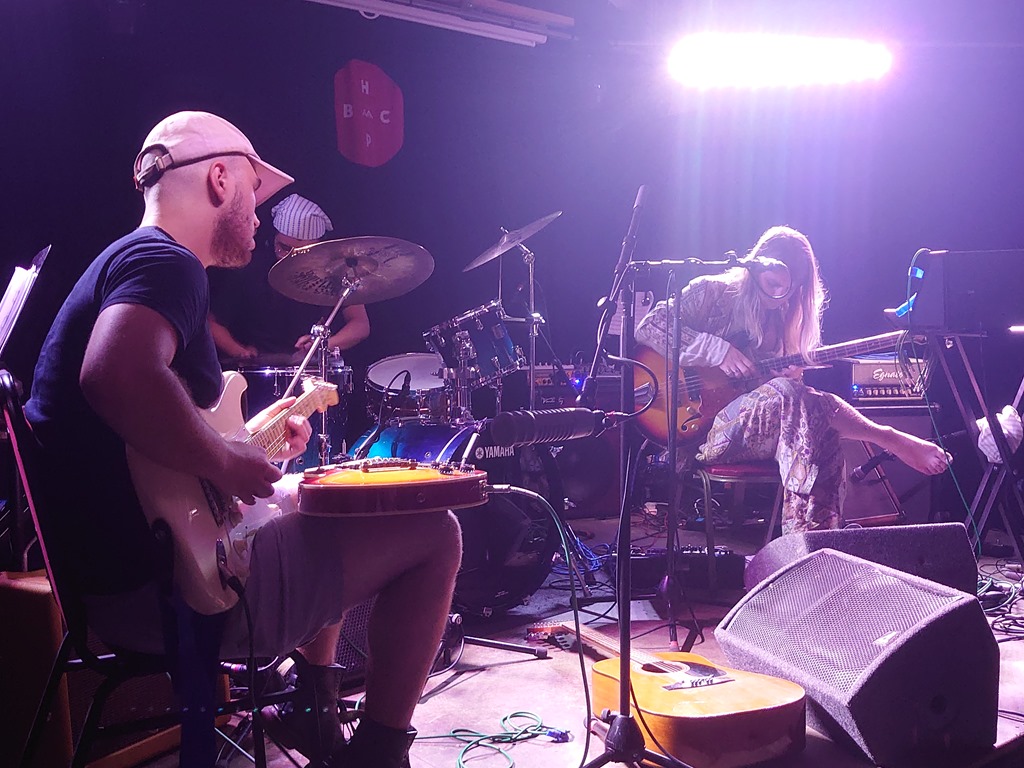
Leeds trio Slozbo Kollektiv are first up, and they serve up a set of the kind of clean, crisp, technical noodling that never really seems to get going or take form. or find a groove… Initially, I’m struck that the drumming is as tight as fuck and the way he handles his sticks is something worth watching. He uses an array of broken cymbals to create a whole host of far-out percussive effects, laying one atop the snare to create a different kind of clatter… But then how tight is the playing when there are no rhythms to speak of, only rattles and bursts of percussion? The set is defined by so much discord and busyness… I find my thoughts becoming as fractured as the compositions. There are, it would seem, extremely tight structures here, but they’re chaotic, esoteric, and non-linear…. Playing two guitars and a horn simultaneously… How many notes can they fit into a bar? Vocals seem fairly redundant, and I come to thinking that they sound like shit musicians pretending to be good ones by playing as many notes as fast as possible and not knowing when to stop. It made for the longest 40 minutes ever.
Slozbo Kollektiv
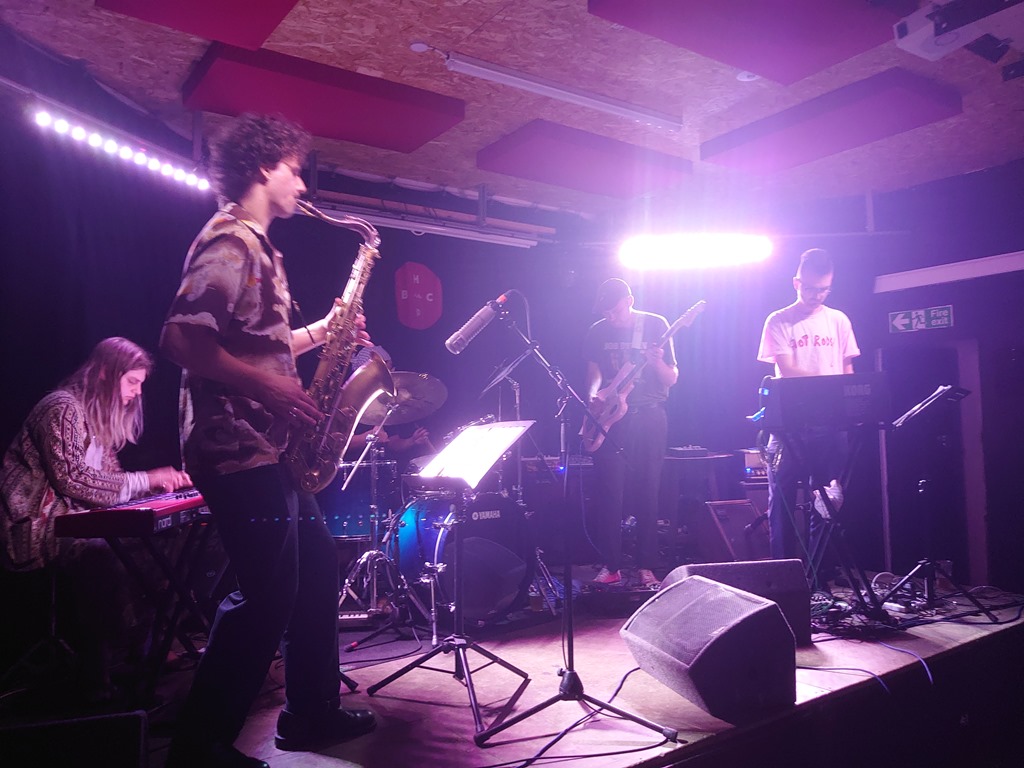
Fergus Quill’s ensemble features the same fascinating drummer, and the bassist from Slozbo Kollektiv is the keyboardist, and again he removes his sandals to play. Compared to Slozbo Kollektiv, this lineup brings more groove, more noise, and a bit of space rock, but still a lot of wanking with the added ‘bonus’ of some big ska overtones. No. Just no. And using your thigh as a mute for a sax? Also no. It does kinda work, but looks ridiculous. Fergus’ counting on of not only the tracks, but each section after a meandering detour gets tiresome and predictable, too.
Fergus Quill
Selecting lineups for gigs is not easy: a little bit of range can make for great energy and an interesting night, but too diverse and it simply doesn’t work. A lineup of similar bands is sure to draw punters who will likely appreciate all the bands on the bill, but can lead to a surfeit of sameness, something which can happen in any genre, but was particularly prevalent during the post-rock explosion circa 2004. By the time you’ve stood through three instrumental post-rock acts with their extended passages of chiming guitar interspersed with crescendos, you’re weary of it all by the time the headliners take the stage.
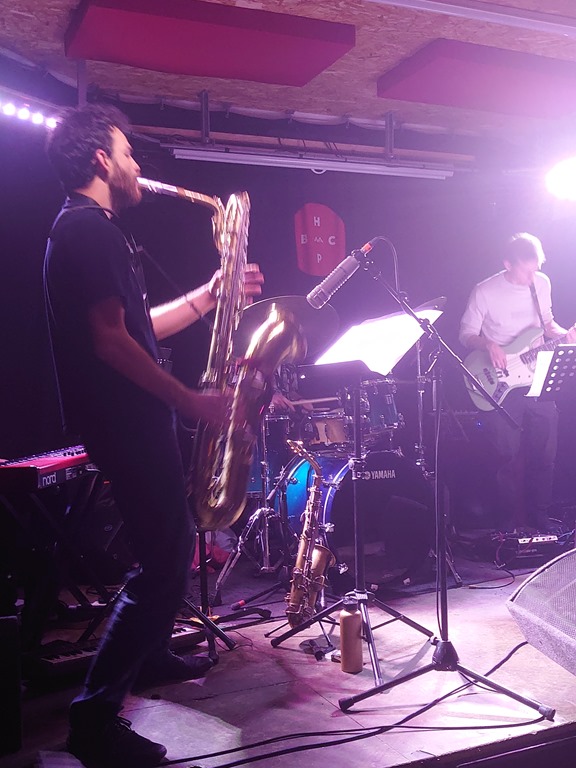
And so it is when Shatner’s Bassoon take the stage. I’m flagging, all jazzed out. Their material – and tonight they’re airing new material ahead of recording it for their forthcoming album – is more structured, atmospheric, building and forming shapes. There are some solid rhythms, moments where they actually settle into something for a time, instead of a constant explosion of sound in all directions all at once. They’ve clearly put the rehearsal time in, and there are all the tempo changes, enough to give you whiplash as they leap and lurch from one segment to another. People are really wigging out down the front, albeit mostly members of the support acts. It all starts to get a bit much after a time: they deal in discord, and the guitar sounds like twanging elastic bands. It’s when I see a guy nonchalantly bopping along from one space to another while clicking his fingers by way of applause I decide I’ve had enough.
Shatner’s Bassoon
There’s no knocking their musical proficiency or adeptness in their field, but there’s noise and there’s noise, and it’s just how I’m wired that once thrills me and the other bewilders, and when you’ve got a bunch of people on stage all playing as hard and loud as they can but not, seemingly, all playing the same tune, I find it hard to dig. For all that, it was good to get out, and they definitely put on a show.







 Aural Aggravation