Archive for July, 2021

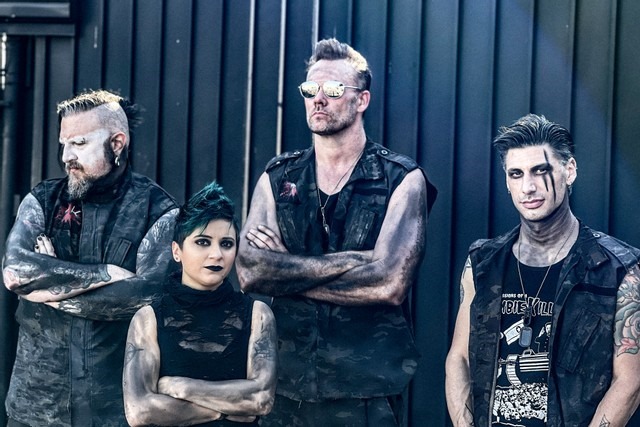
Industrial band FleischKrieg has unleashed their new video for the single, ‘Reach’.  The song features fellow goth/industrial artist NUDA and will appear on the forthcoming album, Herzblut due out October, 2021.

"Our understanding of the larger ecology of mind and matter are inadequate to fully address what’s really happening in our reality. As more people wake up, the more I think people will be harassed. I feel like that’s what I experience.  I think we humans have a lot to learn about what’s really going on in the greater scheme of things."

Watch the video here:

AA

ac129eee-9c62-d6c4-a5d7-576063e32c64

Poet, artist, and Daughters vocalist Alexis Marshall has his solo debut on the way, and here is a new song and visual from it. “Open Mouth” is a song devoid of decoration or sheen; an echoic display of experimental arrangement and poetic stream of consciousness lyrics. The accompanying video, directed by UK-based John Bradburn and starring up-and-coming actor Charlie Greenwood, features beautiful yet stirring art house cinematography as Greenwood emotively performs Marshall’s lyrics.

Watch the video here:

http://a%20href=

A Marhall

Gates of Hypnos  – 4th July 2021

Christopher Nosnibor

This is a split release by, as the title suggests, Sado Rituals and Mass Grave, who each bring approximately twenty minutes of harsh noise wall to the dark, antisocial party.

Sado Rituals’ ‘Funeral Pile of the Nameless’ is a murky cloud of tearing, rumbling devastation.

As I listen, I contemplate whether they mean pile or pyre, but conclude it maters little, especially not least of all to the couple of hundred people who will even ever hear it. We’re in ultra-niche territory here, and no mistake. But it’s a niche filed with a truly hardcore following.

It’s deep, dark, dank, a rumbling morass of formless darkness that billows and rumbles, and over the course of its precise twenty minutes, it sucks the fucking soul from you as it churns away at the guts without shift and without mercy. It feels like standing beneath the rotors of a helicopter, or on the edge of a cyclone spiralling down and drawing all matter into the pits of hell, the sonic equivalent of a black hole. A vortex of bleakness, of dense matter without form. And then, bang on the twenty-minute marks, it stops.

As purveyors of self-labelled ‘blackened noise wall’, Mass Grave’s nineteen-minute gut churner sounds like the tail end of a piano being rolled down a flight of stairs, a rolling crash of dissonance. It’s even darker and dinger than Sado Rituals’ contribution, a low rumble reduced to a slow, low drone that gradually warps as it billows like smoke from a fire on a wrecker’s yard, all types burning and cars slowly melting in the suffocating black smog.

The lack of treble on these two pieces tempers the harshness, in many ways: it’s a real gut-rumbler but neither track feels particularly attacking or abrasive: it’s a noise wall, and no mistake, but one which is more designed to smoother and suffocate than penetrate the flesh and the psyche with its harsh intensity. It’s still punishing, and it’s still gnarly as fuck, and its power lies in just how oppressive, stifling, the two pieces are.

AA

a3190939614_16

Editions Mego – EMEGO305 – 28th June 2021

Christopher Nosnibor

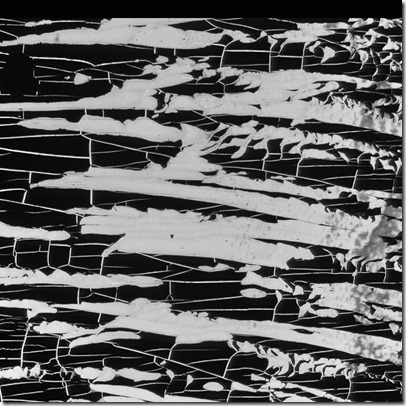
BJ Nilsen’s focus has long been the ‘sound of nature, the nature of sound and the effects these have on humans’, and his exploratory collages and soundscapes tend to draw of field recordings and myriad other sources to create often contrasting, and dissonant works, and Irreal is very much dissonant and contrasting, with moments of tranquillity and subtle, quivering elongated drones disrupted by battering blasts of difficult noise.

The liner notes outline how ‘Irreal is a selection of recordings from different situations encountered in Austria, Russia, South Korea and The Benelux. The range of sound is as wide as is the emotional impact which slides from the unnerving to the shimmering and gor- geous. Doors, bells, birds, wet snow falling from a tree, hacking of wood, water dripping in a cave are all exquisitely captured and moulded into vast landscapes of sound. Human voices, string instruments, descending trains, oceans, winds, grass, trees. These diverse sonic elements are grafted around and upon each other to create a rich tapestry of sound. Electronic embellishments harness the whole to create a singular expressive canvas. The 3 part suite concludes with the Beyond pebbles, rubble and dust, a grand glacial work which serves as a masterclass in extraordinary transcendental drone.’

I’m instantly primed for some challenging scraping drones as the first few seconds of ‘Short Circuit of the Conscious Thought’ build tense, treble scratches, and am immediately puzzled when it halts and there are just clicks in silence. It’s as if the file has inexplicably glitched. From the quiet, a trilling, rippling drone emerges and hangs like a haze – but that smooth stillness carries a tension, which ruptures with distortion and bands like a dozen car doors slamming simultaneously, and at the most unexpected of times. In the final minutes, it evolves into a slow-pulsing minimal ambient Krautrock sequence reminiscent of Tangerine Dream.

Rumbling thunder cracks and crackles all around at the start of ‘Motif Mekanik’, and it booms and grumbles all around a low, ominous drone, and the track is a tumbling tempest of amorphous noise like a raging storm circling and hovering, drifting back and forth, and it’s unsettling. The contrast of the sounds of the elements and the metallic scrape of the eternal drone is perhaps the most obvious way in which Nilsen highlights the relationship between nature and humans, the man-made and the organic. It also intimates the tensions at the heart of that relationship, as strains of ear-splitting feedback cut through the murk and mumble, and it segues quietly into the expansive final composition, the monumental thirty-eight minute ‘Beyond Pebbles, Rubble, and Rust’ – and I know ‘immersive’ is a word I probably use excessively, but it’s entirely appropriate as I find myself swimming amidst the thick, slow—moving sounds of the piece.

Lazy bleeps, like R2D2 on a low battery or the Clangers on ketamine bibble into the mix, before fading out to a drifting mist of dark rumblings that present not immediate routes into the heart of dark mass, only an impenetrable mass of sound, like a mountain rising to the heavens, its summit hidden by a low cloud base. A low bass registers almost subliminally, a single note repeated slow and regular, booming out dolorously. Not a lot happens over a very long time, but the effect is cumulative, and as you sit and stare while the drones and spectral wails of ambience envelop, you find yourself in contemplation and searching for the meaning.

There are all shades of reality, spanning the unreal and the hyperreal. But the irreal is not real. However, where the irreal is distinct from unreal lies in the perception – not just something unreal, but estranged and otherly. In drawing on so many found sounds and field recordings, Nilsen’s album is in fact rooted in the tangibly real, bur recontextualises it, shifting the axes so as to present that reality through the filter of human intervention and incongruity, and as such, distorts that reality to present an interpretation which in turn becomes a fiction and therefore not real, or irreal.

As the rain hammers outside on this early July night, following a day of heavy storms, it occurs to me that what Nilsen articulates through his sonic juxtapositions, is that the relationship between human and nature is precarious: we, as a species, are not nature’s friends, and that progress is disruptive and often damaging – and it’s the human way to command, control, and harness nature for our own ends. But that superiority is an illusion, a delusion, and humanity will always be at nature’s mercy. The relationship is not interdependent or symbiotic, and we need the natural world , whereas it does not need us. In time, we may reach a point where our planet is uninhabitable to us, and to many other species, but it will exist long after we have ceased to, just as it did before. Darkness descends, and at the close, the album tapers to silence – and this is as it will be.

AA
eMEGO305_front

Panurus Productions – 4th August 2021

Christopher Nosnibor

Fading Tapes: a moniker that casts allusions to degradation, the wear and fade through the passage of time, the notion of impermanence and the significance of medium – because the medium isn’t only the message, it’s the determining factor in the lifespan of a record, whereby digital is supposedly forever, but analogue corrodes, deteriorates, and ultimately becomes unusable.

A Cartographer is one who draws or makes maps, and Fading Tapes’ latest work is, ins ways, both map and territory. The titles of the four tracks sketch out the features of the locations in the most minimal of forms – and these aren’t necessarily natural geographical landforms or biomes, but remains of human activity left marking the landscape.

The sequencing of the four compositions, each of which span around fifteen minutes apiece, very much create the sensation that the listener is being guided on a journey, and there is a clear linearity to Cartographer.

Opener ‘East Valley’ calls us to the ritual with an insistent tribal drumming and wailing pipe before… actually, before what the fuck? It’s not so much a building of layers of sound as it is a jet plane flying overhead, devastating the image of a hidden tribe enacting an ancient, esoteric ritual. And this is the dynamic of the piece – ancient collides with modern, and as immense gongs and cymbals crash, ringing out into an expansive desert, unchanged for centuries, hidden from the march of technology and evoking a deep-seated spirituality, the disruptions are deep incisions that disrupt without care for the existing habitat. But over time it’s the soft, supple droning ambience and wordless vocal tones that ring out into a spacious echo that come to dominate. For once, nature, and the old world, wins out as so-called progress falls by the wayside: the valley remains unconquered.

‘Bones’ is a more contemporary-sounding drone work, with conventional western percussion propelling a deep, dark surge of slow-burning desert rock that’s slowed to a the pace of drifting dunes, and the sound is dense. The snare rings out into a cavern of reverb – it’s almost dubby, but it’s accompanied by wailing feedback, that does on, and on, and endless mid-range drones. We learn little, if anything, of the bones themselves, or their origins, but there is a sense that there is little interest in the real detail of the past, and that a sketched narrative is all that there is an appetite for. Instead, to the present, and the future.

The cymbals grow in dominance on the tempestuous ‘Boats’, but again, echoes and shadows dominate, and this very much feels like a window on an historical event, the soundtrack to a battle or other catastrophe at sea where boats were lost beneath the waves. To all intents and purposes, this is a spacious post-rock piece, but it possesses a richness, a level of detail, and a degree of ambience, that is so much more.

The final track, ‘Red Dry Land’ is a hypnotic piece that drifts without real movement, a nagging motif backed by a thrum that simply thumps on unchanging for what feels like an eternity. There’s a scratchy guitar that’s reminiscent of Andy Moor, and mines a more avant-jazz seam, but retains that expansive post-rock vibe, too.

The map charts a route, and as it progresses, it leads the listener back to themselves. This all feels highly evocative, and conjures images in the mind’s eye – but every perception is different. Perhaps that difference ultimately does come down to the map, and one’s experience of the territory – for while the former is fixed, factual, the latter is not, and will always be coloured by individual realities, the eye of the explorer. You may know exactly where you are, and still be lost. With Cartographer, Fading Tapes point the way but provide no real answers. But perhaps that’s ok: the enjoyment is in the journey rather than the destination.

AA

cover

Belgian industrial band Controversial has just dropped the visualizer for their song, ‘Violence’.  The track appears on Controversial’s most recent Cleopatra Records release, Second Genesis.

The song ‘Violence’ is based on a documentary from the 1990s about human violence.

As far as motivation is concerned, Controversial deals with the darker side of humanity. Violence is of course up there and we refer also to war as the culmination of violence. We do it from the position of a spectator outside of humanity.

Watch the video here:

AA

a1682a3a-4436-45be-9939-97afbc6a6e7f

Prank Monkey Records – 11th June 2021

Christopher Nosnibor

The story goes that London four-piece Muscle Vest reportedly ‘formed in 2018 over a mutual appreciation for ugly rock music’, and that’s what they serve up on their debut EP – a sweaty, guitar-driven dirty rock workout that’s brimming with churning riffs, grease and grime. They come out all guns blazing and firing wildly in all directions with the manic racket of ‘Creepy Crawlie’, a juddering, angular rager that melts the best of 90s noise into a mangled metal nugget in the vein of later acts like Blacklisters and Hawk Eyes, and it very much sets the fast and furious tone for the rest of the EP: ‘Stray’ bears fair comparison to Blacklisters’ ‘Shirts’, with a throbbing riff blasting out against a low-slung bassline. If Shellac and Big Black are in the mix, so are The Jesus Lizard and early Pulled Apart by Horses.

Muscle Vest pack in a boatload of adrenaline and bring ALL the noise: it’s fucking ugly and monstrously brutal, and those are its positive points. It ain’t polished or pretty, and if you’re on the market for something gnarly, look no further.

‘We’ll all be dead / we’ll all be dead one day’ vocalist Dave Rogers howls nihilistically into a tempest of abrasive guitar noise that churns and grinds on ‘A Slow Death’. He’s right, of course: the question is whether we will die a quiet, peaceful death, or a horrible, painful one, shrieking in agony for the duration of those final hours. This is very much the soundtrack to the latter, and it’s almost enough to make death sound appealing. Because, well, better to go out screaming than to flicker out. The last track, ‘Blissbucket’ is a minute and three-quarters of blazing napalm, taking its cues from hardcore punk and tossing in all the jarring, jolting guitars that scratch and scrape at all angles across the relentlessly churning rhythm section. It’s fast and furious and brings the EP to a blistering close and then some. It positively burns with an intense fury, and it’s beautifully brutal. Gets my vote, and then some.

Cover art

AA

Biomechanimal and Sentinel Complex join forces to bring you ‘Crown of Glass’, an intense mashup of sounds and styles, leaving a trail of destroyed genres in their wake. Both acts deliver huge vocal performances and brutal production, pulling from symphonic metal, midtempo, harsh industrial, dubstep, and more. Liberation in Domination!

‘Crown of Glass’ refers to the ego that we see in ourselves; this fragile symbol of our own strength. The song deals with the negative side of this ego, how it can lead us to view others and ourselves in a distorted way.

Watch the video here:

AA

a3551925102_16

16th July 2021

James Wells

Here at Aural Aggravation, we may have a predilection for noise and abrasion, but sometimes, we get headaches, sometimes we just get too het up and stressed and life gets so horrible that we need a break. Besides, even pop songs don’t necessarily mean mainstream these days: and without the kind of exposure that propels them to stardom, purveyors of pop can be as underground as the darkest of sludge metal acts.

Bethany Ferrie – 23 and hailing from Glasgow – beings us a piano-led song that’s poppy, but also serious, but without being Coldplay or Keane about it. She does, however, represent a generation of new artists who are emerging with a maturity that belies their years.

On ‘This is Where I Leave You’, Bethanie twists and turns through a gamut of emotional turmoil, and there’s a whole lot of emotional anguish here, but it’s presented delicately and digestibly thanks to a sweetly melodic delivery.

Bethany Ferrie Press Shot 2