Archive for October, 2020

Better Noise Music – 28th August 2020

Christopher Nosnibor

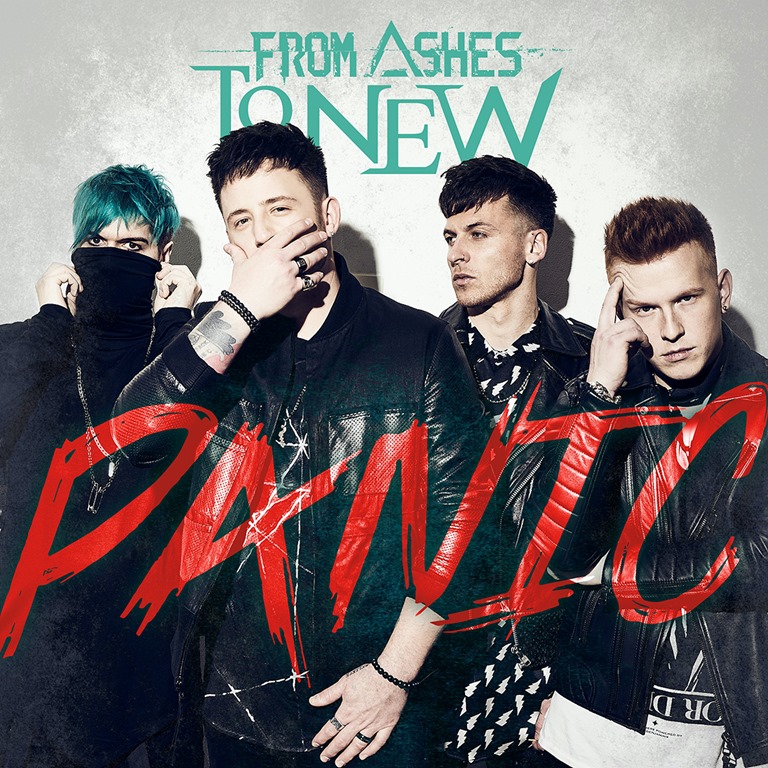
This may be a little belated, but then arguably, so are the band: From Ashes To New trade in melodic alt-rock that crashes in with the blustery force of post-metal before petering out into some middle ground that’s rooted in the turn-of-the-millennium tats ‘n’ haircuts trend. It’s hard to feel the fire and fury of such angst-by-numbers.

Don’t get me wrong: I feel a genuine sympathy for these guys: the scrolling text at the start of the video reminds me of all of the cancellations I’ve had to witness this year, from gigs and holidays, to conferences to recording sessions to…well, absolutely fucking everything. The office setting for the video hauls me back to the day I was required to return to the office – closed for the foreseeable future, possibly permanently – to collect my personal belongings. It felt like an ending, and a weak one that sputter out to nothing at that. The hangar-like empty space could, under different circumstances, have been quite exciting, even exhilarating, but under the eye of a gloved and masked security guard who watched as I separated out personal and company belongings from my desk, bagging up the items that were my own and separating out stationery, IT kit (although I regret not squirreling away a spare mouse now) and paperwork for recycling before leaving the gloomy open-plan building, the blinds half drawn and the lights off for what was probably the last time. It didn’t occur to me that maybe this would be the setting for recording a rock video: much as I wanted to capture the bleakness of the empty space, I was more preoccupied with making sure I’d loaded up and was off the premises in my allotted twenty minutes, and while the security guard was nothing but friendly, I felt tense and pressured, and yes, maybe the pressure was of my own making but I felt like an intruder and like I needed to get out before I cold relax and breathe properly again.

On departing, it struck me that with more of us being designated permanent home workers as the company looks to finding ways to recoup the immense costs of providing everyone with a laptop, the cost savings of not paying for electricity, cleaners, maintenance, and all of the other things associated with an office housing around 80 staff, I may not see many, if any, of the people I’d spent the last few years working with, in close proximity, ever again. Granted, half of them I could take or leave, some of them were cunts, but they all contributed to the fabric of life. I miss life, and I may even miss some of the people.

But it doesn’t change fact that this is some fairly generic and somewhat dated-sounding Limp Bizkit / Linkin Park lift, and while I feel their pain and panic, it’s all downhill from the intro: the video, likewise, as we move away from the TV screen, the source of the panic, to the empty office, something they seem to revel in but which carries quite different connotations for me and no doubt many.

This isn’t clear-cut, and this is personal, and sometimes, the personal does not lie within the universal. ‘Panic’ will no doubt speak to some, even many, and maybe it’s a matter of demographic, but it certainly doesn’t speak to me.

AA
752658

Sacred Bones – 30th October 2020

Christopher Nosnibor

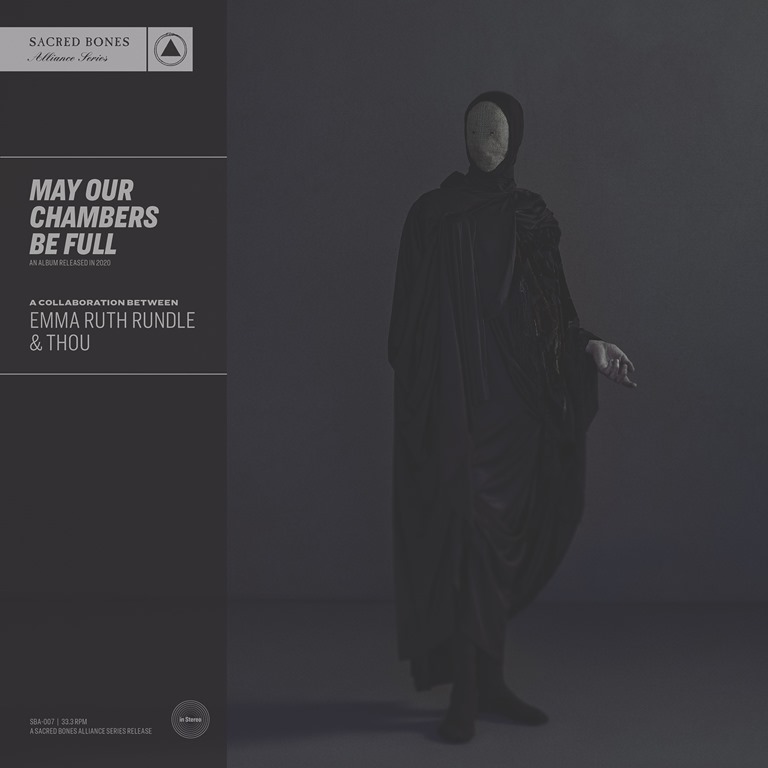
This collaborative release is as interesting as it is unexpected. Coming from the heavier and of the guitar-driven spectrum, it isn’t that the coming together of Emma Right Rundle and Thou is entirely unfitting, but it is unquestionably intriguing. The coming together of two such powerful forces has, unsurprisingly, yielded a work that is yet more powerful still.

As the press release observes, ‘while Emma Ruth Rundle’s standard fare is a blend of post-rock-infused folk music, and Thou is typically known for its downtuned, doomy sludge, the conjoining of the two artists has created a record more in the vein of the early ‘90s Seattle sound and later ‘90s episodes of Alternative Nation.’

Needless to say, it’s pretty heavy in places, and not just sonically, although the guitars – more of which shortly – feel heavy enough to shatter rocks, and again, to refer to the liner notes is to reaffirm this as they note how ‘The lyrical content of the album is a marriage of mental trauma, existential crises, and the ecstatic tradition of the expressionist dance movement. “Excessive sorrow laughs. Excessive joy weeps.” Melodic, melancholic, heavy, visceral.’

The grunge influence in this album is apparent and significant, and it’s nearly all in the riffage – but this is an album with rang and depth as well as some serious heft.

‘Killing Floor’ sees the trudging guitar riff emerging from the swirling fog of an atmospheric instrumental intro that borders on shoegaze, Rundle’s voice rises majestically from the thickly distorted power chords and Earth-like picking, and never has she sounded more commanding, more subtly powerful, and never has she come closer to sounding like Chelsea Wolf. And yet, never has she sounded more unique: Bryan Funk’s strained guttural vocal snarls are utterly gut-ripping and contrast with her majestic, emotionally-rich intonation. It’s one of those songs that suck you straight in, and instantly, you’re drawn into the maelstrom.

The album’s shortest song, ‘Monolith’ is a raging beast of a tune a skull-crushing battering of overloading guitars that comes on like a grunge juggernaut, balancing melody with a density that you feel batter against your chest. ‘Ancestral Recall’ swings between brooding ethereality and raging metal, grace and abrasion, but for the most part, it’s little short of absolutely fucking terrifying, a banshee scream howling into a wall of churning guitar noise that’s utterly punishing.

In contrast to the full-on barrage, there are hints of the goth-folk of early All About Eve on the slower, more sedate ‘Magickal Cost’, and once again, the rich, lilting qualities of Emma’s voice comes to the fore. But when the levee breaks around the midpoint, all hell breaks loose, as multi-layered guitars swerve and bend through a tempest of raging noise and a deluge of percussion. The contrasts, cast simultaneously, are stunning and pack all the impact.

The album’s final cut, ‘The Valley’ is deep, a slow-builder with supple violins teetering hesitantly behind rolling drums and soft swell of clean, echo-soaked guitar. It’s by far the most conventional-sounding song on the album, with the folk-infused rock flavour of Fleetwood Mac being more to the fore than anything remotely alternative – but then the last minute and a half is unbridled sonic annihilation as all of the pent-up fury is unleased.

It’s a fitting final to an absolutely stunning album, an album which explores a broad sonic and emotional range to hit hard in the delivery.

AA

489981

Powdered Hearts – 15th October 2020

Christopher Nosnibor

Gintas K releases albums more often than I change my clothes. That’s of course intended as a comment on the prolific nature of his output, rather than a confession about my personal hygiene post-lockdown, although not going into the office or being around people – or ever within two metres of them – has meant I’ve maybe made slightly less effort of late.

The same clearly can’t be said of Gintas K, at least in terms of his work, since I don’t know if he’s been tweaking away at his circuitry in his pyjamas or the same jeans for a week and a half or if he’s been bothering to shave or deodorise daily. I don’t need to, either, of course.

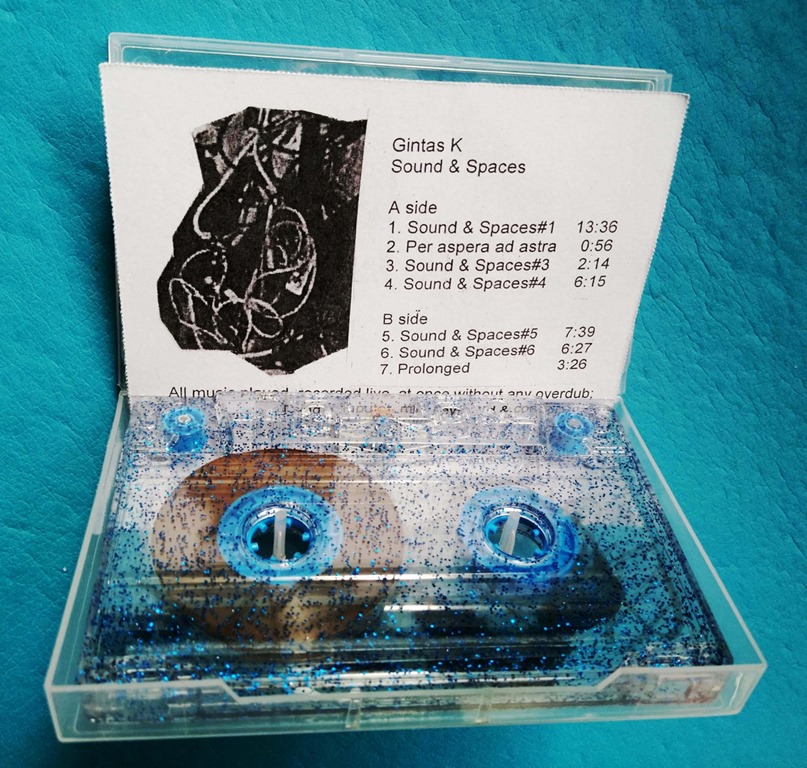
Anyway: Sound & Spaces explores what’s become established as familiar territory for Gintas K, with gloops and bibbles, froth and foam, squelchy bubbles of sound rising up randomly against the crackling burrs of electronic distortion. Sound & Spaces is less attacking and less abrasive than some previous outings, and is les intense and intensive in its interrogation of microcosmic space than some of his previous microscopic, microtonal explorations.

The first track – the thirteen-minute ‘Sounds & Spaces #1’ is a challenging mess of stammers and jolts, fizzing and crackling in a swampy slosh of analogue synth soup. It very much sets the tone, but in context, it’s a comparatively gentle start to what ultimately unravels to be quite a brain-shredder of a set.

‘Per aspera ad astra’ is a brief interlude of tingling, jangling dissonance before ‘Sounds & Spaces #3’ brings a bit of low-end grumbling, whining, and distortion, yawning undulations whizzing and popping all over.

By ‘Sounds & Spaces #4’, it’s almost impossible to differentiate distortion from percussion, and what originates where, although there are distinctly snare-like cracks in the feverish melting-pot of contrasting textures and tones, which become increasingly fragmented, fractured, and overloading as the album progresses. As an album it’s a frothy foment, and while some may find it simply uninteresting or a wash of so much noise they can ignore, I’m unlikely to be alone in finding the experience quite tense and uncomfortable – and nothing more so than the twenty seconds of silence at the end of the overwhelming chaos of ‘Sounds & Spaces #5’

If disorder offends your sensibilities, avoid this recording: once again, Gintas K has captured metal turbulence in aural form. It’s hard to process, but well worth enduring the turmoil for.

AA

a0638906201_10

APF Records – 27th November 2020

James Wells

Sometimes, there’s just no substitute for a full-tilt, balls-out, gut-churning sludgy grindcore for providing that release. There’s something strangely soothing in the relentless blastbeats, the mangled-to-fuck guitar attack, the guttural growls of pain, anguish, and all-out fury. Corrupt Moral Altar get catharsis, channelling every last ounce of rage into fast and furious sonic blitzkriegs, and three years on from their second album, Eunoia, this five-track EP suggests they’ve distilled and bottled three years of fury into seventeen minutes of brutality.

For the most part, it’s pretty much business as usual, in that everything is a pulverizing blast whereby everything thunders and pounds away at a hundred miles an hour, each song leaving you feeling like you’ve been used as a punching speedbag for three and a half minutes. Five songs may not sound like much, but when punishment is delivered at this pace, and with this much force, it’s exhausting. You only have to hope that ‘Cathedral of Porn’ isn’t intended as a tune to wank to.

The intro to ‘Spirit Breaker’ marks a distinct change in tone and tempo, with chiming, post-rocky guitar, before, perhaps inevitably, it gets grimy and nasty and completely full-on. There’s a grand swathe of semi-choral vocals which ring out over the punishing double-pedal drumming and heavy-grind guitars, and it’s a surprising but rather moving shift, and it closes in a more contemplative that returns to the atmosphere of the opening. It’s by no means wimpy, but does abundantly demonstrate that CMA are far more than one-dimensional rage-merchants.

AA

a0919813581_10

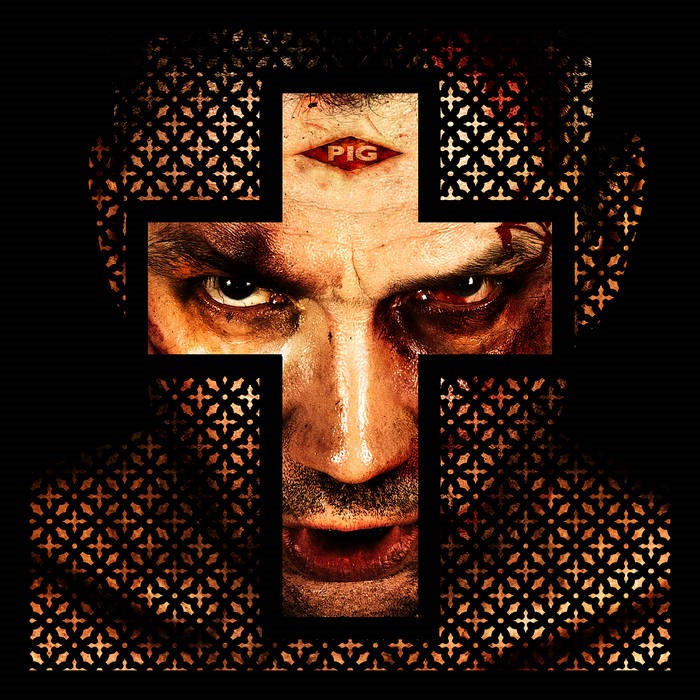
Raymond Watts aka PIG began his musical crusade in a Berlin basement in the shadow of the Wall back in the mid-1980’s. Perhaps it was the terror and turmoil that  lends a certain sense of menace to the trademark decadence of his group’s sound. When the Wall fell, our salacious saviour set out into the desert on a journey that has spawned countless albums and projects….not only PIG, but some of KMFDM’s finest material and numerous other collaborations that have included scoring for Alexander McQueen shows, as well as installations and exhibitions.

Our sacred saint of all seven sins has now delivered a new divine declaration in the form of Pain is God. Fourteen tracks of swine and swagger, it is an exegesis of excess – glitches and guitars, allure and libido, danceable decadence – and the weaponised word of the Lord of Lard, here to save your skin from the wages of sin.

A single from the album entitled ‘Rock N Roll Refugee’ is out now. A delicious taste of electronic rock, Watts describes it as “the demon seed of glam and electronica stirred to an apotheosis of ejaculating guitars and lamenting vocals. A song that’s loose enough for your vices and tight enough for your virtues.” The hook heavy song features backing vocals from Michelle Martinez to add an extra touch of soul, and also sees Watts reunite with guitarist Steve White on record for the first time since PIG released albums via Nothing Records and Wax Trax! in the 1990’s.

A video for ‘Rock N Roll Refugee’ (directed by E Gabriel Edvy) is a decadent dive into Pop art influences, but can be seen as more of a nod to the Fluxus movement and the likes of Nam June Paik or George Maciunas rather than the mainstream Warhol-ian aspects of the genre. The song and video interplay as a homage to Intermedia, filtered through the mind of the Swine.

Watch the video here:

AA

24efacecd220c4deee7774a077e5c91e036ab55a

zeitkratzer productions – zkr0027 – 23RD October 2020

Christopher Nosnibor

As the founder of one of Europe’s leading avant-garde orchestral ensembles in the form of zeitkratzer, whose releases include recordings of Metal Machine Music, works by Stockhausen, and two collections of Whitehouse ‘covers’, Reinhold Friedl is very much at the forefront of contemporary classical. Formed in 1997 with Friedl on piano (sometimes a ‘prepared’ piano, a la John Cage), they’ve established themselves a formidable force, incorporating elements of free experimentalism and drone.

For the recording of KRAFFT, the nine-piece ensemble came together with another respected musical collective, Ensemble 2e2m, a chamber group from Paris dating back to 1972, known for their unique sound and the first recordings of Giacinto Scelsi’s music.

As the press release recounts, KRAFFT for orchestra was composed in 2016 as a commission from the French State and premiered in Paris and Marseille. It was also the first meeting of the two ensembles – and yet the come together perfectly to create four immense, drone-orientated passages.

Being Friedl, there is a great deal of detail and precision behind the methodology: this is certainly not random stop-start hums and thrums or elongated notes played with varying – and usually increasing – intensity, and for this reason I shall quite at length: ‘KRAFFT is a minimalist maximal composition: all instruments play in rhythmic unison throughout. Only the sounds and their combinations change relentlessly throughout the piece. KRAFFT is spelt wrong on purpose to create an ironic-onomatopoetic rendition of the German term “Kraft”, meaning “power” or “force”. The listener is exposed to a sonic undertow. The notion of huge power and force is connected here to clandestine and unknown rules controlling the progression of sound; something is happening, but we do not exactly know what, when or how. KRAFFT is composed with the help of the computer program TTM (Textural Transformation Machine), developed by Reinhold Friedl to sculpture multiple random processes.’

The TTM formed part of Friedl’s Ph.D. at Goldsmiths University London, and was developed by the composer to sculpture texture transformations with the help of sophisticated random processes. As such, Friedl’s compositional methodology develops way in which John Cage incorporated random determiners within his work, and in using a ‘machine’ to make those random selections, he distances the ‘composer’ from the composition and increases the likelihood of true randomisation.

Returning to KRAFFT, there is a clear trajectory to the composition as a whole, namely an intensity and volume which increases incrementally as it progresses over the course of half an hour. The first part is soft, light, even playful, moving into somewhat darker, more discordant territory onto the second.

By part 4, immense booming low-end notes surge and rumble with such density as to have an almost physical force. Atop of this, the smaller strings scrape, squawk and twitter like birdsong and feedback. It’s an eleven-minute tidal wave of sound that swells and surges to a crescendo of truly enormous proportions. While it’s safe to say it’s unlikely to be aired on Classic FM, KRAFFT is as accomplished and powerful orchestral work as you’ll hear all year.

AA

zkr0027_front

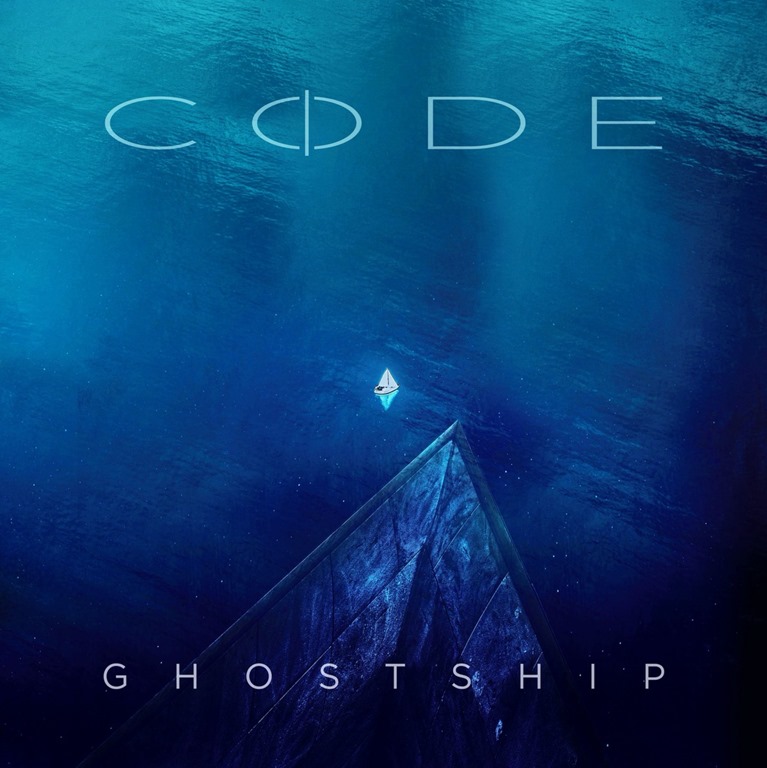
Kent based electronic quartet CODE have released a rebooted version of their 1992 debut single ‘Light Years’, which was available on white label only at that time and remains highly collectable to this day. Attracting support from John Peel at Radio 1 and Colin Faver and Colin Dale at Kiss FM, the original was a cross-genre classic; cosmic and psychedelic yet club-friendly, it pointed towards the future while acknowledging past masters such as Tangerine Dream with its sinuous, mind-bending arpeggiations and minimal melodic motifs. The 2020 upgrade remains true to its industrial techno roots but adds a contemporary dancefloor sheen. Bandcamp orders will also include a remix by Bjika, a musician who melds the spatial elements of progressive and deep house with the rawness of Detroit techno.  
The full length rework of ‘Light Years’ appears on a new album by CODE entitled ‘Ghost Ship’, their first in 25 years.

Watch the video here:

7eaaa5ea05da962bad5d421c72ccbd64ef4e4aaf

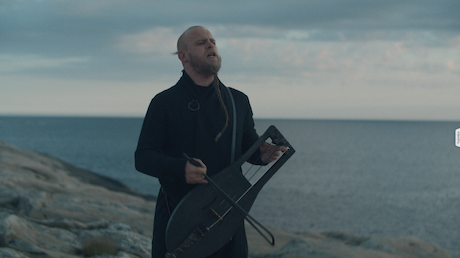
Wardruna today share the title track, and pinnacle moment of their upcoming album, Kvitravn (meaning White Raven). A music video produced by Ragnarok Films reveals a powerful narrative centred around this sacred, elusive creature, and namesake of the album.

Dramatic scenery unfolds from a bird’s eye perspective, and enchanting images of this rare animal are captured, as we follow Wardruna founder Einar Selvik and vocalist Lindy Fay-Hella through the wilderness. As the video unfolds, a question arises, is this sighting only good fortune, or is it destiny?

About the song "Kvitravn", Wardruna founder Einar Selvik states, “I am very excited to finally share this song with you. “Kvitravn” is a song that explores traditions of animal-guides and the symbolism and legends of sacred white animals found in Nordic- and other cultures all over the world. These highly regarded ghostly creatures, whether a raven, snake, bear, moose, reindeer, elephant or lion – are in animist traditions seen as prophetic, divine messengers, and guardians representing renewal, purity and a bridge between worlds.”

Einar Selvik continues, “Being fully aware of how rare it is to come across white ravens, we knew from the start that this would be an ambitious and challenging task to pull off. However, fate seemed to be on our side in this and the “impossible” piece of the puzzle fell into place as if gifted from the divine.“

Watch the spectacular video here:

AA

thumbnail_WardrunastillimagefromKvitravnvideobyRagnarokFilms

Cold Spring – 23rd October 2020

The reverence for Coil amongst their fanbase – which if anything has expanded in recent years, and particularly following the death of Peter Christopherson – is quite remarkable. Emerging in 1982 following the demise of Throbbing Gristle, Coil became the primary vehicle for Christopherson and partner John Balance after contributing to the early Psychic TV releases. And perhaps one of the reasons Coil are held in higher esteem than PTV is that their output, while still substantial, was less in volume but subject to a higher quality control, as well as pursuing esoteric experimentalism while largely managing to avoid cringe-inducing indulgence. That, and the fact they pushed so many musical boundaries without being massive tossers in a musical field crowded with individuals whose creative genius was tempered by tendencies toward major-league assholism: P-Orridge should require no real qualification now, and similarly, the shady characters of the industrial and neofolk scenes, not least of all Boyd Rice and Douglas Pearce have long been exposed. And the fact that both members suffered premature deaths only compounds the way their work resonates with fans, who can only contemplate what cuold have been

Everything around the rights to the Coil catalogue is spectacularly complex, and the origins of this compilation aren’t even entirely straightforward, having originally released by Russian label FEELEE, featuring tracks from all their major albums (barring The Ape of Naples which was released after Balance’s untimely death). They were hand-picked by Coil to represent their best work and originally released to mark their first performance in Moscow in 2001.

Subsequently out of print on CD for almost two decades, this edition courtesy of Cold Spring spans Coil’s entire living career, with A Guide For Beginners – The Voice Of Silver and A Guide For Finishers – A Hair Of Gold being made available together in one deluxe set.

As Nick Soulsby observed of Balance and Christopherson, writing for thevinylfactory.com, ‘As Coil they had embarked on a wild ride from industrial origins originating in the post-Throbbing Gristle outfit Psychic TV, through a spell as dancefloor-channelling experimentalists, onward to their destination as the respected priesthood of pagan rite electronica’. And with a career spanning three decades and eighteen studio albums, it can be daunting to know quite how best to make inroads, so a ‘Best of’ makes sense.

Disc one (A Guide for Beginners) spans their later career, while disc two (A Guide for Finishers) delves deeper towards their origins, and together, in a slightly mixed-up reverse chronology, we’re able to trade their development, and what’s most interesting and apparent is their range and their willingness to explore.

Singling out tracks from a collection that spans twenty tracks and a monster running time, but emerging from the swathe of brooding dark ambience and esotericism, ‘Ostia (The Death of Pasolini)’ stalks brooding neofolk territory, dark, stark, and portentous, but without any of the nationalistic bullshit that often typifies the genre, while ‘Where Are You’ is the soundtrack to psychosis, an eerily minimal backing creeping uncomfortably behind a monotone monologue that’s unsettling and uncomfortable.

Brooding piano and shrieking woodwind and horns forge haunting soundscapes while elsewhere, minimal two-note organ and trilling electronic extranea provide the backdrop to mesmerising spoken-word narratives. Cut-up samples and fragments drift in and out (no surprise for a band photographed with William Burroughs, who had an album released on Industrial Records in 1981) and the thing that really comes across most powerfully from this compilation is that while so any ‘experimental’ and ‘industrial’ acts were – and are – pretty dull, Coil were consistently engaging, focuses on tone and resonance, and ever-evolving.

It would be hard to improve on a selection picked by the artists in terms of what can be considered the best representation of their output, and bias aside, this is hard to fault by way of an introduction.

AA

COIL A Guide For Beginners - A Guide For Finishers - Lo res album cover for web

30th September 2020

Christopher Nosnibor

Ben Wood & The Bad Ideas return to follow up on August’s ‘Black’ with ‘You’re The Crash I Needed’, and of this release Ben says, “We wanted the lyrics to reflect an awakening, a coming-to after a period of being insular and unaware of one’s own actions but for that to be entirely forced upon you by someone else. Musically ‘You’re The Crash I Needed’ was composed to mirror that sensation of when you fall asleep in front of the TV and then it seems explosively loud and totally overwhelms the senses when you wake up.”

That jolt… to nab the line penned by Editors, it kicks like a sleep twitch. We’re all guilty of sleepwalking through life at some point or another, oblivious of ourselves and the potential repercussions of our actions, and such somnambulance has become the characteristic behaviour in 2020 as we drift from one day to the next. The kick will happen, and no doubt the jolt will provide a real shock to many.

‘You’re The Crash I Needed’ is an indie-goth gut-punch of a song, with hell-for-leather drumming and interweaving guitars reminiscent of Rosetta Stone and early Mission and it’s got a vibrant energy and a kind of sweeping openness that’s simply not commonplace in contemporary music. Then again, nor is that kind of chorused guitar sound.

Balancing breeziness and shade, this is a tight and tense rack and a clear single choice, and while it’s retro it’s anything but cheesy. I for one am excited.

AA

Single artwork