Posts Tagged ‘Whitehouse’

11th June 2025

Christopher Nosnibor

Some artists thrive on collaboration. Deborah Fialkiewicz is one of those. While she’s prolific as a solo artist, the volume of collaborative works in her discography is also noteworthy: when she’s not working as part of SPORE, she’s part of the ever-rotating lineup of BLOOM – and that’s before we touch on the frequent collaborations with (AN) EeL, the most recent of which was only released three weeks ago.

The Improvisation Sessions was recorded live May of this year, with a lineup of Dan Dolby, Deborah Fialkiewicz, and John Koser, marking an expansion from the duo which recorded the trilogy of Parallel Minor, Besides, and Hybrid in 2020. Fialkiewicz is without doubt an artist with range, but one who favours the dark end of the ambient spectrum more often than not, and this is very much the case here.

The Improvisation Sessions features two longform tracks which would quite nicely align with a vinyl release.

‘Chameleon Soul’, which spans a colossal continuous twenty minutes, begins with low, rumbling ominous drones, but soon escalates to a busy, buzzy criss-cross of sounds, interweaving and interlacing, leaving one’s head in a spin as if after trying to trace several flies flitting about the kitchen on a hot summer’s day for any period of time. It’s a morass of warping tones overlaying a ballast of churning noise, and any comparisons to Hull luminaries Throbbing Gristle or Merzbow are entirely justified.

The layers of distortion only grow denser and gnarlier as the track progresses, crashing waves of white noise blast in from one side and then the other as they really push to test the stamina. And then you realise we’re only six minutes in. This is a positive: plenty more left to enjoy… Enjoyment is of course subjective, and enjoyment of this requires being appreciative of a dizzying, disorientating assault simultaneous with a full-on white noise blizzard.

The momentary lulls, the spells where they pull back from the precipice of all-out aural obliteration, are far from mellow, as serrated spurs of hard-edged drones, wails of feedback and brain-melting extraneous noise conglomerate to seismic effect. There are some nasty high-end frequencies knocking about in the mix, moments were one has to check if the whistle is coming from the speakers of if it’s that troublesome tinnitus nagging again, and said frequencies rise from a battery of ugly distortion, bone-shattering blasts of which simple explode around the twelve-minute mark, and from hereon in, things only grow harsher, more corrupted, more intense, more difficult to withstand. We’d be inching into polythene bags on heads territory were it not for the variation, but the last three minutes or so are fractured, damaged, and agonizing – part power electronics, part circuit meltdown.

As the world becomes evermore and increasingly fucked up, I find words fail me more by the day. It’s harder to articulate, and this is where I’ve found that sound has come into its own. Sound as the capacity to convey something beyond words, something that lies in the most innermost parts, giving voice to the subconscious, even. On The Improvisation Sessions, BLOOM convey anxiety, gloom, pessimism.

‘The Dark Room’ is indeed dark, constructed primarily around a fixed but thick, distorted hum. Oscillators whine and whistle, and something about it calls to mind Whitehouse around the time of Never Forget Death, when they discovered low-end frequencies and restraint, the impact of a low undulating wave and subtle tweaks of reverb.

It rumbles and drones on, eddying and bouncing around in a shrilling mesh of dissonance. There isn’t a moment where this is an easy listen, and so often, it sounds as if the equipment is faulty, whether it’s a stuck loop or generating unexpected noise.

This set hangs on the edge of ambience, but be warned, it’s dark, and noisy at times, to the extend that it may shred your brain. For me personally, that’s my idea of fun, so it gets a two thumbs up, but for the more sensitive, this is a release to approach with caution.

AA

a3419622385_10

Dret Skivor – 5th May 2023

Christopher Nosnibor

The liner notes to Trowser Carrier’s A Flower For My Hoonoo, originally released in some form or another back in 2013, say everything you need to know about Trowser Carrier – the duo consisting of Dave Procter (Voice) and Java Delle (Noise) – and their purpose.

‘Noise and vocal delivery tend to occasionally focus on edgelord taboo subjects. Trowser Carrier are not like that. After 10 years, Trowser Carrier once more ask the following question – why can’t noise be nice? Find the answers amongst harsh noise and insipid words.’

Procter in particular is no stranger to the noise scene, performing as Legion of Swine and Fibonacci Drone Organ, among others, not to mention countless collaborations. and he’s no doubt encountered more than his fare share of edgelords along the way. Like many makers of noise, he’s also a fan, but not incapable of critique and criticism, and not without humour. And as such, A Flower For My Hoonoo is something that you could describe as a humorous act of rebellion – and since noise and all of the serial killer and pervo shit that is often the subject matter of noise that’s designed to shock ‘normal’ society – this is a rebellion against rebellion, an attack on cack cliché, a parody of po-faced posturing.

The result is a collection of pieces that resemble Alan Bennett fronting Whitehouse, and the track titles largely speak for themselves: ‘a nice cup of tea’; ‘this ketchup is nice’; thanks for hoovering’; and ‘I remain you humble servant’ are all representative – and it’s perhaps as well the titles do speak for themselves since most of the actual words are, in true noise fashion, largely inaudible for blasts of intense pink, white, and brown noise layered up with distortion and overloading synth meldown. ‘sausages for supper’ extols the virtues of vegetarian sausages, with lines like ‘my body is a temple… and I don’t eat The Lord’s creatures.’

From the words it is possible to make out, ‘nice’ is probably the word which appears with the most frequency after ‘the’, and the bland lyrical niceness, a porridge-slick spill of pleasantry worse than saccharine sweetness in that it’s a world of magnolia in word form. It’s like being forced to sit in a corporate ‘wellbeing’ room plastered posters of motivational quotes, only instead of pictures of beaches and sunrises as the backdrop, there are images of crashed cars and slaughterhouses as the ear-shredding electronic racket blasts relentlessly. The fact that they’re short bursts – most around the minute mark – doesn’t make it any easier on the ear: if anything, it’s worse, as the stop-start nature of the sonic assault has the same effect as various methods of torture. The ear-shredding blasts are of the bubbling crackling fucked-up analogue kind.

The ‘mix’ versions of the tracks – which double up the sixteen tracks to thirty-two place the vocals up to the fore and back off the noise (which is different), meaning Dave’s sappy words are nauseatingly clear as he gushes gratitude for tine spent washing dishes together and courteous manners.

The contrast between the aural punishment and the fist-clenchingly pleasant banalities of the lyrics is amusing and frustrating in equal measure. Procter utters these grovelingly insipid lines in a blank monotone, often repeating a singe verse twice to fill the minute of noise as it froths and sloshes and foams and bubbles and drives the meter needles to the upper limits of the red.

It’s overtly silly, but does make serious points about the genre trappings and songs lyrics and musical forms more broadly.

AA

a0863767941_10

No Part of It – 23rd September 2020

Christopher Nosnibor

Slowly raising a hand – dripping in coagulated blood and thick, sticky semen – from the swampy morass of angled noise that’s entirely representative of the contemporary dark electronic scene, where dark ambient, power electronics, and harsh noise sim in the same sewers, Sterile Garden emerge with Acidiosis. It’s pitched as ‘harsh noise for junk metal, tape recorder, and 4 track;, and while Sterile Garden is an open-ended project with countless contributors featuring on their 40+ releases in the 14 years since their inception, on this occasion, Sterile Garden is simply Jacob DeRaadt.

Acidosis contain six untitled, numbered tracks, and they segue together to create on enormous lump of churning industrial noise. Howling whines of nose like jet engines firing up power full-throttle into barrelling blasts of abrasion.

Without lyrics or any form of vocal element apart from the muffled dialogue on ‘Acidosis 6’, the album is purely a host of permutations of mangled noise which feature here with every shade of feedback and distortion imaginable assailing thee listener’s tenderised eardrums. Metallic clattering, and scrapes, barks and yelps and screeching screeds or nail-scraping, eye-watering blurting screeds or treble dominate.

So much of this overloading, speaker-splitting noise is so above the limits, so over the regular limits of noise, it hurts. But while suffering, enduring, or perhaps enjoying the pain, if you can get past the tinnitus-inducing shards of treble, the walls of mid-range that blast away like hurricane, there is detail, there is textural depth. No doubt many would disagree, and this s very much one for the noise aficionados: there no tunes, no structures, just screaming feedback and howls of painful noise, whistling feedback and manged, cacophonous noise hurtling headlong toward the crusher. Alright, it is just needless, neverending noise, but as I was out and about earlier, on a supposedly ‘quiet’ walk, I became attuned to an endless stream of noise ranging from conversations to car engines. Peace and quiet is a myth – although Acidosis is not so much anti-ambient as anti -sanity, a relentless bewildering squall of horrible noise.

Acidiosis is all the metallic clanks and scrapes. With Acidiosis, Sterile Garden have landed the crusher that will crush your soul. It’s a gut-churning, skull-compressing horrorshow that hurts, physically and psychologically – meaning a job well done.

AA

a0786038567_10

Wharf Chambers, Leeds, 4th April 2016

Christopher Nosnibor

Despite there being a fair few middle-aged blokes in black jeans milling about, the demographic of the crowd who’ve turned out to Wharf Chambers on a Monday night is pleasingly diverse.

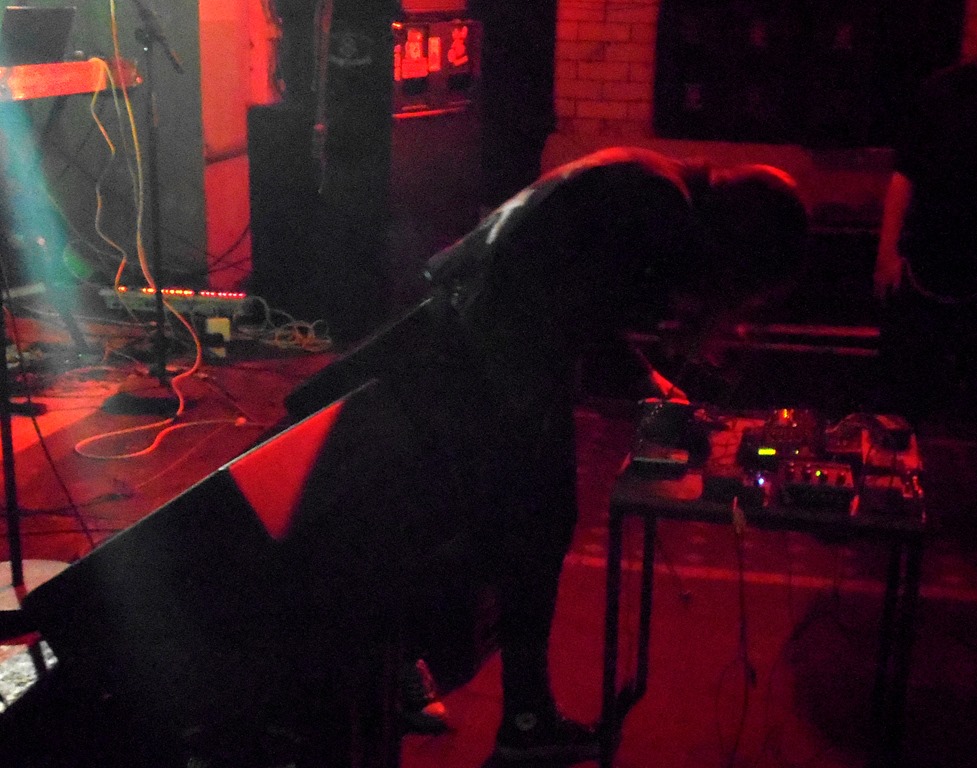
Knifedoutofexistence is one man, Dean Robinson-Saunders. A lone artist with a substantial array of pedals and electronic bits and pieces and a bleak outlook. A fairly standard stereotype on the noise scene. He’s dressed in black, long hair down over his face as he hunches over his spread of kit, laid out on a table on the floor on front of the stage, in near darkness, growling and howling impenetrable intonations of pain and anguish amidst a wall of raging noise. But Knifedoutofesistence stands out by virtue of being making a raging wall of noise that’s texturally interesting, and by the sheer intensity of the performance. He clutches a chain, which he wields and occasionally thrashes against the ground in nihilistic fury.

Knifedoutofexistence

Knifedoutofexistence

A common shortcoming of noise and power electronics shows is that the lineup will be packed out with acts all doing pretty much the same thing, which ultimately gets wearing long before the headliners take the stage. So, credit is definitely due in recognition of the diversity of the bill here.

Circuit Breaker, who’ve been supporting Harbinger Sound label-mates Consumer Electronics around Europe may have proven somewhat divisive amongst the audience members, but the Milton Keynes duo’s brand of dark synth pop, overlayed with screeds of murky guitar provided vital contrast. Wirth his eyes obscured by his hair, and an idiosyncratic style of enunciation which reminds me of Brian Ferry (think the footage of Roxy Music performing ‘Virginia Plain’ on TOTP), I find myself spending much of the set looking at the singer’s teeth. Musically, they’re more like a guitarier, gothier Gary Numan.

Circuit Breaker

Circuit Breaker

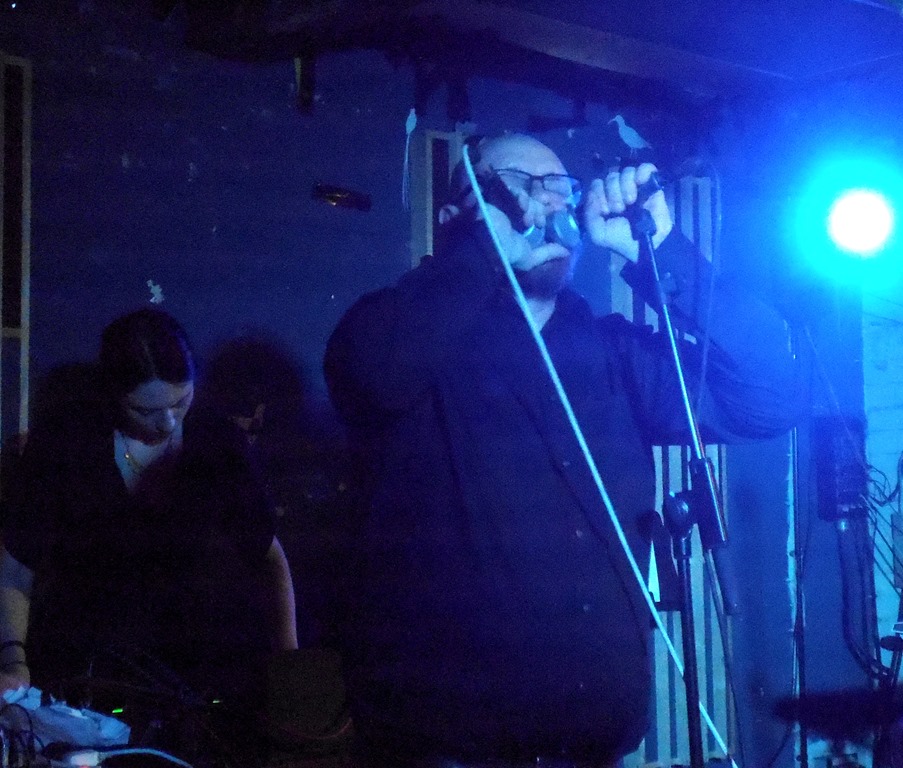
Sarah Froelich – aka Sarah Best – has very nice teeth. She also has some serious lung capacity, and opens both her lungs and mouth wide to vent streams of lyrical abrasion. Flipping in a blink of an eye between sultry poses and a serene expression to raging banshee, she presents a formidable and fearsome presence on the stage. Her whole body tenses as she hollers maniacally, giving her performance a ferocious physicality. Wild, unpredictable, dangerous, she’s the perfect foil to Philip Best’s splenetic tirades.

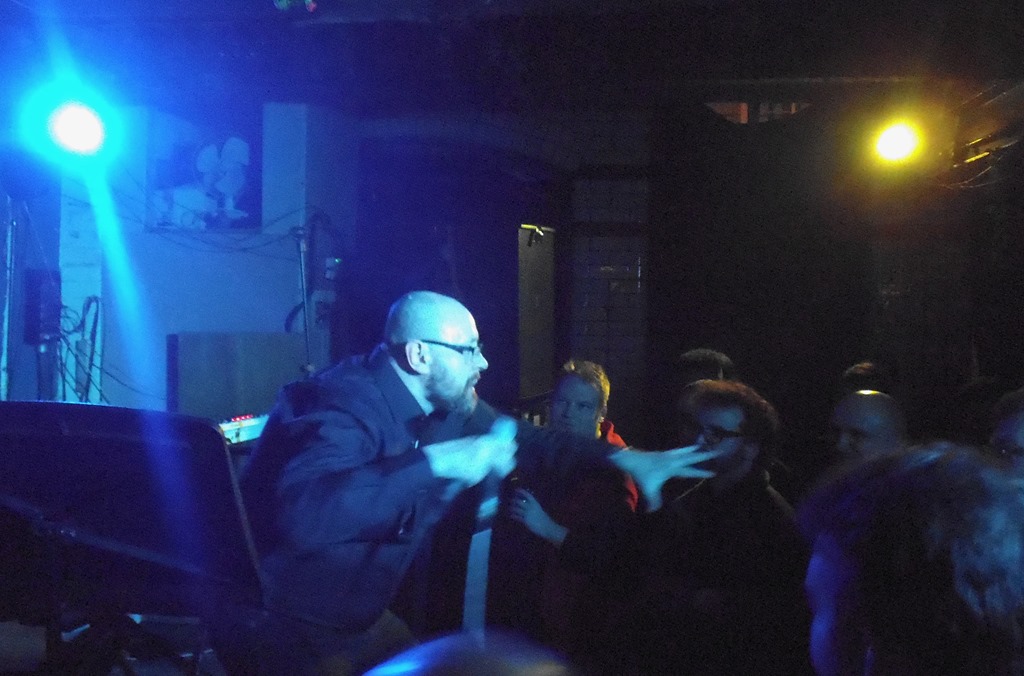
Having seen Best perform with Whitehouse on four occasions between 2003 and 2007, it’s reasonable to expect some crossover in his stage act, but while he still throws the occasional power pose and postures with parodic lasciviousness as he tweaks his nipples, it’s the differences between Consumer Electronics and Whitehouse which are most evident tonight.

Consumer Electronics 1

Consumer Electronics

First and foremost, the thudding beats which drive many of the tracks mark a clear separation from the largely arrhythmic noise of the overlords of the Power Electronics genre. There’s a more overt sense of structure and trajectory to the compositions, and while there is noise, there’s also a greater diversity of texture, and a sense of restraint. More than anything, the sonic attack is used as a means of adding emphasis to the lyrical content, rather than something that buries it.

Best’s lyrics have a poetic quality. We’re not talking pretty pastoral vignettes or vogueish socio-political commentary with a hip-hop vibe, but nevertheless, this is not just some guy shouting obscenities in a blind, inarticulate rage. In fact, you’d be hard-pressed to find rage more articulately expressed, and on numerous occasions during the set, I felt like the Consumer Electronics live experience is in many respects a (brutal, vitriolic) spoken word performance, with the emphasis very much on performance, bolstered by beats and extraneous racket.

Russell Haswell’s contribution to the dynamic shouldn’t be undervalued, either, and his featuring in the current lineup brings new dimensions to the sound. Standing unassumingly at the back, and often nipping off stage, as he unleashes shards of sharp-edged analogue fire.

Consumer Electronics 2

Consumer Electronics

There are some tracks that go all-out on the assault – ‘Co-opted’ finds Best and Froelich duelling over the most ferocious delivery of the refrain ‘Cunts! Co-opted by cunts!’, but much of the set, culled largely from the two most recent albums, Estuary English and Dollhouse Songs, shows just how much Consumer Electronics have refined Power Electronics and the extent to which they explore nuance and contrast. Tonight, they’re nowhere near as loud as many Power Electronics acts, not least of all Whitehouse at their most explosive, but the impact of the set is truly immense.

20th November 2015

Christopher Nosnibor

As the press release reminds me, from around 2005 – 2010, ‘Leeds had one of the most vibrant DIY hardcore/metal scenes in the UK with Humanfly, Chickenhawk, Whores Whores Whores, Narcosis, Year of the Man, The Plight, Red Stars Parade, Bilge Pump, Gentleman’s Pistols and Send More Paramedics playing week in, week out alongside regular visitors to the city such as Bossk, Taint and Manatees.’

I saw a fair few of these bands: in fact, one of the first gigs I attended in Leeds, and my first trip to the Brudenell, was Whitehouse, supported by Broken Bone (who were shit) and Whores Whores Whores (who were incredible). While bands like Kaiser Chiefs and I Like Trains have garnered broader popularity due to their greater accessibility in commercial terms, the likes of Blacklisters are in many ways more representative of the seething fury that bubbles like molten lava at the heart of the contemporary Leeds scene.

The majority of the 2005-2010 acts are now long extinct, many have gone on to form newer bands creating a whole host of exciting new heavy music – the success of Chickenhawk since they rebranded as Hawk Eyes has been remarkable, and thoroughly deserved. One of the bands to have emerged from this period of effervescence is False Flags, formed out of the ashes of Red Stars Parade, Whores x 3 and Year of the Man. Hexmachine is their self-released debut mii-album.

That it is self-released is significant: the post-millennium Leeds scene has very much been about the DIY ethos, and also about the noise. Hexmachine is unaplogetically brutal, blending dizzying math-rock elements with bludgeoning power-chords and monster riffage to cook up an angular, violent metal-edged stew.

It’s not completely po-faced or built on endless rage and angst: ‘Pet Wolf’ is about frontman Jenko’s Chihuahuas, and elsewhere, ‘Phone My Wallet’ stokes a ferocious inferno about 21s Century problems. But rather than undermine the band’s premise, these details only add to their appeal: the topics are relatable, and the delivery is relentlessly visceral. The anger is explosive and sends flares in all directions. The delivery, and production, is immediate, raw, and in your face – and that’s exactly as it should be.

False Flags

https://falseflags.bandcamp.com/