Posts Tagged ‘technology’

29th August 2025

Christopher Nosnibor

When I was a child, I used to suffer anxiety – often when I was unable to sleep (my complex relationship with insomnia began at the age of five) – that my memories were stored in the vast eighteen-volume encyclopaedia my family owned, and I would be unable to access them because I couldn’t remember which volume they were stored in. Not that it was recognised as anxiety at the time: my parents would tell me to stop padding downstairs and bothering them, and to go to sleep. There’s a (sort of) valid reason for this (the anxiety, not the parental dismissal, but that’s an essay for another time): said encyclopaedia was made up from weekly magazines string-bound in identical hardback covers – a precursor to those infinite volume magazines devoted to knitting or whatever, or where you would build a Death Star in 300 instalments, that would likely cease publication before the collection was complete – and there were issues missing, including segments of the index, and topics were not arranged alphabetically like a conventional encyclopaedia. I couldn’t even find my favourite illustrations of dinosaurs fighting a lot of the time.

Things have only become more difficult since the advent of the Internet, and while spent my youth and even my early twenties in a pre-Internet world, there are many now who have never known anything else. Kids have existed online even pre-cognisance thanks to parents posting endless pics of them growing up on social media, and YouTube and Netflix have replaced conventional TV for anyone born in the last twenty years now.

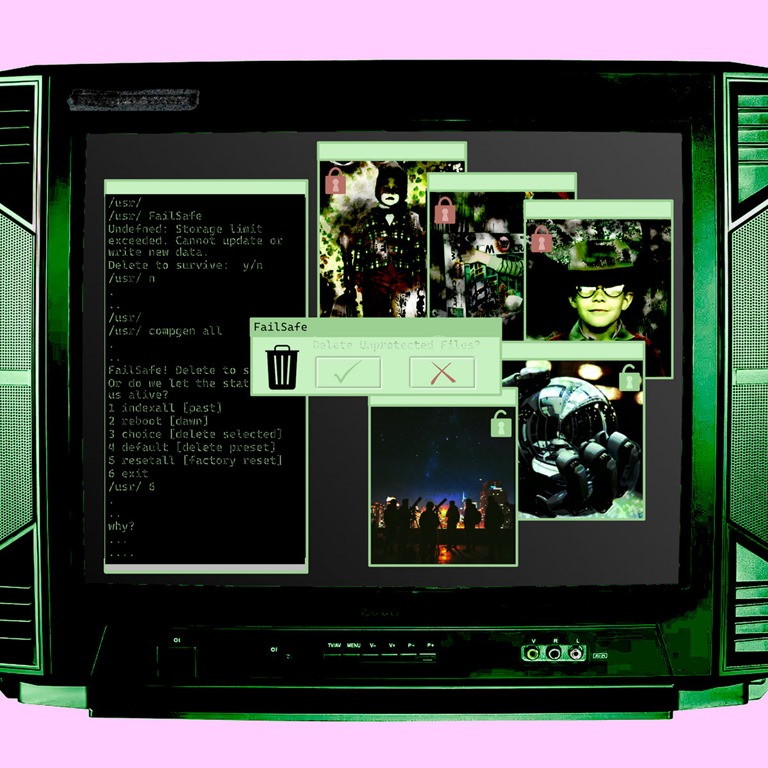
Memory, identity, and their changing nature of both under the conditions of lives lived permanently online, are primary subjects of exploration for solo artist Will N, songwriter, performer, engineer, admin, and the man behind industrial / darkwave act Solid State Sunlight. These topics provided the focus of the ExoAnthro EP last year, and ‘Failsafe’ continues that trajectory, ‘address[ing] the realization that the more we develop our own identity, the less memory remains for experiencing life moving forward. Does it delete previous memory to make space for ongoing growth? What memories are disposable? What are the consequences if it fails?’

I hadn’t considered this, or the idea of what he refers to as ‘data-poisoning’ before, having come to view the mind as a recording device, which captured and archived every single experience, every thought, e very book read, movie seen, but stored them in such a way that it accessing those archives was often a random process – Random Access Memory in the most literal sense.

But we scroll, and we scroll, and we troll, and we troll, and personalities become fragmented, real-life and online personas and experiences partitioned off from one another. Who are you? As AI takes over, the lines are becoming increasingly blurred.

‘FailSafe’ is a gnarly, glitchy technoindustrial stomp through melting circuitry that collides Depeche Mode and Nine Inch Nails with Twitch-era Ministry, with crunching beats dominating jolting electronics and raspy vocals. The intro is a grating bass throb, emerging from an abstract crackle – and then the beat kicks in. And it kicks hard.

If the autotune / robotix breakdown in the middle sounds a shade retro or corny, it works in context, reminding us of how the visions of the future portrayed not so long ago have been replaced by a truly dystopian present. The future was exciting. Computers would make life easier, give us more leisure time and infinite knowledge: that was the promise. Now look where we are. The corporate takeover of the Internet was where it all started to sour, and it was inevitable, but still somehow came as a surprise.

With ‘FailSafe’, Solid State Sunlight draw together a host of references and points of discussion, directly or otherwise, through the savvy hybrid formulation of the composition. It’s hard, and it hits with some attack. This is the vibe of the late eighties and early nineties updated to poke the paranoia of the now. We live in troublesome – by which I mean hellish, fucked-up – times, and with ‘FailSafe’, Solid State Sunlight poke that nerve.

AA

a1907026816_10

Invada Records – 28th May 2024

Christopher Nosnibor

Well, this one landed out of the blue. A boon for fans, a shock to everyone, necessitating a reshuffle of review diaries for the likes of me.

It’s been six years since the last Beak> album. There are good reasons for this, as they explain: “After playing hundreds of gigs and festivals over the years we felt that touring had started to influence our writing to the point we weren’t sure who we were anymore. So we decided to go back to the origins of where we were at on our first album. With zero expectations and just playing together in a room.”

This is a remarkable slice of honesty about the effects of touring on the creative process, and band relationships. Most bands start at home – in some sense – with writing songs and the aspiration of touring those songs. But the dynamics change with success, and when touring relentlessly, time to write new material is squeezed. Over time, particularly with a pandemic interfering with, well, everything, many bands evolve their methods to operate over distance, and there’s always a risk that some of the dynamic is lost and stuff gets dialled in. It’s true that it’s now possible for bands to operate at distance, intercontinentally, even, but that’s not the Beak> way. They thrive on that instant interplay, the interaction, and without it, there’s simply no Beak>.

When they do come together they work fast. Single ‘Oh Know’ was ‘recorded on the only day the band could physically get together during the winter lockdown’ and released in October 2021. They really do make the most of their time, and their music – particularly this latest effort – froths with the urgency of pressured time. The urgency which has always permeated their music is banged up a couple of gears here, and as a result, >>>> is a frenzied explosion, with perhaps a desperate edge.

This being a Beak> album, it’s brimming with experimentalism, oddness, woozy psychedelia and persistent Krautrock pulsations, relentless beats. This being a Beak> album, it’s bloody great, and a lot of fun.

But that said, much of >>>> actually feels pretty bleak. Yes, Beak> turn bleak. It’s like a band having a blast while staring into the abyss, conscious that the end is near, but carrying on because at some point…

Of the album’s sudden and unexpected release, the band say in their statement, “At its core we always wanted it to be head music (music for the ‘heads’, not headphone music), listened to as an album, not as individual songs. This is why we are releasing this album with no singles or promo tracks.”

‘Oh Know’ isn’t included here, but the album does, however, include flipside ‘Ah Yeh’, and it does slot in nicely with its downtempo, lo-fi Pavement on sedatives vibe. It’s kinda loose, with rattling drums and drags out with a quivering organ drifting over a tense bassline, and it works something of a trance-inducing spell over the course of six minutes. You get the sense that however long and far part these guys are, they share a magical intuition, and whenever they do manage to get into a room together, creative sparks fly.

The band continues, “the recording and writing initially began in a house called Pen Y Bryn in Talsarnau, Wales in the fall out from the weirdness of the Covid days. Remote and with only ourselves and the view of Portmeirion in the distance we got to work.”

“With the opening track, ‘Strawberry Line’ (our tribute to our dear furry friend Alfie Barrow, who appears on the album’s cover) as the metronomic guide for the album, we then resumed recording, as before, at Invada studios in Bristol, whilst still touring around Europe and North/South America.”

‘Strawberry line’ makes for fairly a low-key opener, with a trilling organ and psychedelic reverby-drenched vocals rippling atop a bubbling bass before a shuffling beat enters the scene. But it stands as an eight-minute statement of intent, with that statement being that >>>> packs density to equal its melody. ‘The Seal’ delves into Krautrock, with a relentless groove centred around the rhythm section dominating. It grows dark. It grows tense. It’s sparse, minimal, but it persists, and four and a half minutes in, there’s a taut, jangling Joy Division guitar part.

Chilly synths and a robotic, rolling, repetitive bassline dominate the slow-melting ‘Denim’, a hazy psychedelic downer which delivers delayed gratification with the bursting of a monster riff. ‘Hungry Are We’ is delicate, reflective, post-rocky, with vocal harmonies which again allude to 60s pop and perhaps a bit of prog.

‘Bloody Miles’ marks a stylistic shift towards groovier territory, with a nagging bassline that borders on funk, but the tone remains doggedly downbeat, without getting depressing. With one foot firmly in the early 80s new wave sound, there’s no shortage of weirdness and warpy, brain-bending discord here, not least of all in the shadowy vintage-sounding electropop of ‘Secrets’, that brings together elements of Soft Cell and The Associates with the atmosphere and production of New Order’s Movement.

>>>> is often stark and claustrophobic (and nowhere more so on the eight-minute closer), and it’s always intense and brilliant. Beak> have surpassed themselves – again.

AA

a3178303801_10

Crooked Acres – 29th March 2024

Christopher Nosnibor

Megalithic Transport Network is the vehicle – if you’ll excuse the necessary pun – of Martyn Stonehouse, and as his project’s moniker suggests, Stonehouse has quite a deep-seated interest in transport systems, as well as, more broadly, industrialisation, and what one might call the heritage of production and its progress, with previous works including Excavations On Harthill Moor, and other meditations on geographical / environmental events.

As the accompanying notes outline, ‘Drawing inspiration from the 18th and 19th century mining works at Alderley Edge in Cheshire, Engine Vein explores themes of our industrial past and the myths surrounding the historical site itself, which has been worked since the early Bronze Age up until the 1900s. As well as the mines themselves, the area is full of intriguing features and is steeped in folklore, including the story of The Wizard, The Golden Stone and a Holy Well.’

The tracks titles clearly are directly connected to specific locations, and mark the points at which human geography intersects with physical geography – quite specific instances of man-made interventions imposed upon the landscape, you might say: ‘Descent Assembly’; ‘The Hough Level’; ‘Engine Vein’; ‘West Incline’; Windmill Hollow’. Our relationship with mining has changed substantially over the long centuries. What began as a marvel of development has now become a defining feature of the destruction of the planet by human hands and machinery. But this is how our species is: we always go too far, beyond what’s necessary or sustainable. It’s small wonder there’s a collective nostalgia for bygone days and the deeper recesses of history.

Engine Vein, though, sits in a unique space, between two levels of nostalgia, and the present.

First, as for the method and practicality of its creation, Engine Vein was ‘written as live evolving pieces of electronic sound, each recorded using an AE Modular Synthesiser, Korg MS2000 and Yamaha R100 direct to tape, before being digitally transferred’.

And so it is with Engine Vein that MTN explores a tale of industrial with industrial sounds, and if not necessarily vintage equipment, at least using kit that evokes the spirit and sound of a different kind of industrial, namely that of the late 70s. Engine Vein doesn’t replicate the gnarliest noise of Throbbing Gristle, but the more proto-electro pulsations of cuts from 20 Jazz Funk Greats.

It is, as a listener, difficult to directly correlate the track to their associated locations, for two reasons: first and foremost, there’s no ‘field’ element to the compositions, nothing which is identifiably evocative, nothing which associates the sounds with time or space, period or location. But as much as this, there is the historical gap which sits unbridged – how post-millennial technology emulating the sounds of the late seventies and early eighties connects with the time frame which inspired it.

None of this is to say that Engine Vein is a bad listen: it’s simply better, perhaps, to listen to it separately from its context. It’s rare for a time / place inspired / orientated release to be so overtly beat-driven, and for all the dark shifting ambience which lurks and lingers in the further reaches of the many layers, Engine Vein is a throbbing, pulsating, and quite up-front, energy-strong set which draws as much on 90s dance tropes and rave as it does more primitive 80s forebears.

Of course, for the artist, the experience may be entirely different again: perhaps, for him, this is a listening experience which harks back, back, way back and back further. The title track, with its low, slow pulsations and layered facet, does perhaps speak on another level, and its low, dark throbbing certainly has a resonance which bothers the midriff if not one’s perception of history.

Engine Vein is constructed around a dense sonic haze, throbs and pulses. And at times it’s hard to separate the reality from the recordings, as well as the hazy memories. Dark heavy drones, gouging lines ploughing thick and deep churn the ground to a depth and drag the thick sods over one another. ‘Windmill Hollow’ draws the set to a slow, sludgy conclusion, and leaves you feeling dredged out, tired.

There are manifold depths and layers to explore here, making Engine Vein an album worth spending time with.

AA

a0735635442_10

Toronto tech death band Apogean has unveiled the third single, ‘Hueman (The Pleasure of Burn),’ off their debut record, Cyberstrictive, slated for 08 March 2024 via The Artisan Era physically (vinyl, CD) and digitally. The track, along with its accompanying music video, contributes to the album’s core theme of exposing the dark side of technology and digital poisoning by painting a dystopian picture of Blue LED Light Fallout.

Apogean States: “‘Hueman (The Pleasure of Burn)’ tackles the aftermath of a lifetime of exposure to blue LED light. Describing the physical ailments and the effects of poisonous photoradiation on the human populace, this song and video serve as a metaphoric representation of what awaits a generation plugged into cyberspace. Musically, this piece marks a turn towards adding more black metal elements to our music. This allows us to use more atmospheric choruses and expand the depth of feeling that we can provide artistically.”

Watch the video here:

AA

Apogean is a five-piece band from Toronto, Ontario, seeking to transcend metal’s traditional realms with their musical machinations. Drawing inspiration from a broad spectrum of artistic influences, this Canadian ensemble is set to embark on an unending journey, exploring the intersections of progressive metal, technical death, deathcore, and blackened death, positioning themselves at the forefront of heavy music’s ever-evolving landscape.

Despite their recent formation, Apogean features members bringing years of honed skills, diverse collaborations across genres, endorsements from leading musical instrument brands, and notable ventures into video game collaborations and licensing original compositions featured on ESPN. Their debut EP, Into Madness, was released in June 2021 through Blood Blast distribution, with mixing and mastering from renowned metal producer Zack Ohren (The Faceless, All Shall Perish, Immolation, etc.).
Cyberstrictive, the debut album, is Apogean’s first venture with the new vocalist Mac Smith, known for his involvement in various projects and recent stint as the live vocalist for Decrepit Birth. Beyond his vocal responsibilities, Mac, with a background in managing notable metal bands, also independently oversees the management of Apogean.

Across 10 songs, Cyberstrictive discloses the dark aspects of technology, taking a broader look at its impact on our minds, bodies, and souls. Drawing significant inspiration from Ray Bradbury’s Fahrenheit 451 and echoing the dystopian excerpts of George Orwell’s 1984, the album explores the hazards of modern technology, covering risks such as sensory damage, psychological trauma, desensitization, information paradoxes, predatory practices targeting children, addiction complexities, and the erosion of creativity. Ultimately, the album culminates in a reflection on overarching manipulation and concludes by addressing the burdensome aspects of technology, employing wordplay and metaphor to illustrate the overwhelming drawbacks outweighing the benefits in the modern digital world.

AA

f0236dfa-637b-fda8-1ee9-3a26e431a882