Posts Tagged ‘reflective’

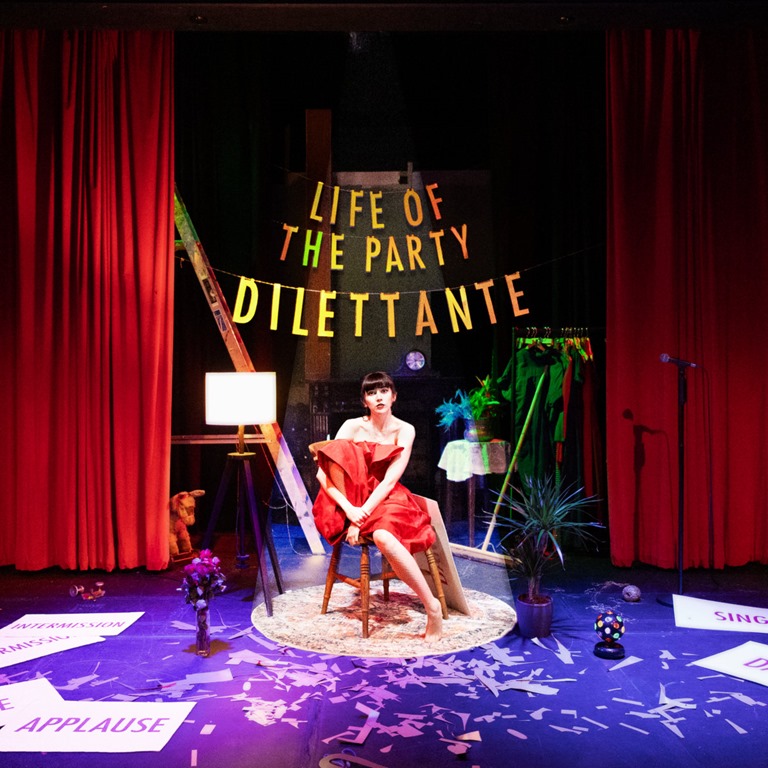
Dilettante return with their second album Life of the Party, Pidgeon’s first totally self-produced record and her most personal one yet. Made in the confines of a converted freight container, the album is an outpouring of frustration towards societal pressures and the acceptance of realising she sees the world differently to others. “I went to see Poor Things and I really felt like Emma Stone’s character made sense to me,” explains Francesca. “She’s really literal and sort of just looks at the way polite society always does things and says, ‘why are we doing that? That doesn’t make sense, let’s do it this way’.”

Life Of The Party covers a range of topics, from turning thirty and feeling the pressure to start a family, to feeling constrained within monogamous relationships as well as the more weighty matter of speaking out about sexual assault and dealing with the associated repercussions.

Sonically, the album maintains Dilettante’s signature art pop sound and impressive loop pedal skills whilst also diving into a more synth heavy realm. In parts, the record also sees Pidgeon exploring a gentler sound, reverting back to a more traditional and raw songwriting “I’d been listening to Andy Shauf and Harry Nilsson a lot and I was trying to actually write from the piano”. Life of the Party sees Dilettante continue to push boundaries, “This record is, at times, the weirdest stuff I’ve ever put out and at times the poppiest,” she adds.

To coincide with the release, Dilettante have released a video for the title track. Watch it here:

AA

a3699144988_10

12th July 2024

James  Wells

This may be Lanna’s debut single, but she’s by no means new to the industry, and has featured a couple of times here at Aural Aggravation with her band Miss Kill, who have garnered some thumbs up for their feisty grungy / alt rock sound.

Initially, I felt a sense of disappointment, assuming – erroneously, as it turns out – that the duo had parting and would never fulfil the early promise and future potential. It came as a relief to discover that Miss Kill are thriving, and have an album out soon, but in the meantime, Alanna is launching a parallel solo career. It’s a twofer!

But what’s interesting about Lanna’s debut single is that while her bio indicates a continuation of Miss Kill’s energetic flight, their emotive grunge stylings, again referencing inspiration from ‘Alternative, Garage and Pop artists like The Kooks, Hole, Cherry Glazerr, Chris Isaak, Placebo & Pearl Jam’, this feels like quite a departure. The premise is that, ‘rather than whine about breakups and having your heart broken’, ‘Forever’ ‘is all about the amazing feeling you get when you’ve found your special one.’

But for a song that’s so much about an effervescent emotional state, it’s remarkably subdued, with a soft, delicate piano, introspective vocal and backed-off drums with a hushed rimshot keeping slow and steady time. It may be a million miles wide of the mark, but this debut sounds for all the world like Lanna is pining for the thing she’s lost, a sad celebration for the loss of a special one as she finds herself bereft and alone.

That doesn’t mean that ‘Forever’ isn’t true to those principles of grunge and alternative rock, but probably feels more like a mid-album slowie than a lead single, and is more Chris Isaak than Pearl Jam or Hole. Still, it’s a well-realised song with an emotional weight that’s conveyed with sincerity, and leaves many doors open for future releases.

AA

Lanna image 1

Edinburgh born Kendall based artist Celestial North has shared ‘Yarrow’, a haunting atmospheric ‘botanical’ soundtrack.  For fans of Nils Frahm, Olafur Arnalds or Sigur Ros, this reflective and meditative piece gently sways with a wash of pianos and sighing melodies. It’s a tantalizing other side of Celestial North’s artistry and a teaser for her album released later this year. 

Watch the video for ‘Yarrow’ here:

AA

She says of the song:  “I often think in ‘music’. My thoughts are usually awash with colours and sounds. I was sitting trying to meditate, or contemplate, beside the yarrow patch in my garden. I was finding it difficult to articulate how I was feeling and started to feel a bit frustrated. I decided to sit quietly and start again. I realised that I didn’t really have any words to write down as such but I did have a tune playing in my head. I decided to record this tune on my piano and added some other elements that I felt benefitted the song — a bodhran drum, a choir, the rustling of the yarrow patch and the roses recorded from my garden and some simple electronic sounds.  This botanical soundscape is representative of how I felt whilst I was sitting with the yarrow and the tune played on the piano is the tune that was playing in my head whilst sitting with the plant."

473734

Fabrique Records – 29th April 2022

Christopher Nosnibor

On her latest project, Jana Irmert shrinks the focus of her thoughts and her music on the microcosmic – although that certainly doesn’t extend to the microtonal. What Happens At Night is an intensely-focused work that places the lens onto textures and tones, and an examination of the relationship between the physical and the cerebral. You may call it a celebration of overthinking, but ‘philosophical’ feels a more appropriate term for her musical meditation on life and death – specifically death and beyond, the part of the life journey no-one has ever reported on and will, one assumes, be forever unknown and unknowable.

The liner notes set out the granular nature of the album’s composition: ‘Like layers of sediment, sounds are being pushed up from underneath, floating away or sinking back to the bottom. At the core of the album lies a question: What will be left of us? While Earth melts, we go on. But eventually, there will be a point in the future where all that will be left of humanity is a thin layer of rock. While this may seem like a deeply gloomy prospect, it also carries a great deal of comfort: the reminder that we are only a small particle in a vast system so big that we can never fully grasp’.

This is the limitation we all live with: the inability to comprehend life without us, what it would be like to not exist. Much of it’s ego, but perhaps it’s also a preprogramed limitation. Everything is dust, and once we pass, ashes to ashes, dust to dust, we become desert, and nothing changes: the world goes on… and on. And that’s a disheartening prospect; for the majority, our legacy won’t extend beyond our lifetimes, and the world at large is unaware of our existence while we’re here, let alone likely to experience any ripples in our wake. But even the world will be finite, ultimately. It will be swallowed by the sun in supernova. But none of us will be here to report on it by then.

What Happens At Night is dark and stark, and with just four tracks and a running time of less than half an hour, it’s perhaps technically only an EP, but feels like an album in every respect.

There’s a dolorous chime of a bell and a shrieking anguish of tortured spirits trailing like comets fading through the sky at the start of the album’s first piece, ‘Particles’, and everything simply floats and drifts. It’s ambient in the conventional sense: it’s background, you don’t really pay close attention while it’s playing, but it does subtly slant the mood.

‘Ashes’ is but a drifting fragment between the megalithic pieces on either side: it’s barely three minutes in duration. If ‘Dust is the Rust of Time’ is sparse it’s also dense, and a sedated heartbeat pulses uncomfortably throughout, amidst shuddering, gasping breaths of panic. You feel the anxiety at the passing of time; what have you achieved, and what will be your legacy? How will you be remembered in a world without you? It’s a tense, dense, gloomy sound, and you come to realise you are nothing, you’re simply here to go, and one day you will be but dust. Deal with it. And yet… It’s not a question of there being something more beyond, as such. And yet… ‘Stratum’ closes, and it’s the splash of waves and the quiet roar of a buffeting wind and the slow sound of the dust settling as incrementally, life returns to earth in slow, sedimentary layers, and each layer fossilises a period in time for all eternity. You may be dust, you may be forgotten, but in some form, are eternal in the earth.

Irmert articulates nothing specifically or directly here, but instead, What Happens At Night provides a sonic backdrop which invites contemplation.

AA

FAB097_front