Industrial rock band, FLEISCHKRIEG has just unleashed their new single, ‘I Believe In Gnomes’.
‘I Believe In Gnomes’ is a song about our beliefs, who shapes them, and why. Many things that were too absurd to believe in (such as UFOs) have now been proven to be true. The crackpots have been vindicated. Now the gnomes ask us to consider what else have we been lied to about, and why. They ask us to examine our beliefs. Are they really ours to begin with or did we inherit them from a society bent on hiding the truth from us?
The single was Produced/Mixed/Mastered by Logan Mader who has produced and mixed acts such as Fear Factory, Divine Heresy, and Five Finger Death Punch. ’I Believe In Gnomes’ is available on all major digital outlets including Spotify and Bandcamp.
Check the video here:
FLEISCHKRIEG is the result of a chance encounter between an Uber driver and a drunk passenger partying in Seattle. The driver, Richard Cranor, and the passenger, Thomas Crawford, found themselves kindred spirits through a mutual love of Rammstein and industrial metal. When the opening act dropped out of Thomas’s solo ‘Ceraphym’ show, he invited Richard to perform in their place. Richard agreed with the caveat that Thomas play guitars. FLEISCHKRIEG was formed.
The group, currently based in L.A., cite Rammstein, DK-Zero, Die Krupps, and Lord of the Lost as musical influences. Their moody electronic sound melds industrial metal with darkwave undertones, creating the genre of ‘Brutalwave’: a blend of new wave, metal guitars, and crushing industrial dance beats and vocals. Now with the addition of Nick Mason on drums and Kaylie Cortez on synth/keyboards, FLEISCHKRIEG’s live shows are a force to be reckoned with.
And we’re back once again in the divergent and varied field of what’s come to be goth in the 21st century, and it’s a very far cry from its post-punk roots. The late 70s and early 80s saw the emergence of Siouxsie and the Banshees, Bauhaus, The Cure, The Sisters of Mercy, The March Violets, Christian Death and a slew of bands who would subsequently be labelled as ‘goth’, and who were subsequently joined by the likes of Red Lorry Yellow Lorry, The Cult, Fields of the Nephilim, The Mission, etc., etc. The fact of the matter is, there was little commonality between these acts, and that goth was something of a media fabrication. What about the fans? Let’s not confuse the fans and the artists, or a subculture with its icons. So what was a scene that never was morphed into an evermore diffuse group of subcultures, with an ever-broader range of bands who had little or nothing in common beyond their shared fanbase. After metal, there can be few labels that provide an umbrella for a greater range of styles.
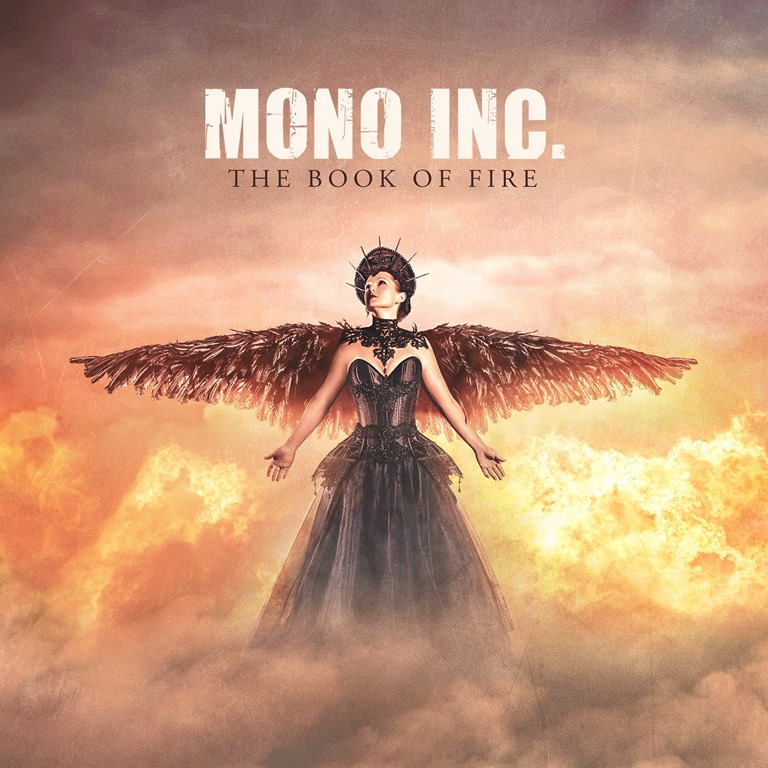
So here we are, presented with The Book of Fire, the eleventh album by German goth-metal act MONO INC. And while it’s goth, it’s not really my kinda goth, and couldn’t be further from the dark post-punk or art-rock stylings of the first wave of bands. Is this evolution, or dilution, cross-pollination and contamination? I suppose that’s a matter of perspective.
The album’s first song, the title track, is over seven and a half minutes long. It begins with a slick guitar that almost manages to sound like a harpsichord, and then it glides into some kind of Celtic folk metal and it very soon starts to become uncomfortable. Uncomfortable because such buoyant energy is more the domain of the hoedown knees-up. The folk-hued power-metal of ‘Louder Than Hell’ brims with positivity about strength and stuff, and explodes with crisp synths and choral backing vocals and it’s fun enough, but it’s also pretty cringy: it’s the kind of thing Germany might enter into Eurovision.
Then again, ‘Shining Light’ has such a massive chorus and a hook so strong that it’s hard to resist even when you’re hating it: it has that uplifting surge that lifts you and carries you away on the tide from the inside.
The euphoria swiftly dissipates with the next song, ‘Where the Raven Flies’, which is the definition of theatrical cliché melodrama. And herein lies the problem, which I accept is entirely personal, at least on a primary level. In short, I think it’s cheesy and naff.
On a secondary level, and one which is more objective, what The Book of Fire represents is very much a commercial take on the genre; theatre and drama don’t necessarily equate to an absence of depth, but this is good-time party goth, and any emotional sincerity is polished away under a slick veneer of pomp and overblown production. In this way, it’s as credible as examples of either folk or goth as Ed Sheeran’s ‘Galway Girl’ or Doctor and the Medics’ rendition of ‘Spirit in the Sky’. It displays all the trappings, but none of the authenticity. For all the theatre, there’s a woeful absence of substance, the brooding is third-rate thespianism rather than the anguish of tortured souls.
Elsewhere, ‘The Last Crusade’ is riven with choral bombast, but is little more than an obvious ‘This Corrosion’ rip-off, that once again leans heavily on Germanic folk tropes, and ‘The Gods of Love’ similarly brings together Floodland-era Sisters with Rammstein. I’m sure plenty will view this as a good thing, but they’d be wrong, so wrong. ‘What have we done?’ they ask repeatedly on the final and suitably epic finale track ‘What have We Done’, and it’s a fair question: whatever it is, it’s not good.
In fairness, it’s not quite ‘Rocky Horror’ bad on the spectrum of play-goth, but it’s not far off, and while it’s sonically ambitious, creatively, it’s depressingly derivative.

 Aural Aggravation