25th March 2026
Christopher Nosnibor
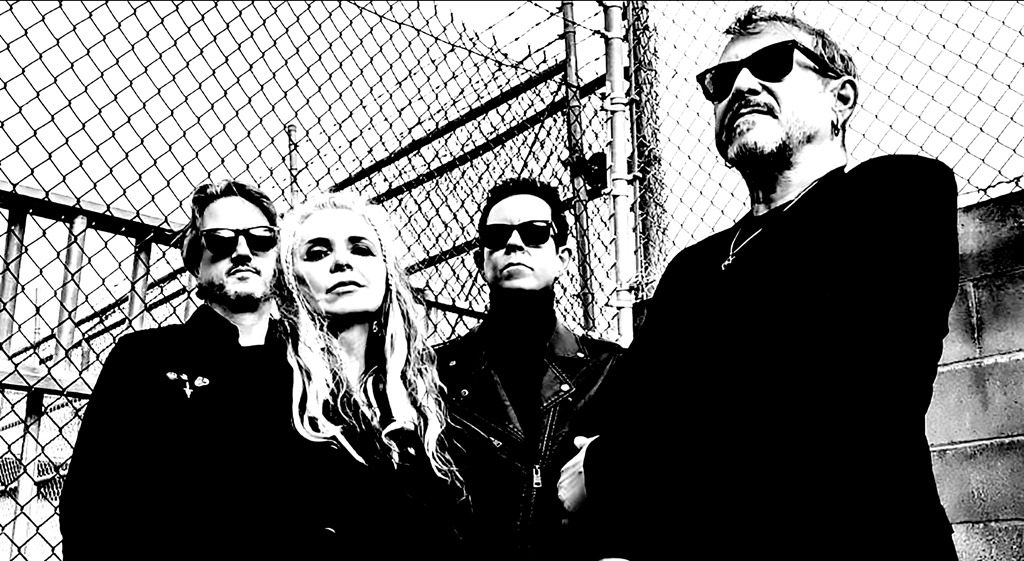
Pitched as ‘one of the most exciting new bands on the North American dark post-punk scene’., Octavian Winters formed – or, as their bio would have it – ‘was born into the ghostly isolation of San Francisco’ in 2022. Already, the pandemic seems to have receded into a past which feels like a fever dream. The fact that German post-punk legends Pink Turns Blue dig them enough to have picked them as support for their tour of the western US in April speaks for itself, and in many respects, so does this single, a thick slice of classic vintage-style gothiness that’s cooked to perfection.
Frontwoman and lyricist Ria Aursjoen says: “‘Elements of Air’ is about how we see the world, our chosen frame of reference, and how much power that holds over us — including the power to destroy things we value. The direct inspiration was someone I knew who chose to view the world through a lens of hate, and how that ultimately cost the friendship.”
In these times of extreme division, this is likely to be a scenario which is relatable to many. While the arrival Trump in the Whitehouse (and the advent of Brexit here in the UK) was an obvious moment of rupture, the pandemic proved to be a defining moment in time where people seemed to take more polarised positions. And since emerging from the successive lockdowns, the world feels like a different place – a place not only in the grip of war, but a place where people seem intent on causing anguish, antagonism, and aggravation, as if they’re spoiling for a fight, and if it’s not over immigration or race or the like, then they’ll settle for sparking a dispute over car parking or dustbins. Disharmony dominates the social discourse, and many have found themselves having to sever ties to once-close friends in the interests of self-preservation.
Driven by rolling drums and a dense bass, it’s topped by a choppy, metallic, flange-coated guitar, reminiscent at times of X-Mal Deutschland, which scratches and scrapes it way through the track. And then there’s Ria Aursjoen’s airy vocals which breeze in and weave a spellbinding melody. Part Toni Halliday (Curve), part Maria Brannigan (Sunshot), she brings an almost poppy vibe to the dark-edged post-punk party. Sure, it’s a formula that has its roots much further back, with The March Violets and Skeletal Family incorporating an accessible, pop-with-a-twist vocal, with snaking melodies steeped in Eastern mysticism.
Listening to any ‘new’ goth inevitably leads me down a rabbit hole of memory lane excursions into ‘old’ goth: the genre is rich in intertext and references, influences and appropriations, and it was ever thus, the early 80s acts who were goth before the label existed – Bauhaus, The Sisters of Mercy, Siouxsie – all belonged to the post-punk milieu, which draw on Bowie, The Doors, The Stooges. Perhaps more than in any other genre, there’s a lineage and a trajectory which can be traced back through the decades to its musical prehistory and which has remained quite intact through the various waves, of which there have now been several.
As such, it’s not so much about breaking new ground, but how inventively the tropes are used, and how well-crafted, how well-executed the songs are. And in the case of ‘Elements of Air’, the crafting and execution is spot on.
AA
AA



 Aural Aggravation