Posts Tagged ‘Norman Westberg’

Christopher Nosnibor

The last tour of Swans’ current iteration, drawing the curtain on a succession of albums – and tours – which have been truly immense in every way: the build-up felt like the end of an era. The event itself, perhaps less so. At one point, someone calls out a request. “We don’t do that,” Gira explains, in a kindly manner. He seems pretty relaxed tonight, and smiles a fair bit. No-one in the band gets bollocked or scowled at, and they all seem to be having a pretty good time.

But no, they certainly don’t do ‘that’. You don’t go to see Swans expecting to hear choice guts from their extensive back catalogue. You don’t even go expecting to hear songs, at least not in any recognisable form. The versions of recorded songs bear only limited resemblance to their studio counterparts, twisted, stretched, and otherwise evolved while on the road to a point whereby they’re almost new songs entirely. Recent shows have seen the band playing sets spanning a full two and a half hours, while only featuring six songs.

Before we come to Swans, Jessica Moss, who, amidst an extensive catalogue of work over the course of a lengthy career, is best known for her contribution to Thee Silver Mt. Zion Memorial Orchestra and being part of the whole Godspeed You! Black Emperor milieu. Tonight, she plays a rendition of her latest album, An Unfolding, in its entirety, and it’s breathtaking. Her nuanced violin and vocal work is augmented with booming, resonant bass tones. There’s a lot of yakking at the bar and further back in the 1,000 capacity, sold-out venue, where the house light stay up toward the rear of the room for the duration of the night, but for those of us in the front two-thirds, it’s a spellbinding experience, which perfectly sets the tone for the main event.

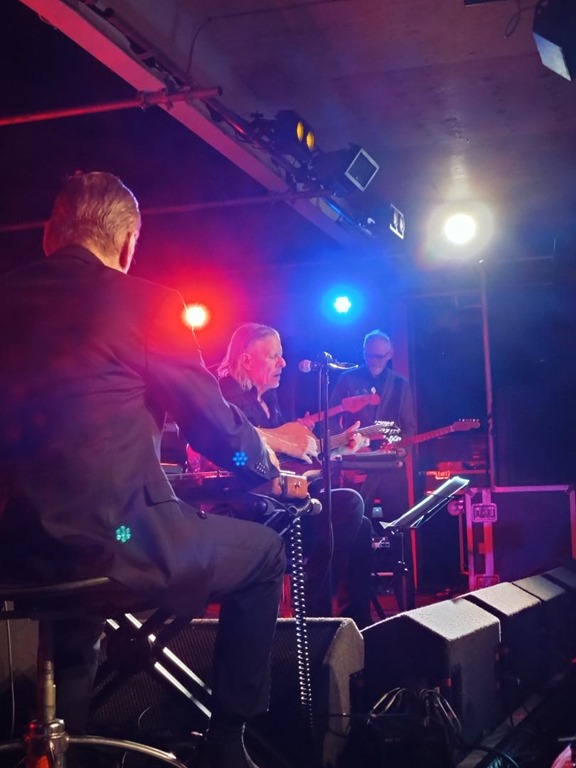
Moss’ half-hour set is over by around 8:40, and Swans, after a few brief checks, take to the stage around ten minutes later. Gira politely asks that there are no cell phones – “at least not where I can see them”, before he begins strumming a monotonous at two strings. He does so for what feels like an eternity. Or perhaps not. When Swans play, time takes on a different meaning, and it’s been a feature of this current iteration that the songs evolve and elongate over the course of the extensive tours, transforming and transmogrifying over the weeks and months on the road. They’ve been touring Birthing and this ‘farewell’ for a fair while now, although the set on the most recent leg has only featured ‘The Merge’ from said album. With ‘Paradise is Mine’, from The Beggar, and ‘A Little God in My Hands’, from To Be Kind, this is as close to a retrospective set as you’re likely to get, but none of these songs much like the studio versions, and half the set therefore features material which is either new or so far removed that it’s been retitled as well as restructured. But as I say, you don’t come to a Swans show for the songs. You come for the experience. And what an experience it is.
S1

It’s fair to say that there is simply no other band like Swans. Their reputation for extreme volume is only part of the story, a piece of the equation. Older fans who saw them in the 80s love to regale with tales of people throwing up, passing out, and so on, and that they’re pretty tame these days, and I have no reason to believe that these are purely apocryphal. Gira just can’t do quiet: even his solo acoustic sets playing smaller venues circa 2003 / 2004 were fucking punishing.

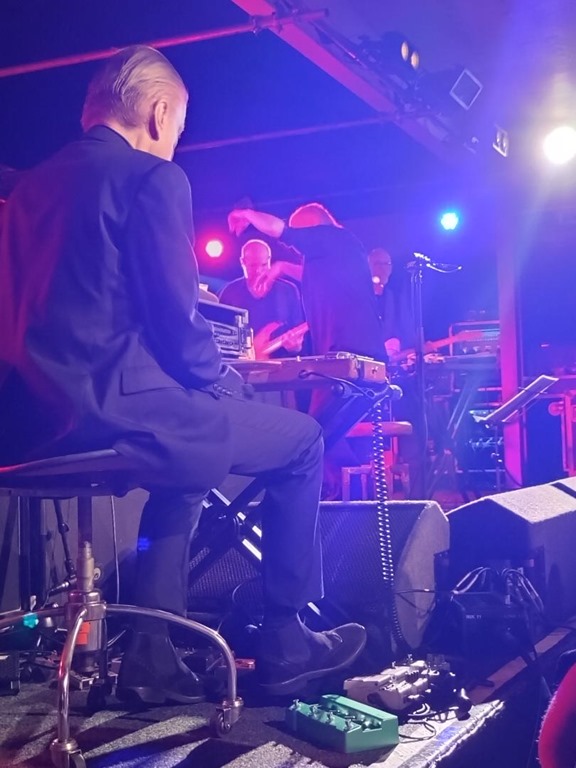
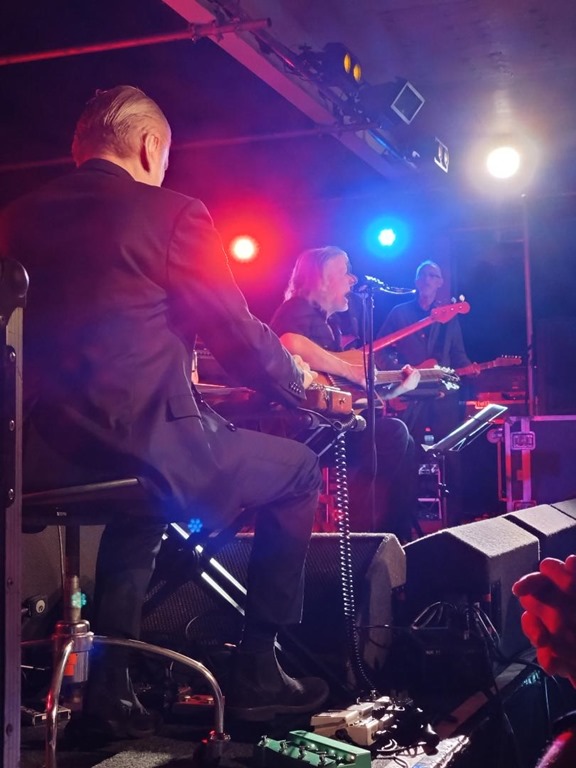
Some time in, Gira downs his guitar and stands up, turning to face the band, and flails his arms as if experiencing some kind of rapture or episode. But every gesture is a signal, from which the band members – there are six of them, plus Gira – and his near-psychotic choreography guides them through ebbs and flows, to ever greater, more intense crescendos. It’s maybe half an hour before the full drum kit kicks in, and I feel my nostrils vibrate with the sheer quantity of air displaced from the speakers. It’s transcendental, euphoric.
S2S3

A number of people who had started the set near me in the front row dissolved. I didn’t really notice when: like almost everyone else, I was simply transfixed. And yet, this was by no means loud by Swans standards: while I can’t claim to have witnessed the nauseating brutality of their early years, or the notorious punishment of the Burning World tour (ironic that their gentlest album, released on a major label, should have been served by a tour of such infamous volume… or perhaps not, perhaps it was a statement to prove that they hadn’t sold out), their shows at Leeds Stylus in 2016 and 2017 were something else – something so intensely physical, it hard to find the words. Then again, on their last visit to Leeds, playing at The Belgrave, I found myself thinking ‘this isn’t so loud’ but before long finding myself dizzy and wondering quitter where that immense noise had grown from. And this is perhaps an indication of how they’ve evolved. The bludgeoning force is still very much present, not least of all with two basses and the return of Norman Westberg to the lineup – surely one of the world’s most patient and understated guitarists, content to stand, not playing for ten to fifteen minutes, before battering away at one or two chords and thirty BPM for the next fifteen minutes, creating noise and texture rather than doing the conventional ‘guitarist’ thing – but now it’s more subtle, growing building, slowly, so slowly. A tweak here and there, another player adds a later, and while you’ve been watching the dynamics of the two bassist and Gira’s windmilling, the volume has increased threefold and your ribcage is rattling and your brain is slowly scrambling. Kristof Hahn does things with lap-steel that is beyond comprehension, cranking out squalling, screaming walls of noise – but there isn’t a weak element in the lineup. They each bring something unique, and the collective output is something else.

If this is the end of Swans doing big band, big noise stuff, then they have certainly delivered a finale of spectacular proportions. And whatever comes next, we look forward with bated breath.
Room40 – 18th July 2025

Christopher Nosnibor

Norman Westberg seems to be a man of few words. Through all of his years with Swans, I can only recall interviews with Gira and Jarboe, although I have for many a decade now admired Westberg’s stoic approach to playing: no showmanship, no seeking of attention, instead channelling the sound, often with infinite patience, screeding feedback and a single chord for an eternity. His solo material is considerably softer than Swans in tone, but no less brimming with tension and atmosphere, and this is nowhere more apparent than in his solo live sets, as I recall in particular from seeing him open for Swans in Leeds two years ago. Onstage, he was unassuming: in contrast, the sound he made, was powerful.

And so it is that the words which accompany Milan are not those of the artist, but Room40 label head Lawrence English, who recounts:

In 2016, I invited Norman Westberg to Australia for his first solo tour.

He’d been in Australia a few years before that, touring The Seer with Swans, and it was during this tour that I’d had the fortune to meet him. Since that time Norman and I have worked on a number of projects together. He very kindly played some of the central themes on my Cruel Optimism album and I had the pleasure to produced his After Vacation album.

Last year Norman shared a multichannel live recording with me from a tour where he was supporting Swans. The recording instantly transported me back to the first time I heard Norman perform.

Whilst many people know his more dynamic and tectonic playing associated with his band practice, Norman’s solo work is far more fluid. Often, when I hear him live, I imagine a vast ocean moving with a shimmer, as wind and light play across its surface.

Norman’s concerts are expeditions into just such a place. They are porous, but connected, a kind of living organism that is him, his instrument and his effects. He finds ways to create moments of connection which are at times surprising, and at others slippery, but always rewarding.

There’s a deeply performative way to his approach of live performance. There’s a core of the song that guides the way, a map of sound, but there’s also an extended sense of curiosity that allows unexpected discoveries to emerge.

Milan, which I had the pleasure to work on for Norman, captures this sense perfectly. It is a record that exists in its own right, but is of course tethered to his other works. It’s an expansive lens which reveals new perspectives on familiar vistas.

This almost perfectly encapsulates my own personal experience of witnessing Westberg performing. And Milan replicates that same experience magnificently. Admittedly, despite having listened to – and written about – a number of his solo releases, including After Vacation, I was unable to identify any of the individual pieces during or after the set. Such is the nature of ambient work, generally. Compositions delineate, merge, and while the composer will likely have given effects settings and so on, which are essential to their rendering, to most ears, it’s simply about the overall effect, the experience, the way movements – even if separable – transition from one to another.

This forty-minute set is dark, disturbing, immersive, somewhat suffocating in its density, from the very offset with disorientating oscillations of ‘An Introduction’. It flows into the next piece, ‘A Particular Tuesday’, where tinkling, cascading guitar notes begin to trickle down over that woozy undulation which rumbles and bubbles on from the previous track. And over time, it grows more warped, more distorted. Something about it is reminiscent of the instrumental passages between tracks on Swans’ Love of Life and White Light from the Mouth of Infinity, and for all the swirling abstraction, there are trilling trickles of optimism which filter through here.

Amidst a swell of bass-booming, whorling sound on sound, gentle, picked notes just – just – ring clear and give form to an amorphous sonic mass, but this too gradually achingly, passes to the next phase, and then the next again. ‘Once Before the Next’ is the sound of a struggle, like trying to land a small wooden rowing boat in a gale. And it’s in context of this realisation that there are many depths and layers to Milian, but none which make for an easy route in, and there is no easy ‘check this snippet’ segment. Instead, it’s the soundtrack which prefaced the ugly one w know is coming.

While Milan is obviously a live set – and at times, the overloading boom of the lower frequencies hit that level of distortion which only ever happens in a live setting, and the sheer warts-and-all, unedited, unmixed approach to this release is as remarkable as it is incredible in listening terms. This isn’t a tidied-up ‘studiofied’ reworking of a live show. Milan is a document of what happened, as it happened. You can feel the volume. The density and intensity are only amplified by the volume, and you really do feel as if you’re in the room. Let it carry you away.

AA

AA

a1125531819_10

The Whimbrels is an outer-borough masterpiece. The sound is dense, polyrhythmic, hard, and sweet, hooks and riffs to save your soul pop out at unexpected moments. The players’ credits — The Glenn Branca Ensemble (dating to the 1980s), The Swans, J. Mascis — predict the guitar-driven, sonic onslaught of The Whimbrels, captured on their startling debut – and as a taster, they’ve unveiled a video for the song ‘She is the Leader’.

A Whimbrels show involves racks of guitars, tuned in different and unconventional ways with the players constantly switching between them. ‘The Whimbrels’ album showcases this. There are counterpoint choirs, dueling e-bows phase against each other, chunking, poly- and cross-rhythmic interludes, soaring arias of distortion from Westberg and Evans’ strangely melodic and inventive guitar. Evans’ and Hunter’s vocals front a three-guitar line up tuned every way but normal. The ax men are veterans with contrasting styles that come together in a potent whole. The beats are smart and unrelenting. The album concludes with the instrumental Four Moons of Galileo, four short sections with the inner two framed by shimmering walls of descending, slowly evolving harmonies. The title recalls the four moons discovered by Galileo, suggesting the many more then lurking unknown in space.

ARAD EVANS (guitar, vox, primary songwriter) was a member, recorded and toured with Glenn Branca’s ensemble from the 1980’s until Branca’s death a few years ago. He is founder and still performs with Heroes of Toolik. In addition to Branca, he has played with Quiet City, Rhys Chatham, Ben Neill, John Myers’ Blastula, The SEM Ensemble, The New Music Consort, Virgil Moorefield’s Ensemble and many other groups. “A truly inventive and surprising guitar player.” (Rick Moody, The Rumpus Aug. 25, 2016).

NORMAN WESTBERG altered the course of rock as the main guitarist of the Swans over 35 years, contributing "overwhelming waves of volume with a mix of the rhythmically slashing and the harmonically sensual." He has a busy career as a solo artist and with other projects, such as Heroin Sheiks, NeVah and Five Dollar Priest.

LUKE SCHWARTZ is a New York guitarist and composer to watch; he also toured and recorded with Branca, and he performs in a wide range of groups, including Rick Cox, Joh Hassell, Lotti Golden, Wharton Tiers and with several of his own projects, The Review and the improvisational Hive and Quiet City and is in demand for film scoring work.

MATT HUNTER (bass, vox, songwriter) is a co-founder of New Radiant Storm King and plays or has played with a galaxy of cool projects, including J. Mascis & the Fog, King Missile, Silver Jews, SAVAK, and his own Matt Hunter and the Dusty Fates.

Drummer STEVE DiBENEDETTO, is a widely shown and collected fine art painter but also in in high demand for his music. ("The Spinless Yesmen" 1984—89, "Wonderama",aka "The Shapir-o-Rama" 1990—95, Airport Seven from 2010 to 14). He frequently collaborates with Dave Rick (Bongwater, King Missile, Yo La Tengo, Phantom Tollbooth) and Kim Rancourt (When People Were Shorter and Lived by the Water).

LIBBY FAB (drummer on That’s How It Was) is a founding member of the noise duo Paranoid Critical Revolution. She was technical director of Glenn Branca’s Symphony 13: Hallucination City from 2006-09 and toured as drummer for his ensemble on the Ascension: The Sequel tours. Her own electro acoustic and video works have been featured in festivals in Europe, North America and the Caribbean.

JIM SANTO (producer) partnered for many years with Wharton Tiers in the fabled The Kennel studio. At his own Tiny Olive, Santo has worked with a wide range of clients and projects. As a guitar player, his credits include The Sharp Things, George Usher and Harley Fine.

The New York Times once placed Arad Evans on “an index of creative or experimental electric-guitar-based music in America — young lords of the wild in the post-rock tradition.” That description fits The Whimbrels perfectly. You may need earplugs.

AA

Whimbrels_platforms

Room40 – 6th September 2024

Christopher Nosnibor

For an album that’s based solely on the sounds of the guitar, Dust Resonance sounds distinctly unlike a guitar album. As the title, Dust Resonance, suggests, this is a work of extended, drifting drones, a set that’s predominantly ambient in nature.

But as Norman Westberg’s recent solo releases – also released on ROOM40 – have demonstrated, it is quite possible to take the guitar into this territory, and to create expansive, subterranean drones with just six strings and some distortion pedals, and perhaps some reverb thrown in.

As Zimoun himself explains, he was interested in the guitar as a sound source for some time and have explored it on previous editions including Guitar Studies I-III. “On this work,” he says, “I’ve experimented with different methods and materials, specifically a Magnatone tube amplifier from the 1960s, and various speaker membranes covered with dust, soil, or small stones. The friction of these materials on the vibrating speaker membranes produced slight distortions and irregularities in the sounds, alongside the warm tube tones of the vintage amp.”

As such, the dust is rather more literal than metaphorical here, but the title and the substance of the sound presents a work that functions on multiple levels, with the connotations of dust settling as time elapses and the idea of dust and drones hazing together working alongside the physical interference of organic material with the mechanics of the recording process.

Zimoun’s approach, then, like Westberg’s, is similarly simple and sparse, but at the same time, adds an edge of experimentalism which is quite unique. The addition of materials to create friction and alter the texture of his guitar may take its cues from the ‘prepared piano’ pioneered by John Cage and taken forward as a career choice by Reinhold Friedl. I can’t think of so many examples of the guitar being twisted and mangled in such a way, or an artist taking such an organic, earthy approach to breaking down the fundamentals of the sound of their instrument of choice. It does, however, create the context for an album which features nine dronescapes which creep into one another to forge a continuous hum, scratching, scraping, quite literal earthworks. The thought of earthworks draws me to a place where I find myself reflecting on hut circles, tumuli, and the landscape of the iron age, something I was fascinated by in my early teens and have once again become drawn to having resumed, after a lengthy period, walking moorlands and studying the details of OS maps. And so it’s purple-hued heather-covered moors and outdoor expanses which occupy my mind as I listen to this, a work which evokes similarly vast and barren spaces.

The album contains nine numbered pieces, which hover low and heavy and segue into one another to create one single, monolithic work, and one of immense density. The colossal ‘DR Part 2’, which grinds on for almost nine minutes is exemplary.

I recently wrote on the experience of listening to the instrumental ambient release Ambient Short Stories by Bistro Boy, which slotted firmly into the ‘background’ ambient slot: soft, gentle, undemanding. This is most definitely not background: the dense, buzzing tones and uncomfortable frequencies of Dust Resonance place it firmly in the foreground. It’s impossible to settle back and let this drift over as you yawn and slowly relax into a space of tranquillity. Dust Resonance makes you squirm, sends tension down your spine. Throughout, there is a sense of unease, discomfort, of wrong, which rumbles in the guts.

Dust Resonance is a work which, beneath its smooth surface ambience, is grinding, rough-hewn, slow, and dragging, with billows of cloud accompanying the low-level churn. Something about this, paired with the slow-building spin, starts to feel a shade disorienting. You might sleep, but you may not sleep comfortably.

AA

a0068423991_10

Erototox Decodings – 1st March 2024

Christopher Nosnibor

Holy hell! Where to start? We’ll come to the band’s pedigree and the CVs of this supergroup in due course. But first, the immediate impact of this second album by The Children – that’s what hits in an instant. Perhaps because I missed the first, I simply wasn’t prepared in the way I might have been, but then again, is there any adequate preparation in advance of this?

A stark acoustic guitar – something about the way it’s picked and pulled is sharp, tense, scratchy, in the opening bars of ‘gOd is a Bereaved’ is prickly, awkward – paves the way for an eye-opening vocal performance. It simply doesn’t conform to the mores of conventional musicality, and instead flies skyward and swoops towards the ground in terrifying, unnatural flips and arcs. Something is certainly sudden, and it’s not a craving, but the impact of this completely out-there sound. Intense is an understatement.

‘Woven Mother Aflame’ brings brooding atmospherics split asunder by explosive percussion – a snare that has the power to split skulls cutting through serpentine strings and heavy, resonant bass reverberations which hang in the air, before the gentler ‘Breathing Shards’ fades electronics into a strummed acoustic guitar. Breathe… out. But all is not comfortable. The quavering vocals – not quite falsetto, not quite any specific range, but warbling, tremulous – quiver, uncomfortably atop and amidst the multi-layered backdrop which slopes and slides and traverses through starless space as basslines stroll and amble sedately.

Some background: The Children… ‘are . They have been making music together for over 15 years. Former Barkmarket bassist John Nowlin and drummer Rock Savage have consistently anchored the rhythm section, with a savagely airtight groove that’s both thunderous and mellifluous, primal and funky, and cellist Kirsten McCord has regularly enriched the band’s sound with her somber, lulling phrasing as a one-woman string section. John Andersen was a founding member and key early collaborator. The inimitable vocalist Shelley Hirsch has been a visceral contrapuntal foil for several live shows. Former Swans guitarist Norman Westberg and clarinetist Johnny Gasper provided invaluable texture to the recording sessions for this LP.

Norman Westberg has long been one of my favourite guitarists on account of his absolute minimalism: few guitarists would be content to bludgeon away at two chords for eight minutes straight, but his stoic patience is a rare trait which sets him in a league of his own. His more recent solo work is noteworthy for his sculpting feedback into musical shapes, and as such, his magnificently understated contribution to this album is essential.

Then again, how really to assimilate this? Our instinct, as humans, is to trust what we know, to lean into the familiar, the comfortable. This is perhaps why so much conformist pop, accessible blues-rock, landfill indie, continues to command so much appreciation. It’s not even that it’s easy and comfortable, but that it sits within an established framework with which people are comfortable – and the same, unsurprisingly, applies to people. ‘Weirdos’ are ostracised, and find themselves on the fringes, alone. People find ‘otherness’ simply too much of a challenge. Who can honestly say they haven’t taken a step back and made effort to put distance between themselves and a ‘crazy’ in their lives or on social medial? No shame in it: life is difficult as it is, and you have to have limits on who and what you can accommodate. But the point stands: other peoples’ disturbances create further disturbances. And A Sudden Craving sounds pretty disturbed.

A Sudden Craving is the sound of otherness. Yes, the vocals in particular are difficult to process. They sound… well, deranged. Wailing theatrically in a howling whorl of chaos and discord, underpinned by a hypnotic wave and monotonous plod of percussion, they really stand out as the definition of mania. ‘Breathing Shards’ may be mellower, but still possesses a sharp, jarring edge.

A Sudden Craving is scary because it doesn’t conform to any norms. Every one of the album’s ten tracks is unsettling, uncomfortable, unpredictable. It has depth and detail and many great qualities. Comfort and ease of access are not among then.

A Sudden Craving is a great album. It is not an accessible album, or an album which is comfortable or easy in any way. But then it’s not designed to be. It’s a head-shredding riot which really delivers some uncomfortable moments. At times I’m reminded of late Scott Walker. It’s compelling, and it’s quality, but one to file under ‘W’ for ‘Weird Shit’.

AA

a0924183782_10

Young God / Mute 25th October 2019

Christopher Nosnibor

On receipt of the new Swans album, I posted on Facebook that I was ‘too excited to download it.’ This wasn’t sarcasm or bathos. The arrival of a new Swans album is always an event of no small magnitude, and with a certain sense of duty to deliver a review of a band I’ve revered my entire adult life comes a certain weight of responsibility to do justice. Swans have always been more than merely a band, standing as a sonic entity with almost infinite capacity to overwhelm. And they haven’t lost that.

Their last three studio albums, The Seer (2012), To Be Kind (2014) and The Glowing Man (2016) redefined epic and over their course took extended improvisational forms to a logical conclusion, each with a duration in the region of two hours.

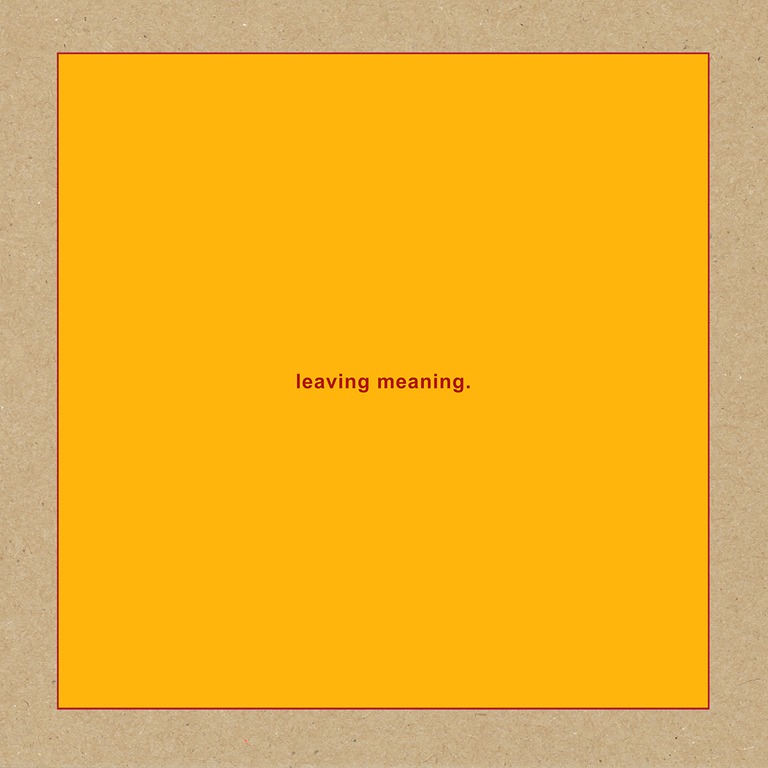
Given the tone of Michael Gira’s statement about the end of the iteration of the band who produced these albums, Leaving Meaning brings two substantial surprises, the first being that many of the personnel from the previous incarnation remain present, and the second being the speed of its arrival. Kristof Hahn remains in the latest lineup, which also features eternal mainstay Norman Westberg – arguably as integral to the band as Gira himself – albeit only on some tracks, and Thor Harris, Phil Puleo, and Christopher Pravdica. They’re joined by an immense cast of contributors including The Necks, Baby Dee, Anna and Maria von Hausswolff, and Larry Mullins.

Leaving Meaning sees Gira take a slightly different and more openly collaborative approach to the realisation of his ideas, and it’s a more concise record in comparison to its predecessors. It’s all relative, of course, but in context, ninety-three minutes is concise.

Because of its sheer enormity, Leaving Meaning isn’t an album it’s entirely appropriate to dissect, and it’s constructed in such a way that it is very much best experienced as an album rather than dipped into. That means its effect is optimal when experienced in a single session, but that also means – as was the case to an even greater extent with its predecessors – that it requires a significant commitment of time in a time-pressured world. But then, Swans’ music has the capacity to lift the listener out of time and into another zone altogether.

The longer tracks are considerably shorter than even most off the shorter tracks on the last three albums, with the twelve-minute ‘The Nub’ being the album’s longest track.

Intro segment ‘Hums’ is appropriately-titled, consisting of just two minutes of cascading, hovering drones interwoven for create a soft ambience. ‘The Hanging Man’ revisits the nagging, dizzying cyclical bass motifs of numerous extended workouts from the last trilogy, and grinds it out for ten minutes. Anyone who’s familiar with the band’s extensive back-catalogue will be aware that this style of composition harks back to the band’s dawning and has remained a trademark of theirs, as well as Gira’s solo work. Paired with Gira’s vocal delivery, which switches from a monotone drone to a maniacal holler of elongated vowels and jabbering ululations and monosyllabic barks and yelps, it’s vintage Swans that threatens a climax around the mid-point but saves the real intensity for the finish. It’s less about volume than plain, bludgeoning repetition.

‘Amnesia’ is not the same ‘Amnesia’ as on 1992’s Love of Life. Perhaps Gira’s forgotten about it. It is, however, a brooding acoustic-led folk song. At heart. One of the things that constitutes a significant point of departure on Leaving Meaning is the return to sparser structures: gone are the immense sustained crescendos and pulverising explosions of discordant noise. There’s an altogether more mellow feel about Leaving Meaning. That said, there are orchestral and choral surges which punctuate both here and elsewhere.

A

‘Sunfucker’ is another classic Swans composition built around endless repetition, and with its backing vocal chants serves as an apocalyptic counterpart to ‘I Am the Sun’ from The Great Annihilator. Tapering off to drones in the mid-section, it suddenly explodes into a stomping glam bash. It’s bewildering, unexpected, everything all at once and probably the most daring and adventurous thing Swans have recorded in their entire career.

‘The Nub’ is gloomily funeral. Ethereal, haunting, but ultimately bleak in mood; ‘Some New Things’ is mantric, looping, hypnotic, while ‘My Phantom Limb’, one of the album’s standouts, has stronger echoes of Greed-era’s tortured pounding. It sits at odds with the rest of the album, but then so much of the album sits at odds with itself it feels right in a perverse way.

So what do we take from this? More or less what we’ve take from Swans over the last thirty years: with their ever-shifting parameters but constant core focus and the creative vision of Michael Gira always the driving force, Swans never cease to evolve, but never cease to be Swans, and are immediately identifiable as Swans, however far out they go.

swans-leaving-meaning

Leaving Meaning is the fifteenth studio album for SWANS, the follow up to 2016’s The Glowing Man, and is due for release by Mute / Young God Records (N America) on 25th October 2019. Leaving Meaning will be released on double vinyl in a brown chipboard sleeve, double CD in a brown chipboard digipack and digitally.

Written and produced by Michael Gira, the album features contributions from recent and former Swans, members of Angels of Light as well as Guest Artists Anna and Maria von Hausswolff, Ben Frost, The Necks, Baby Dee, and a Hawk and a Hacksaw,

Michael Gira explains, “Leaving Meaning is the first Swans album to be released since I dissolved the lineup of musicians that constituted Swans from 2010 – 2017. Swans is now comprised of a revolving cast of musicians, selected for both their musical and personal character, chosen according to what I intuit best suits the atmosphere in which I’d like to see the songs I’ve written presented. In collaboration with me, the musicians, through their personality, skill and taste, contribute greatly to the arrangement of the material. They’re all people whose work I admire and whose company I personally enjoy”.

Listen to the first track from the album, ‘It’s Coming It’s Real’ here:

In autumn, Michael Gira will be touring select cities on a solo tour with Norman Westberg. Swans will tour in the spring of 2020.

11 Oct – Skanu Mezs Festival – Riga, Latvia

13 Oct – Saint Petersburg, Russia

15 Oct – Moskva, Russia

18 Oct – Athina, Greece

19 Oct – Thessaloniki, Greece

23 Oct – Ljubljana, Slovenia

25 Oct – Bucharest, Romania

26 Oct – Cluj-napoca, Romania

28 Oct – Warsaw, Poland

29 Oct – Warsaw, Poland

31 Oct – Kyiv, Ukraine

1 Nov – Vilnius, Lithuania

2 Nov – Helsinki, Finland

Room40 – RM481 – 13th July 2018

Christopher Nosnibor

Norman Westberg’s first full-length album since the termination of SWANS in its most recent configuration marks something of a departure, both in terms of sound and approach. Having previously recorded his solo works by what he calls his ‘one take; it is what it is’ method, After Vacation is a project of evolution, and also of collaboration, with Lawrence English acting as producer, weaving together the parts to create rich layers. The press release refers to Westberg’s ‘web of outboard processes, with delays, reverbs, and other treatments all transforming the sound of the instrument’s output. And yet After Vacation feels like so much more than this, as the guitar itself fades into the distance beneath the effects. The results are evocative, with careful details overlaid onto the broad washes of sound which define the compositional forms.

The album begins in expansive and haunting style, with what sounds like brooding, atmospheric orchestral strings and tense piano, but the shadowy shade of ‘Soothe the String’, like all of the album’s six pieces, features nothing but guitar. And with it Westberg creates lustrous layers of sound, drifting sonic mists and hazy hues. ‘Sliding Sledding’ forms an immensely deep, slow-turning swirl that moves like vapour, through which single notes ripple as they echo and fade.

The individual compositions are formed through subtle shifts and delicate transitions, and offer distinct and separate moods. However, they melt into one another, to create a vast vista of soft-edged ambience.

The title track which draws the curtain on the set marks a departure from the rest of the album, as Westberg picks at his guitar in an almost folksy fashion, and it sounds like a conventional guitar, although it’s accompanied by an organ-like drone that hovers in a long, unchanging note, which gradually rises to the fore as the plucked notes fade into the distance.

There’s a certain comfort in this conclusion, bringing the listener as it does to more familiar ‘guitar’ territory while still emblematising the experimental, treatment-orientated approach to reconfiguring the sound of the instrument.

#

AA

Norman Westberg - After Vacation

Room40 – 17th February 2017

Christopher Nosnibor

The title carries an implicit connotation of juxtaposition. It’s also a direct reference to the 2011 text by Lauren Berlant, which explores power and the ‘cruel optimism that has prevailed since the 1980s, as the social-democratic promise of the postwar period in the United States and Europe has retracted’ and the collapse of the liberal-capitalist dream.

English explains the album’s context as follows: ‘Over the course of creating the record, we collectively bore witness to a new wave of humanitarian and refugee crisis (captured so succinctly in the photograph of Alan Kurdi’s tiny body motionless on the shore), the black lives matter movement, the widespread use of sonic weapons on civilians, increased drone strikes in Waziristan, Syria and elsewhere, and record low numbers of voting around Brexit and the US election cycle, suggesting a wider sense of disillusionment and powerlessness. Acutely for me and other Australians, we’ve faced dire intolerance concerning race and continued inequalities related to gender and sexuality. The storm has broken and feels utterly visceral. Cruel Optimism is a meditation on these challenges and an encouragement to press forward towards more profound futures.’

For Cruel Optimism, English has enlisted, amongst others, Swans contributors Norman Westberg and Thor Harris. As their recent excursions outside Swans demonstrate, they are both musicians capable of magnificently nuanced sound – a stark contrast to the shuddering power of Swans in full force. They bring subtle, understated performances to the pieces on which they feature here. Tony Buck and Chris Abrahams of The Necks are also featured, although again, their input is suitably muted and the line-up is far from overplayed in the promotional materials which accompany the album.

A sense of contrast and contradiction is woven into the fabric of the soundscapes which combine to form Cruel Optimism, as soft layers drift down over coarser, grainer sonic terrains beneath. There are moments of darkness, shadowy, vaguely unsettling but not overtly eeriy or horrific, tempered equally by moments of tranquillity and light ‘Hammering a Screw’, as its title suggests, is an awkward, jarring piece. Sinister chords jam and jolt abrasively, rupturing the soft tissue of sound which hangs almost invisibly in the air while fluttering heartbeats pulse erratically way down in the mix. ‘Negative Drone’ rumbles ominously, a formless, amorphous cloud of sound which bleeds into the must-like atmospherics of ‘The Somnambulist’. The album ends with the entwined drones of ‘Moribund Territories’, which offers a tone of bleakness which intimates the dissipation of optimism in the face of a chilling future.

Writing in October 2016, English described the album as an album of ‘protest against the immediate threat of abhorrent possible futures’. Depressingly, those futures have arrived, and we are now living in dark, dark times. But for all of the turbulence which motivated the compositions and the underlying anxiety poured into their realisation, Cruel Optimism is a beautifully calm album, in the main – or at least, it maintains a calm exterior. As such it’s a work of peaceful protest, which succeeds in making itself heard in a loud, violent, and ugly world.


RM470_Lawrence_English_Cruel_Optimism

Hallow Ground – HG1605 – 1st June 2016

Christopher Nosnibor

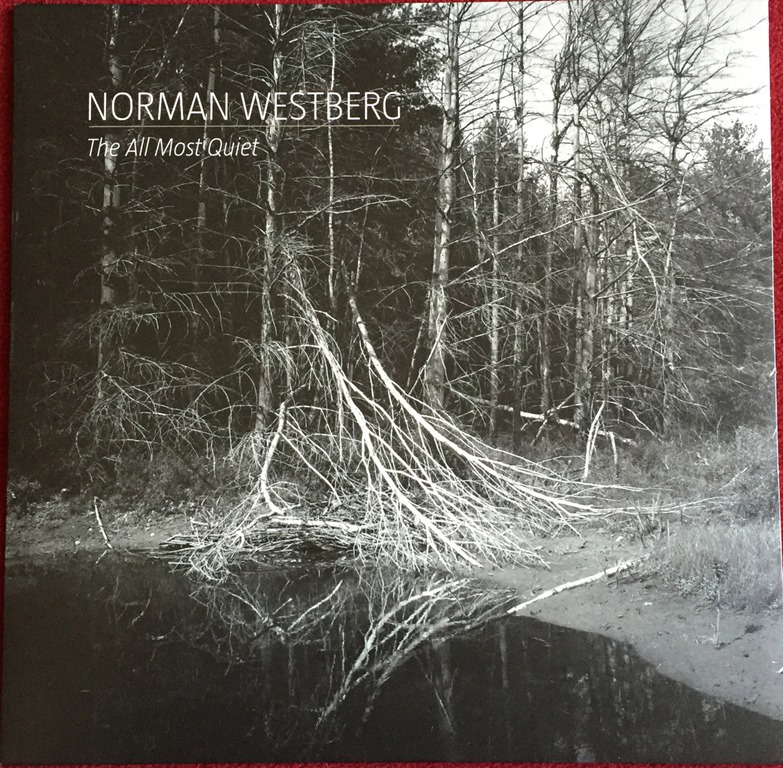
While MRI, released by Room40 in February, was a reissue of a 2012 album, The All Most Quiet contains new material in the shape of two long-form tracks. Like its predecessor, The All Most Quiet is radically different from his contributions to Swans. The fact he’s actually found the time to compose and record new material is impressive in itself: the latest Swans album, The Glowing Man was released on 10 June, and the two-hour colossus of a sonic experience was developed and recorded off the back of a full year spent touring its predecessor, To Be Kind. Given the duration and intensity of a Swans live show, it’s remarkable that Norman Westberg’s had time to piss and still has the energy to stand, let along record a new album. But then, perhaps his solo work has therapeutic benefits, and affords him the opportunity to decompress after long days spent in the Swans pressure-cooker.

The All Most Quiet is, as the title suggests, not a loud album. It is also a gentle album. But that doesn’t mean it lacks dynamic tension, and while it is calming, it’s also not completely undemanding.

The title track starts its long, meandering journey as a mid-range drone which pulsates subtly. The tonal changes which emerge are gradual. It’s easy to let it simply drift by, and it’s pleasant enough to appreciate in this way, but attentive listening brings its rewards. The introduction of new layers, textures and tones, shifts in the scale and pace of oscillations change the mood, subtly, inconspicuously, but no less definitely. And while The All Most Quiet bears no obvious resemblance to Swans, it is possible to hear a certain correlation in the way Westberg builds on slow-burning transitions to hypnotic effect. There are hints of ominousness and darkness, but the sense of scale and grandeur seeps through the very fabric of the sound. The second track, ‘Sound 2’ maintains the atmosphere, and the absence of any clear highs or lows builds a tension beneath the calm surface.

The All Most Quiet once again highlights the trait I most admire in Norman Westberg’s approach to guitar laying: patience. No heroics. No sense of the ego common to guitar layers. His playing is focused on achieving texture and an overall listening experience. Whether he’s peeling off shards of noise, as on early Swans’ releases or creating more sculpted sound, as on their later releases, and in his solo recordings, at no point dos one ever find oneself thinking ‘what fretwork! What guitar wizardry!’ In fact, much of the time, Westberg’s guitar doesn’t sound like a guitar, particularly on The All Most Quiet. And for the most part, the sound is too immersive for one to really think at all.


Norman Westberg - The All Most Quiet


Norman Westberg Online