Posts Tagged ‘nordic’

Music For Nations / Sony – 24th January 2025

Christopher Nosnibor

While studying English Literature at university, I undertook a module on Anglo-Saxon literature. It was fascinating to learn the etymology of certain words, and the way in which commonplace phrases came to be, and one thing which struck me was the reverence the Anglo-Saxons held for the bear, with not only words like ‘berserk’ deriving from a fierce, angry bear, with armies placing their berserkers at the front of their lines, foaming at the mouth and gnashing their teeth on their shields to strike fear in the hearts of their opponents, but the phrase ‘lick into shape’ came from the belief that bear cubs were born as balls of fur, and their mothers would literally lick them into the shape of a bear. In so many aspects of life, through history, humans have aspired to be like bears.

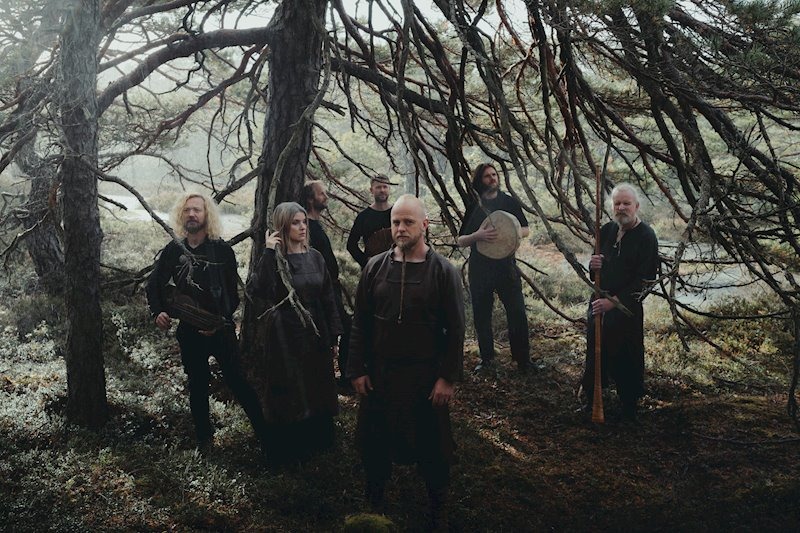
It is this which provides the central theme of Wardruna’s sixth album, as the accompanying notes expand upon:

The bear frequently figures in the oldest myths of mankind in the northern hemisphere, and many indigenous people still regard this animal as a totem, honouring it with rites and songs. It was once our respected guardian, our guide to edible plants and berries, a creature we both feared and admired. Although the bear from the very beginning has constituted a threat to our own lives and those of our livestock, humans have always identified with the bear in various ways. If you skin the animal, its body underneath the fur strongly resembles that of man, which may be a reason legend has it the bear in fact originated from humans, and for thousands of years we have strived for its strength and wit. In some cultures, “treading the path of the bear” means pursuing what you’re truly meant to do in life.

Because this is a Wardruna album, it taps into ancient mythologies on a level which goes far deeper than some kind of conceptual cosplay or superficial skirting around the subject. Wardruna has a way of tapping into a spirituality which resides in our very bones, our DNA. Their music resonates, powerfully, in ways which are hard to articulate beyond the fact it stirs something deep inside. Birna is more than an album, it is a force of nature distilled in musical form.

‘Hertan’ begins with a thudding rhythm like a heartbeat which provides the backdrop to a spoken word introduction and, suddenly, a swelling surge of sound, clattering wooden-sounding percussion and bold choral chants. Immediately, it evokes images of a primal heritage, of rituals performed on moorlands around open fires, animal skins, ceremonies exulting pagan spirits, and a connection with the earth which transcends words alone.

The title track is simply immense, a colossal, powerful blast of sound, which conveys the strength – and also the gentleness – of the she-bear. It’s perhaps here where they most successfully articulate the appeal and fascination of the bear, a creature capable of the most divergent behaviours, so caring to its cubs, but would absolutely annihilate anything when threatened. There’s a reason why you don’t, as they say, poke the bear.

The fifteen-and-a-half-minute ‘Dvaledraumar’ (Dormant Dreams) enters rather more ambient territory, lunging into slow droning darkness after a hooting call like that of a conch shell being blown, or similar. Along with ‘Jord til Ljos’ (Earth to Light), it forms ‘a two-song meditation creates a joint hibernation between animal and listener’. It’s somewhat sad, that we haven’t taken cues from the bear to hibernate. It doesn’t feel natural to drag oneself out of bed and trudge to work in darkness, when it’s often cold, wet (or snowy, depending on geography), and windy. Before industrialisation, before electricity, working hours were limited by daylight, and in feudal times, serfs would effectively hibernate, unable to work the field during the winter months. I’m certainly not saying that this was a golden age of any kind, but capitalism and technology have certainly failed to deliver the lives they promised with a wealth of leisure time.

Sitting and reflecting on this, the rippling, repetitive melodies of these two tracks washing over me, I once again find myself envisaging dense, expansive woodlands, a habitat thick with vegetation, and sparse with population, a world before humans lost touch with nature and even humanity, and fucked everything up so badly. And I suppose it’s this desire to rewind the clock, to unfuck the planet, to undo centuries of mistakes to rediscover that which lies subconsciously in our hearts, which Wardruna connect with so perfectly.

Following this extended hibernative segment, they return first withHiminndotter which evolves from being sparse and folksy to a frenetic frenzy of tribal percussion and a powerful choral refrain. ‘Tretale’ presents a haunting rumble with a breathy, hypnotic vocal. It’s built around a low, deep-lunged organ-like drone, but cuts back to some hypnotic passages where the insistent beat stands almost alone.

The eight-and-a-half-minute ‘Lyfjaberg’ brings the album – which is epic in every way – to a close with a slow, hypnotic beat and repetitive instrumentation and vocal chorus. It draws you in in such a way as to suspend time and space: it’s hard not to get lost in the moment, but also, ultimately, in time. I suspect I’ve described Wardruna’s music as ‘transcendental’ before, and more than once… but is the word which most accurately describes their music. Yes, THE word – and perhaps the only one. Because this… this is something else.

AA
167087

29th July 2022

Christopher Nosnibor

There’s something quite unique about the Nordic / Scandinavian strain of contemporary post-punk. It’s not easy to pinpoint, nothing you can really put your finger on. But there’s something in that balancing of light and dark, and it’s something I probably became subconsciously attuned to at an early age, listening to A-Ha in the mid-80s when I was still in primary school. I would only later come to realise just how strong the currents of darkness and melancholy ran through their precise pop songs, and that this was what the enduring appeal was years later.

Sleep Kicks don’t sound like A-Ha, of course, although the same basic musical elements are there, not least of all something of an anthemic 80s feel (although that’s more In the vein of The Alarm or Simple Minds and bands with a more overtly mainstream ‘rock’ style). ‘No Chains’ picks up were they left off last year, and they’ve been honing the contrasting elements. The song is dark, but also light, with layers of guitar and a full production that gives it an expansive feel, but it is, also, without question, a killer pop tune with an immense chorus that’s bold and uplifting, with a sweeping choral backing, which makes for a big, fat, juicy earworm.

AA

296649923_435527541924827_3082798543878671684_n

After being involved with Heilung for two years, and more recently with the worldwide-acclaimed movie The Northman as songwriter and actor, Jonas Lorentzen decided to focus on his own musical expression, based on a reimagination of Nordic Folk and spiritually driven music. The result is Nebala, spearheaded by Jonas Lorentzen, but assisted and graced by powerful talents such as Sebastian Gainsbourough (Vessel, The Northman, Manchester Collective), Kjell Braaten (Wardruna, Origami Galaktika) as well as non-musician minds assisting in the conceptual development, Doctor Mathias Nordvig (Professor of Pre-Christian Religion at CU Boulder) and Philosopher Naina Gupta (University of Kingston).

Nebala unveils today the new single ‘Ant Mér Sjalfri Þér’, a song about unfulfilled love, desire and longing consuming us. It refers to the myth in which Wōdan sought the Billingas magwia, the Maiden of the Fleeting Moment. In this myth, love and desire are ripped away from the ones who have let themselves be consumed. The artist also releases a new video, a short film in which the songs ‘Ant Mér Sjalfri Þér’ and ‘Laþu’ merge to create ‘The Eternal Child’.

Jonas Lorentzen comments: "This is the entire art film as we originally intended. A story about a man trying to come to grips with his own demons and desires. Inspired by mythology and Jungian archetypes."

Watch the video here:

Using traditional frame drums, lyre, tagelharpa, Tibetan singing bowls, and throat singing, Jonas Lorentzen has developed a unique Indo-Nordic sound for Nebala that toys with timescapes, soundscapes, and cultural boundaries to bring you back to the primordial experience of music itself.

He comments on the album: “When you let yourself be taken by desire and lust, you will be consumed by what the ancient Germanic peoples called Laþu. The ancestor of our modern word “to let,” laþu suggests giving into natural desire and emotion. When Wōdan sought the deepest knowledge of the cosmos he had to brave the dangers of the deep caves in Hnitbjörg and let himself be taken by the desire of Gunlaþu, the forceful goddess of the underworld.”

AA

JL

By Norse – 26th November 2021

Christopher Nosnibor

Hildring is the second album by Wardruna vocalist Lindy-Fay Hella with musicians Dei Farne. It’s been a long time in the making, with ‘Taag’ dropping as a single back in the summer of 2020. But what is time when the world is off its keel and the world is spinning at a different pace, one so rapid we’ve lost touch with our innermost selves? Lindy-Fay Hella and Dei Farne connect with a past world, a time before technology: not necessarily a more primitive time, but a time in which there was a closer connection to earth and nature, and also to the inner self, the core spirit.

‘Hildring’ is the Norwegian word for mirage, and it’s fitting, for despite the solid, tribal percussion that dominates the sound, paired with solid, chunky basslines, the remaining musical elements are fleeting, flitting, mellifluous, transient, impossible to grasp a firm hold of.

That isn’t to say the album is all airy atmosphere and no substance: quite the opposite, in fact, there’s a sturdiness and density to the richly layered compositions, and it’s a very fine balance of the seemingly separate elements, namely the solid, and the ethereal and airy. The drumming is immense, ribcage-rattling, rousing. There is a wonderfully rich, earthy quality to Hildring. In keeping with Wardruna’s quest to explore Norse cultural and esoteric traditions by delving into ancient history and mythology, so in this collaborative project Lindy-Fay Hella continues that focus. The sound is modern, but the album is deeply evocative as echoes of the ancient resonate forward through every note, and you feel the aura of generations past around your being as you listen. It resonates in ways beyond expression, beyond lived experience. It’s deep, and it’s powerful, and strikes a resonant chord from the off with the percussion-led title track, where soaring vocals and a driving bass melt together amidst spacious waves of sound, and it sets the bar and the form.

In something of a shift from the overarching style, ‘Insect’ feels rather more overtly electronic, with skittering glow-worm flickers flitting hither and thither, but it’s still packing a rare emotional intensity.

‘Compositionally, ‘Briising’ is minimal; drums, bass, sweeping, droning synth, and incidental cymbals accompany a balanced, inwardly-focused vocal performance. There’s a menacing, growling vocal that is again otherworldly, and if not scary, then unsettling. ‘I return to fire’, he repeats in a dark, gravelled monotone.

‘Taag’ goes big on the expansive sound, and it’s sweeping, immense, immersive. It’s bordering on the grandiosity of post-rock, and propelled by urgent drumming. Elsewhere, the sparse, looping synth of the appropriately-titled ‘Otherworld’ is relentless and resonant.

Throughout, Lindy-Fay’s vocals are outstanding, and the album showcases her remarkable vocal dexterity. Often light and airy and floating and soaring above all layers of human perception, Hildring is magical, mystical, beautiful, majestic, and powerful. There, I managed to not to use ‘epic’!

AA

GDOB-30H3O1-001.pdf