Posts Tagged ‘Merzbow’

Dret Skivor – 1st August 2025

Christopher Nosnibor

Having debated the merits – or otherwise – of the extensive, expansive, hyperdetailed press release, and having felt a certain trepidation when tackling a work rooted deeply in weighty postmodern theory beyond the peripheries of my personal field of – perhaps rather specialist – expertise, I find myself on altogether more confident footing here. The latest release on Dret Skivor, a Swedish label devoted primarily to drone, noise, (darker) ambient, and general weird shit, offers up two longform tracks, each corresponding with a side of a C30 cassette, accompanied by precisely zero information, beyond the fact that it was ‘Mastered by Dave Procter at Svinig Studio, Skoghall.’ Hell, it doesn’t even have any capital letters.

I’m at ease with this. When it comes to abstract / instrumental / experimental works, I don’t need to know who the musician or musicians are, what gear they’re using, and unless there’s something quite specific which inspired or motivated the work on a theoretical or personal level, I generally prefer to allow the music to speak for itself, and for my mind to do the work of interpreting how the sounds affect me.

The tracks are, in fact, both exactly 14:27 in duration – which is oddly precise. It’s the only thing which does seem to be precise, but not odd, about the compositions – such as they are, with ‘my crustacean brother’ manifesting as a huge, churning wall of full-spectrum noise. It’s the mod-range that fills the space and fills your ears and your head as it barrels from the speakers, a dense, relentless rumble like a mangled engine – but there’s low end that hits around the gut and enough treble to add an extra level of pain. Sometimes, it sounds as if there may be fucked-up vocals gnarled up in the machine, distorted, fractured, and buried in the mix – but it’s as likely that it’s my ears deceiving me as my brain tries to subconsciously find form in the formless. If you mic’ed up a tractor engine and then ran the recording through half a dozen distortion pedals, it would likely sound like this. The sound feels mechanical, analogue: rather than harsh in the way pure digital often is, this is the sound of moving parts, or rusted metal flapping as it slowly disintegrates. Around eleven minutes in, it seems to gain in volume and intensity, but this again could be an auditory hallucination. Yes, this is how methods of torture involving sonic elements, the likes of which were trialled as part of MK Ultra, work. It’s not sensory deprivation, but complete sensory overload. When it stops, the silence feels wrong.

‘gås!’ is a fraction less dense, favouring treble a little more, and also containing more detail, or at least more clarity, which allows the detail to be heard. There is a distinct throb which creates a rhythm – one which glitches and stutters as it snarls and roars. It’s harsh, pure, brutal sonic punishment, taking the Merzbow template and… replicating it perfectly, not just sonically, but in the spirit of inflicting damage, both physical and psychological, on the listener, knowing that the whole thing is insane, beyond excessive, testing the patience as well as the stamina over the course of almost a quarter of an hour. It’s nasty, and I love it. You (probably) won’t like it, sugar…

AA

a0540901673_10

11th June 2025

Christopher Nosnibor

Some artists thrive on collaboration. Deborah Fialkiewicz is one of those. While she’s prolific as a solo artist, the volume of collaborative works in her discography is also noteworthy: when she’s not working as part of SPORE, she’s part of the ever-rotating lineup of BLOOM – and that’s before we touch on the frequent collaborations with (AN) EeL, the most recent of which was only released three weeks ago.

The Improvisation Sessions was recorded live May of this year, with a lineup of Dan Dolby, Deborah Fialkiewicz, and John Koser, marking an expansion from the duo which recorded the trilogy of Parallel Minor, Besides, and Hybrid in 2020. Fialkiewicz is without doubt an artist with range, but one who favours the dark end of the ambient spectrum more often than not, and this is very much the case here.

The Improvisation Sessions features two longform tracks which would quite nicely align with a vinyl release.

‘Chameleon Soul’, which spans a colossal continuous twenty minutes, begins with low, rumbling ominous drones, but soon escalates to a busy, buzzy criss-cross of sounds, interweaving and interlacing, leaving one’s head in a spin as if after trying to trace several flies flitting about the kitchen on a hot summer’s day for any period of time. It’s a morass of warping tones overlaying a ballast of churning noise, and any comparisons to Hull luminaries Throbbing Gristle or Merzbow are entirely justified.

The layers of distortion only grow denser and gnarlier as the track progresses, crashing waves of white noise blast in from one side and then the other as they really push to test the stamina. And then you realise we’re only six minutes in. This is a positive: plenty more left to enjoy… Enjoyment is of course subjective, and enjoyment of this requires being appreciative of a dizzying, disorientating assault simultaneous with a full-on white noise blizzard.

The momentary lulls, the spells where they pull back from the precipice of all-out aural obliteration, are far from mellow, as serrated spurs of hard-edged drones, wails of feedback and brain-melting extraneous noise conglomerate to seismic effect. There are some nasty high-end frequencies knocking about in the mix, moments were one has to check if the whistle is coming from the speakers of if it’s that troublesome tinnitus nagging again, and said frequencies rise from a battery of ugly distortion, bone-shattering blasts of which simple explode around the twelve-minute mark, and from hereon in, things only grow harsher, more corrupted, more intense, more difficult to withstand. We’d be inching into polythene bags on heads territory were it not for the variation, but the last three minutes or so are fractured, damaged, and agonizing – part power electronics, part circuit meltdown.

As the world becomes evermore and increasingly fucked up, I find words fail me more by the day. It’s harder to articulate, and this is where I’ve found that sound has come into its own. Sound as the capacity to convey something beyond words, something that lies in the most innermost parts, giving voice to the subconscious, even. On The Improvisation Sessions, BLOOM convey anxiety, gloom, pessimism.

‘The Dark Room’ is indeed dark, constructed primarily around a fixed but thick, distorted hum. Oscillators whine and whistle, and something about it calls to mind Whitehouse around the time of Never Forget Death, when they discovered low-end frequencies and restraint, the impact of a low undulating wave and subtle tweaks of reverb.

It rumbles and drones on, eddying and bouncing around in a shrilling mesh of dissonance. There isn’t a moment where this is an easy listen, and so often, it sounds as if the equipment is faulty, whether it’s a stuck loop or generating unexpected noise.

This set hangs on the edge of ambience, but be warned, it’s dark, and noisy at times, to the extend that it may shred your brain. For me personally, that’s my idea of fun, so it gets a two thumbs up, but for the more sensitive, this is a release to approach with caution.

AA

a3419622385_10

Room40 – 9th May 2025

Christopher Nosnibor

Merzbow is an artist who requires little to no introduction, and one with a catalogue so immense – with in excess of five hundred releases credited – it’s beyond daunting for not only a beginner, but even a keen noise-lover. This is the reasons I personally own very few releases, and have only picked up a few incidentally along the way.

As Masami Akita approaches seventy, and Merzbow marks forty-five years of noise, this output shows little sign of abating, but it does seem an appropriate time to reflect on some previous releases which may be considered either ‘classic’ or ‘pivotal’. 1994s Venereology has been receiving some retrospective coverage of late, revered largely on account of its reputation for being the loudest, harshest thing ever, ever.

But here we have a reissue of The Prosperity Of Vice, The Misfortune Of Virtue, released a couple of years later, a much lesser-known work, but still during what’s broadly considered to be the golden era of the 90s, and, as the accompanying notes suggest, it’s ‘one of a series of unique editions from his vast catalogue that reveals a side of his practice often under represented.’

During the late 1980s and into the 1990s, Masami Akita was sometimes working on film and theatre music. In this space he created a series of recordings that capture the full scope of his sound worlds.

Given the nature of these settings, his compositional approaches were varied, seeking to create both intensely crushing walls of sound and more spatial, and at times rhythmic, pieces that plot out an approach to sound making which atomises his universe of sound, and uncovered the singular detail that is often consumed in the whole.

The Prosperity Of Vice, The Misfortune Of Virtue is the soundtrack to the theatre piece Akutoku no Sakae/Bitoku no Fuko by Romantica. Based on Marquis de Sades’s Historie de Juliette ou les Prosperités du vice & Les Infortunes de la vertu, this recording was originally released with limited distribution and remains one of the lesser available Merzbow recordings.

Completely remastered and contains an additional cut from those original sessions, this reissue of The Prosperity Of Vice, The Misfortune Of Virtue presents nineteen blasts of noise and rumbling and shrieking, scraping discord and dissonance. Many of the pieces are brief – a couple of minutes or so – and there is so much texture and tonal rage here, its sonic vision is remarkable. To many, of course, it will just ne noise – horrible, nasty, uncoordinated noise. But listen closer, and there is a lot happening here. The noise is, indeed, nasty, and the output is, brain-blasting chaos, for sure. But what these untitled pieces showcase is an intense focus and an attention to detail which is so much more than brutal noise. The Prosperity Of Vice, The Misfortune Of Virtue is, comparatively speaking, not that harsh – although when it is harsh, it’s absolutely next-level brutal with shards of treble exploding in walls of ear-shredding punishment. It contains a lot of clattering and crashing, like bin lids being dropped, and cyclical, thrumming rhythmic pulsations. There are tweets and flutters, bird-like chirrups flittering above cement-mixer churning grind with gnawing low-end and splintering treble, overloading grind and would oscillations.

The Prosperity Of Vice, The Misfortune Of Virtue is the sound of a man pushing all the buttons and turning all the dials at once and seeing just how far he can tweak them. There are moments of minimalism, of slow, stuttering beats, of mere crackles, passages one might even describe as ambient – a word not commonly associated with Merzbow. But the way in which The Prosperity Of Vice, The Misfortune Of Virtue explores these dynamics, and contains quieter more delicate segments, not to mention some bleepy electronica that borders on beat-free dance in places, is remarkable: while so much noise is simply repellent to anyone who isn’t attuned to it, The Prosperity Of Vice, The Misfortune Of Virtue offers engagement and offers openings to listeners with a broader interest in experimental music.

Eclectic is the word: we hear a chamver orchestra at the same time we hear strings being bent out of shape and what sounds like a Theremin in distress. While a fire alarm squawks in the background. This is everything including the kitchen sink. Imaginative and experimental, it’s noise with infinite dimensions.

AA

RM4195 front

October 2024

Christopher Nosnibor

Having just effused over the benefits of Bandcamp Friday, as well as wrestled with the overwhelming volume of notifications and review submissions, this one lands as the kind f curveball only the likes of Foldhead are likely to deliver, in that this is by no means a new release. Beserk Pinball Machine / Quasar Delirium was in fact first released back in 2021, as something of an archival recording: ‘Recorded in 2015 for a tape label that ceased to exist prior to the intended release date. The 25 copies that had been made were distributed at the Experimental Yorkshire festival which took place at Hebden Bridge Trades Club on 21 July 2018’ And now the Bandcamp page has been refreshed, with ‘two new mixes + a new piece.’

I’m not sure if ‘beserk’ is an intentional variant of ‘berserk’, but I’m going to assume it is. The etymology of the word ‘berserk’ is quite fascinating. The word itself means ‘out of control with anger or excitement; wild or frenzied’, but its origin lies in the reverence the Saxons held for bears. ‘Berserk’ translates as ‘bear shirt’, and berserkers were the warriors placed at the front of a battle formation: their job was to chew their shields, gnash their jaws and foam at the mouth like frenzied bears in order to share the shit out of their opponents before the charge.

This release is every bit as scary and unpredictable as a frenzied bear, and certainly inflicts a bear-like mauling on the senses, being particularly brutal on the ears, and on the lower intestines for that matter.

The opener and lead track, ‘Beserk Pinball Machine’ is an absolute noise monster. There are – sort of – vocals in the mix, but they’re distorted and largely buried beneath a deluge of mangled noise, churning distortion and feedback all mixed together to forge the nastiest mess of trebly sonic ruination. It’s just shy of fifteen minutes shattering, explosive, convulsive digital meltdown which makes Merzbow sound mellow, and Kenji Siratoi supremely calm in comparison. Paul Whatshisface, having previously been a member of Smell & Quim and Swing Jugend – as well as occasional noise duo …(something) ruined has had a long career operating in harsh noise circles, and this is both noisy and almost unspeakably harsh. The noise frenzy ends abruptly, but there’s a spell of low-level hum at the end which offers some respite, however much the not-silence nags.

‘Quasar Delirium’ is appropriately titled: another quarter of an hour of brain-melting, tinnitus-inducing noise squall. Only this has more fizz, more squeal, more laser bleeps, more treble, and more feedback, more melting circuitry, all against a backdrop of churning cement-mixer grind, washing machine spin-cycle metallic reverberations. The experience is how I imagine standing next to a massive propeller engine without ear defenders, while a Star Wars type laser-gun battle takes place all around – while buildings explode and collapse all around, and there is nowhere to hide.

The concept of remixes in this context is rather amusing, and ‘Machine Pinball Bezerk’ and ‘Delirium Pulsar’ are more about fucking shit up even harder than remixing in the more conventional sense. ‘Machine Pinball Bezerk’ sounds like an atomic bomb: it’s noise on the scale of the scene in Threads where the buildings are decimated by a wall of white-hot flame. It’s a scene that seems to last an eternity despite being maybe five minutes at most. The fifteen minutes of ‘Machine Pinball Bezerk’ feels like a lifetime and you can almost feel the tinnitus coming on after just five minutes, while your brain melts and trickles out of your ear.

‘Delerium Machines’ delivers more of the same, the most pulverising, excruciating blasting racket. It hurts, and the overall experience is disorientating: an hour and a quarter of the most abrasive, churning noise imaginable. It’s not Harsh Noise Wall, but there’s not much variety, either, meaning that this release is a relentless assault that will likely leave you wilted, drained by the end – and that’s assuming you can still hear.

AA

AA

a1518553209_10

Tartarus Records – 26th April 2026

Christopher Nosnibor

The mood which pervades all life right now, feels pretty bleak. It’s not only that turning on the news brings endless darkness, with endless reports of multiple wars and families around the globe, but it feels as if a cloud has descended over all existence for all but the mega-wealthy who are living it large, laughing their way around the globe on cruises and in private jets in the knowledge that they’ll be gone and interred in spectacular mausoleums or at least having secured their notes in history and with extensive entries on Wikipedia. My daughter, who’s twelve, and loves retailing me with facts, told me just last night that based on current consumption, oil supplies will be exhausted when she reaches the age of fifty-six. “I don’t want to live til I’m fifty-six,” she said. It wasn’t spoken with an air of pessimism of gloom, but a statement grounded in an acceptance of the hell that the future holds.

It’s in this context that we arrive at III, by extreme experimental duo All Are to Return, who preface their new album with the commentary that ‘We have entered a new age of extinction – of poisoned lands, habitat destruction and encompassing climate catastrophe. AATR III reflects the harshness of life laid bare to the vagaries of capital, of uncaring generations heaping misery on their successors and the life-forms with which they share a fragile biosphere.’

Something I find bewildering is that in the nineties, environmental issues were pretty niche, as was being vegetarian – you’d be hard-pressed to find vegetarian cheese or yucky TVP on the high street, and would only be able to score some half-edible veggie sausages in Holland and Barrett or some crustie hippie shop down some side-street. Now, this is mainstream, and yet still politicians back big businesses who push fracking and deforestation and place profits ahead of what most refer to as ‘sustainability’, but is, ultimately, in reality, ‘survival’.

Perhaps I digress a little, but feel it’s relevant before returning to the pitch which explains how ‘The album’s unmitigated brutality of sound and expression are mediation of these concurrent events. Colossal noise-scapes are shaped with pulsing synth patterns, shredding percussion and vocals that are screams from the void. As a whole, the many-layered compositions carry massive assaults on the senses and a rage unhuman.’

The first few seconds alone are an all-out sonic assault, a blast of harsh static noise, a howling white noise blizzard which hurts. And from thereon in, it only gets harsher, an obliterative wall of noise that goes full Merzbow in no time. It shivers and trembles, grates and vibrates, everything overloading, eardrum-shredding, abrasive, aggressive, snarling, gnarly.

Not everyone ‘gets’ noise: to many, it is just ‘noise’. But noise is a vehicle which provides a unique catharsis, a means of channelling rage which cannot be conveyed in words alone. There are vocals on III, but they’re the sound of demonic torture in a sea of flame.

Thunderous, speaker crackling distortion overloads, and the vocals are butt demented, demonic shrieks buried amidst a skin-stripping nuclear blast. Every track is harsher and louder and denser than the last – and it’s the perfect soundtrack to the world right now. It would equally be a perfect soundtrack to Threads, being pure white-noise, blinding apocalypse in sound.

‘Drift’ is entirely representative: a solid wall of noise, harder and heavier than a slab of concrete – and it is the perfect encapsulation of the rage of life in the now. I sat down to listen to this as Iran rained missiles down on Israel in retaliation for the bombing of their embassy in Syria… Israel immediately vowed to return fire. Gaza has been levelled. We’ve just endured the wettest – and warmest – February and March on record here in the UK and half the country is under water, and many places received the entire rainfall for April in the first week, since when we’ve had more frosts than in the previous two months. Around the globe, wars rage and famine is rife, and frankly, everything is fucked. To think otherwise is delusional. Legacy? It’s clear what the legacy of the 21st Century will be, and ‘Legacy’ encapsulates that perfectly.

All Are to Return articulate their anguish at this fucked-up state of affairs by the medium of the harshest of noise. And it makes perfect sense. III isn’t quite Harsh Noise Wall, but it is fucking brutal. ‘Archive of the Sky’ is nothing short of devastating.

III hurts. It rakes at your guts, it rains heavy blows from every angle. It rapes your ears and pounds your cranium, it thumps your ribs and slays your sense. Every second is a sonic detonation, a devastation annihilation, a squall, a wall, an explosive blast, the sound of the world caving in, the sound of the absolute end. You want to hear the sound of the apocalypse? Listen to this, and live through the end of the world. It’s coming, and sooner than you care to contemplate.

AA

AATR III Artwork

Dret Skivor – 6th October 2023

Christopher Nosnibor

It’s been a few months since we’ve heard from Legion of Swine, one of my favourite vehicles for the intensely prolific Dave Procter – because LOS are noisy, abrasive, and unpredictable, and I have fond memories of numerous demented performances and a couple of collaborative sets together. Even when sadly sans pig-head mask, having developed an allergy to latex, the gnarly electronic noise Dave cranks out is messed up and often times hurts.

Dave, and the Swine, are both highly political animals, and once again it’s politics which have spurred him to clack his trotters into activity and snort his disapproval of current affairs.

L.H.S. is accompanied by uncharacteristically expansive liner notes, which prove useful, and so I shall quote in full:

‘This release pays credit to Värmland folk who campaigned to create a better society and are represented by the letter LHS.

L is Selma Lagerlöf who was heavily involved in women’s suffrage and received a Nobel Prize for literature in 1909.

H is for Gerda and Mauritz Hellberg who were central characters in the right to vote campaign.

S is for Torgny Segerstedt who took a stand against the Nazis in his role as editor at Göteborgs Handels- and Sjöfarts-Tidning.

The image used in this release is a reminder of how the free market is way more important than people in some eyes.’

It lays it all out there, and reminds us how failure to learn from history is guaranteed to doom the future. Admittedly, the way things are looking now, we’re doomed one way or another and likely sooner than anticipated due to sheer greed and a refusal to face facts. In the face of this, there’s a part of me that feels as if complaint or resistance is futile, because we’re already fucked. But we need to go down fighting. We need to at least die trying, to know we’re did our best.

L.H.S. is the sound of the fight. It’s a fucking racket, blasting in from the outset with overloading distortion, cutting in and cutting out, a blasting overload that just hurts and is an instant headache. It’s the harshest of electronica which only gets nastier and more intense and insane as it progresses. By three minutes in, it sounds like someone smashing a bin lid connected to a contact mic, recorded on a mobile phone. The treble is high all the way, and the sounds are metallic, distorting, like someone tearing the door off a garage in a gale or something similarly deranged. And deranged it is, from beginning to end.

We’re in Merzbow territory here. And it actually hurts. Ten minutes in, there are some vocals, but they’re impenetrable shrieking derangement, buried in feedback, before things get really gnarly.

L.H.S. is nasty, and I absolutely love it. I suspect most won’t. It’s one to file alongside Whitehouse, Merzbow, and Prurient. It’s brutal, and as niche as fuck, and Dave knows it. Embrace the pain. This is something else.

AA

AA

a3749396098_10

Dret Skivor – 11th January 2021

I had the pleasure – and it was a pleasure for me, if not necessarily the audience – to perform a couple of times with Legion of Swine. They were noisy, brutal affairs: while Dave Procter’s many musical guises span most shades of noise, with a particular leaning toward all things drone, his work as the lab coat wearing porcine purveyor of aural pain.

The audio on this release is taken from Legion of Swine’s set for the Chapel FM 24-hour Musicathon, which took place on 12th-13th December 2020, which featured forty-five acts in twenty-four hours. Performing at 6:15am on Sunday 13th, the chances are few caught the performance as it aired live, but here, a year on, is an opportunity to bask in the gnarly noise at leisure and a more socially amenable hour. Not that there’s much that’s socially amenable about this: the liner notes explain how ‘It’s “almost” Harsh Noise Wall, but not quite as some random parts of reverb tails interact with others at various stages to create the slight variations.’

So how does that translate as a listening experience? Well, as the title suggests, the noise never abates during this twenty-six-minute blast of electronic abrasion. There are no breaks, no vocals, and next o no sonic variety, although there is some – and it’s heavily textured. In fact, it would be most readily summarised that it sounds like the cover looks: grey, grainy, but woven so as to be not entirely monotone and uniform in shade.

When I find myself listening to HNW – which admittedly, isn’t that often, as I generally prefer the concept to the experience, despite the fact I do very much like my noise to be immersive, not to mention somewhat testing – I find myself hearing subtle shifts in tone and frequency. I suspect it’s the result of some auditory illusion, the aural equivalent of an optical illusion as my receptors strain to find some variety, some detail on which to pin a response of some sort, in the same way a freshly-painted wall will reveal patches that are not as well covered as others the longer you look at it. The beauty – and I use the term with extreme caution here – of this performance is that those patches do exist, and are purposefully brushed into the finish.

This is alternately the sound of a distant swarm of hornets and swimming underwater. The recording doesn’t convey the kind of extreme volume that is an element of a lot of harsh noise, although one suspects that a large proportion of the interplay between sounds is derived from the way that reverberate, resonate, and rub together and against one another, and any comparison to Merzbow is entirely appropriate. But the lack of overt volume only accentuates the sameness – or near-sameness – of the sound, and what’s more that sound is a continuous torrential churning noise that sits in the midrange, and hammers like metal rain, a relentless digital downpour. It’s ultimately oppressive in its relentlessness, and over time seems to fade into the background, as anything with such a lack of dynamics inevitably will. But this is not about stimulating the senses so much as numbing them and challenging the listener to endure. It’s a test alright, and a tough – but good – one.

AA

a2596588712_10

No Part of It – 23rd September 2020

Christopher Nosnibor

Slowly raising a hand – dripping in coagulated blood and thick, sticky semen – from the swampy morass of angled noise that’s entirely representative of the contemporary dark electronic scene, where dark ambient, power electronics, and harsh noise sim in the same sewers, Sterile Garden emerge with Acidiosis. It’s pitched as ‘harsh noise for junk metal, tape recorder, and 4 track;, and while Sterile Garden is an open-ended project with countless contributors featuring on their 40+ releases in the 14 years since their inception, on this occasion, Sterile Garden is simply Jacob DeRaadt.

Acidosis contain six untitled, numbered tracks, and they segue together to create on enormous lump of churning industrial noise. Howling whines of nose like jet engines firing up power full-throttle into barrelling blasts of abrasion.

Without lyrics or any form of vocal element apart from the muffled dialogue on ‘Acidosis 6’, the album is purely a host of permutations of mangled noise which feature here with every shade of feedback and distortion imaginable assailing thee listener’s tenderised eardrums. Metallic clattering, and scrapes, barks and yelps and screeching screeds or nail-scraping, eye-watering blurting screeds or treble dominate.

So much of this overloading, speaker-splitting noise is so above the limits, so over the regular limits of noise, it hurts. But while suffering, enduring, or perhaps enjoying the pain, if you can get past the tinnitus-inducing shards of treble, the walls of mid-range that blast away like hurricane, there is detail, there is textural depth. No doubt many would disagree, and this s very much one for the noise aficionados: there no tunes, no structures, just screaming feedback and howls of painful noise, whistling feedback and manged, cacophonous noise hurtling headlong toward the crusher. Alright, it is just needless, neverending noise, but as I was out and about earlier, on a supposedly ‘quiet’ walk, I became attuned to an endless stream of noise ranging from conversations to car engines. Peace and quiet is a myth – although Acidosis is not so much anti-ambient as anti -sanity, a relentless bewildering squall of horrible noise.

Acidiosis is all the metallic clanks and scrapes. With Acidiosis, Sterile Garden have landed the crusher that will crush your soul. It’s a gut-churning, skull-compressing horrorshow that hurts, physically and psychologically – meaning a job well done.

AA

a0786038567_10

Editions Mego – EMEGO264 – 5th July 2019

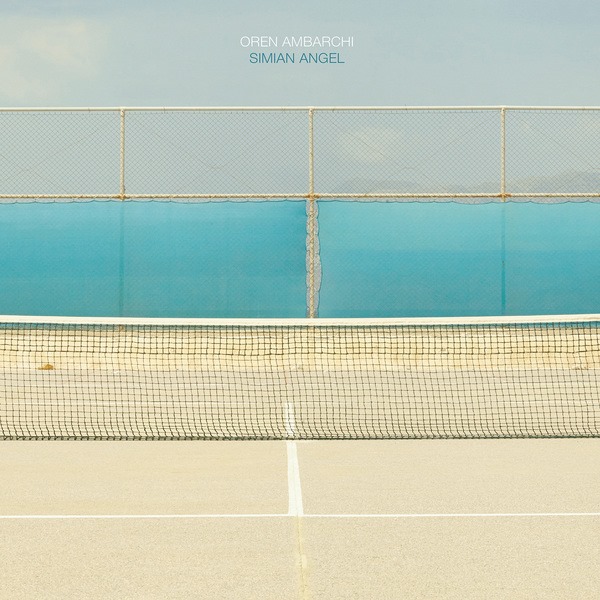
Australian avant-gardist Oren Ambarchi has enjoyed a varied career spanning over three decades, and includes among his associations Sunn O))), Merzbow, and Burial Chamber Orchestra. To describe his output as ‘prodigious’ would be an understatement.

According to the press release, ‘Simian Angel finds Oren Ambarchi renewing his focus on his singular approach to the electric guitar, returning in part to the spacious canvases of classic releases like Grapes from the Estate while also following his muse down previously unexplored byways’.

It continues: ‘Reflecting Ambarchi’s profound love of Brazilian music – an aspect of his omnivorous musical appetite not immediately apparent in his own work until now – Simian Angel features the remarkable percussive talents of the legendary Cyro Baptista, a key part of the Downtown scene who has collaborated with everyone from John Zorn and Derek Bailey to Robert Palmer and Herbie Hancock’. Some of this has meaning: a lot of it doesn’t. I don’t know everything, and nor have the time or inclination to research. Jobbing reviewers crib from press blurbs and make like they know stuff. The majority are lying.

Neither Brazilian music nor guitar are overtly apparent on the two long-form tracks which make up Simian Angel: the sixteen-minute ‘Palm Sugar Candy’ consists of supple, trilling organ notes drifting across clopping, loping, irregular wood-based percussion which fades out to nothing leaving only soft, whisping tones which weave in and out of one another.

The title track is vague, piano notes rising into a rarefied air. It builds gradually into flurries of notes which flutter like snow in a breeze, skittering unpredictably. Baptista’s contribution is remarkable in its subtlety: a sedated heartbeat pulse which occasionally stutters and stammers. Around the mid-point of this twenty-minute mod-inspiring epic, the piano halts unexpectedly and an upward gliding drone alters the previously straightforward trajectory of the composition. Simmering down into twittering gentleness, subtly twisted with the slightest hints of dissonance and eventually transitioning into some mellowed-out semi-ambient reinterpretation of minimalist jazz – which isn’t nearly as bad as it sounds. Instead, the slowly insistent beats force something approximating a solid frame on which all the other abstraction hangs – and it works.

AA

Oren Ambarchi – Simian Angel

Room40 – EDRM419 – 30th November 2018

Christopher Nosnibor

Despite having released about a thousand albums since first emerging in 1979 (Wikipedia states ‘over 400 recordings’, which still makes for a completists impossible dream), a new Merzbow album still instils a certain glimmer of excitement and anticipation. Perhaps it’s the fact that while Masami Akita’s work sits squarely in the domain of ‘noise’ and the element of surprise is limited when it comes to a new release – there’s no dropping of a sudden and unexpected pop or country album, for example – his capacity to push the parameters of a genre he almost singlehandedly defined means that there’s always something to warrant interest.

Writing on MONOAkuma, a live recording made in Brisbane in 2012 at the Institute Of Modern Art, Lawrence English, the man behind the ROOM40 label, recalls ‘this was the second time I had the pleasure to present him live in Australia. To me, this performance epitomises the physiology of Merzbow’s sound work. He creates in absolutes; sonically he generates a tidal wave of frequency that sweeps across the spectra with tireless frenzy. Merzbow’s capacity to conjure a massive swirling mesh of analog and digital sources is without comparison. His work is one of physiological and psychological intensity; a seething, psychedelic and utterly visceral noise-ocean.’

English continues by noting that ‘2019 marks the 40th anniversary of the commencement of Merzbow. This recording, which epitomises Merzbow’s 40 years as arguably the most important noise musicians of our time, demonstrates the intense and complex audio world Merzbow has created. It’s the perfect starting point from which to wade into the noise ocean that is Merzbow’s vast output.’

Sidestepping the fact Merzbow has been in existence almost as long as I’ve been alive, I’d be inclined to agree: MONOAkuma is quintessential Merzbow and encapsulates all of the defining features of said vast output.

I’ve personally only witnessed Merzbow once, performing in Glasgow in 2004 – a set which saw him split the signal between the PA and a massive – and I mean immense stack of Marshall cabs. Akita was barely visible, perched atop a wall of speakers that made the combined backline of both Sunn O))) and the Quo look like they’re travelling light. The sound he produced through this set-up was a face-melting, brain-bending, tone-shifting wall of noise. I’m not sure I’ve ever been quite the same since.

MONOAkuma, then, contains 50 minutes of classic Merzbow. It begins with s few seconds of scratchy feedback. It tweaks at the nerve-endings. And then the levee breaks and the sonic deluge explodes. All the frequencies, all the tones, all the textures erupt simultaneously and blister and burn and fire in all directions. It’s so dense, so immense, so all-encompassing and immersive: the experience is overwhelming. There is noise, and then there is Merzbow. There is so much detail here… although it’s almost impossible to absorb even a fraction of it with so much, and delivered at such volume. Everything is tossed and churned in a barrelling tempest of relentless abrasion that scours the skull’s interior – select cement mixer / blender / washing machine / oil drill / swirling vortex / apocalypse simile of choice here. Whiplash blasts of funnelling distortion howl and scream in a churning tunnel of overloading distortion, and within six minutes it’s hitting the lower levels of pain and by 21 minutes aural and psychological ruination is achieved. The power lies in the ever-changing textures and tones: there isn’t a second were the sound doesn’t change, and it’s this constant shift that makes it so powerfully challenging, with layer upon layer of howling racket tearing the air to the point of atomization.

Few artists – if any – have the capacity to inflict brain-pulping anguish like Merzbow. This isn’t just nose: it’s all the noise. All at once. Amplified to the power of ten to create screeding, screaming, multi-tonal, multi-faceted blitzkrieg. There is no respite, no space to make shelter. It hurts. And until you’ve experienced Merzbow in full effect, you really haven’t experienced noise. And MONOAkuma is relentless in its assault. This is total noise, relentless, obliterative, devastating.

But as punishing and oppressive as it is, there’s something cleansing and cathartic about it. And herein lies the pleasure of the pain and the ultimate joy of Merzbow.

Please note: All proceeds from MONOAkuma will be used to fund research and preservation attempts for the Tasmanian Devil, which in recent years has suffered greatly due to effects of a transmissible facial cancer.

Merzbow - Mono