Posts Tagged ‘long-form’

Dragon’s Eye Recordings  – 22nd August 2025

Christopher Nosnibor

A year on from my review of Yorkshire Modular Society’s Fiery Angels Fell, I find myself presented with another release of theirs on LA label Dragon’s Eye Recordings, and I can’t help but contemplate the circuitous routes by which music travels, since the release landed in my inbox courtesy of a PR based in Berlin – while no-one in my sphere of acquaintance, which includes a broad swathe of electronic artists around York and, indeed Yorkshire as it spreads in all directions – appears to have even the first inkling of the existence of YMS, despite their connection to Todmorden. But then, I often observe that what holds a lot of acts back is confinement to being ‘local’, and it’s a lack of vision, or ambition – or, occasionally, practical matters – which prevent them from reaching the national, or international, audience they deserve.

Yorkshire Modular Society clearly have an audience, and it’s not going to be found at pub gigs in their native county. This is true of most experimental artists: there’s no shortage of interest in niche work globally, but it’s thinly spread. There are places, predominantly across mainland Europe, and like Café Oto, which cater to such tastes, but they’re few and far between, which explains why most such projects tend to be more orientated towards the recording and release of their output, their audience growing nebulously, more often than not by association and word of mouth.

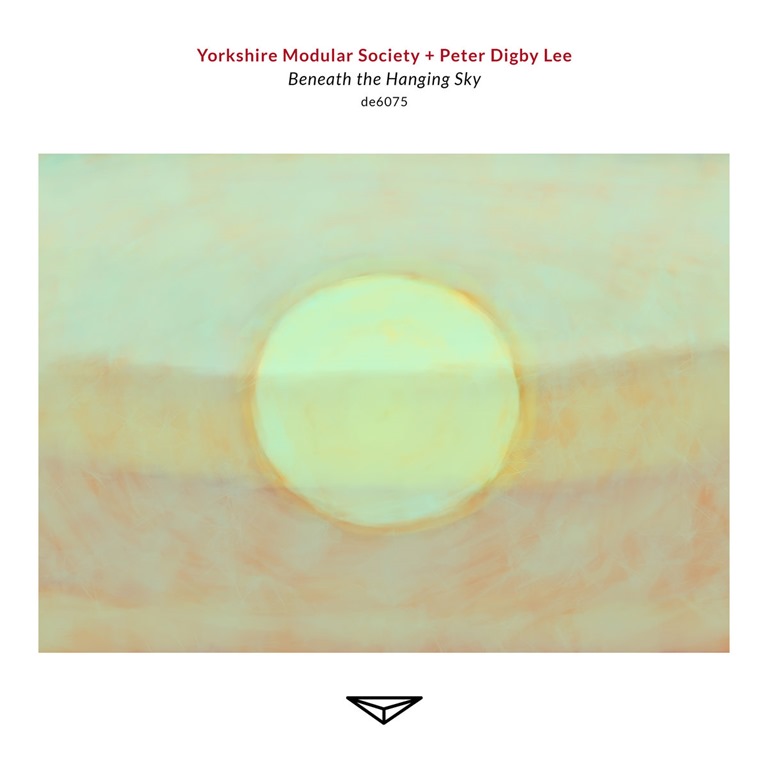
This release – which is the first collaborative album from Yorkshire Modular Society with Peter Digby Lee – could only ever really be a download. With ‘a suite of four ambient compositions shaped by intuition, ritual, and shared resonance’, it’s over two hours in duration, giving recent Swans a run in terms of epic.

The story goers that ‘The artists first crossed paths not through conversation, but through shared vibration — at the resonance Drone Bath in Todmorden. A quiet alignment. Some time later, Peter sent over a treasure trove of sound: samples he had recorded and collected over many years — textures, fragments, and moments suspended in time. From this archive, Dominick Schofield (Yorkshire Modular Society) began to listen, to loop, to stretch, to shape… What followed was a process of intuitive composition—letting the materials speak, revealing what had been buried in the dust and hum. This album is the result: four pieces, each unfolding from the source material with care and curiosity, a shared language spoken in tone, breath, and resonance.’

The title track is soft, gentle, sweeping, lilting, serene, floating in on picked strings, trilling woodwind and it all floats on a breeze of mellifluousness, cloud-like, its forms ever-shifting, impossible to solidify. With hints of Japanese influence and slow-swelling post-rock, it’s ambient, but also busy, layered, textured, thick, even, the musical equivalent of high humidity. It moves, endlessly, but the breezy feel is countered by a density which leaves the listener panting for air. The sound warps and wefts in such a way as to be a little uncomfortable around the region of the lower stomach after a time, like being on a boat which rocks slowly from side to side. ‘Beneath the Hanging Sky’ lays for almost thirty-six minutes, and it’s far from soothing, and as a consequence, I find myself feeling quite keyed up by the arrival of ‘Glass Lung’, another soundscape which stretches out for a full half-hour. This is more conventionally ambient, softer, more abstract, but follows a similar pattern of a slow rise and fall, an ebb and flow. Here, the application is emollient, sedative. I find myself yawning, not out of boredom, but from relaxation, something I don’t do often enough. And so it is that this slow-drifting sonic expanse takes things down a couple of notches. You may find yourself zoning out, your eyes drooping… and it’s to the good. Stimulation is very clearly not the objective here.

Third track, ‘Echo for the Unseen’, is the album’s shortest by some way, at a mere twenty-two minutes in length. It’s also darker, dense, more intense than anything which has preceded it, and as ambient as it ss, the eternal drones are reminiscent of recent both latter day Swans, and Sunn O)). The epic drone swells and surges, but mostly simmers, the droning growing more sonorous as it rolls and yawns wider as the track progress. There are harsher top-end tones drilling away in the mix as the track progresses. It makes for a long and weighty twenty-two minutes, and we feel as if we’re crawling our way to the closer, ‘Spiral of Breath’, which arrives on a heavy swirling drone that’s darkly atmospheric and big on the low-end. Instead of offering levity, ‘Spiral of Breath’ is the densest, darkest piece of the four, as well as the longest. With no lulls, no calm spells, no respite, it’s the most challenging track of the release. It’s suffocating. There is no respite. There is, however, endless depth, and eternal, purgatorial anguish.

AA
a1425387917_10

Room40 – 30th June 2023

Christopher Nosnibor

There is no quick way to consider this album. And for many reasons – the first being that it needs to be heard in its entirety before being able to summarise and pass critical comment. The second being that after hearing it, one needs to drag themselves from the wreckage of their psyche and process an experience that is likely akin to a week being subjected to psychological experiments at the hands of the CIA under MK Ultra. Brace yourself…

As his bio points out, ‘Tony Buck is no stranger to the realm of durational performance and composition. As a part of Australian unit The Necks he has been central to defining a reductive, but rich sound language that equally interrogates timbre and time…[and] with Environmental Studies he moves even further into these longitudinal pursuits.’

Longitudinal is one word to describe this album. It’s a single, continuous piece, some two hours in duration, and while there are a couple of five-minute excerpts designed to give potential listeners an indication of what it’s like, it’s simply impossible to convey the experience in snippets. The snippets are lifted from the album’s lighter moments: that doesn’t mean they’re mellow, melodic, but the multi-layered clattering percussion that’s evocative of some kind of space-jungle and brief segment of avant-jazz feedback is nothing in the wider context. And – as I always say – context counts.

While chart music – geared toward snappy three-minute cuts which are 90% chorus – and the inclusion of streams when compiling charts, has effectively killed the album in the mainstream, further afield (and to be fair, you can’t get much further afield than this), the album is still very much a cherished format for both artists and listeners alike. In fact, it’s interesting to observe the rise of the really long album. I will often harp on about Swans releases from the last decade, but they’re not isolated. Frank Rothkkaramm released an album as a 24-hour CD box set – which couldn’t be much more different from Throbbing Gristle’s 24 hours box – as he explored sounds which helped with his tinnitus. Numerous doom, drone, and ambient albums in recent years have really pushed the parameters of an album thanks to digital releases not being subject to the same limitations of physical formats – or the same production costs. Is the medium the message? Perhaps, at least to an extent.

The recorded medium was always an issue: even going back to the height of the classical era, once recording became possible, the media limited what could be released, meaning to hear a full performance of, say, Handel’s Messiah, you had to be there, since even a recording which required a box-set album release required truncation. It also, of course, required the turning of records and the segmentation of the work.

In its day, Earth’s groundbreaking Earth 2 challenged the conventional notion the ‘the album’ – more even than any monster prog releases like Yes’ eighty-one minute Tales from Topographic Oceans and the two-hour plus, sprawling triple YesSongs. Because what differentiates these is the fact that Yes was a lot of noodling wank, while Earth did something different, with a specific desired effect intended, and its duration was in fact integral to its cumulative effect, namely that of a sonic blanket of suffocation. Anyway: the point is that Environmental Studies is an absolutely immense album, and it’s a work that needs to be heard as an album. You may find yourself drifting in and out, but it feels as if this is part of the experience: better to drift than experience in fragments.

The accompanying notes describe Environmental Studies as ‘An incredibly dense matrix of interwoven voices and layers, each occupying and exploiting a unique space within the fabric of the sound-environment, co-existing to slowly reveal themselves in multiple interconnected relationships.’

Immediately from the start, the listener is assailed by a deluge of discord and dissonance and streams of noise. It gradually drifts through an ever-evolving, eternally-shifting journey, where mellow jazz piano and slow-melting notes emerge and drip slowly over cascading cymbals and an infinite array of extraneous sounds which wash in and out. There are passages of supple, strummed acoustic guitar – which get harder and more challenging at times but also explore mellow passages –– and gurgling extraneous nose, straining, clattering. There are sections which so tense, straining and submerged by noise that as feedback twists and turns and groans and hums, that the enormity of Environmental Studies finally hits.

There are infinite layers of percussion rattling shakes and clangerous curiousness, with errant twangs and all kinds of shades of strange, with dingy distortion crashing in heavy amidst the a maelstrom of noise that sounds like a hundred pianos being thrown down a hundred flights of stairs at the same time while someone in the top floor flat blasts a Sunn O))) album at wall-cracking volume and there’s a fire broken out in the basement and it’s rapidly escalating upwards.

An hour in, we’re in sonic purgatory – and it’s absolutely magnificent. The polytonal percussion builds and builds; industrial, tribal, everything all at once, with sonorous drones and crushing distortion and noise and wailing feedback whistling and screaming all the while, it’s a relentless barrage of sound – but not noise, and that’s an important distinction here. There are noises, and they’re collaged into something immense, with the rattling of cages and furious beating of skins.

When it does simmer down, some time further in, we find ourselves in an alien landscape, that’s strangely spacey and tense before the next round of percussion barrels in. Environmental Studies is big on beats, but not all of the beats are big: insectoid skittering and scratchy flickers are as integral to the complex interweaving as the thunderous floor toms and reverberating timpanis, and everything melts together to weave a thick sonic tapestry.

While there is nothing about Environmental Studies which is overtly heavy in the conventional sense, to immerse yourself in the album is an exhausting experience, both physically and mentally. But if art doesn’t challenge, what is it for? It’s merely entertainment. This is not entertainment. But it is an incredible work of art.

AA

a1038790420_10