Posts Tagged ‘Legion of Swine’

Dret Skivor – 4th April 2025

Christopher Nosnibor

This latest release on Swedish microlabel devoted to the most underground of underground music, Dret Skivor, may be form an act we’ve not heard of before, but something about it has all the hallmarks of the eternally prolific Dave Procter all over it. The man behind Legion of Swine (noisy) and Fibonacci Drone Organ (droney) and myriad other projects and collaborations – some occasional, some one-off – has a distinctive North of England drollness and a penchant for pissing about making noise of all shades, after all.

Released on CD in a hand-painted edition of just two, the notes on the Bandcamp page for the release are typically minimal: ‘Is it dungeon synth? Is it just spooky music? Is there torture afoot?’ I would say I will be the judge of that, but dungeon synth is a genre I’m yet to fully get to grips with, although it does for all the world seem as if it’s a genre distinction that’s come to be applied to spooky music, and seems to have grown in both popularity and usage comparatively recently, despite its roots going back rather further.

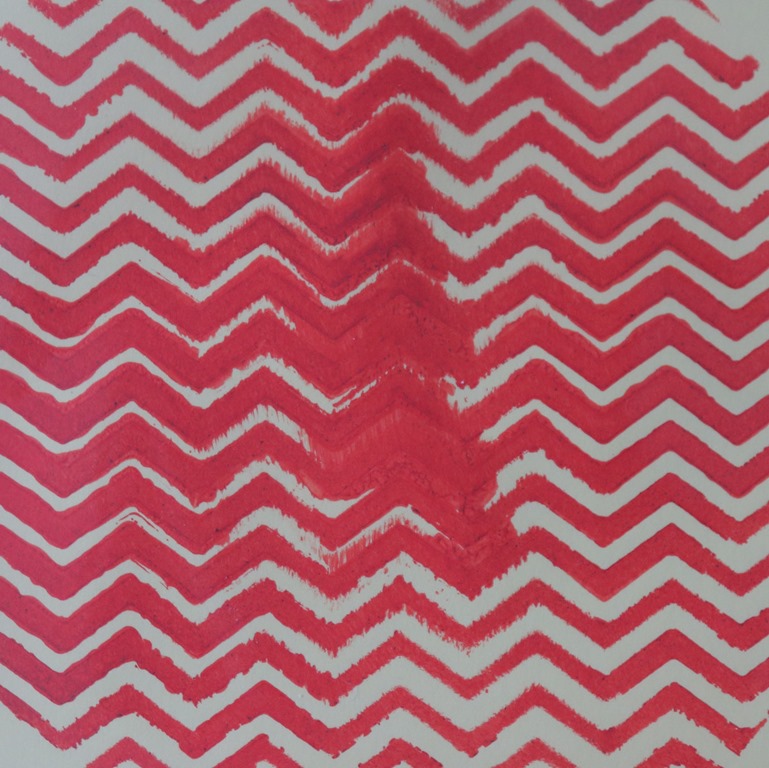
The cover art doesn’t give much – anything away, and in fact, I might have hoped for something more… graphic. But perhaps less is more here. However, the titles of the two tracks –‘the shithouses’ shithouse’ and ‘the festering flesh of the neoliberal’ are classic Procter and could as easily be titles for poems by Dale Prudent, another of his alter-egos.

The first begins with a swelling thrum of what sounds like a chorus of voices, possibly some monastic indentation, layered and looped and multitracked to create a torturous cacophony. For the first twenty, thirty, forty seconds, you wait for a change to come, for something to happen. After a minute that expectation is diminishing, and by the three-minute mark it’s impossible to be certain if there really are keyboard stabs swirling in the mix in the midst of it all, or if your ears and mind are deceiving you and you’re losing the plot. For some reason, I’m reminded of the Paris catacombs – not because it’s actually creepy, but because, just as seeing rows and rows of bones stacked up for quite literally miles becomes both overwhelming and desensitising after a time, so hearing the same sound bubbling away for ten minutes is pretty much guaranteed to fuck with your head. Near the eight-minute mark, there are most definitely additional layers of buzzing drone and there are some tonal slips and slows, like listening to a tape that’s become stretched or is slipping on its spool, but by this time your brain’s already half-melted, and I find myself contemplating the fact that while visiting the catacombs on a sixth-form art trip, one of my fellow students accepted the challenge to lick a skull for eight Francs – which was about a quid at the time. I was less appalled by the fact it was a human skull than the fact the bones looked dusty and mossy, and had probably been touched by even more unwashed hands than the handle of the gents lavs at a busy gig venue.

And so we arrive at the twenty-two-minute ‘the festering flesh of the neoliberal’. It begins with a distant clattering percussion – like someone bashing a car bonnet with a broken fence post heard from a quarter of a mile away, but with a gauze of reverb, as if echoing from the other side of a valley – or, put another way, like listening to early Test Dept through your neighbour’s wall – while a pulsing, pulsating electronic beat, like a palpating heartbeat, thuds erratically beneath it. And that’s pretty much it. But there are leaps and lurches in volume, and the cumulative effect of this monotonous loop is brain-bending. There are gradual shifts, and seemingly from nowhere rises a will of croaks and groans which grow in intensity, and it may well be an auditory confusion, but regardless, the experience is unsettling. Twenty-two minutes is a long time to listen to a continuous rumbling babble that sounds like droning ululations and a barrage of didgeridoos all sustaining a note, simultaneously, for all time.

Is it dungeon synth? Probably not. Is it spooky? Not really. It is torturous? Without doubt. This is a tough listen, with dark babbling repetitions rendered more challenging by the cruelly long track durations. The torture afoot is right here.

AA

a2009823040_10

Dret Skivor – 1st November 2024

Christopher Nosnibor

Procter’s been at it again. The only artist I know who can go on tour and play under different guides doing different music – or ‘music’ – depending on the booking. Not that anything he does is commercial or has any kind of mass appeal: it comes down the question of if you’re on the market for harsh noise or something a bit gentler. And how he’s back from one of his excursions, here we have new studio work, which clearly didn’t make the merch table – released in a limited physical edition of just three hand-painted CDs.

One might wonder just how far it might be possible to push the concept of Fibonacci Drone Organ, but since the mathematical Fibonacci sequence is endless, so it would seem are the limits of this project. This particular outing, with a title inspired by Ken Loach, does mark something of a departure for FDO, being less droney and more barrelling bassy murky noise. It’s also more overtly political – nothing new for Dave Procter, but usually something reserved for his other projects.

‘Disenchanted with the state of the fucking world? You’re not alone’ he writes. ‘This is a synthesised reflection of the current state of my brain. I hope it brings you some peace.’

How much peace one can expect from longform tracks entitled ‘war war death death’ and ‘american client state’ it’s hard to really know, but I for one can relate to Proctor finding solace in the cathartic release of creating dense noise. Because there comes a point where words are not enough: indeed, there are no words. In fact, I derive some comfort – small as it is – from this release. It does indicate that the state of Dave’s brain isn’t the best, but with the US election looming and the very real possibility that Trump could become president again, I can’t help but feel a combination of gloom and outright terror. In recent months, as the war in Ukraine has rumbled on, and the hell on earth in Gaza has escalated, and escalated, and escalated, and Israel’s nauseating genocidal mission continues to be funded by the West, it’s felt like a growing weight in the atmosphere. I’ve found myself tense and on edge. Everything is wrong. ‘I find no peace,’ as Thomas Wyatt wrote.

It feels as if the world was waiting for the pandemic to pass, and as if during the successive lockdowns, world leaders were simmering, festering, building their fury to unleash the moment restrictions were listed. Recent years have been painful, and as Procter’s brief notes indicate, there are many of us who are struggling, powerless, as our governments continue to push the line of Israel’s ‘right to defend itself’. No-one would deny that right, but no rational person would agree that a death toll of almost 44,000 – with many tens of thousands of women and children, not to mention other civilians in that figure – is proportional, or merely self-defence. While news outlets do report these figures – which are, it has to be said – beyond nauseating – there is no compassion in the reporting. Deaths are but numbers, the words ‘humanitarian crisis’ but words. The images of smoke and dust and devastation are horrifying, but to actually be in the midst of it, with no safe places to go, as schools and hospitals are targeted, is beyond imagination.

It’s in this context that Procter has created two grey, grating, heaving and ugly tracks, one fifteen minutes in duration, the other over twenty-three.

‘war war death death’ is bleak, and dense. There’s the heavy whip of helicopter blades at the hesitant start of the track, which gradually emerges as a long, wheezing, churning drone, resembling the rumble at the low end of the mechanical grind of the first Suicide album. And this is pretty much all there is. And from this minimal piece emerges a sense of desolation, particularly as the end, which concludes with just rumbling static – and nothing. Devastation. Dust. Annihilation.

‘american client state’ is again, heavy a serrated edged, humming drone that hovers, panning and circulating like a malevolent drone. It’s pitched in the range that really gets under your skin and penetrates the skull, not in an exhilarating way, but instead slowly wears down the spirit, dissolving any sense of motivation. The monotone hum seems to somehow articulate, in ways that words cannot, the sense of powerless I personally feel, and suspect others do, too. There’s something empty in the monotony, not to mention a squirming discomfiture. What can we do?

All digital sales money from this release will go to the Palestinian Medical Relief Society, and while it may be a drop in the ocean, and while what needs to happen is for aid to actually be allowed to be delivered – something which will require an intervention which is long overdue – something, anything, is better than nothing.

Often, there’s a droll humour to Dave Procter’s work, but apart from the title, the higher the monkey climbs, the more you see of his arse is a bleak work, and a depressingly droney as it gets. But it provides an outlet, an expression through which to focus that release, and reminds us that we must hope against hope for better ahead.

AA
a1192190513_10

Dret Skivor – 7th June 2024

Christopher Nosnibor

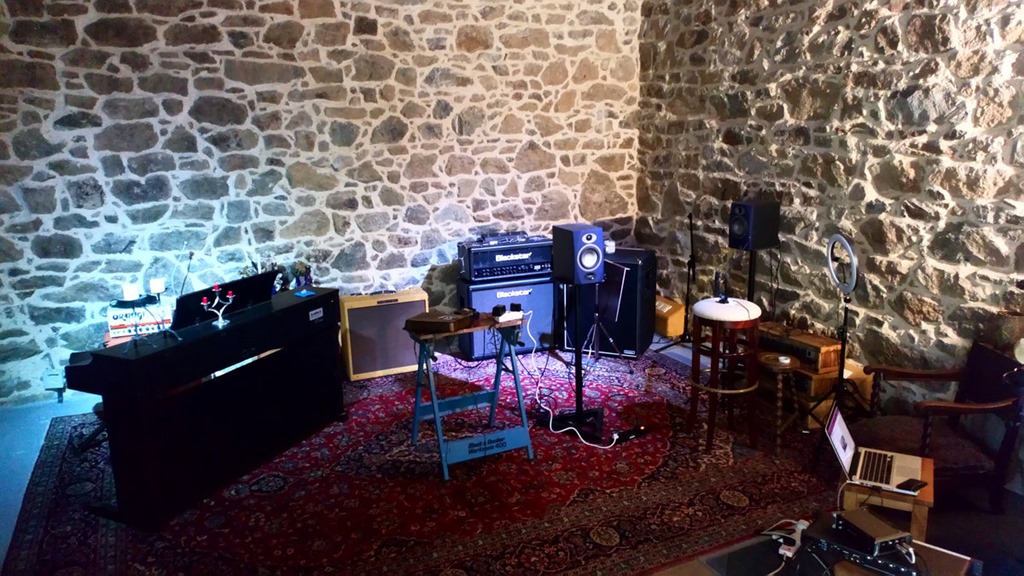
Legion of Swine trotted out for a few live exhibitions in the last few months, but Live at Plourac’h documents a show which was something of a one-off among these, with the performance having taken place in a studio (Soundfackery Studios in Brittany) and streamed live, followed by a Q&A, with audio from both featuring here.

Like many noise acts, T’ Swine tends to keep performances brief. The brevity is, in may respects, part of a tradition on the scene, and while Masonna’s explosive three-minute sets take this to an extreme – and why not? Noise is all about extremity, and finding new limits to push beyond. It’s all about the impact of the short, sharp, shock. Leave them wanting more – those who haven’t fled the room, hands clasped to their ears, while holding back the urge to vomit, anyway.

Even in the absence of the old performance aspects of Legion of Swine shows, whereby Dave Procter would be anonymous in a lab coat and latex pig mask, which means we get to witness the bearded, bespectacled northerner looking quite unassuming, sonically, LoS remains a formidable force.

Opening with strains of feedback and scratching buzzes of distortion, the set holds a single, undulating note of wailing, droning feedback noise for what feels like an eternity, the frequencies and tone changing but still offering nothing more than feedback for the first five minutes of the set. The level of strain and the tension builds, but still, holding back, holding back, testing the patience as well as the eardrums. To have been in a room with this, at gig volume would hurt. Then, unexpectedly, things drop in intensity, and it’s a heavy hum, a long, low, whine that nags and throbs.

As a noise sculpture, this is a restrained, patient piece which hovers within the parameters of a very limited range in terms of frequencies and particularly texturally, manipulating feedback in the mid- and lower-ranged for the bulk of the sixteen-minute duration.

Even recorded, with the separation from the actual event, the frequencies and volume are conveyed clearly here, and there’s a gut-trembling grind to the lower-end oscillations. The release notes summarise the kit as a ‘trusty metal roasting tin and a couple of effects pedals’, and whatever the truth of the facts around the gear involved – which I suspect would have been minimal – the racket created is significant.

There’s a long, long fade to nothing.

There is a certain amusement in the fact that the Q&A lasts twice the duration of the set itself. Dave speaks engagingly on the technical processes of his use of contact mics, and, yes a baking tin, and the mechanisms involved in changing pitch and creating feedback, and so on. It’s a nerdfest that Steve Albini would have been impressed by. He discusses room space, PA, body temperature. ‘Every time, it’s a different thing’, he says.

His recollection of room temperatures and their effect on sound is remarkable, and the dialogue is illuminating. Like so many noise artists, there is a yielding to the random, to circumstance, eventuality, accepting that no two performances will be alike as acoustics and the way sounds interact is spontaneous and unpredictable.

The interview is interesting and wide-ranging, but to discuss and dissect it at length here feels like a job for a longer, more academic discursion.

This is a niche release: that’s a given. Side one will inevitably receive more plays. But both warrant same time. Listen, and learn. Enjoyment is probably optional.

AA

a0816152283_10

Dret Skivor – 3rd May 2024

Christopher Nosnibor

Dret Skivor seem to have managed to sync their release schedule to Bandcamp Fridays pretty neatly. Meanwhile, the man behind the label, Dave Procter, has enough different musical projects to fill the entire label’s roster single-handedly.

Not content with pumping out harsh noise as Legion of Swine and ambient drone with mathematical divination as Fibonacci Drone Organ, and spoken word ramblings backed with dark noise as Trowser Carrier, or collaborating with countless other artists, notably Claus Poulsen with whom he (ir)regularly convenes for a release, and a brief excursion as twAt clAxon, Procter has also been operating as Klôvhôvve, a vehicle for ambient / glitch weirdness.

Following on from Is it? It is, an album containing two longform tracks which offered their own call and response, released in March, Live at JT Soar feels on one hand like a bit of a stop-gap, but on the other, a reasonable consolidation. More than reasonable, in fact, considering that Procter devotes a considerable amount of time to performing live – and is perhaps the only artist I can think of who will book a tour and not play under the same guise more than a couple of times, or for two consecutive shows. It is, undoubtedly, easier to get bookings if you have a broad range of styles to offer promoters, even if that range does sit under the wider umbrella of obscure electronic weirdy shit.

Before we ger to the obscure electronic weirdy shit of the recording, it’s worth a brief acknowledgement of the cover art, which is truly classic Procter (the photographs which grace the covers of his two collections of poetry / rants as Dale Prudent are strong cases in point). Gritty, unpretty, urban, and a bit off kilter, snapshots of the everyday strange. Here was have a shot of the outside of the venue, still with its signage for JT Soar, Wholesale Fruit and Potato Merchants, from which it takes its name. Unassuming is an understatement for this building, with graffiti on one door, and a piece of street art depicting Nottingham’s best-known polemicists, Sleaford Mods, replicating the artwork for their most recent and widely-acclaimed album, UK Grim on the garage door. The shot is some real-life documentary, its relevance heightened because the vocally socialist Procter departed the UK for Sweden post-Brexit because… well, Brexit.

Klôvhôvve’s set, which lasts twenty-four minutes, is mellow and mellifluous to begin with, but soon swerves into a melting together of soft tones with scratched, warping drones, the glitching eating into the surface of the looping tapes affected at first. Vocal snippets, fractured, fragmented, distorted, cut in and out, as the music ebbs in and out unpredictably.

There is a sense of nostalgia about this, but the overarching sensation is more that of a post-apocalyptic narrative, a bleak dystopia of degradation, of societal collapse whereby only damaged recordings and fragments of past technologies remain, twisted, rusted, malfunctioning. The set does have distinct segments, although they do flow together to form a continuous set, and as such, it makes sense that it’s released here as one single track. It’s not as if anyone is going to be skipping to hear the hit or their favourite song of the set, and it’s structured around transitions between evermore haunting atmospheres. It’s pretty unsettling stuff, dank and grumbling with thunderous rumblings away off in the background while a continuous slow of babbling and sharp scrapes cut into the foreground. But then there’s something resembling a trilling, twisted rendition of ‘Silent Night’ which crackles and stutters through static, and it warps and crackles its way to a slow fade.

There is some strong tonal separation here, and the interjections which appear unexpectedly are almost enough to make you jump But for the most part, it makes your skin crawl – slowly, in a state of curiosity and ponderous hesitation – as you winder where it may be heading.

Procter understands the importance of music which makes you feel uncomfortable, which tests your limits, and this release captures a live set which really teases at the tenterhooks.

AA

a3905712960_10

Skoghall Recordings – 5th April 2024

Christopher Nosnibor

I don’t really know too much about this release. It came my way via one inbox or another, with a download, but no cover art, no press release. And for some reason, I had expected it to be longer. But it’s a Skoghall release, and features Dave Procter (Legion of Swine, Dale prudent, Wharf Street Galaxy Band, etc ad infinitum) and some mates.

We’re looking at a couple of tracks, both short of five minutes. Nothing wrong with that – there’s a lot to be said for keeping things simple, and keeping things concise. Do I need the backstory, an essay on the contributors and their backgrounds? No, no I don’t. No-one does, really.

I do feel we’ve become altogether excessively invested in the wrong details in recent years. Time was when an act could release a record, it would be reviewed on its merits, or it’d slip under the radar and all we’d have would be the music. There would often be no mention of who did what on the record., and there would of course be no website, no source by which to obtain details of personnel or a bio. Nowadays, journos – people like me, although I don’t consider myself a music journalist by any means – get picked up on the slightest inaccuracy, we get asked to change spellings and correct who played bass, amend the cover art and the release date… This is not right. The press’ purpose is to independently proffer opinion, to critique, and where facts are missing, perhaps plug the gaps with assumptions, why not? While reviews are a part of the promotional cycle, it’s important – at least for me – to be apart from it all. In short, press is not PR, and should on no way feel obliged to give frothingly enthusiastic reviews simply because they’ve received an advance copy.

I digress, and admit that I tend to provide positive coverage of the releases which come my way which I like, rather than slapping down the releases I’m less keen on. When you get fifty or more submissions a day, you can afford to be selective, and besides, life is short and I’m not going to spend mine squandering energy on stuff I have no interest in.

I have a strong interest in this, though.

What’s on offer are two slices of minimalist electropop with a keen late seventies / early eighties feel. A single droning note hangs throughout the first track and a drum machine clips and clops away recreating the sound of early Young Marble Giants – only here, Procter drones and stutters a blank, low vocal delivery, half-robotic, half crooning, and drifting astray in a swamp of reverb.

The (virtual) flipside is dronier, noisier, a serrated-edged grating drone providing the backdrop to a challenging piece where a clanking percussion saws away and Procter rants -away in the background, again, immersed in reverb and low in the mix – about control and its uses and abuses. Now you’ve got control… what are you going to do with it? He asks, antagonistically.

The answer, well, it depends on who you’re asking. Power is a difficult thing, and – so hark back to an early SWANS track, what we see is power for power’s sake – use and abuse, but more of the latter. Show me – when was power last used for benevolence? I don’t want to be dragged down in this now, and there is plenty of mainstream outrage in circulation, so let’s get back to the release.

It’s succinct, it’s tense, it’s uncomfortable. Bring on ‘Two’.

AA

a4206158382_10

Dret Skivor – 2nd February 2024

Christopher Nosnibor

Nostalgia sucks. On so many levels, nostalgia sucks. It’s something which looms a longer, darker shadow over life with ever years that passes, as every memory recedes further into the past until eventually it tips over the horizon, beyond sight, to a distance whereby its very happening takes on a dream-like quality and you begin to question if the even was real or imaginary, a myth which has grown from the creeping spores of hazy recollection.

I was probably ahead of the curve when I began feeling pangs of nostalgia on moving to secondary school in 1987. Nostalgia wasn’t big business then, and didn’t even strike me as something that so many people felt deep pangs of back then, although perhaps shows like The Golden Oldie Picture Show which I would often watch with my parents after coming home from Cubs should have given me a clue as to how adults mire themselves in their past. It was on reaching my thirties when I began to separate from my peers who constantly bemoaned the state of music, now there was no good new music, how it had all turned to shit since they left school.

Today, I took myself for a quiet pint, only to find myself eavesdropping inadvertently on a couple of old bastards complaining how there’s no proper music anymore, how it’s all 70s and 80s bands which headline Glastonbury and it’s all rap like 10-bit and one began spouting on how he saw Dave Grohl’s band, Metallica, on TV and wasn’t into it. Then they raved about Pink Floyd and The Eagles and now awesome they are, and how their songs are ‘minutes, minutes long… And then there’s a guitar solo. And Dire Straits… and how Blondie’s career ended with Parallel Lines, but they did this comeback song, like Duran Duran. I wished I was deaf, and congratulated myself for not being so painfully moored to the past – or so ill-informed.

But for all of this, I feel a pang of sadness on the arrival of a new Legion of Swine release. I miss Dave Procter’s presence in the UK for a start, surely one of Brexit’s biggest losses, at least on the underground music scene. I miss his crazy noise shows, particularly back when he would don a latex pig’s head and lab coat to crank out harsh noise. I have a particularly fond memory of our two collaborations, but especially the room-clearing effort where I yelled like a maniac as he ambulated the venue with a portable speaker emitting screeds of feedback in the middle of the afternoon.

Beyond this particularly personal context, of course, the latest offering from Legion of Swine is by no means a nostalgic work, although it does explore wibbly analogue synth and lasery sounds which hark back to the early 80s, when primitive synths were becoming widely available. But then, it equally passes nods to early Tangerine Dream, and to the bubbling pink noise and synthy waves of Throbbing Gristle early Whitehouse. But, on balance, the listening experience alone does not evoke nostalgia. What the hovering hums do evoke is a sense of awkwardness, if difficulty.

Legion of Swine’s output has never been about commercial success, but noise for the sake of simply making. Art as it should be. It it’s for the benefit of Legion of Swine first and foremost, for whom it’s entertainment. It’s for the benefit of an audience as a secondary concern, and the number of people who are likely to be entertained by this is few. But it’s a storming album, which really explores tones and texture. Consisting of a tow longform tracks each with a running time around twenty minutes, it’s an evolutionary piece, and within each continuous composition, the various segments flow from one to the next.

It reminds us of the fundamental difference between albums made up of ‘songs’ and shorter pieces and longform works, in that the former can contain ideas and concepts in a compartmentalised way, with no necessary correspondence between them, while the latter is a journey, and requires an altogether different level of focus and concentration in order for it to work as such. Gloopy alien soundscapes and long, low, ominous drones are rent with laser blasts and trickling ominous electronics worthy of some vintage sci-fi works, and ‘jag hör röster’ is a lot less overtly noise-orientated than previous Legion of Swine releases and live outings, sitting very much within the domain of dark ambience rather than abrasive noise. But it’s well-executed and with occasional blasts of overloading, needles-into-the-red distorting drone, it’s not as mellow as all that, with skronking feedback and earwax-vibrating buzzing and an array of organ-vibrating oscillations pouring their way into your ears. ‘hör du röster?’ is absolutely head-melting thick, buzzing noise abrasion all the way, a monstrous wall of distorted drone amped up to the absolute max, with surging, sloshing swells of dense analogue noise, and a relentless barrage at that.

Uncomfortable as always, under ytan ligger nåt is one hell of a racket. All hail the Swine!

AA

a3325660179_10

Dret Skivor – 6th October 2023

Christopher Nosnibor

It’s been a few months since we’ve heard from Legion of Swine, one of my favourite vehicles for the intensely prolific Dave Procter – because LOS are noisy, abrasive, and unpredictable, and I have fond memories of numerous demented performances and a couple of collaborative sets together. Even when sadly sans pig-head mask, having developed an allergy to latex, the gnarly electronic noise Dave cranks out is messed up and often times hurts.

Dave, and the Swine, are both highly political animals, and once again it’s politics which have spurred him to clack his trotters into activity and snort his disapproval of current affairs.

L.H.S. is accompanied by uncharacteristically expansive liner notes, which prove useful, and so I shall quote in full:

‘This release pays credit to Värmland folk who campaigned to create a better society and are represented by the letter LHS.

L is Selma Lagerlöf who was heavily involved in women’s suffrage and received a Nobel Prize for literature in 1909.

H is for Gerda and Mauritz Hellberg who were central characters in the right to vote campaign.

S is for Torgny Segerstedt who took a stand against the Nazis in his role as editor at Göteborgs Handels- and Sjöfarts-Tidning.

The image used in this release is a reminder of how the free market is way more important than people in some eyes.’

It lays it all out there, and reminds us how failure to learn from history is guaranteed to doom the future. Admittedly, the way things are looking now, we’re doomed one way or another and likely sooner than anticipated due to sheer greed and a refusal to face facts. In the face of this, there’s a part of me that feels as if complaint or resistance is futile, because we’re already fucked. But we need to go down fighting. We need to at least die trying, to know we’re did our best.

L.H.S. is the sound of the fight. It’s a fucking racket, blasting in from the outset with overloading distortion, cutting in and cutting out, a blasting overload that just hurts and is an instant headache. It’s the harshest of electronica which only gets nastier and more intense and insane as it progresses. By three minutes in, it sounds like someone smashing a bin lid connected to a contact mic, recorded on a mobile phone. The treble is high all the way, and the sounds are metallic, distorting, like someone tearing the door off a garage in a gale or something similarly deranged. And deranged it is, from beginning to end.

We’re in Merzbow territory here. And it actually hurts. Ten minutes in, there are some vocals, but they’re impenetrable shrieking derangement, buried in feedback, before things get really gnarly.

L.H.S. is nasty, and I absolutely love it. I suspect most won’t. It’s one to file alongside Whitehouse, Merzbow, and Prurient. It’s brutal, and as niche as fuck, and Dave knows it. Embrace the pain. This is something else.

AA

AA

a3749396098_10

Christopher Nosnibor

It’s been a while. It’s been a while since the last Wonkystuff. Like, six months or something. It’s been a while since Deluxe Hugs debuted at a previous Wonkystuff, and just as long since they last played. It’s been a while since legion of Swine last played in the UK, and even longer since the porcine prince brought his brand of harsh electronica to York – like about four years. Time flies when there’s a pandemic and everyone gets so screwed by lockdown conditions that they’re trepidatious about going back out and find their urge to create, to get out, to perform, has gradually leached out of them to the point that any event is a herculean effort to perform or attend.

The great thing about Wonkystuff nights, as I’ve perhaps mentioned previously, is that they’re not only brilliantly-curated melting pots for musical hybrids from the fringes on all fronts of electronica and beyond, but they’re also wonderfully warm and welcoming occurrences with a real sense of community. And so we’re all here being socially awkward and comfortable and accommodating of that awkwardness, acknowledging the fact none of us get out as much lately, while being pleased to see friendly faces. And you know what? This isn’t just ‘nice’. These are the fine threads that keep people together – not just in a community sense, but individually, knowing that for all the isolation, we’re not alone.

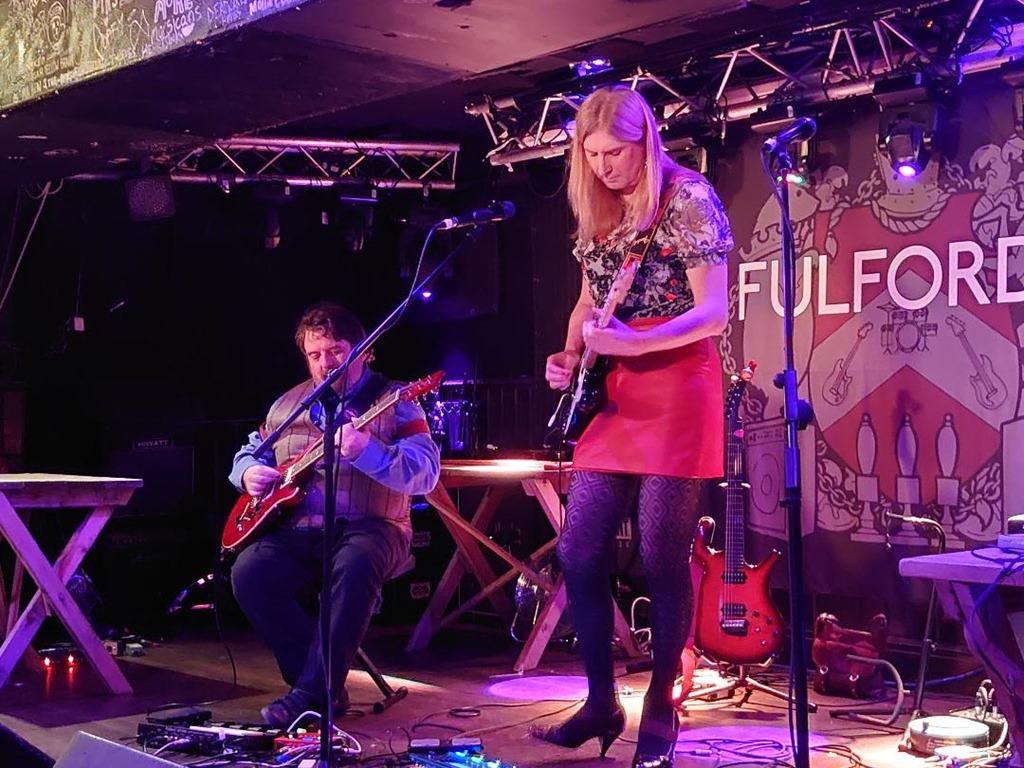
The Wonkystuff House Band who played at Wonkystuff #19 mutated into Deluxe Hugs on a night it seems I failed to document for some reason. Anyway, their debut was fun, a stab at entertainment and some kind of alt-disco thing, and tonight… well, tonight it’s apparent that they’ve not spent much time together since last time. But with big, squelchy bass, disco grooves, and atonal vocals, through the chaos, the songs shine through, as does the chemistry between the three. ‘People in charge/they know what they’re doing…’ drones Simon, and the layers of irony are impossible to ignore. It’s a bit punk and it’s a lot of semi improv fun.

Hugs

Deluxe Hugs

Up next, Spore, a duo from Hull, bring big, dank, murky modular noise. They churn outa mass of swirling dark ambience that slides into power electronics and old-school industrial. The emergence of a thumping drum beat part way through made for a change of texture. Their set is hypnotic, but also sounds like a noise gig with a club night in the next room. I feel I should collaborate with these guys – because they’re ace, and Nosnispore has a definite ring to it.

Spore

Spore

Glider Theory are a Leeds-based guitar and drum machine duo. They bring soaring, drifting, post-rock post-punk hybrid instrumentals… Guitars that sound like synths. Guitars that sound like woodwind… Ambient contrails. It’s nice.

Glider

Glider Theory

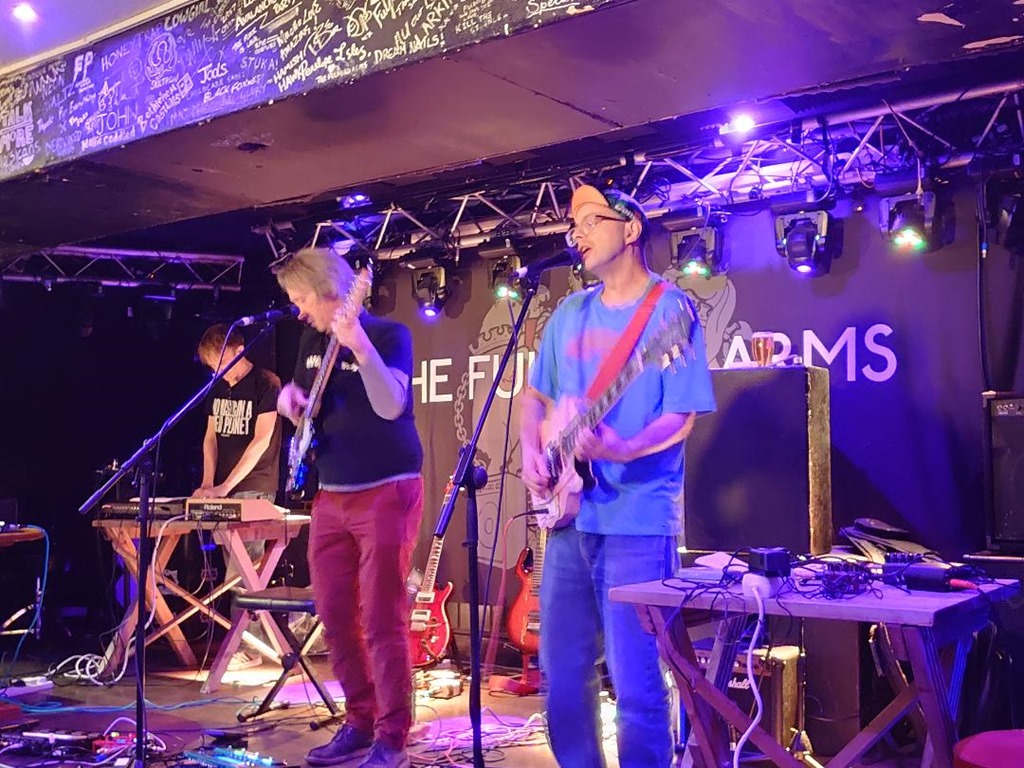
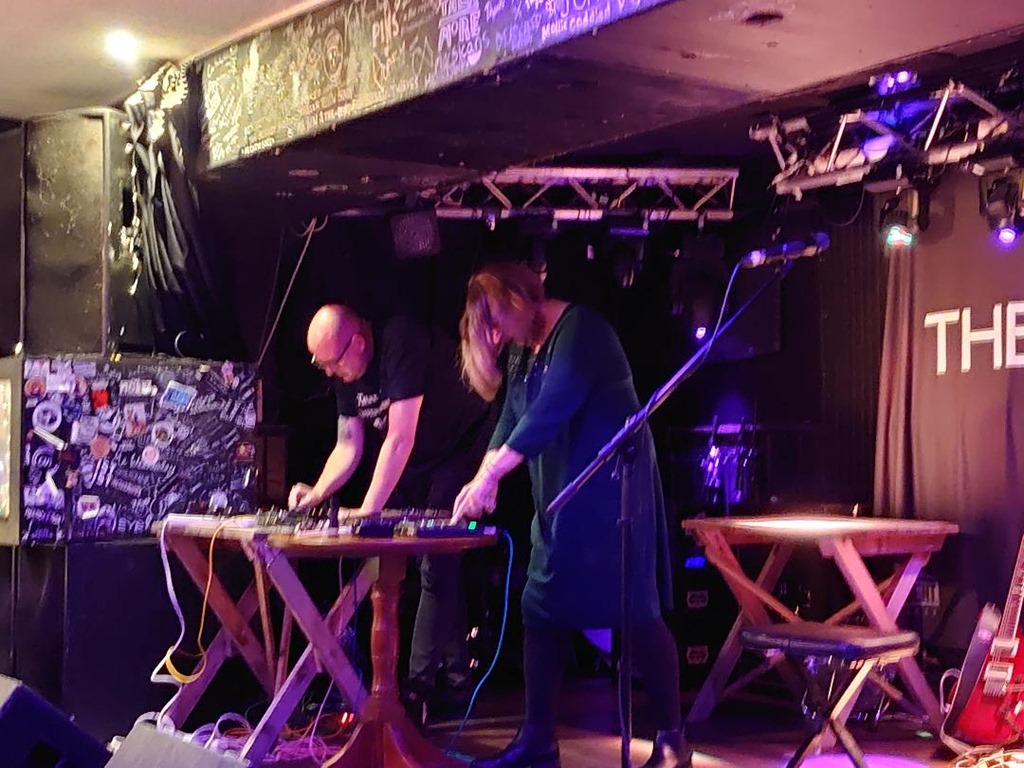
But if you want more nice, you don’t want Legion of Swine. Me, I don’t want anymore nice: I want to feel uncomfortable and I want my ears to hurt, and my chest too vibrate, which is the main treason I came down to see legion of swine on the first date of their UK tour on a visit from Sweden. And I got what I wanted.

Legion 1Legion 2

Legion of Swine

The set, in near darkness bar a deep red light, begins with static drone. The distorted hum continues, buzzing, grating, sawing. It tense and uneasy, in a way that’s reminiscent of 90s Whitehouse It’s surprisingly quiet, and, I reflect, kinda like listening to a hair dryer. Then it stops, and there’s a rumble, a breeze. It’s more ominous than abrasive… Until suddenly it isn’t. A harsh noise wall erupts. And keeps on building. Fuck. It hurts. It’s an immense sonic force. And then… then it stops. Proctor does his signatory trotter pose at the end of the set. It’s a welcome return for one of the north’s greatest masters of din, topping off a top night.

DRET Skivor // Bad Tapes – 5th November 2021

Christopher Nosnibor

There’s niche, and then there’s microniche. Swedish cassette label Dret Skivor, this time in collaboration with Bad Tapes, present a split release that on paper doubles the audience, meaning they could probably shift a larger run. So is the run of just twelve copies of the cassette an act of wilful obscurantism? Or is it simply an awareness of market reach for what is, by all accounts, an obscure and difficult release?

Housed in some particularly (out of character) tranquil fine art depicting a rustic scene worthy of Turner, created by the ubiquitous one-man noise scene that is Theo Gowans, this collaborative effort was recorded to celebrate the midsummer of 2021 – released, appropriately just days after the end of British summertime, and also coincidental with November’s Bandcamp Friday.

Side A is occupied by ‘midsommar’, a celebration Scandinavian style. It’s not exactly a celebration in the sense of a carnival atmosphere, but it is a celebration of a momentary pause, the point at which the year hangs at its apex before its gradual retreat back towards darkness and autumn.

It manifests as fourteen minutes of ominously hovering drone during which almost precisely nothing happens. It’s ominous, and its power lies in its commitment. That is to say, it’s the Waiting for Godot of drones. Practically nothing happens. There is no discernible variation. There’s not even much to listen to for change; the texture is flat, the tone is flat. So many releases are referred to as exponents of drone, but this, this is the definition of drone. It’s not doomy, it’s not dark: it’s almost completely blank. Not so much sound pouring into a sonic void, but fourteen minutes whereby sound creates a sonic void.

Flipside ‘midsummer’ is typically Gowans; midsummer English style – some chatter over the setting up of mics and the loke, some field recording ambience, birdsong and a small choir starts things off gently if there’s a lot going on at once, and then a barrage of feedback and churning noise that obliterates everything. It gradually slides into a morass of interweaving drones that undulate and twist, with all sorts of extraneous fizzes and scrapes intersecting throughout. If ‘midsommar’ is a smooth drone, an endless stretch to a clear horizon ‘midsummer’ is an unsettled and unsettling experience dominated by disruption, there is discord and discontinuity, and a pervading air of discomfort.

Taken together, the two pieces provide contrasting perspectives which illustrate that experience is not fixed, but something which comes from perception.

AA

a1635961788_10

Dret Skivor – 11th January 2021

I had the pleasure – and it was a pleasure for me, if not necessarily the audience – to perform a couple of times with Legion of Swine. They were noisy, brutal affairs: while Dave Procter’s many musical guises span most shades of noise, with a particular leaning toward all things drone, his work as the lab coat wearing porcine purveyor of aural pain.

The audio on this release is taken from Legion of Swine’s set for the Chapel FM 24-hour Musicathon, which took place on 12th-13th December 2020, which featured forty-five acts in twenty-four hours. Performing at 6:15am on Sunday 13th, the chances are few caught the performance as it aired live, but here, a year on, is an opportunity to bask in the gnarly noise at leisure and a more socially amenable hour. Not that there’s much that’s socially amenable about this: the liner notes explain how ‘It’s “almost” Harsh Noise Wall, but not quite as some random parts of reverb tails interact with others at various stages to create the slight variations.’

So how does that translate as a listening experience? Well, as the title suggests, the noise never abates during this twenty-six-minute blast of electronic abrasion. There are no breaks, no vocals, and next o no sonic variety, although there is some – and it’s heavily textured. In fact, it would be most readily summarised that it sounds like the cover looks: grey, grainy, but woven so as to be not entirely monotone and uniform in shade.

When I find myself listening to HNW – which admittedly, isn’t that often, as I generally prefer the concept to the experience, despite the fact I do very much like my noise to be immersive, not to mention somewhat testing – I find myself hearing subtle shifts in tone and frequency. I suspect it’s the result of some auditory illusion, the aural equivalent of an optical illusion as my receptors strain to find some variety, some detail on which to pin a response of some sort, in the same way a freshly-painted wall will reveal patches that are not as well covered as others the longer you look at it. The beauty – and I use the term with extreme caution here – of this performance is that those patches do exist, and are purposefully brushed into the finish.

This is alternately the sound of a distant swarm of hornets and swimming underwater. The recording doesn’t convey the kind of extreme volume that is an element of a lot of harsh noise, although one suspects that a large proportion of the interplay between sounds is derived from the way that reverberate, resonate, and rub together and against one another, and any comparison to Merzbow is entirely appropriate. But the lack of overt volume only accentuates the sameness – or near-sameness – of the sound, and what’s more that sound is a continuous torrential churning noise that sits in the midrange, and hammers like metal rain, a relentless digital downpour. It’s ultimately oppressive in its relentlessness, and over time seems to fade into the background, as anything with such a lack of dynamics inevitably will. But this is not about stimulating the senses so much as numbing them and challenging the listener to endure. It’s a test alright, and a tough – but good – one.

AA

a2596588712_10