Unseen Worlds – 4th August 2023
Christopher Nosnibor
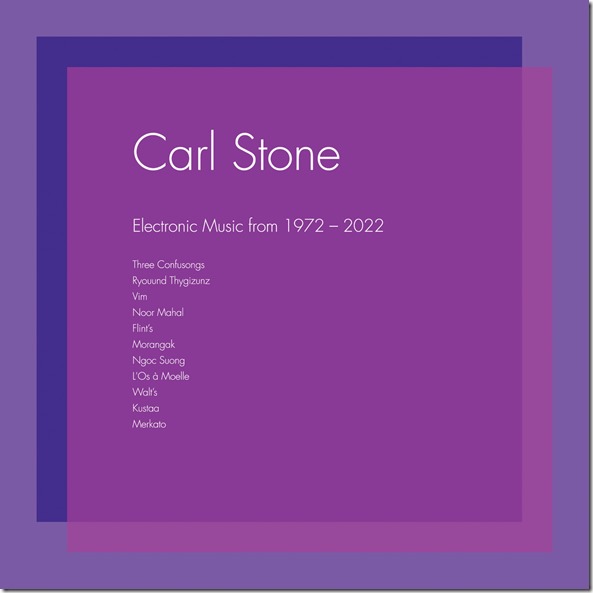
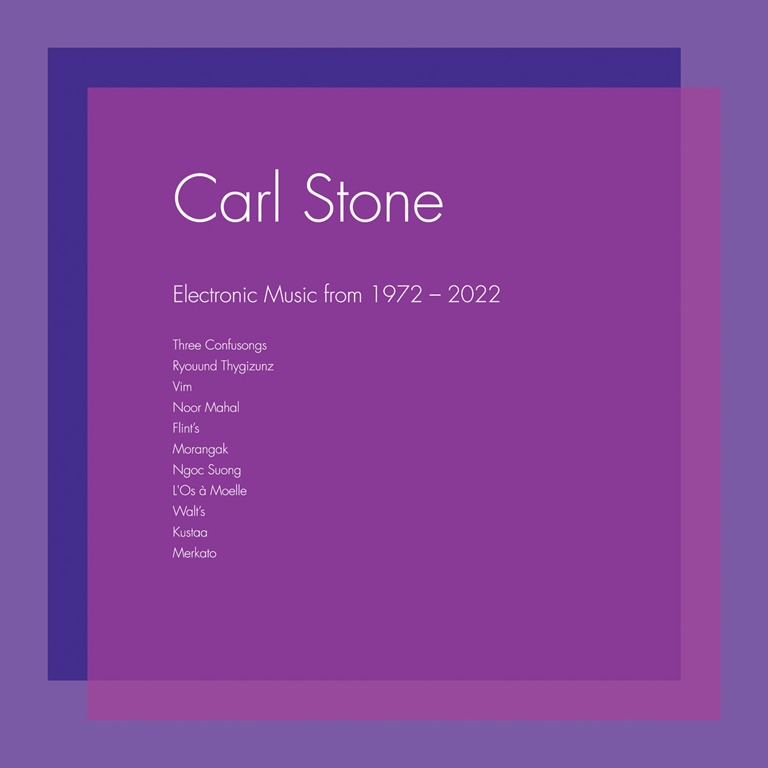
Having failed to make it to Carl Stone’s show in Leeds the other week – in the same way I’ve failed to make pretty much any shows this year and am largely tied to engaging with music in recorded forms for the foreseeable future, it feels only right that I should compensate in some small way with a review of his upcoming compilation album, a monster career-spanning triple album.
And when it comes to his career, the title sets out the immense landmark it represents. Not just the fact that this release is a summary of a career spanning half a century, but the broader context that there has been electronic music for so long. Village Voice have called him “the king of sampling”. Being born in 1975, I only became aware of sampling in the late 80s, and while Tangerine Dream and Kraftwerk and Throbbing Gristle are legendary as pioneers of electronic music, you probably don’t generally think of there being many other artists breaking ground and experimenting as far back as 1972.
The accompanying notes provide an outline that’s easier to quote than to summarise: ‘Electronic Music from 1972-2022 seeks to frame fifty years of Carl Stone’s compositional activity, starting with Stone’s earliest professionally presented compositions from 1972 (‘Three Confusongs’ and ‘Ryound Thygizunz’, featuring the voice and poetry of Stefan Weiser – later known as Z’EV) up to the present. This collection is not meant as a definitive history but rather as a supplement to be used alongside the previous two archival releases. It is simultaneously an archival release marking Carl Stone’s evergreen 70th birthday and a document of archival art. In the spirit of disorienting repetition and layering, call it an archive of archiving.’
This, then, is by no means a retrospective in the conventional sense, but it does clearly trace a trajectory of the evolution of Stone’s work. The album doesn’t spread the tracks evenly, being weighted heavily to certain years, with each year effectively representing an era.
The 1972 material, which occupies side A and represents the early years, is very much a cacophony of loops and echoes, reminiscent of William Burroughs and Brion Gysin’s tape experiments of the later 60s, and foreshadowing the first releases by Foetus and Cabaret Voltaire, as well as the disturbing drones and processed vocals off Throbbing Gristle, and clearly very much ahead of its time and venturing into the realms of dark ambient before it was even given a label.
Side B leaps forward fifteen years to 1987, with a brace of scraping, discordant pieces, both of which extend beyond the ten-minute mark. The production of these more structure, beat-orientated collage pieces is quite eye-opening: how times and technology change! ‘Vim’, which sounds like a cut-up of The Beach Boys is very much a cut-and-paste assemblage of loops, but the sound is crisp and marks an evolution more of light years than actual years. At ten and a half minutes, it feels it goes beyond proving its point, but then again, perhaps that is a point in itself. It also reminds us of the changing musi8cal landscape: 1987, the year the Justified Ancients of Mu Mu released the sample-riot 1987: What the Fuck is Going On. This is significantly more sophisticated than the JAMMs, and takes a less confrontational approach to the application of the emerging technologies. In contrast, the other 1987 track, ‘Noor Mahal’ combines tribal drumming and hypnotic folktronica, prefacing the airy new age folk crossover forms that would bubble up in Enya’s ‘Orinoco Flow’ and The Beloved’s The Sun Rising’ a year or two later.
And this is what ultimately threads Stones’ work together. He’s astute enough to be aware that evolving technologies are in themselves the soundtrack of the times, and it’s clear listening to this in sequence that experimental music invites chicken-and-egg discussion as to whether the music evolves because of the way technology facilitates it, or of the technology encourages those who are so inclined to push it to its furthest ends.
There’s just one nineties cut, with the jaunty ‘Flint’s’ from 1999, before the millennium brings a selection of dark jerky pieces (‘Morangak’ (2005) is a particularly gnarly Dalek-like mess of a loop) with two absolute beasts in the form of ‘Ngoc Suong’ (2003) and ‘L’Os à Moelle’ (2007), which both sit around the twenty-three minute mark and occupy a side of vinyl apiece, proving particularly disorientating. The former is also particularly testing, an experience akin to water torture, while the latter is… different by its sameness. Like listening to The Eagles on a three-hour car journey. I woke up with a jolt, my face on my keyboard, realising my review was incomplete and it was fifteen minutes later than it had been, and this track feels like a comment on the time in which it was created. It gets weirder as it progresses, of course.
Cut forward to 2022, with three much shorter pieces occupying side F, and ‘Walt’s’ presents a different kind of surprise, being bright, crisp, with technicolour energy and it’s almost game-showy. Spinning folksiness with cornball AI –sounding blooping, and also whipping in some Bollywood bang and an 80s synth-pop vibe, it’s dizzying, and these elements are present in varying levels on ‘Kustaa’ and ‘Merkato’ which are overtly ‘world’ music inspired wile spreading in all directions at once. And this, ultimately, is what Electronic Music from 1972-2022 tells us: Carl Stone has spent five decades ahead of and / or capturing the zeitgeist, distilling the essence of the contemporary into a headspinning whirl. This may be a swift tour, but at the same time it’s comprehensive, and well worth exploring.
AA
AA
 Aural Aggravation