Posts Tagged ‘John Cage’

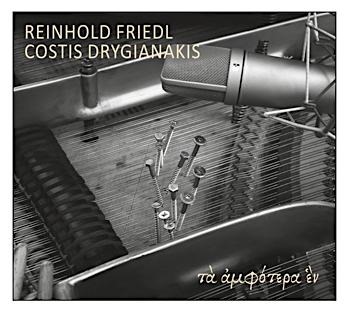
Reinhold Friedl & Costis Drygianakis – ta amfótera en / two into one

zeitkratzer productions – 28th February 2025

Christopher Nosnibor

Reinhold Friedl has been a significant contributor to the world of avant-garde music for a long time, not only as a leading explorer of the potentials of the prepared piano, as pioneered by John Cage, but in excavating the works of historical composers and reconfiguring those of more contemporary ones, leading the zeitkratzer ensemble through performances of Metal Machine Music and selected cuts from Whitehouse’s catalogue.

This particular collaboration coalesced during the pandemic, after which, as we learn, ‘Costis Drygianakis recorded Reinhold Friedl’s special piano sounds on a Blüthner grand piano with a bunch of extremely diverse microphones, ranging from a beautiful old Neumann U67 to a cheap tape cassette machine and even a Dictaphone. The resulting recordings have been classified, selected and processed at his home studio in Kritharia, Greece. No other sounds have been used.’

ta amfótera en is one continuous piece, just over an hour induration, and it’s a journey, to say the least. By ‘journey’, I mean torturous experience. It’s dark, punishing, pulverising, scraping, nightmarish. The first two minutes alone are a soundtrack to extreme horror – fear shaking amidst tremulous piano, heavy discord rumbling low and disconcerting to the point of spiking anxiety, after which there are protracted warped drones and rumblings which drag on, scraping and twisting, sonorous and uncomfortable. Amidst rolling, swirling, churning ambience and awkward, uncomfortable noise, random piano notes spike, seemingly at random. Gongs chime, crash, and clash.

When I was a child, the warping, discordant intro to ‘Rio’ by Duran Duran intrigued me. It created a palpable tension which affected me inexplicably at the age of nine. Perhaps this brief snippet of sound, dissonant, metallic, paved the way to my later obsession with musical otherness. The specific reason I reference this formative experience is that lengthy segments of two into one sound almost exactly like those opening bars of ‘Rio’ – scraping, discordant, a little like twisting metal.

two into one warps and hums, scrapes and drones, and occasionally plonks and thunks, the sounds rising from a random and seemingly unarranged twisting spill of sonic strangeness. There are chimes, and chsllenges.

There is much space – just as there are whistles and feedback – on two into one. The experience is, perhaps inevitably, disorientating, vaguely bewildering, even. There is something about this work which lifts you off the planet: to attempt to pin it to the particulars of contemporary rock music seems to be missing the point. Explore this release… and discover.

AA

Friedl 2

Futura Resistenza – 27th January 2025

Christopher Nosnibor

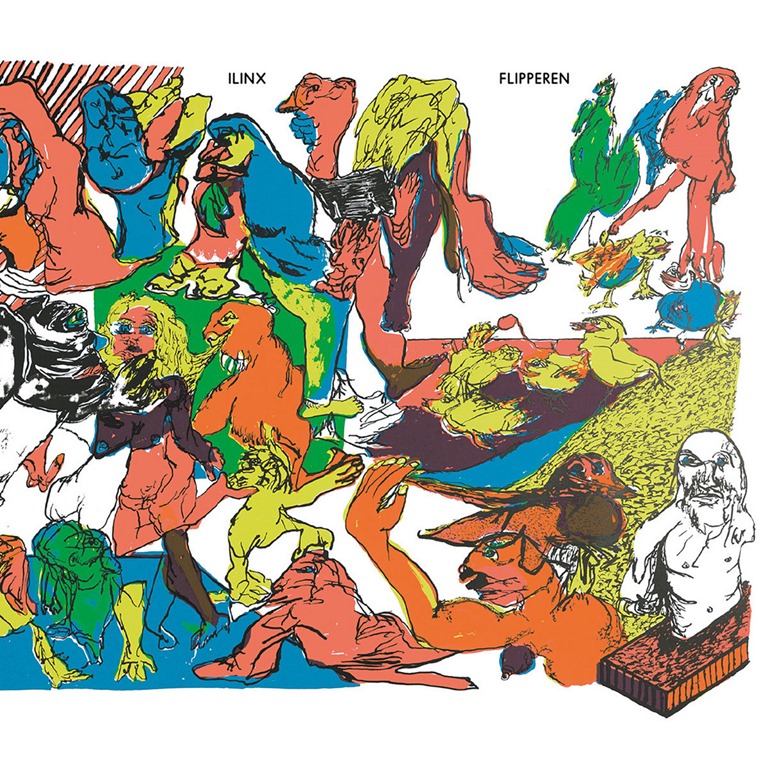
Some years ago (like about seventeen years ago), when I embarked on my reviewing journey proper, I was introduced to whacky experimental work and the world of microtonality. It was an absolute revelation. Just as, growing up in the 80s and raised on the Top 40 singles and Now That’s What I Call Music, discovering goth, alternative, John Peel, and Melody Maker completely changed my head, so did entering this new world. Onje thing that completely spun me was the way in which some artists extrapolated and academicized some pretty stupid or mundane stuff. This is a reasonable example. To quote: ‘Flipperen takes the randomness of pinball and turns it into music. Using recordings from old pinball machines, the music mixes chaos and structure, reflecting the Fluxus spirit of play and chance. It’s a wild ride through sound, where things don’t always make sense–but that’s the fun of it.’

Flipperen began as a lockdown / COVID project, of course. As they detail, ‘During the quiet and strange Covid days, Suzana Lașcu, Robert Kroos, and Reinier van Houdt began a recording project based on the soundbites of pinball machines. They visited the empty Dutch Pinball Museum in Rotterdam and captured field recordings of machines from the 1960s to the 1990s. From these, they selected 28 samples to serve as thematic starting points for what they called ‘game pieces,’ recorded in two sessions at Sonology Studios in The Hague. The recordings were then shaped into sound collages using cut-up techniques and probabilistic processes.’

These processes mean that the end product is a very long way removed from the actual sounds of metal balls pinging and rolling about inside a glass-covered case. Instead, landing between Brion Gysin and John Cage, we get a collection of weird and woozy fragmentary pieces – compositions would be something of a stretch – ranging from awkward ambience to crashing and banging that sounds like a prepared piano fitted with lump hammers. There’s playful, whimsical sighing and trilling, psychedelic trippery and some fairly straight jazz-flavoured piano in the mix. There’s Clangers-like whistling and clattering and clanking, pops and thuds, explosive industrial noise and frenzied country. There are moments which sound like someone grunting through a comb with greaseproof paper, others which sound like the strumming of an egg-slicer, others still which create the impression of a piano being dropped down a flight of stairs.

The final cut features twenty-six tracks, the majority of which are around a couple of minutes long, or even significantly shorter. But there are a couple which run to around six and a half minutes of uncoordinated chaos, and it’s a lot to take in.

The appeal from a sonic and experimental perspective is that ‘Pinball is a game that combines control and randomness—each action leads to an unpredictable result, and the outcome is always uncertain’, and as such, the patterns which provide the material for these pieces are erratic, unpredictable, and ultimately, not really patterns at all. And so it is that Flipperen shunts forwards and backwards, crackles and pops with zany snippets of this, that, and everything, conjuring a wild collage of disparate elements and all kinds of discord.

As much as pinball machines lie at the heart of Flipperen, it’s really a wide-ranging collage work with randomness at its heart. It’s fun, it’s fascinating, it’s brain-bending – and one might say it’s a work of Flipperen genius – but you definitely have to be in the mood for something quite this far out.

AA

a2489366009_10

Institute For Alien Research – 15th January 2025

Christopher Nosnibor

Bath-based microlabel Institute For Alien Research tends to focus on compilation releases, with open submissions, on various themes. One long-running series is Collage Music, each of which features fifteen works, the only stipulation being that their duration is 4:33. Not a second more, and not a second less. They’re not looking for interpretations of John Cage’s seminal work, and as such, the duration is in many ways arbitrary beyond the idea that artists respond to limitations and set parameters in different ways, and as this – the twenty-eighth in the series (as the title indicates) – illustrates the point unequivocally.

With ‘Circumstances’, Support Group ease us in gently with some slightly woozy, echo-soaked, ambience, before Lezet stammer and glitch through a multi-layered slice of abstraction with ‘Colonnades of Fear,’, which may also be ambient, but it far from relaxing, although it’s Robert & Lamy who are the first to venture into much darker territory, with the kind of doomy, drony warped tape and noise experiments that are reminiscent of Throbbing Gristle in places.

The arrival of ‘bruits de la vie’ by samelectronics feels like something of a watershed moment, being the first piece to present big, bold sounds – feedback and immense powerchords, which, instead of feeling heavy or oppressive, open an expanded horizon, to surprisingly uplifting effect. The rough, lo-fi punkiness of ‘Johnny got no respect’ by This is The Utter vs Chelsea comes as a surprise bang in the middle, being the album’s first straight-up guitar-based cut, and it’s a savage semi-cover to boot.

Along the way, there’s a superabundance of weird shit, with collages and field recordings and ethereal haunting soundtrack-like compositions, dark electronica, spaced-out BBC Radiophonic Workshop type soundscapes, and banging dance, courtesy of Sbilts, with ‘Acid Dog’, who mine a vintage techno sound propelled by old-school drum machine sounds. That snare! Samples! It’s a sonic time-machine!

Just as grassroots venues are essential on so many levels, so are labels who put out releases like this. Most of the contents of such compilations is ultra-niche, and will never expand beyond being so – and that’s ok. There is a huge audience with niche tastes who simply aren’t catered for by bigger labels, bigger venues. Most of the acts here are unlikely to ever play to more than twenty-five people, assuming anyone will put them on, and they’re never going to be snapped up by a label which has aspirations of making money. Self-releasing is find, but it’s hard to reach the tiny, fragmented target audience. But a label like Institute For Alien Research, having established a reputation for providing a platform for the full spectrum of experimental electronica and beyond, creates its own niche. It may seem hard to believe when there are maybe a few hundred or so people who are into it, but this really is what the world needs. Capitalism is killing cultural diversity, and it’s killing art.

The fact that Collage Music (28) is a mixed bag is a good thing. It would be all too tempting for the label to be picky, sniffy, selective, and offer up a compilation which is more homogeneous, unified, that presents, ultimately, a curated collection determined by personal taste. And that would have been fine, and entirely their prerogative. But Collage Music (28) is all the better for its wild eclecticism. You might not like all of it – and it would be probably be a bit strange if you did – but in listening to it, there’s a chance you’ll find your eyes are opened to something you didn’t know you would like, and it’s absolutely guaranteed you’ll hear artists you would never have otherwise encountered. So dive in!

AA

a3223356046_10

zeitkratzer productions / Karlrecords – 22nd September 2023

Christopher Nosnibor

SCARLATTI represents something of a departure for zeitkratzer, the neoclassical collective headed by Reinhold Friedl, master of the prepared piano and a renowned avant-garde composer in his own right. While their performance and recordings usually focus on modern composers and avant-gardists spanning Stockhausen and John Cage via Whitehouse and Lou Reed, with a reinterpretation of Metal Machine Music, here they turn their attention to the altogether more historical figure of Domenico Scarlatti (1685-1757). He is best known – although this is relative – for composing some five hundred and fifty-five keyboard sonatas, and his being a progenitor of classical music. But a large portion of his work went unpublished in huis lifetime, and much has only been available sporadically since.

As the notes which accompany the album explain, ‘Little is known about Domenico Scarlatti… His music is, so to speak, left to its own devices: free, cheeky, playful, sonorous, surprising… Harmonically strolling again and again into unforeseen regions, the ear leads, not the theory; and also the fingers get their right: playful and haptic it goes. Scarlatti explained, “since nature has given me ten fingers and my instrument provides employment for all, I see no reason why I should not use all ten of them.”

But Scarlatti does not contain music by Scarlatti. Instead, the six tracks presented here are all composed by Friedl in response to Scarlatti’s work.

As such, this is much a celebration of Scarlatti’s ideas and approach to composition and so the explanation of the process and thinking behind it bears quoting: ‘Freedom, friction and listening pleasure instead of convention: “He knew quite well that he had disregarded all the rules of composition in his piano pieces, but asked whether his deviation from the rules offended the ear? He believes there is almost no other rule than that of not offending the only sense whose object is music – the ear.”

‘Reinhold Friedl applied this principle and composed the music for a choreography by dance company Rubato. Dance music drawn from Scarlatti, who was so inspired by dance music. The material of the piano sonata F-minor K.466 is twisted anew in all its richness, shifted back and forth, declined, frozen, noisified, sound structures extracted, floating. Those who know the sonata, will more than smell it’s [sic] shadows.’

The six pieces are indeed varied, in terms of mood and form. ‘lias’ is booming, droning, woozy, slow discordant jazz, low, slow, and with lengthy pauses. It’s not something anyone can dance to, and rather than light and playful, it feels dark and sombre. This is less true of the altogether sparser, but stealthily atmospheric ‘muget’.

‘pissenlit’ blasts in with churning industrial noise, a snarling blast that lurches and thunders, crashes and pounds withy relentless brutality. It’s clearly as far removed from the music of the seventeenth century as is conceivable, but beside the lilting piano and quivering, droning strings and subsequent stop-start levity of ‘reine des prés’ the sequencing of the pieces serves to highlight Scarlatti’s versatility, if not necessarily his predilection for playfulness. The playfulness manifests differently and unexpectedly here: ‘pissenlit’ is in fact the French word for ‘dandelion’, a plant often associated with a certain element of fun, of lightness, so the fact that this piece is three and a half minutes of gut-punching abrasive noise worthy of Prurient or Consumer Electronics is illustrative of the disparity between expectation and actuality.

Discord and discomfort abounds as drones and strings tangle amongst one another, heaving and wheezing and occasionally offering glorious, sun-hued vistas through the breaks in the widely varied forms, which feel elastic, and as if Friedl and co are stretching the fabric of the material to see just how much it will give. And it turns out, there is a fair bit of room. ‘reine des prés’ explores space, the gaps and pauses between the notes, and feels like a sort of musical cat-and-mouse which would equally work as soundtrack piece, but it has a cartoonish quality which means it’s more Tom and Jerry than anything else. But it is by no means flippant, throwaway. Entertainment is serious business, after all.

‘violette des marais’ brings pomp and drama… while the final track, ‘astis’, is skittish, playful but also frustrating in its hesitant, halting structure.

Scarlatti is interesting, entertaining, and bold, going out on a limb to present such an unconventional interpretation of a historical artist’s career. But this is largely the purpose of zeitkratzer: together, they re-present music, excavating the archives but presenting them through a prism of contemporary and avant-gardism, with jazz leanings but without being jazz in the way most would interpret it. In short, zeitkratzer continue to push and redefine musical boundaries, and long may they do so.

AA

a1585066167_10

Dret Skivor – 18th June 2021

Christopher Nosnibor

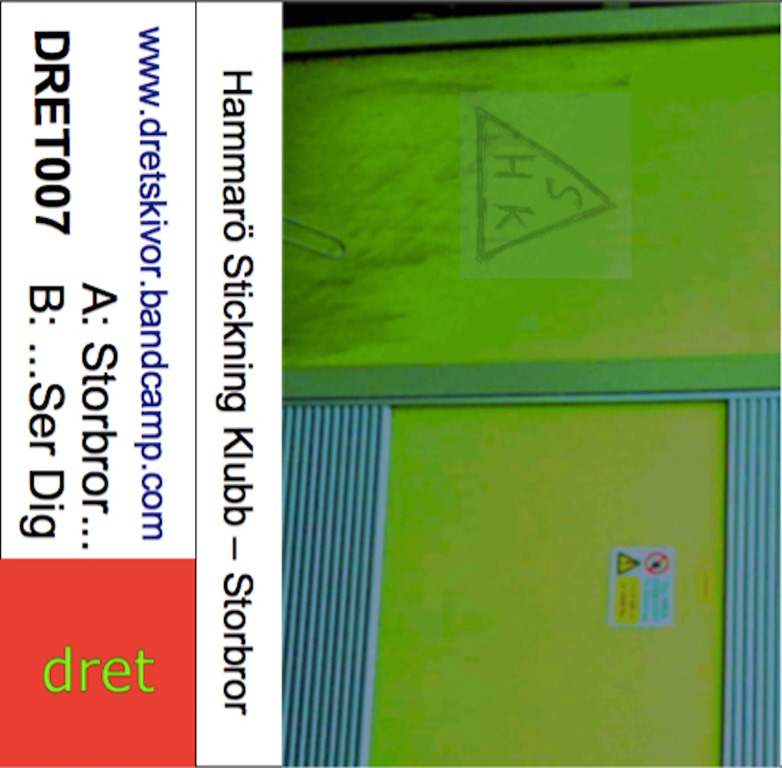
Swedish cassette label Dret Skivor continue to expand their catalogue at pace with another made-for-tape two-tracker in the shape of Hammarö Stickning Kubb’s Storbror Ser Dig. As is customary, biographical information for the label’s seventh release is nil, and technical information is sparse, the accompanying notes simply stating ‘Six oscillators, reverbs, psychoacoustics, voices in your head, chance methods.’

Methodologically, this evokes the spirit of John Cage – substitute eight or twelve radios with six oscillators, retain the random, and, well, there you have it. The fascination of the random – particularly where there are multiple operatives or machines involved – is the way it can yield moments of unanticipated interplay. It’s not just about the overlaps and intersections, either, but the spaces where one or more of those elements is not participating or contributing. It’s here where the potentials of permutation present themselves. Maths, I‘ll freely admit, isn’t one of my greatest strengths, but the permutations of six clearly offer significant numbers of variations. And on the one hand, while it is mathematical, there is also a strong musical and literary lineage of permutational work, with Brion Gysin’s permutational poems being a strong example of how a simple phrase consisting of maybe four, five, or six words can yield a substantial array of variants through the process of permutation. Then, of course, there is Dret label founder Dave Procter’s own Fibonacci Drone Organ project, which is – as the name suggests – mathematically based.

The permutational aspect of Storbror Ser Dig – split across two twenty-minute pieces, ‘Storbror.’ (side one) and ‘…Ser Dig’(side two) aren’t really apparent, but on the former, a minimalist drone swells to a filler drone that continues to expand in density over time.

‘…Ser Dig’ occupies a lower mid-range register and subtly wavers through slow oscillations. Not a lot happens, but this is a work that demands a certain level of focus – or otherwise, no attention whatsoever, by which I mean that close listening will reveal minute details, and that intent, alert state of scrutinising the sound brings with it a different state of mind, a certain clarity. Contrastingly, allowing oneself to become one with the drone is a deeply relaxing experience: headphones, dark room and candle, a smoky scotch all contrive to a certain slow fade in and out of the continuum, which is different altogether. It encourages you to empty your mind and instead of reflecting on any sense of trajectory, simply immersing oneself in the slow, subtle ripples of sound that reveal themselves over time. No drone is ever just a drone: there is always movement, shapes, undulations, ripples, waves. They are all present in this subtly-shifting, rippling dronescape that evolves over the course of its forty-minute duration. And the details are nice, but nicer still is just to sit back and let it play out, because life is stressful and demanding enough and sometimes, details simply don’t matter. With this, it’s time to go with the flow.

AA

DRET007 tape inlay card

CD Epicentre Editions EPI-2101

Christopher Nosnibor

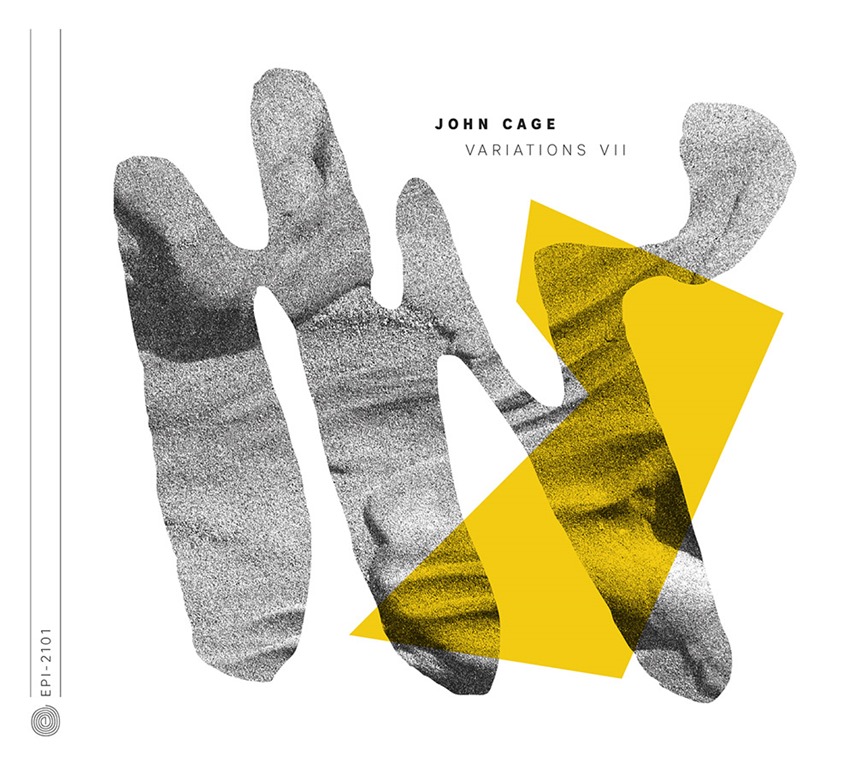
It’s testament to his degree of innovation and influence that John Cage’s works remain a source of fascination for so many almost 30 years after his death. Few composers have reached across so many fields, let alone a composer as radical and overtly experimental. But Cage singlehandedly broke all the ground, especially when it came to exploring elements of the random, of the relationship between the performance and the audience, and of incorporating strands of philosophy into the creative process.

This recording of Variations VII is very much an unadulterated document of a specific event, best detailed in the liner notes:

Variations VII was created by John Cage to be performed at a special event, 9 Evenings, Theatre & Engineering, held from 13th to 23rd October 1966 in New York and in which a team of engineers, led by Billy Klüver, worked with ten artists from the American “avant-garde”, with the aim of enabling them to extend their exploration of the possibilities of electronics in their own art. Here is how John Cage described this piece in the programme for the event:

« It is a piece of music, Variations VII, indeterminate in form and detail, making use of the sound system which has been devised collectively for this festival, further making use of modulation means organized by David Tudor, using as sound sources only those sounds which are in the air at the moment of performance, picked up via the communication bands, telephone lines, microphones together with, instead of musical instruments, a variety of household appliances, and frequency generators. »

And so ‘Intro’ is four minutes of audience chatter, a throng of conversations, all in French, over and across one another. It may feel superfluous to some, but in so many ways, it’s integral to the experience. It not only captures the moments before the performance as it happened, but also transports the listener there, and reminds us that this is not a studio work, designed to capture some kind of perfect realisation of the piece for all time. There is no trickery or manipulation after the fact: this is a live performance, in front of a live audience, something that happened in the moment, and the moment is all there is, and the life of the piece is tied to that specific moment. And then, there is the fact that Variations VII is, effectively, about chatter.

Crackles of static, whistles and whines rent the air as the performance begins; the sound of radio dials turning, tuning in, finding – or failing to find – the right wavelength. Hums, hisses, and snippets of conversations, fragments of music. Whups and whirs, shill shards of feedback and blizzards of white noise emerge from a myriad pieces of sound, booming yawns of interference all criss-crossing over one another in a disorienting real-time sonic collage. Machines grind, babies cry, there are explosive, thunderous blasts of distortion, It’s like walking down a busy street, hearing pieces of conversation, radios blaring from cars, engines revving, and the parallels with William Burroughs’ cut-up technique, for those familiar, are clear. This replicates the experience of life in real-time, and real-time experience is not linear, but simultaneous: a plane flies overhead and you catch sight of an advertisement, and a reflection of a face in a shop window while conducting a conversation, and all around, other people conduct their own conversations…

The mechanics of it are complex and ambitious, but also typical of Cage’s approach to composition:

‘Ten telephone lines connected to the sounds of ten different locations in New York City. History has taught us that one of the first uses of the telephone at the end of the 19th century was, besides transporting voices, the live re-transmission of concert performances of opera. A few privileged listeners could therefore listen to the music in their own homes. Several decades later, John Cage reversed this, so to speak, by inviting the sounds of several distant environments into the concert venue!’

And so it is that the 1966 piece was performed live once more on August 15th, 2020 at the festival Le Bruit de la Musique. The performance lasts for an hour and eight minutes, during which time we’re subjected to a bewildering array of sounds, unconnected, disparate, all completely independent of one another, uncoordinated, random, haphazard and hither and thither. It’s a bewildering experience: not a lot happens, but at the same time, everything happens, a lot of it simultaneously. For the duration of the performance, the spell remains unbroken. For some reason that I really can’t explain, I find myself sitting, ears pricked, on tenterhooks, listening out for details. Towards the end, a blitzkrieg of overlapping extranea build to a tempestuous tumult of harsh noise that sounds like Throbbing Gristle a whole decade before their conception. And as it gradually tapers down, a cough from the audience cuts through the quiet – but it’s not quite finished. We wait, on edge.

Suddenly, there is silence.

Only when the performance ends is the tension broken.

There is a pause, a few seconds of uncertainty, before the applause breaks. There are a few whoops, but mostly, it’s polite. Enthusiastic, but polite. There is no chatter now. One suspects that having witnessed this – bearing in mind that it’s 1966 – many would have been simply stunned of vocabulary. The era may have been accustomed to all kinds of newness, all kinds of shocking, taboo-breaking art, but this…?

Variations VII hasn’t dated, and not lonely does it still sound contemporary, it remains incredibly relevant: if anything, its relevance is greater in 2021 than it was in 1966, perfectly recreating the experience of total media and sensory overload. Never mind The Beatles, here’s John Cage.
zeitkratzer productions – zkr0027 – 23RD October 2020

Christopher Nosnibor

As the founder of one of Europe’s leading avant-garde orchestral ensembles in the form of zeitkratzer, whose releases include recordings of Metal Machine Music, works by Stockhausen, and two collections of Whitehouse ‘covers’, Reinhold Friedl is very much at the forefront of contemporary classical. Formed in 1997 with Friedl on piano (sometimes a ‘prepared’ piano, a la John Cage), they’ve established themselves a formidable force, incorporating elements of free experimentalism and drone.

For the recording of KRAFFT, the nine-piece ensemble came together with another respected musical collective, Ensemble 2e2m, a chamber group from Paris dating back to 1972, known for their unique sound and the first recordings of Giacinto Scelsi’s music.

As the press release recounts, KRAFFT for orchestra was composed in 2016 as a commission from the French State and premiered in Paris and Marseille. It was also the first meeting of the two ensembles – and yet the come together perfectly to create four immense, drone-orientated passages.

Being Friedl, there is a great deal of detail and precision behind the methodology: this is certainly not random stop-start hums and thrums or elongated notes played with varying – and usually increasing – intensity, and for this reason I shall quite at length: ‘KRAFFT is a minimalist maximal composition: all instruments play in rhythmic unison throughout. Only the sounds and their combinations change relentlessly throughout the piece. KRAFFT is spelt wrong on purpose to create an ironic-onomatopoetic rendition of the German term “Kraft”, meaning “power” or “force”. The listener is exposed to a sonic undertow. The notion of huge power and force is connected here to clandestine and unknown rules controlling the progression of sound; something is happening, but we do not exactly know what, when or how. KRAFFT is composed with the help of the computer program TTM (Textural Transformation Machine), developed by Reinhold Friedl to sculpture multiple random processes.’

The TTM formed part of Friedl’s Ph.D. at Goldsmiths University London, and was developed by the composer to sculpture texture transformations with the help of sophisticated random processes. As such, Friedl’s compositional methodology develops way in which John Cage incorporated random determiners within his work, and in using a ‘machine’ to make those random selections, he distances the ‘composer’ from the composition and increases the likelihood of true randomisation.

Returning to KRAFFT, there is a clear trajectory to the composition as a whole, namely an intensity and volume which increases incrementally as it progresses over the course of half an hour. The first part is soft, light, even playful, moving into somewhat darker, more discordant territory onto the second.

By part 4, immense booming low-end notes surge and rumble with such density as to have an almost physical force. Atop of this, the smaller strings scrape, squawk and twitter like birdsong and feedback. It’s an eleven-minute tidal wave of sound that swells and surges to a crescendo of truly enormous proportions. While it’s safe to say it’s unlikely to be aired on Classic FM, KRAFFT is as accomplished and powerful orchestral work as you’ll hear all year.

AA

zkr0027_front

Elli Records – EL07 – 13th November 2018

Christopher Nosnibor

Silence has long intrigued us. Variations of the philosophical question, ‘if a tree falls in a forest and no one is around to hear it, does it make a sound?’ have been a subject of contemplation since the 18th Century. As much as this ponderance is concerned with perception rather than the existence of silence, it does also hint at the idea that sounds are only what we hear. Does silence actually exist? In an evermore noisy world, the possibility of silence seems to have diminished beyond the vanishing point. And the more impossible its attainment becomes, the more we seek and desire it. And yet, at the same time, some people fear silence, even if only subconsciously.

In my own experience, even a moment of peace is conspicuous by its mere existence. My attempts to escape the noise of the world invariably prove futile; the babble of the office, the endless throng and thrum of traffic and people on the journeys there and back; a wife and child and general domestic noise on either side of those. Taking refuge in my office, I spend my evenings listening to music, the whirr of my laptop’s fan and the click of the hard drive a constant even when the music stops, while dogs bark outside and neighbours clatter around in their kitchens on either side. The lived experience is one of no escape, and no respite, and one which confirms the myth of silence.

Much meditation and mindfulness is concerned with seeking silence, if only internally, and musical experiments with silence have been manifold, although perhaps most famously by John Cage. It was on visiting an anechoic chamber – a room designed in such a way that the walls, ceiling and floor absorb all sounds made in the room, rather than reflecting them as echoes, and also externally sound-proofed – at Harvard University and Cage’s realisation of the impossibility of silence that prompted the composition of ‘4’33”’.

It was a similar room – this time at the Mechanical & Acoustic Research Lab LMA-CNRD in France – which not only inspired Julien Bayle to explore silence, but provided the source material for the album, captured during two hours of silence in the room. The results – as the title hints – are anything but silent.

As the text which accompanies the release explains, ‘Tiny random variations of physical electronic noises coming from the recording system itself, as uncontrolled spectres haunting the wires, have been captured and amplified, cut into tiny slices and grains, and used, both as basic sound sources feeding the Bayle’s machinery, and as modulation sources influencing pre-existing sound textures and continua performed live by the artist.’ Evoking Cage, it suggests ‘Violent Grains of Silence is the interpretation of the impossibility of silence by Julien Bayle’.

From what appears as nothing on the surface, Bayle has not only created something, but something immense. Violent Grains of Silence is not a hushed, tranquil work, but one of volume and great sonic turbulence. Violent is indeed an appropriate descriptor. Violent Grains comprises a series pieces through which whispering, grumbling, crackling, groaning, droning sounds swirl and eddy. There are crackling blasts of explosive static, grinding, electric, metal-edged abrasions – ‘Distr’ is a particularly blistering burst of coruscating noise. ‘Unpr’ buzzes and fizzes and thunders, a heavy barrage of low-end sounds creating the effect of an arrhythmic percussion.

Amplification counts for a lot, but it’s only possibly to amplify something which already exists. And so it is that Bayle has created a work which is rich in texture and tone, dynamic and at times disturbing.

This is truly the sound of silence. And the silence is at times deafening.

AA

Julien Bayle - Violent Grains

Hallow Ground – 16th November 2018

Reinier Van Houdt’s 2016 solo album Paths of the Errant Gaze was a collage of quiet, dark ambience, and Igitur Carbon Copies continues in a similar vein. The inspiration for this work is the unfinished gothic tale Igitur, a collection of texts ultimately abandoned by the author, the French symbolist poet Stéphane Mallarmé in 1869.

Considering the fragmentary nature of the incomplete work, not to mention Mallarmé’s tendency to incorporate theoretical aspects within his practise, the appeal to an artist like Van Houdt isn’t hard to see: a classically-trained pianist who’s collaborated with artists ranging from John Cage to Charlemagne Palestine and has been a member of Current 93 since 2012, he’s long been fascinated with ‘all matters that defy notation: sound, timing, space, physicality, memory, nose, environment’. This is one of those works that could very easily inspire a full-blown essay instead of a review, and there’s a temptation to write it – but does anyone actually want that? Does anyone have the time to read it, even if I had the time to write it – and I mean properly?

To reduce the experience and reflection to something manageable, with Igitur Carbon Copies, Reinier Van Houdt presents a work of immense theoretical depth in an accessible form, although obviously these things are relative. That is to say, it’s a challenging album, but one’s appreciation doesn’t require a priori knowledge of the theoretical concepts around authorship and originality, around chance and destiny, around temporality, and the myriad contexts behind it. On the surface – a deep, dark, rippling surface as it may be – it’s a dark ambient work littered with muttered speech. Beneath that surface, there’s a lot going on. And so what Van Houdt presents is in no way a carbon copy, but a corrupted, adapted interpretation of Igitur. And so begins the journey through the stages of copying and alteration, a question which lies at the heart of postmodern textual interrogation, and William Burroughs’ novel Cities of the Red Night. Text mutates. Even a carbon copy is a copy: it is not an original and therefore different.

The eerie and the uncanny reverberate around every shadowy corner of the album’s ten compositions, some of which are but the briefest, most fleeting sonic experiences, starting with the 40-second opener, ‘Annunciation’, which begins with dank and distant rumblings which expand into turning ambient tones, before segueing into ‘An Empty Set’ in a blast of static that lasts but a fraction of a second but completely fractures the flow.

Drawing source material from Mallarmé – revised by Van Houdt, and read by David Tibet in his best monotone – there is a distinct sense of narrative about Igitur Carbon Copies, however disjointed. The vocals are treated, albeit subtly, to render them with a certain trembling reverb that adds a disquieting edge. And there are extended passages that rumble and undulate, a simmering sonic soup. It doesn’t really go anywhere, and nor does it need to: it creeps around on the peripheries of the senses and pokes at the psyche almost subliminally. The effect, then, is difficult to define, but it’s nevertheless something that happens. One traverses Igitur Carbon Copies in a certain state of somnambulance and bewilderment. But one definitely traverses it, and its effects are definite.

AA

Reinier Van Houdt – Igitur Carbon Copies

Christopher Nosnibor

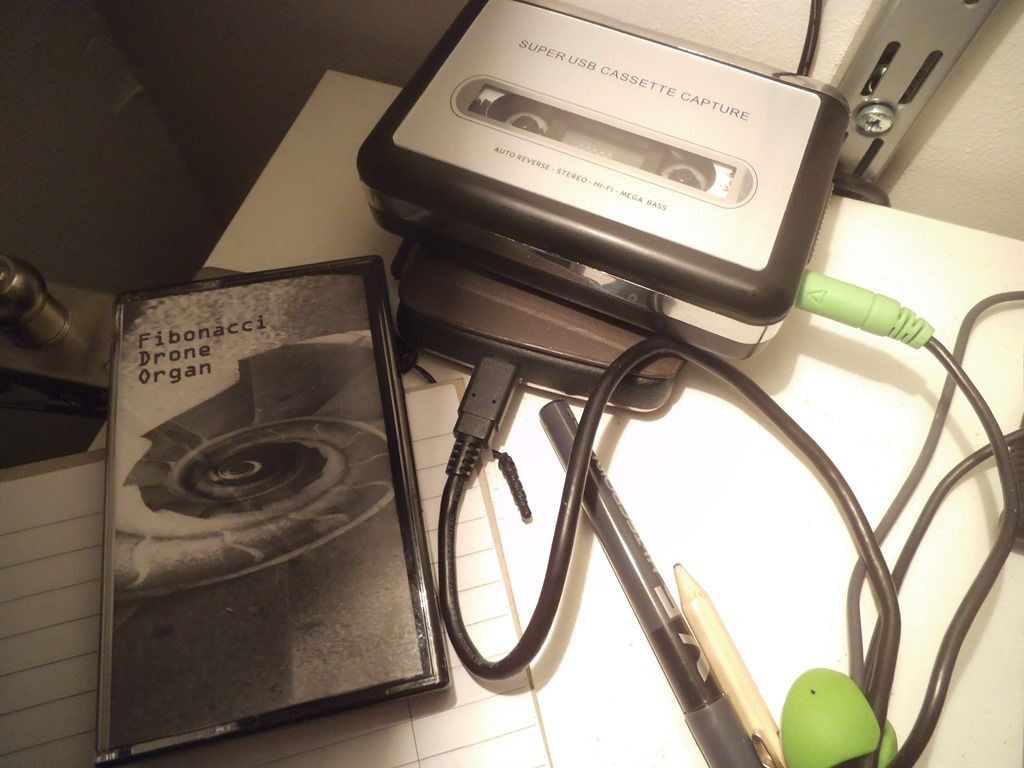
Fibonacci Drone Organ: three random words spliced together, unshackled from the constraints of context to allow free association to determine interpretation? Or a descriptive indication of what Dave Procter’s second- or t(h)ird-latest (this month saw the debut of HUNDBAJS, which is Swedish for dogshit, the absolute latest) of his myriad projects which include the Wharf Street Galaxy Band and Legion of Swine? The cassette release contains precisely no information whatsoever, even down to a track listing, but a spot of digging reveals that it’s the latter – which should come as no surprise, given that the man behind FDO curated a ‘10 Hours of Drone’ event a while back. The album contains two pieces, each occupying a side of the tape, and they’re formed around droning organ notes. Long, long droning organ notes.

And my (rather limited but suitably fruitful) research uncovered that FDO ‘uses the Fibonacci Series as part of the compositional process,’ that ‘the notes are chosen via dice rolls and coin tosses,’ and that ‘the durations of the notes are chosen by the Fibonacci Series. Notes are added at the appropriate time.’

From this, I infer that in technical / theoretical terms, FDO compositions emerge from an intersection of John Cage-inspired randomness and the mathematical precision of Fibonacci. What this actually means, ‘m not entirely sure, and thankfully, the technical aspects don’t impinge too heavily on the output from a listening perspective. Ultimately, it’s all drones. And on this outing the ‘appropriate’ time for adding noes is seemingly after an eternity.

This means that across the tape’s duration, not a lot happens. Notes may be added, but at such distance that the layers build so gradually that the pieces are over before much depth, resonance or layering has occurred. This is all testament to Procter’s unswervingly uncompromising approach to music-making, and encapsulates the reasons I personally hold him in such high regard (and it’s fair to say that if there’s one person I’ve worked with who’s intuitively understood my vision for creating spoken word with the most hellishly mangled noise, it’s Dave who’s been behind the majority of my best and most exhilarating collaborative live work). With more projects, pseudonyms and releases to his credit than seems humanly possible, he’s practically a one-man underground scene in his own right. Look up ‘northern avant-garde’, and you’ll likely find a picture of Dave Procter – or a bloke in a lab coat sporting a pig’s head or something.

Procter gets art, and is an artist, but doesn’t espouse the pretentious trappings of being an ‘artist’ (or, worse still, an ‘artiste’). Which means he can not only get away with releasing a tape containing 40 minutes of theory-backed drone without appearing a tit, but delivers some of the most brilliantly self-aware electronic drone you’re likely to find.

Side two (not that the sides are marked) brings a quavering decay to the elongated drones – which hover toward the higher frequencies – by way of contrast to the strong, stable drones of side one. The effect is cumulative and ultimately soporific, and it’s definitely the music and not the beer as I listen to the spindles rotate on my tape deck and the notes drift from the speakers. Sometimes, there’s no shame in sleep.

DSCF6863

AA