Posts Tagged ‘innovation’

Cruel Nature – 24th May 2024

Christopher Nosnibor

It seems as if every album of the year has been released on this date, May 24th – and by every album of the year, I mean all of the releases have landed at the same time, but also that this album and the other ‘best album’ contenders have all landed simultaneously, too. It’s meant that I’ve been absolutely swamped, and struggling to listen to everything, let alone formulate thoughts and render them coherent – something I fear I struggle with at the best of times.

Surveying this release, I learned that ‘Prosthetic Self is a collaboration between CRUSHTRASH & NICHOLAS LANGLEY that seamlessly blends the energy of early ‘80s dark industrial synth pop with the mesmerising allure of ’90s electronica. Drawing inspiration from iconic acts like Coil, The Associates, Depeche Mode, Björk, and Portishead, this album is a sonic journey that transcends time and genre boundaries.’

It does feel as if every electronic act with a dark leaning wants to be Depeche Mode, and every electro-based Industrial act is essentially wanting to be Pretty Hate Machine – era Nine Inch Nails – who in turn sounded a fair bit like Depeche Mode if truth be told. That’s no real criticism, as much as an observation of the extent to which those two acts broke ground and created new templates in the 80s. However, the industrial elements of Prosthetic Self hark back to a time before Nine Inch Nails, and presents a more experimental form.

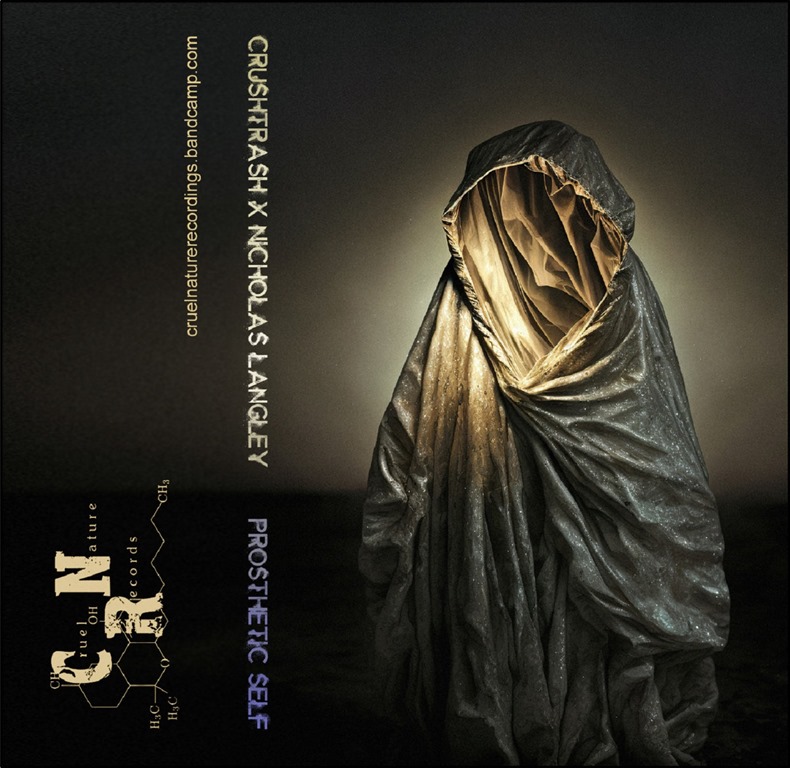
The tile, Prosthetic Self Connotes a sense of falseness, the fake exterior we apply to ourselves in order to deal with people and society. Workplaces – particularly offices – tell us to ‘be ourselves’ at work, while at the same time telling us we need to leave our problems and personal baggage at the door, but at the same time seem incapable of dealing with non-conformity. Well, come on then: what do you want: individuals or clones? Prosthetic Self is an exploratory work which presents a multitude of facets, and it’s a fascinating journey which leads one to the question as to what is real and what is construct, artifice. The cloak, on the cover, with its empty hood feels like a representation, not necessarily for this collaborative project, but the album’s themes, searching for what lies beneath the prosthetic self: is there, indeed, anything at all? Then again, how much here is style, and how much is substance?

There’s certainly a lot of well-studied style on display. ‘Bring Some Change’ is dark but also soulful, and their referencing The Associates hints at the almost operatic stylings of the vocals at times, and against some stark backings prone to some unexpected sonic ruptures and moments of heightened tension and drama, I’m also reminded of Scott Walker.

‘Claustrophobia’ is appropriately-titled. ‘In my dream, something’s wrong, caving in…’ Crushtrash croons with hints of Dave Gahan in his delivery against a slow-moving murky throb. But there’s a really attacking percussive loop that knocks on the top of your skull which makes it tense rather than soothing, and before long, panicked breathing gasps in the darkness, and you’re drawn into the nightmare.

Elsewhere, glitching, knocking beats shuffle and click, and the production really brings these to life in a way that makes you clench your jaw and tense your shoulders. ‘Selective Memory’ has something of a collage structure about the way the sounds are brought together and overlaid, with sampled snippets woven in alongside the bubbling vintage synth sounds.

In places, the kind of retro vibes which permeated 90s trip-hop seep into the shadowy atmospherics, and ‘Subtle Fetish’ comes on like Marc Almond in collaboration with Tricky, spinning lascivious wordplay along the way.

Prosthetic Self creates a lot of atmosphere with minimal arrangements, and they work because of the close attention to detail, the multiple layers of percussion which pulse and snake through spartan synths, more often than not with a simple, repetitive bass overlaid with subtle details, in a fashion which adeptly recreates the sound of the early 80s. In doing so, it recalls a time when so much was new, innovative. Coming at a time when there is so much sameness, and production and mixing has come to be all about the loudness, to hear a set of songs which really concentrate on dynamics and detail, it seems unexpectedly different.

AA
a1438080285_10

Not Applicable – 4th March 2022

Christopher Nosnibor

Instant disorientation is the effect of hitting ‘play’ on Isambard Khroustaliov’s Shanzhai Acid. What the hell is this? Woozy drones and amorphous waves or warping wisps ripple and blur, and hums like a swarm of drunken bees weave precariously through an alien soundscape. I’m accustomed to experimental and sci-fi, but this… This, I was not fully prepared for. By fully, I mean at all.

It’s vaguely sci-fi in its strangeness, and I find myself blinking and bewildered in a lack of comprehension as to what it’s all about.

Welcome to the world of artificial intelligence, which may well be intelligent, but in a way that’s so artificial as to have taken leave of intuition. To unpack that, the liner notes explain that Shanzhai Acid is an album ‘produced through artificial intelligence design and interaction with modular synthesisers. Reminders of the complex, granular music of Autechre, Fennesz’s reimagined environments, the deconstructed dance music of Lorenzo Senni, and the expanse, gestures and sheer reach of Gerard Grisey’s spectral master-work: Les Espace Acoustiques, Shanzhai Acid exists in its own intersection of art, design, music and technology where process and function are transcended to produce an album of extraordinary auditory allusions’.

My initial reaction was, if I’m honest, ‘hell yeah!’ Because innovation in music seems to have slowed so badly over the last decade. No, that’s not my ageing and being stuck in the past. I’m not saying there’s been no good or exciting new music. But innovation stalled: I believe that to be pretty much fact. Because it’s pretty much all been done by now. Guitars have been taken to their limits and beyond, meaning most significant advances since the late 70s have been driven by the use and abuse of technology, and while hip hop and dance music have certainly exploited technology, we’ve not seen anything as radical as the advances made by Throbbing Gristle and the like in the last forty years.

There are points during Shanzhai Acid that both Throbbing Gristle and certain dance tropes are evoked, with crackles and fizzes and static shudders and glitches pop and hum and there is circuitry in interplay, whirring and wowing. It’s hard to tell how much meaning to attach to the titles of these pieces, or even how seriously to take it. But then serious music can have a playful element, and ‘Experts v. Shamans’ sounds like R2D2 in communication with a nightmarish fairground ride. It’s a journey – and a disorientating one at that – that leads to the seven-minute slow-grinding drone and stirring swirls and hums that build layer upon layer on ‘Meanwhile Cephalopods’. Meanwhile, cephalopods what? No, there is no what. It simply is.

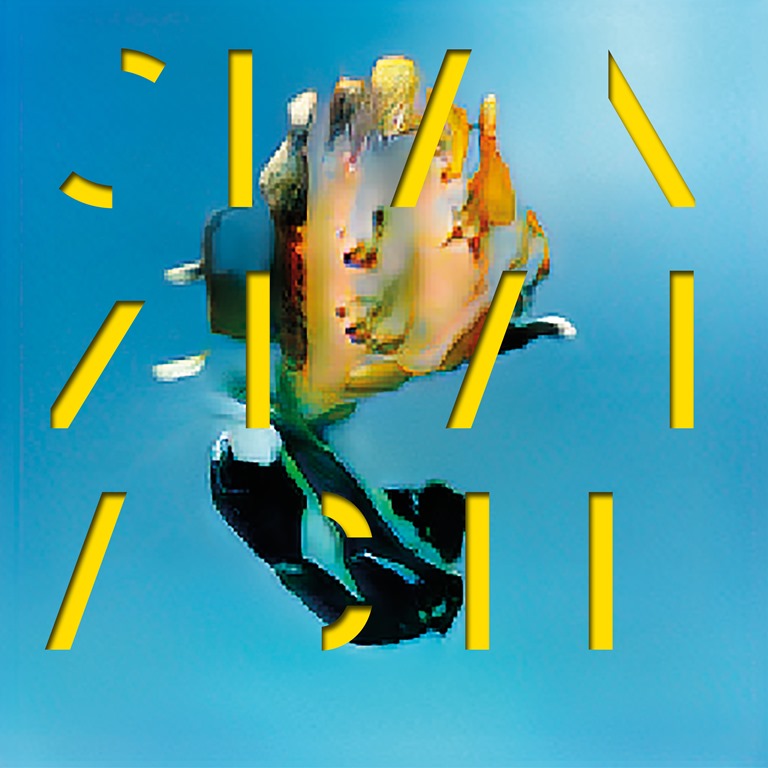
Shanzhai Acid is a remarkable abstract work that delves into microtonal and glitch territory, swerves wide into drone and ambience, and scratches at the shores of early industrial and vintage avant-garde. With such wide-ranging elements scrunched together, it’s a unique hybrid and a refreshing, if at times challenging listen. And while you should supposedly never judge a book (or album) by its cover, Shanzhai Acid sounds like the cover looks.

AA

Shanzhai Acid album cover 6000px RGB

Roman Numeral (US) / Wolves And Vibrancy (EU) –13th August 2021

Christopher Nosnibor

Linear narrative can be so dull, so predictable, or otherwise lacking in intrigue and imagination. There is so much more challenge – both as a writer and a reader – to a work that doesn’t follow that standard beginning / middle / end convention. There’s nothing predictable or obvious or linear about Fawn Limbs’ their third long player.

‘Day three. I woke up in a bed made of hay and roots. For a brief but fleeting moment, I couldn’t recall the incidents of the past days…’ This is how we arrive in Darwin Falls. It’s a sparse country vibe, a bit True Detective. It’s hazy, hot. The dry, cracked voice of Lee Fisher narrates the scene, and we’re as lost and bewildered as he is. Where are we? Why are we here? What the fuck happened? The picture gets darker as it unfurls, and it’s a slow, languorous build… and then, unexpectedly, everything erupts and shit spews forth as if from a volcano bursting from the very molten pits of hell. It tears with a burning fury at your guts and at your organs, and this is punishment. And then, this is calm, this is tranquillity. This is schizophrenic, unpredictable. It’s too much to process.

How you do describe Fawn Limbs? Odd and experimental is perhaps a fair starting point, and the first track in this is both. ‘Nesting Lumens’ is abstract and ethereal, a shade abstract, but it’s also raging chthonic demon-noise metal and all the brutality delivered with a razor-sharp technicality. It’s perhaps most interesting when the rage dissipates and we’re left with expensive post-rock tropes, and these extend into the majestic

The Transatlantic trio describe themselves as ‘avant-garde mathgrind’ and that seems a fair summary of the blistering hellfest that is Darwin Falls.

We’re still struggling to find orientation amidst the slow-twisting post-rock smog of the opening segment of ‘Wound Hiss’ when things suddenly turn brutal, a battering sonic assault that’s brief but so violent as to cause concussion.

It’s the extremity of the contrasts that render these songs so staggering in their impact. As a post-rock band, they’re outstanding at forging delicate, graceful pastoral pieces, musical passages of delicacy and grace – but instead of breaking into breathtaking crescendos of cinematic beauty, they rampage into howling blasts of anguish that explode on the most frenzied slabs of extreme metal. There are moments of eerie spaciousness, as on ‘Caesura’, a short piece which appropriately provides a moment of respite, and mellow interludes such as the still waters of laid-back jazz at the start of ‘Twitching, Lapsing’ which jolts into life with a haemorrhage-inducing blast of rampant noise and only becomes more impossible as the brass collides with a nuclear storm and a tsunami of noise.

If Justin Broadrick and co successfully combined free jazz with slow, industrial grind as GOD, then Fawn Limbs push the concept to another level, and the spoken word sections provide a fascinating counterpoint to the roaring, blazing sonic blasts that come in between. But ultimately, comparisons simply don’t hold up here. True innovation is rare, and we’re unaccustomed to it: it’s difficult to respond to it appropriately, somehow. It phases us. Shuddering, bemusement, bewilderment. A lack of comprehension. How do you measure it, and how do you process? Darwin Falls is a remarkable album, a sonic supernova, and it’s no mere hybrid: it is truly unique. Prepare to have your mind – and eardrums – blown.

AA

Darwin Falls ARTWORK