Posts Tagged ‘humour’

Panurus Productions – 20th June 2025

Christopher Nosnibor

You’d think that cassette labels would be not only niche, but few and far between, and in the main, they are, but Newcastle is home to not one, but two labels who provide a near-endless supply of releases to satiate the need for weird shit the world over, with Cruel Nature Records being one, and Panurus Productions being the other. The labels have a considerable amount in common, too, not least of all in that they both favour music that’s of a quality, rather than a style.

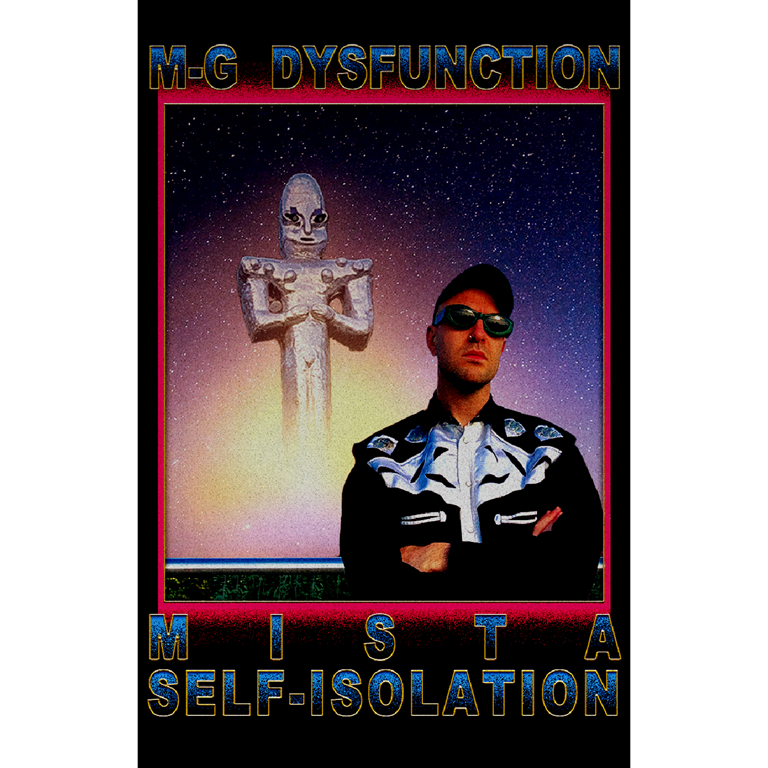
The latest Panurus release is a perfect case in point. The label’s previous offering, a split release from Belk and Casing was a raw blast of guitar overdrive. In contrast, the third album from M-G Dysfunction is of an altogether more experimental bent, leaning toward hip-hop and beat-driven electronics, but once again marking the close connection between the scenes in Leeds and Newcastle, both of which have become significant spawning grounds for the offbeat, the difficult, the wilfully obscure.

According to the blurb, ‘Mista Self-Isolation is the fullest realisation of the M-G Dysfunction project to date – a record of trepidation and humour, of lopsided passion and warped poetics. This album is about surveying the wreckage of monoculture and navigating the act of making music amidst a land-grab of rights, melodies and rhythms by people who never liked music in the first place. It’s about properly honest artistic expression – what “keeping it real” looks like, sounds like, feels like in 2024. It’s about getting some official beats and saying fly shit over them.’

That it’s quirky may be obvious, but it’s a necessary headline observation. On the one hand, it’s white rap, so there’s an awkwardness, but on the other, there’s some dirty experimental electronic noise layered over the beats, and this is an act that shared a stage with Benefits, a band who may have made their reputation by being angry, shouty, and noisy, but who aren’t without humour or an appreciation of nuance.

As tracks like ‘Roger Daltrey (Permanent Record)’ illustrate, M-G Dysfunction are multifaceted – something likely to leave many quite nonplussed. How can they do jokey, daft, a bit random and be serious at the same time? In truth, the answer is simple: because human beings are complex creatures, capable of a vast range of emotions and infinite ways of expressing them. It’s something we seem to have lost sight of in recent years, when everything has been boiled down to binaries, and everything is a conflict because the lines have been marked in such either / or terms. It’s no longer possible to be a woolly socialist: suggest that, I dunno, people on disability benefits are right to receive free prescriptions, and you’re labelled a left-wing extremist, a communist, and by the way, disabled people should get back into work or die. Something is severely fucking wrong with this picture.

Back in the early 90s, genre crossovers were all the rage, and the Judgement Night soundtrack was a real watershed moment that took the idea of rock / rap crossover, first witnessed in the mainstream when Run DMC and Aerosmith did ‘Walk This Way’ to the next level. At that time, it felt like a new future was emerging, and perhaps, even a future where boundaries and differences were dismantled. But here we are, and times are bleak.

But with Mista Self-Isolation – an album which is by no means an exercise in buoyant pop tunes – M-G Dysfunction show that in 2025, there is still scope to create something that speaks of what it is to be human.

The structured, beat-led songs are interspersed with self-reflective spoken word segments, spanning CBT meditation and contemplations on experiences and life in general. It is truly impossible to predict the twists and turns this album takes.

’50 Words for Blow’ comes on like a hip-hop-inspired barber’s shop quartet, while ‘John Wick’ is a critical memo, and the title track is abstract, minimal, dreamy but quietly intense. ‘Junglists Only’ is a perfectly executed pseudo-banger which knows it’s absurd and works because of it. The last song, ‘All that is Solid Melts into Deez Nuts’ evokes both humour and at the same time draws attention to M-G Dysfunction’s hip-hop credentials. If you know, you know, as cunts say, but for those who don’t, it’s a reference to Dr Dre’s ‘Deeez Nuuuts’ from The Chronic in 1992.

Postmodernism is alive and well after all, at least in some quarters, and it’s very well in the world of M-G Dysfunction. There is a lot going on on Mista Self-Isolation – and it’s all good.

AA
cover

RAT LORD, the Norwegian trio known for their ferocious energy and tongue-in-cheek approach, is back with a brand-new single, ‘Now Diabetical’.

“If you dig the idea of grindcore and powerviolence while poking fun at black metal, Rat Lord is gonna be your new favorite band,” says Decibel scribe Addison Herron-Wheeler about this unorthodox Norwegian act.

Following the success of their debut album This Is Not A Record, Rat Lord returns with the brilliantly titled Blazed In The Northern Sky. The band—comprising guitarist/vocalist Yngve Andersen, drummer Sigurd Haakaas (both from Blood Command), and bassist Martine Green—continues to push boundaries with their unique blend of powerviolence and grindcore.

The full album is set to drop on August 30th via Loyal Blood Records, but you can get an early taste of the chaos with the new track ‘Now Diabetical’ here:

The band comments: “‘Now Diabetical’ is a song about eating healthy, so you don’t catch diabetes type 2, which is a big problem for some. The title may or may not be making fun of Satyricon’s ‘Now Diabolical.’”

The follow-up to the band’s 2022 debut album This Is Not A Record, sees RAT LORD churning out the same gritty and destructive powerviolence/grind sound that received strong praise from various publications along their humorous lyrical content, this time parodying some of the most famous songs and events from the Norwegian Black Metal history, the album title for instance clearly nods at Darkthrone’s A Blaze in the Northern Sky.

964277-820x461

New Reality Records – 9th January 2023

Edward S. Robinson

Literature was the original rock ‘n’ roll. Throughout history, writers have not only been at the cutting edge of culture, but they also invented the rock ‘n’ roll lifestyle centuries before the concept of rock ‘n’ roll came to be.

Latterly, literature has become ‘establishment’, entrenched in a certain model based on agents and publishers and increasingly concerned with margins and the trappings of capitalism at the expense of placing art in the public domain.

Stewart Home has never been establishment, and never will be, which is precisely why his latest novel failed to land a deal with any publisher. Now, the establishment will likely scoff and say that no publisher would take it because it’s not what they were looking for, or it’s too niche, or it’s too risky or too risqué. But back in the 80s and 90s, those were all reasons why publishers would take on a title. Others may say, while looking down their noses, that it’s simply trash and therefore of no interest because it’s crap, but that argument doesn’t wash when major publishing houses put out shit like 50 Shades and continue to squander gallons of ink on populist toss like Dan Brown and Stephen Leather and while amateur ‘erotica’ is all the rage online. After all, the mainstream has a habit of observing emerging trends and then seeking to monetise them. Moreover, in the 80s and 90s, Home published a slew of books through anarchist publisher AK Press and the then-edgy Serpent’s Tail with his trashy politicised pulp rips on Richard Allen. He found a home with Scottish imprint Canongate for his audacious ‘Diana’ novel 69 Things to Do with a Dead Princess, before Virgin published Tainted Love in 2005. So it certainly isn’t that he hasn’t a well-established publishing record, or that potential controversy has been an obstacle to publication in the past, meaning that what we’re seeing the publishing industry narrowing its horizons while focusing on broadening margins.

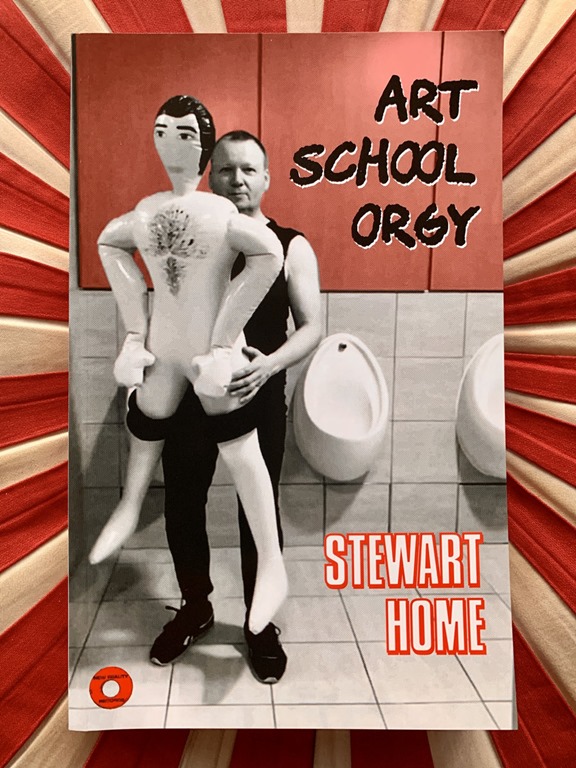
For all that, Home has always existed beyond the milieu of the conventional, emerging from the avant-garde art scene and xeroxed zine culture of the 80, and so it stands to reason that he would reject publishing convention and find a record label to publish Art School Orgy. The fact that it’s a fictionalised biography of sorts of a living artist, namely David Hockney, is perhaps one reason most publishers shied away from the book in a culture that’s evermore litigious, although there’s never any question that this, like many of Home’s previous works, is anything other than a huge, audacious exercise in taking the piss.

Home’s style has long been hard to pigeonhole, as it varies from book to book: while his earlier works were perversely trashy and bluntly anti-literary, he’s proven over the course of his now-lengthy career, to be remarkably adaptable: The Assault On Culture was overtly and quite explicitly academic, while Tainted Love, Down and Out in Shoreditch and Hoxton, and She’s My Witch all showcased a measured narrative form, and while the last of these three employed classic Home methods of repetition, much of the purpose seemed to be to grind the reader down with a text whereby very little happens, over and over again. But then, Home has long been an author who revels in the anti-climax. Equally, though, he is a master of the climax, and there are many of those in Art School Orgy, the pages splashed all over with vintage Home phrases referencing liquid genetics and hand jobs and a lengthy speech on anal sex.

In fact, so many elements common to Home’s oeuvre are present here, demonstrating his knack for recycling and willingness to continue to work a theme long beyond the point of exhaustion.

The lengthy extracts or even complete texts quoted within the text – including an exhaustive catalogue of methods for cock and ball torture, or CBT, which reads like an endless catalogue of kinks like Sade’s 120 Days of Sodom – are quintessential Home, and while none of these (fictitious) tomes conjure quite the awe of works like the seminal ‘Christ, Marx, and Satan United in Struggle’, they still bring a certain gravitas to the riotous spunkfest that is the main body of the text. As for the main body of the text, well: if Home initially traded parodically in sex and violence, Art School Orgy stitches it all together in a tale of sexual violence, and if previous works dropped in dirt every few pages to push the story along, on this outing, it’s fair to say that the dirt is the entire point of the story, and he stuffs page after page with perversion.

The dialogue is magnificently stilted and as corny and unconvincing as the best of his earlier works, too, but then again, E. L. James made her fortune pedalling worse dialogue minus the irony, and even worse sex scenes, too. And in its juxtaposition of more middlebrow fiction with the cheapest, smuttiest pulp, Art School Orgy occupies similar space to Come Before Christ and Murder Love. At times, the awkward stylistic crunches are frustrating, but this is classic Home: a wind-up merchant par excellence, his aim is to create works which are frustrating, and on many levels.

In the (throbbing) vein of Blood Rights of The Bourgeoise, the chapter titles are pithy phrases designed to shock (‘An Explosion of Spunk’; ‘Egyptian Mummy Porn’; ‘Desperate for Cock, Hungry for Fame’… and so on). You’d think after this length (and girth) of time, audiences would be numb to the tactic, and yet… no. ‘The Tip of David Hockney’s Waxed Manhood Lit Up Like Christmas Tree’ and ‘A Bottle of Bell’s Up the Backside is Rough Sex Heaven’ aren’t chapter titles one expects in a novel, literary or otherwise, and even the likes of James, for all the salacity of the Fifty Shades books, presents as infinitely more coy. There are no ‘inner goddesses’ in Art School Orgy, just endless depictions of throbbing gristle and wads of hot spunk. There’s nothing subtle about Home’s writing: there doesn’t have to be, and ultimately, that’s the point. With Art School Orgy, Home highlights just how conservative literature – even supposedly low-brow, populist kink fiction – really is. And when you consider the context, despite the supposed proliferation of perversion since the advent of the internet and the debate over the way shows like Game of Thrones has beamed rape And incest into living rooms across the globe, we live in dangerously conservative times, where ‘free the nipple’ is actually a thing. This was not the case in the 60s, when nipples simply were free, and by 1967, seven years after Hockney’s coming out as gay, homosexuality was finally decriminalised in Britain.

This is, one suspects, a key motive behind Home’s text; not to paint Hockney as an indefatigable BDSM fuckmachine – which it has to be said, seems the primary thrust – but to make the point that consensual Sadomasochism is the choice of those involved, and the fact that it was outlawed at the time the book is set is, well, as perverse as the acts depicted.

Repeatedly referring to Hockney as ‘our rapscallion’ every few pages becomes annoying and predictable within the first thirty pages, but Home has the stamina and the audacity to keep it going for the duration of the book’s two-hundred-and-ninety pages. Of course, he’d sight Bergson and the theory that repetition is the basis of humour, and I can’t deny that I’m chuckling while squirming uncomfortably – but not nearly as uncomfortably as the protagonist, who is subjected to page upon page of the most excruciating tortures imaginable. There is absolutely no let-up during Art School Orgy, and for this, it’s Home’s most outlandish and challenging novel to date. It makes you feel all kinds of discomfort all at once.

This is very much the response reading Home tends to elicit. You can’t help but laugh, but equally feel incredibly uncomfortable, for a range of reasons, not least of all a nerve-jangling sense that everything about this writing goes against what you’re taught literature should be. But first and foremost, it’s a rollocking read, because however hard Home pushes a point or sells an agenda, he never loses sight of the idea that a good book entertains. And Art School Orgy is a proper romp.

0030582657_10

Art School Orgy is available to order via New Reality Records’ Bandcamp.

10th September 2021

James Wells

Whoever said goths and industrialists have no sense of humour? Or that they hate pop? It’s long been a myth perpetuated by outsiders pedalling stereotypes that goths and fans of industrial music are moody, po-faced twats who mope around looking glum while listening to depressing music and reading depressing literature. Cheer up goth – have an Irn Bru! The early noughties advertising slogan pretty much sums up the popular perception of anyone with dyed black hair and black clothes, but in a position of polarity to so many straights who are crying on the inside, you’ll likely find adherents of shadier subcultures are laughing on the inside, while rolling their eyes at the normies.

There’s a long history of whacky covers going right back to the post-punk roots of the genre, with Bauhaus and The Sisters of Mercy making some inspired cover choices spanning ABBA to Dolly Parton, not to mention Fields of the Nephilim’s stunning take on Roxy Music’s ‘In Every Dreamhome a Heartache’, and Revolting Cocks’ crazed, audacious ‘Da Ya Think I’m Sexy’.

And if the outré cover has over time become rather standard form, there’s always room for a good one, and this, people, is a good one, courtesy of LA-based quartet FleischKrieg, who you’d never guess were influenced by Rammstein and 3TEETH.

Lifted from the forthcoming FleischKrieg album, Herzblut, due out in October of this year, they’ve cranked up the sleaze for this one. It may be a fairly straight cover, but it amplifies the original eightieness and adds a while lot of grind. Instead of blasting up the guitars, the synths are more grating, the drums bigger, more explosive, and of course, it’s the gritty metal vocals that really define it. If it’s a shade predictable in its straight-up approach, then it makes up for it just by being so damn solid. Hurgh!

AA

288899