Trace Recordings – 11th October 2024
Christopher Nosnibor
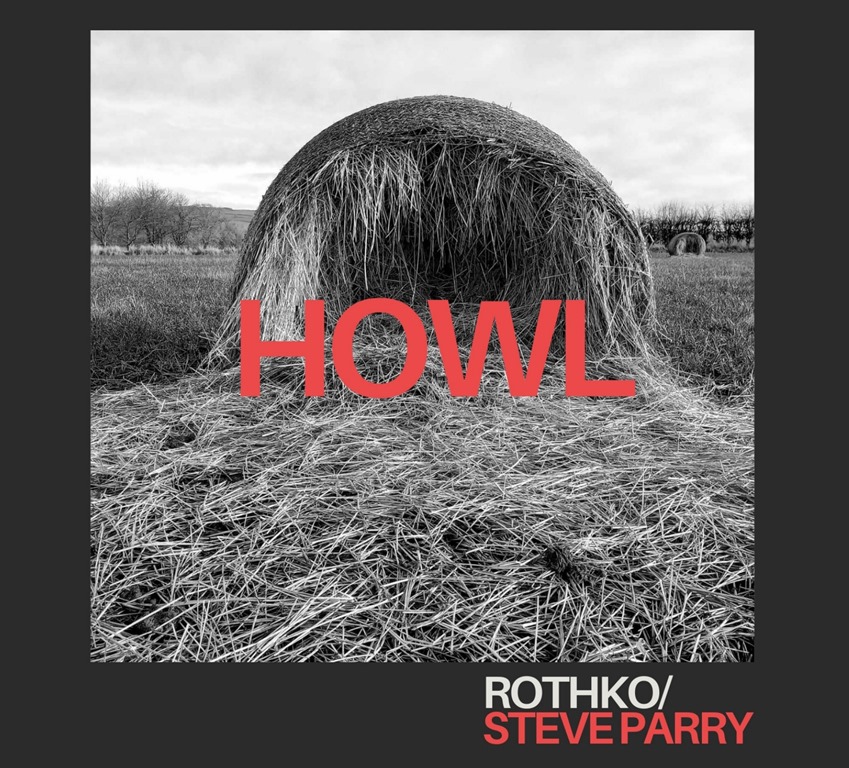
One might say that this collaboration has been a long time in coming: the pair have been friends for some twenty years, and have made contributions to one another’s recordings over that time. There’s no question that it was worth the wait. Their process and the way in which they each contributed is integral to the finished work, and here, not only to save typing, but to ensure nothing is lost in translation or paraphrase, I shall quote from the accompanying notes:
‘Emanating from the sounds of a church organ, with many short pieces recorded by Steve Parry in an ancient secluded church, and then embellished by Beazley, with his resonant bass tones, electric guitar and electronics, HOWL captures the senses of ambience, harmony, discordance and noise, with recordings of the churches space, of its emptiness, interspersed with the music.
‘The two, long, resulting pieces, create an almost ritualistic event, of something taking place that is mysterious, uplifting, and, in parts, unsettling.
‘The album reflects an emptiness, the echoes from ancient walls, a deep sense of place—and the refractions between these two artists. HOWL veers between moments of meditative beauty and unsettling discord, creating a soundworld that feels ritualistic, mysterious, and transformative.’
This is very much an accurate summary and fair description of the album, consisting as it does of two compositions each with a running time of around twenty minutes, but it’s more of a challenge to convey in fullness the resonant effects of this vaporous sonic drift. The first, ‘In the Season of Darkness’ is formed around elongated drones, but their organ origins isn’t immediately obvious in the ear. One associates the instrument with bold, piping swells which sing to the heavens, but here, it’s more subdued, almost a low, rumbling wheeze which provides an eddying undercurrent. Acoustic guitar and slow, meandering bass are far more dominant, and it’s very soon clear that this is by no means an ambient work, or a work without structure or form. The guitar and bass play distinct notes and motifs, often alternating with one another, but sometimes playing in co-ordination, and others still across one another. Treble strains like taut whines of restrained feedback filter through, these higher-end frequencies forming a counter to the resonating bass and the mid-range organ drone which slowly begins to emerge and take form a few minutes in.
The dissonant incidentals rupture the surface like lightning through a thick, rolling cloud cover. The mood is sombre, ominous. The fact it’s pitch black outside and has been since around 6:30, I’m feeling autumnal and writing by candlelight probably means I’m feeling it more, but this is music with a subliminal, subconscious pull. There’s a segment around the mid-point where there’s a pause, and there’s nothing but clatters and clanks, like tin cans rattling in the wind, before the drone returns, darker and denser than before, and with a sepulchral reverb, and it’s something which taps into something primitive and earth-born within. I can only really articulate it by way of a brief recollection of a time I visited an obscure stone circle in Scotland. Most of the stones were gone, but the shape of the circle was marked out by a ring of nettles. It was probably around twelve metres in diameter, and the few remaining stones were no more than three feet high. It was a little way off a minor road, in an unkept grazing field and as unremarkable as it was forgotten and neglected, and I had only paused by it because I had spotted it on the map. But, arriving at the place, something happened: the air temperature dropped a couple of degrees, the wind sped up and clouds obscured the sun; but more than this, there was an atmosphere which brought goosebumps and a shiver down my spine. The place had an atmosphere, and I almost felt as if I was for a brief moment splitting across millennia. The sensation was but fleeting, but it was palpable. The experience of hearing this piece is akin to that, resonating on a level beyond the sphere of commonplace experience.
Counterpart composition, ‘In the Season of Light’ is, again, constructed around a long, long, reedy drone, this time with piano and delicate scrapes and wind-like rustles and whooshes adding the additional layers and textures. It doesn’t feel our sound especially light or uplifting: dark sonorous tones and groaning creaks occupy the corners, before, again around the mid-point, a gentle guitar part, reminiscent of later Earth tunes, arrives, and there are some delicate strings, too. Finally, light begins to break through.
HOWL clearly has no correspondence with Allen Ginsberg’s seminal poem, but does very much tap into something primal and primitive, the way we feel the effects of the seasons, the sun, the moon, possessing what one might perhaps describe as a ‘spiritual intuition’, reaching elemental aspects of the human DNA. Understated, but powerful and moving, it’s a subtly intense work.
AA




 Aural Aggravation