Posts Tagged ‘Guitar’

Cruel Nature Records – 25th October 2024

Christopher Nosnibor

Mike Vest’s output continues to be nothing short of staggering. He’s played with a host of bands – great bands at that – Bong, 11Paranoias, Drunk In Hell, Blown Out – to name but four, and Discogs records a total of one hundred and sixty credits, with a hundred and nineteen of them being for instruments and performance.

Sear is the latest album from Vest’s ongoing solo project, Lush Worker. The accompanying notes promise a work ‘Blending smouldering guitar explorations with old-school noise psychedelia,’, and an album which ‘showcases Vest’s signature maximalist guitar sound mixed with heavy riffs and drone-rock atmospherics. A blissful yet intense listening experience.’

With stoner doom merchants Bong, Vest explored, in detail, droning riffs over longform formats: 2018’s Thought And Existence contained just two tracks, each just shy of twenty minutes in duration. Around the same time, Vest released Cruise as Lush Worker, a half-hour long behemoth, and he’s continued to pursue epic soundscapes.

Sear is perhaps the most epic yet.

Momentarily, on noting the title, I thought of the Swans album, which spans a full two hours, and its monumental title track. But a single letter makes all the difference. While a ‘seer’ is one who sees, a visionary, with all of the connotations of spirituality and mysticism, ‘sear’ is to scorch, burn, or to fry meat at a high heat. And over the course of thirty-eight monumental minutes, Vest spins forth guitar work which blisters and peels, the sonic equivalent of white-hot sheet metal. At first, drums thump away, almost submerged as if engulfed by a flow of molten lava. The squalling wall of noise heaves and howls, while sibilant sounds like whispering voices of the dead burst like pockets of has rupturing from the seething sonic miasma.

Long, meandering lead work emerges over time, the most spaced-out trippy solo seeping out over a thick, grainy backdrop of droning overdrive, from which strains of feedback break through, before everything gradually sinks into a swirling soup of feedback and distortion, the rhythm having collapsed.

The experience is somewhat akin to listening to Metal Machine Music and Earth 2 simultaneously, but that’s only an approximation of everything that’s going on here. While there’s no overt structure to Sear, there is a strong sense of ebb and flow, and each time the immense sound tapers off for a time, it gradually rebuilds to a point that seems even denser and more intense than before. Around the twenty minute mark, the percussion is back, and there is later upon layer of yawning drone which swirls into an eternal vortex. And the fact that it does go on for what feels like forever is essential to the fullness of the experience. A burst of this may give a flavour, but ultimately, Sear is designed as a fully immersive work, and indeed, it is.

For all the detail here – there are so, so many layers and textures to this – it’s the immense drone that sucks you in and leaves you staring into space. It’s like the cyclical growing hum of ten thousand didgeridoos, amplified and reverbed, and over time, the sounds seems to bend and twist, and it feels as if your very perception is warping as it slowly melts out of shape.

After half an hour, the drums once again stop, and an eight-minute wind-down begins. It’s another lifetime of slow-shifting blurring shades as darkness gradually descends and silence finally follows.

AA

cover

Ex Records – 20th September 2024

Christopher Nosnibor

It’s hard to conceive that The Ex have been going for a full forty-five years. It’s more than understandable that the pandemic proved a challenge for them, a band accustomed to getting out and doing it live. As their bio points out, in 45 years they did more than 2000 concerts in 45 countries. But creativity isn’t something that can simply be switched off. Again, to turn to how their notes set it out, ‘The pandemic was a standstill for many, including The Ex. Or perhaps it was more a kind of recharging, as the band is back on national and international stages with new music, ready to return to the studio… It was time for a new 45rpm 7” single. From the brand-new set they are playing full-on this year, they picked two blinking tracks: ‘Great!’ and ‘The Evidence’.

For some reason, I’ve always considered The Ex to be more of an album band, but as the compilation Singles. Period evidences, they’ve released a fair few singles through the years. And what’s interesting is how they clearly approach singles and albums very differently, exploring expansively on albums in the same kind of way they do live and striving to see just how far out they can push things, while exercising remarkable discipline and concision with the single releases, with tracks of two or three minutes and rarely exceeding four in running time. This awareness or tailoring of material to medium is quite a rare thing, but illustrates their phenomenal versatility as musicians, and also provides some insight into their methodology and creative processes.

‘Great!’ is. It’s an uptempo meandering sliver of discord whereby the musicians play across one another rather than together to spin a slice of angular post-punk that’s not a million miles from The Fall in their early years. ‘The Evidence’ – which clocks in at under three minutes – is more focused-sounding, and more noisy. Both songs are the work of a band who are still firing on all cylinders with ideas and energy.

This single is exhilarating in unexpected ways. It sounds fresh – and yes, it might also sound like it’s from circa 1979, but it sounds authentically 1979, rather than some old buggers trying to recreate and rekindle the vibe of their youth. Just what their secret is, I don’t know – although one suspects the fact that they’ve continually striven to create, and to create something new, something different, is a significant factor. In life, as well as with musicians, it’s so easy to simply settle, to adopt a routine, to take the easiest path within an established comfort zone. Fair enough: most people want an easy life, especially when they reach a certain point. But, critically, to accept a diminishing scope for activity is to consign oneself to a future of diminishment in every way. This clearly isn’t the mindset of The Ex, and this single provides ‘The Evidence’ that they’re still ‘Great!’.

And after that shameful punchline, I should probably get my coat – but shall instead pour another drink and get to the next review – because diminishment is stagnation and death, and re-engaging with The Ex post-pandemic is an invigorating experience.

AA

EX148 front

Room40 – 6th September 2024

Christopher Nosnibor

For an album that’s based solely on the sounds of the guitar, Dust Resonance sounds distinctly unlike a guitar album. As the title, Dust Resonance, suggests, this is a work of extended, drifting drones, a set that’s predominantly ambient in nature.

But as Norman Westberg’s recent solo releases – also released on ROOM40 – have demonstrated, it is quite possible to take the guitar into this territory, and to create expansive, subterranean drones with just six strings and some distortion pedals, and perhaps some reverb thrown in.

As Zimoun himself explains, he was interested in the guitar as a sound source for some time and have explored it on previous editions including Guitar Studies I-III. “On this work,” he says, “I’ve experimented with different methods and materials, specifically a Magnatone tube amplifier from the 1960s, and various speaker membranes covered with dust, soil, or small stones. The friction of these materials on the vibrating speaker membranes produced slight distortions and irregularities in the sounds, alongside the warm tube tones of the vintage amp.”

As such, the dust is rather more literal than metaphorical here, but the title and the substance of the sound presents a work that functions on multiple levels, with the connotations of dust settling as time elapses and the idea of dust and drones hazing together working alongside the physical interference of organic material with the mechanics of the recording process.

Zimoun’s approach, then, like Westberg’s, is similarly simple and sparse, but at the same time, adds an edge of experimentalism which is quite unique. The addition of materials to create friction and alter the texture of his guitar may take its cues from the ‘prepared piano’ pioneered by John Cage and taken forward as a career choice by Reinhold Friedl. I can’t think of so many examples of the guitar being twisted and mangled in such a way, or an artist taking such an organic, earthy approach to breaking down the fundamentals of the sound of their instrument of choice. It does, however, create the context for an album which features nine dronescapes which creep into one another to forge a continuous hum, scratching, scraping, quite literal earthworks. The thought of earthworks draws me to a place where I find myself reflecting on hut circles, tumuli, and the landscape of the iron age, something I was fascinated by in my early teens and have once again become drawn to having resumed, after a lengthy period, walking moorlands and studying the details of OS maps. And so it’s purple-hued heather-covered moors and outdoor expanses which occupy my mind as I listen to this, a work which evokes similarly vast and barren spaces.

The album contains nine numbered pieces, which hover low and heavy and segue into one another to create one single, monolithic work, and one of immense density. The colossal ‘DR Part 2’, which grinds on for almost nine minutes is exemplary.

I recently wrote on the experience of listening to the instrumental ambient release Ambient Short Stories by Bistro Boy, which slotted firmly into the ‘background’ ambient slot: soft, gentle, undemanding. This is most definitely not background: the dense, buzzing tones and uncomfortable frequencies of Dust Resonance place it firmly in the foreground. It’s impossible to settle back and let this drift over as you yawn and slowly relax into a space of tranquillity. Dust Resonance makes you squirm, sends tension down your spine. Throughout, there is a sense of unease, discomfort, of wrong, which rumbles in the guts.

Dust Resonance is a work which, beneath its smooth surface ambience, is grinding, rough-hewn, slow, and dragging, with billows of cloud accompanying the low-level churn. Something about this, paired with the slow-building spin, starts to feel a shade disorienting. You might sleep, but you may not sleep comfortably.

AA

a0068423991_10

Ici d’ailleurs – 31st March 2023

Christopher Nosnibor

Matt Elliott, since breaking out from the Third Eye Blind moniker, has maintained a fairly steady flow of output, with an album every three years or so, with this being his ninth.

Farewell To All We Know (2020) and The Calm Before (2016) were just the most recent, with the former bring a dark, lugubrious affair: the title carried connotations of facing finality, something that doesn’t really sit comfortably in Western culture outside of the realms of art – and it seems that death has become an even greater taboo in recent years, with anything which references death, and particularly suicide – requiring a trigger warning.

Given that suicide is the single most common cause of death in males under the age of forty-five in the UK and a high on the tables in the US and many other countries, and that death is the sole inevitability in life, I feel it’s something to be faced up to, not shied away from. It may be a contentious view, but we don’t get to choose whether to leave the room in real life, so why in art? Perhaps bringing these subjects out into the open – in the same way as mental health has finally become accepted as being something we can discuss – would render them less triggering. Herein lies something of a contradiction, in that we now discuss mental health, but not the effects or consequences. And have we really broken the barrier on mental heath? I often hear or see people saying they’re not having a good day or week because ‘mental health’. It’s progress, in that historically people would have rather said they had the shits than were struggling – but there’s further to go, especially if we’re to be sure that ‘mental health’ doesn’t become the new ‘upset stomach’ that gets a pass from disclosing what’s really wrong. Not because prying is to be encouraged, but there’s talking and there’s talking, and if we’re really going to talk about mental health, then shutting a conversation down by using the phrase isn’t going to make that happen.

The press release suggests that Farewell To All We Know was ‘a harbinger of the collapsological crisis that was COVID 19. What can be built when everything is down, when everything has crumbled, ideals and beliefs, a sense of commonality and community?’ Of the new album, it poses further questions: ‘What is left when you are without words? What is left? Death, perhaps, but also life… What is left? A form of awe that dulls? An enthusiasm that dries up? A curiosity that no longer makes sense?’

As the title suggests, with The End Of Days, Elliott once again has his focus placed firmly on finality. And just fifteen minutes surveying the news suggests that we really are living at the end of days: plague, natural disasters… it’s not a question of if, but when, and how? Will climate change bring about the end of days for humanity, or will we wipe ourselves out with nuclear apocalypse before we reach that point?

‘All life’s wasted time’, he intimates on the title track which opens this delicate six-song suite – a sparse acoustic folk tune that has a lilting quality that’s easy on the ear. It sounds like he could be singing this sitting in a rocking chair by the fire, but brings a tear to the eye as he articulates the parental worries many of us – myself most acutely – feel.

And even all the smiles on children’s faces bring you pain

When you think of what they’ll face

And if they’ll even come of age

A world resigned to flame

Because we’ve burned it all away

You – I – feel so helpless. Turning down the heating, turning off the lights – you tell yourself you’re saving the environment, but you’re only making your life more difficult while industrial complexes around the globe churn out more pollution in a minute than any household will in a lifetime.

‘We need to wind time back to the eighteenth century before the industrial revolution and show them now’, my daughter told me over dinner this evening. She’s eleven, and she’s right, and I feel the anguish flow through me as the horns swell in a rising tide of warped brass atop the flamenco guitar in the closing minutes of this ten-minute epic.

It’s not the last, either. ‘Healing A Wound Will Often Begin with a Bruise’ is over eight minutes in length, and ‘Flowers for Bea’ is an immense twelve and a half. ‘Song of Consolation’ sits between folk and neoclassical and is achingly beautiful, but offers little consolation. Because what consolation is there?

Incorporating jazz and baroque, The End Of Days feels less darkly oppressive than its predecessor, sliding perhaps into bleak resignation to provide the soundtrack to the drinks in the basement bar on the last night on earth. Yes, tonight we’re going to party like it’s goodbye forever. This is the album to which to clink glasses and hug and cry and share final gratitude for those who have been there for us, made our lives worth living as we swallow hard and brace ourselves for the inevitable.

AA

IDA158_front

25th February 2023

Christopher Nosnibor

There aren’t many singles that grab you with the opening bars, but silktape succeed with a tune that’s deeply rooted in both nineties and turn of the millennium alternative, spidery tripwire guitars spiralling around math-rock motifs against a hammering bass and sturdy drumming. They present all the angles with some shouty vocals atop guitars that some in from this side and that, with hints of Fugazi, …Trail of Dead, and Jacob’s Mouse cutting in alongside more recent reference points to make for a busy but solid and breath-catching sound, and they’re coming to the chorus now, and….

The chorus – well, it sounds like it belongs to a different song altogether. When they pitch it as being ‘’anthemic’, they’re absolutely right, but it’s from that vein of emo that renders it rather anticlimactic following the tense dynamics of the verse. It’s very much a cliché terrace-chanty ‘woah-hoah’ effort that would be more effective if it didn’t sound so template-drawn, down to the ‘ok not to be ok’, message, which is positive but somewhat uninspired and uninspiring.

The midsection, where they drop everything right down is brilliantly realised, and the song’s structure, paired with the contrasting guitar sounds, is outstanding. It’s early days for these guys – ‘Sink or Swim’ is only their second single, and they clearly have the songwriting skills and musical skills which demonstrate huge potential – and no doubt they’ll go far and almost certainly swim rather than sink once they decide for certain which audience they’re going for.

AA

su59301-silktape-Sink_Or_Swim-Silktape_Metway_Press_-_161122_-_Will_Fraser_Creative-11

silktape by Will Fraser Creative

28th January 2023

James Wells

Honeybadger’s bio describes the Brighton trio as ‘spiky’ purveyors of ‘gutter psychedelia/grunge’, and ‘Cold Wind’ certainly delivers on that. Fast and gritty, lo-fi and fuzzed out, the guitars are all the grunge – but then the break brings a full-on tremelo-happy wig-out that’s out of this world!

But if the song is carried by an energy that invites comparisons with early Arctic Monkeys, the bassline runs away in a completely different direction, with one of those wild grooves that runs here, there, and everywhere: Luca – age just twenty-one – is possessed of magic fingers. Or perhaps he’s just possessed. Either way, these guys pack in so much dynamic and raw talent into three-and-a-half minutes that it’s dizzying, and it’s a proper rush.

AA

Honeybadger Artwork

Unsounds Records – 1st November 2022

Christopher Nosnibor

Andy Moor has been nothing if not prolific over the course of his career, which is now well into its fourth decade, and his collaborations are truly multitudinous. He’s one of those musicians who clearly thrives on this approach to working – as comfortable contributing as steering his own path.

I’ve covered a fair few of his efforts over the last decade and a bit, both here and elsewhere – with my belated introduction in 2011 arriving via his appearance on Anne-James Chaton’s ‘Transfer /2: Princess in a Car’ single release.

Moor’s style is by no means accessible or easy, and is as distant from mainstream as is possible, but it’s highly distinctive, and this is unquestionably a significant part of his appeal, both to listeners and fellow musicians.

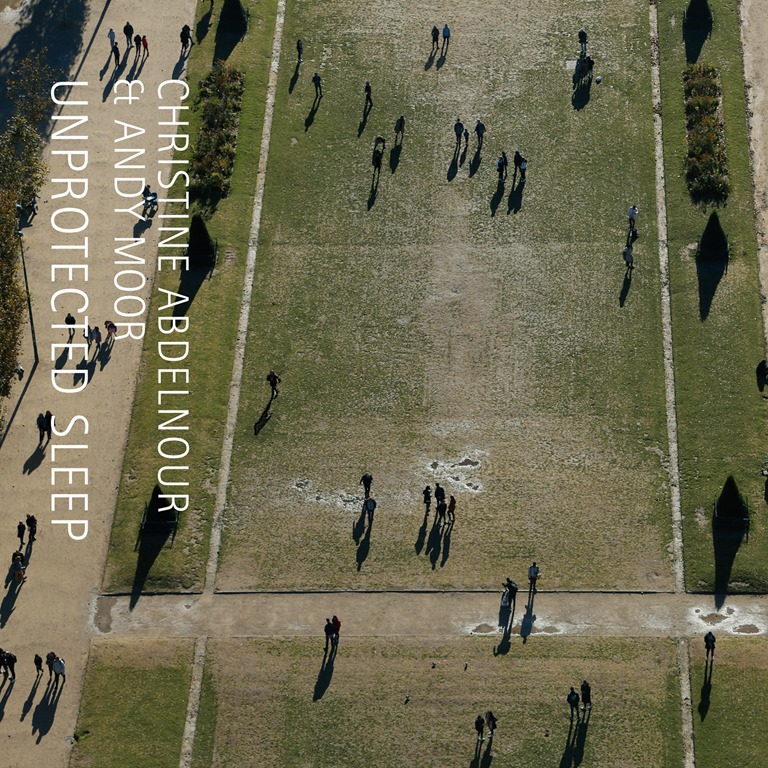
For this work, the accompanying notes explain how ‘Christine Abdnelnour and Andy Moor have explored the notion of hypnagogia or ‘unprotected sleep’ to drive their process for this improvised album, delving in their own experience and memories. Unprotected sleep is commonly defined as an altered state of consciousness that occurs beyond the proper or intended time of waking up, not sleeping in your own safe bed, or even sleeping without a blanket. Being slightly out of phase, one is vulnerable, fragile, but the mind is at the same time very fluid, ultra-associative with an extraordinary memory. In their music making Abdelnour (saxophone) and Moor (guitar) explore the possibilities of real and hallucination sounds and ranges that might come with deep dreaming.’

I had never known that this was a term before, but that it exists speaks on multiple levels, and on a personal level. Sleep is one of the most vital of human functions, but also the most neglected. I’m writing this at 11:30 at night after starting work at 6:30 this morning; five hours of sleep disturbed by lengthy anxiety dreams and broken by the occasional nocturnal anxiety attack is standard. I’m by no means alone in my difficult and often antagonistic and troubled relationship with sleep.

On Unprotected Sleep, Christine Abdelnour and Andy Moor soundtrack the traumas of troubled sleep magnificently. Moor’s scratchy guitar is both metronomic and agitatingly atonal, forging an aural representation of the head-nodding fatigue that so often sweeps over while challenged by needling thoughts that prick a way to wakefulness, or otherwise nag at the psyche

The heavy, grating drone of ‘80db is Loud if You’re Snoring’ ret with scraping guitars and squawks and scrapes if feedback before surging amongst the clattering of cans and escalating to a peak that will inevitably collapse. It drones and groans, and ultimately fades out.

On ‘Compartment 5’, the drone reaches an oppressive level, and it’s enriched by a blank, drony thrum. The density grows, as does the intensity, and it reminds me of the hours spent turning over and over, unable to find that right position, unable to get comfortable, and unable to that headspace conducive to settle to rest: instead, everything is an awkward, uncomfortable churn, accompanied by an unsettling sense off impending doom. The ‘Exchanging Oversize Chrome Objects’ brings a head-pounding crashing beat and uncomfortable churn that’s deeply unsettling, and there’s an uneasiness that permeates the album as a whole.

For many, the experience, if not necessarily the specific sounds, will resonate. Unprotected Sleep is a far from relaxing or soothing sonic experience, built on drones and dissonance, lurching atonal wandering guitar parts and inconsistent tempos that butt against low-key but uncomfortable saxophone drones and honks. Enjoyable is not the word, but compelling most certainly is.

AA

74U_front

The Helen Scarsdale Agency – 7th October 2022

Christopher Nosnibor

Having effectively rediscovered her appreciation for the guitar during the pandemic, Ekin Fil returns to her musical roots on Dora Agora, although it doesn’t sound like a ‘guitar’ album in any obvious or conventional sense. The guitar is acoustic, and the compositions are – at least in structural terms – limited to a couple of chords, played in a scratchy strum back and forth, providing more rhythm than melody. There’s so little to take a firm grasp of here, and not only structurally. How to appraise something that touches to lightly, offers so little that’s tangible, and yet has such an effect on a deeper, essentially subliminal level?

Subliminal is indeed the word, a word I spent several hours scratching around for as the most appropriate adjective for this most affecting of works. It touches you, and reaches deep, but you simply have no idea why. After all, there isn’t much to it, at least superficially. There’s no real dynamic, there are no hooks or choruses to speak of, and it’s more a listening experience defined by what isn’t rather than what is. But what it is, is utterly compelling.

I often try to consider just how listening to an album makes me feel over what it necessarily does, but on listening to Dora Agora I can honestly say I’m not sure, and can’t be certain if I will ever know.

Across the ten compositions, the majority of which are comparatively brief, with the longest being just over four and a half minutes, and the majority being closer to three, Ekin conjures waves of wispy atmosphere, and the songs flow through your system and psyche without a trace, existing as nothing but vapour which evaporates instantaneously.

The first couple of pieces are instrumental, and on the subsequent songs featuring vocals, as on ‘Ghost Boy’, she spins achingly magnificently misty melancholia, minimal shoegaze where her voice and acoustic guitar drift in a cloud of echo and the sparsest ripples of synth. ‘Buried Again’ is haunting, eerie, and Ekin sounds like a spirit floating through air.

The production leans toward the lo-fi but not to the detriment of the songs: quite the opposite, in fact. The songs are so sparse, so skeletal, as to be barely there, existing almost intangibly, often so nebulous as to lack obvious structure. ‘Agora’ is built loosely around an undulating back-and-forth chord repetition, while ‘Bulutlar Kuslar’ is overlaid with myriad incidentals as she skips breezily through its soft, open space. ‘Yo Feelings’ is so vague that it slips free of any constraints of order as it points the album into the cloud-flecked sky. As the last seconds of echo reverberate into the distance, there emerges a sense that Ekin Fil has transcended the realms of music and the earthbound domain to alchemise something that’s truly beyond.

AA

a0499157403_10

James Wells

Fucking hell, we really are running out of names, aren’t we? To the point where even otherwise memorable bands are forgettable because of their ultra-generic name. And some acts sink without a trace because they’re simply impossible to even find through an Internet search. Actor is an obvious example for me, but then we’ve recently had Loungewear grace these virtual pages, and now bloody Tracksuit. How would The The or The Police have faired in the Internet age, I wonder? I mean, stepping aside from the fact their music is tedious and people would probably skip their songs faster than ever now. But it seems like bands aren’t even trying now: Sports Team? Two very different acts operating as Working Men’s Club? Are they trying to bury themselves before their careers have even begun, or do they simply have no imagination and no concept of how The Internet works? Or have we simply reached the apogee of postmodernism, the point at which truly everything has been done, there is no ‘new’, only regurgitations and rehashing, and culture has reached its inevitable dead-end?

It’s a shame Tracksuit have doubly done themselves a disservice with a moniker that’s not only super-generic but also a bit shite, especially as it really doesn’t reflect what they’re about at all. It’s a shame because ‘Ghost of Rome’ is decent. It’s not some lame rappy shite or laid-back bedroomy r ‘n’ b: it’s fundamentally a stripped-back psychedelic rock tune with a keen sense off dynamic and a palpable energy, meaning there’s a lot to like as they dig in with a lively and buoyant bass groove that’s got action and detail. It’s got a heavy 70s vibe about it and it kicks ass – but probably doesn’t need anymore cowbell, because everything is just right.

Click the image to listen:

artworks-Mr3Pcx2wRdaWEIqW-kQ1W9Q-t500x500

Last month, Mat Ball (BIG | BRAVE) announced his first full-length solo album, Amplified Guitar, arriving on The Garrote on 1st July on all formats.

Today he shares the entrancing and moving video for second single, ‘To Catch Light III’. Filmed and edited by Joshua Ford at The Garrote HQ in Illinois using the most simple elements, this video presents a remarkable visual analogue to the economy and elegance of the music and provides an astounding physical account of the sound.

Having recently stood transfixed watching Ball wring notes from his guitar and similar setup while on touch with BIG | BRAVE, this video is both mesmerising and representative of that experience. Calling to mind the expansive guitar workouts of Dylan Carlson’s solo work, ‘To Catch Light III’ hints towards and album that’s rich, textured, immersive.

Watch the video here:

Recorded at Hotel2Tango by Godspeed’s Efrim Manuel Menuck, Ball performed each of these beautiful songs in a single take. Plucking, strumming, bowing, or just slowly moving an electric guitar of his own construction in front of an array of amps, Mat Ball managed to expertly coerce some very deeply moving music from very little. 

Additionally, Mat Ball shall release a book, Accidents (with orders via www.thegarrote.com and Bandcamp). Operating as a visual analog to the Amplified Guitar LP, the work in Mat Ball’s book Accidents is also based on chance: chance in discovery, chance in process, or chance in accidental results. Whether found at rest and documented in that natural/untouched state, or assembled/touched by Ball’s hand, the aleatoric element in each piece is vital. First edition limited to 100 copies.

cosmicimg-prod.services.web.outlook.com

Photo Credit: Stacy Lee