Crónica – 20th January 2026
Christopher Nosnibor
As time passes, our tastes change. For some, they narrow and become more cemented, more deeply entrenched. There’s a broad acceptance that people become more conservative as they grow older – which may explain why, with our ageing population, we – that’s the western world – has become more in favour of conservative values, such as low tax and a belief that the past was a golden age in which hard work was rewarded, and of course, music was better. There is certainly more than a grain of truth in the boomer stereotype. And as a Gen X-er, I’ve observed people I grew up with, and /or have known for many years become set in their ways and their listening habits, locked in the 90s in their musical tastes, and becoming increasingly churlish about the youth of today and the like.
I consider myself fortunate to be surrounded by friends and acquaintances, both in real life and in the virtual world, who are deeply invested in new music. The fact I get sent new music of all kinds from around the globe is only half of the story, as it would be so easy to sweep vast swathes of it aside to listen to, and review, nothing but goth, contemporary iterations of post-punk and new wave, grunge, and reissues. In fact, I could devote my entire listening time and run a website dedicated to nothing but reissues and still be incredibly busy. It would probably garner a huge readership, too. But no: I am constantly encouraged to listen to new music, and the fact of the matter is that I thrive on it, and never fail to get a buzz from new discoveries. As such, since I began this journey as a music writer, my horizons have broadened beyond a range I would have ever imagined.
A measure of this is that my first encounter with the music of Rutger Zuydervelt, back in 2014, was marked by a most unimpressed four-star review, in which I said that Stay Tuned was ‘a bit of a drag’. While I don’t feel particularly inspired to revisit it now alongside my writing of this review, I feel I would likely have been more receptive to its longform minimalism now.
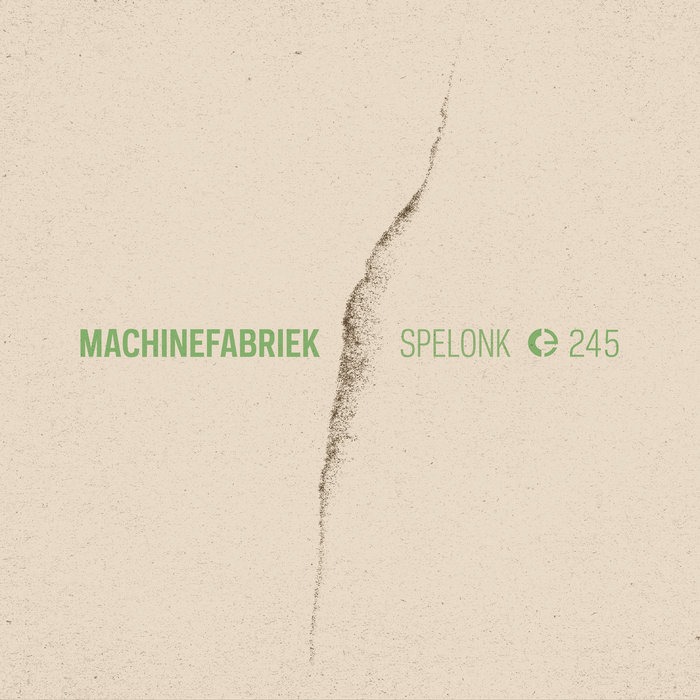
Spelonk is not quite as long in form – three compositions spanning a total of forty-two minutes, and sees Zuydervelt taking some time out from his dayjob to indulge in the act of creating for pleasure – or, perhaps, more accurately, creating out of the need to experience freedom, to feel that metaphorical – and perhaps literal – sigh of release.
As he explains, ‘Most of the music I make nowadays is commissioned for film, dance, or other projects. And I love it — it’s the best job in the world! — but sometimes I have to pull myself away from it, and make something purely for myself. My 2004 release Omval was one of these works, as is now Spelonk. These projects are always made in short bursts; once I start creating, things fall into place quickly, as if the ideas were (unknowingly) already there and just needed to get out of my system.
The three tracks that comprise Spelonk (simply titled I, II, III) are built with “hardware jams” that I recorded with my live setup. It’s all quite hands-on, with effects pedals, an oscillator, and electronic gadgets. The magic happens when combining different recordings, layering them, and hearing what happens. Listening is always a favorite moment in the process, with a welcome element of surprise. I guess it’s all about creating alien landscapes — alien also to me too — that are exciting to explore.’
‘Alien landscapes’ is a fair description of these sparse works, constructed with layers of ominous drone. On ‘Spelonk II’, there are chittering sounds which scratch like guitar string scraping against a fret, or perhaps a ragged bow dragging against a worn string, but by the same token, untranslatable voices come to mind. The drones are eerie, ethereal, and hang low like mist or dry ice: it’s not nor merely an example of dark ambient work – there is very much a 70s sci-fi feel to it, hints of BBC Radiophonic Workshop emerge between every surge and crackle as slow pulsations reverberate among the unsettling abstraction. Over the course of the track’s eighteen minutes, there is movement, evolution, and just past the midpoint, there is a shift, where trilling organ-like notes and digital bleeps emerge, evoking recordings from space travel, and, as rippling laser sounds begin to burst forth, vintage sci-fi movies and 70s TV.
There are moments of near silence as ‘Spelonk II’ drifts into ‘Spelonk III’, also eighteen minutes in duration. Here, clanks and bleeps bubble and bounce and echo erratically, unpredictably, over a backdrop of low hums and reverberations. The low-end vibrates subtly but perceptibly, and while the experience is not one which instils tension, the cave-like digital drips and sense of space, as well as darkness, is not relaxing. You find yourself looking around, wondering what’s around the corner, what’s in the shadows. And while there’s no grand reveal, no jump fright here, the second half of ‘Spelonk III’ grows increasingly murky and increasingly squelchy and unsettling.
Over the album’s duration, Spelonk grows in depth and darkness, becoming increasingly dark, strange, and unsettling. Rutger Zuydervelt makes a lot out of very little, to subtle but strong effect.
AA
 Aural Aggravation