Posts Tagged ‘Experimental’

Ventil Records – V008

Christopher Nosnibor

Variations on Bulletproof Glass follows 2016’s Decomposition I-III which also featured Christina Kubisch, and set out to explore – and demolish – the well-worn thematics of field recordings.it represents something of a deviation in terms of its methodology, as well as its focus. This fourth decomposition collapses material rather than location, and places a very different focus on the concept of field recordings, centring not on the out and about, but the controlled space, and with a clearly defined specificity.

Variations on Bulletproof Glass is a literal title, being constructed from ‘waves which were transmitted through a bulletproof glass pane while it was exposed to major physical impacts’. But of course, like most works which are devoted to a microcosmic sound source, that source becomes increasingly obscured the closer the lens looms. While there are moments that do sound vaguely evocative of glass, cracking and splintering, there’s not a single classic crash and tinkle, a solitary smash and splinter. None of the sounds here betray their origins, and Kutin and Kindlinger have manipulated the source material to forge something altogether in a different sonic sphere from the pieces that lie scattered at source. There may be hints of scrapes and ricochets on/off glass, but there’s nothing which overtly says ‘this the sound of glass’ in the (de)construction of these samples. Because this is bulletproof glass, for a start. It has different properties, and can withstand greater punishment. The consequence is that so must the listener: this is challenging, and difficult to readily access.

‘X26’, the first of eight pieces, clanks and scrapes, and the chanking treble is countered by woozy bass. It has all the hallmarks of experimental dub, and even builds some dense, gut-churning rhythmic pulsations and dynamic beats – none of which even hint in the slightest at the source of the sounds. ‘Throne’ is a jolting, stop/start attack, and Elvin Brandhi’s vocals are stark, dishevelled, wild and wide-eyed. ‘PANE#2’ blasts away at a beat that echoes Throbbing Gristle’s ‘Discipline’ as synth-like sounds howl and wail aggressively before tapering to a quieter place.

Elsewhere, the sonorous, trilling done and scrape of ‘L.I.W’ is uncomfortable, and not for a single second does one listen to this and think that this is an album to mellow to, or even to function to. It’s not just distracting, but the sound of abstract obstruction.

AA

Kutin Kindlinger – Decomposition IV

The Sublunar Society 053 – 11th May 2018

James Wells

Just as Facebook advertising and Amazon recommendations prove that algorithms can be applied usefully but are no substitute for human input.

Of course, The Rosenberg Algorithmic Music Generator is subject to human input, in that it was created by Mick Sussman himself. A programme is designed to ‘compose’ ‘unique’ music, by ‘making decisions based on a sequence of randomised processes.’ The nineteen compositions collected here seem to suggest a greater leaning toward the random than the musical. There are notes and there are rhythms, but none of them seem to coordinate with one another, and the sounds are trebly synthetic, 80s computer gamey. The cover art has obvious ‘matrix’ connotations, and tells much of the story of what The Rosenberg Algorithmic Music Generator is about. Only, this is the sound of the matrix collapsing, of being stretched and pulled in all directions, twisted and tossed.

Sussman observes in the liner notes that in programming terms, Rosenberg is a primitive piece of coding, but is sufficiently versatile to enable him to vary musical phrasings and tempos – to the extent that one option enables the user to allocate a different tempo to each instrument. Why would anyone do this? Because, I suppose. It’s an indication of Sussman’s adoption of avant-garde principles, to disassemble and reconfigure that which has gone before, to build anew. It may well be that no-one has done this before not because they haven’t thought of it, but because they didn’t want to, but that’s every reason for Sussman to be the first.

The result is a disorientating, bleepy, bloopy clamour of sound, with digital notes flying in all directions in an exercise where the concept is considerably more appealing than the experience of the end product.

AA

Mick Sussman – The Rosenberg Algorithmic Music Generator

Alrealon Music – ALRN083 – 20th April 2018

James Wells

The title of Anita Loos’ 1925 novel and the 1953 film starring Marilyn Monroe may have passed into general acceptance, but if gentlemen prefer blondes, I personally prefer brunettes myself. Make of that what you will, but as such, a house of blondes has limited appeal ordinarily, although on hearing this, I’m inclined to make an exception. Time Trip is a varied and expansive electronic-led work which forges expansive spaces with nebulous synths and insistent beats.

‘Discovery #1’ builds ambient eddies of sound around a droning organ synth atop a motoric groove, and there are infinite nods to the likes of Kraftwerk and Tangerine Dream here, as undulation, oscillating synth repetitions bibble and tweet over long, undulating synth drones and insistent, repetitive beats.

There’s some droning, modular crackle and fizz to the yawning oscillations of ‘Mean Solar Time’, and the overall sensation of Time Trip is one of reaching back. It plucks flickers from shoegaze and ambience as well as the origins of electronica, positioning itself within a slow-arcing trajectory without defining its place in concrete terms.

This is music that billows, ripples, throbs and pulses, and is content to loiter on the peripheries of the focus-zone. The beats flicker and click, pitter and patter, while the synths glister and gleam, twisting in flange-soaked zero-gravity. It all feels very familiar, but at the same time, it’s rather nice.

AA

House of Blondes – Time Trip

Christopher Nosnibor

The missive which contains a link to the album lays out the facts. ‘August 2015: On a sweltering summer evening, Sly & the Family Drone brought their sweat-soaked carnival of chaos to east London. This is a recording of that night.’

Café Oto seems to be the venue of choice for weirdy, avant-garde experimental acts to capture their live sound – or perhaps it’s one of the few venues that truly embraces all that it weirdy, avant-garde and experimental in the first place. This, of course, is one of the benefits of operating on a not-for-profit basis. Art takes precedence over capital. It’s also an intimate space, where even a small crowd will make the place feel like it’s heaving, and it’s possible to really feel that connection between performer and audience in an up-close setting. Truly, here’s no substitute for being able to smell the sweat and see the whites of a perfomer’s eyes

Sly and the Family Drone have been pushing the parameters of messy noise for about eight years now, and while their recoded output explores all areas of murkiness and abrasion, their live shows are something else. Chaotic and cathartic, the only predictable part is percussion – that is to say, a lot of percussion.

This particular outing is heavy, and percussion-heavy from the outset. Thick, low-end blasts thunder through pounding drums. The percussion intensifies in both power and pace, while the droning bass frequencies bottom out to a place below the pelvic region while explosions of top-end squeal painfully. Less than ten minutes in, and they’ve hit total overload. Over the course of the album’s hour-long duration, they maintain it, and if anything, continue to push further, harder, louder, harsher. Crescendo hits after crescendo, and cumulatively, it’s punishing – in the best possible way.

It’s not just a hell of a noise: it’s all the noise. Even when the noise abates and the relentless battery of snare halts temporarily, eardrum-perforating feedback and whirring, hissing shards of treble fill the space. Through speakers, it hurts. Once can only imagine the impact and potential damage inflicted on those actually present. This is less a case of ‘you probably had to be there’ and more about ‘damn, I wish I’d been there’.

AA

cover

Christopher Nosnibor

There’s no such thing as a night off. I may habitually tweet that I’m taking the night off for beer and live music, but that’s simply my way of telling the world I won’t be posting any reviews, I won’t be active on social media and probably won’t be responding to emails either. Watching bands and drinking beer has been a hobby of mine for a long time now, and I still enjoy it, but even when not guest-listed for reviewing, I tend to take notes and photos out of habit and for posterity. I’m naturally assuming my memory won’t be able to store all of the live shows I’ve attended when I get older, give that I struggle now, so the reviews are rather like postcards to my future self.

The WonkyStuff nights aren’t so much niche as ultra-niche – and that’s a good thing. The mainstream is oversaturated, and to cater to those tastes is a huge gamble. Focusing on a niche and knowing it well means that while there’s a very definite ceiling on audience potential, those being catered for are far more likely to actually bother. And so it is that on a hot Wednesday, around thirty people take seats in front of the stage to witness a smorgasbord of the most far-out experimental music you’ll find anywhere.

My future self, if presented with a photo of New Victorian Architecture’s performance would likely be ‘Christ, you have seen some weird shit’. Which corresponds with the multiple texts I received bearing the letters ‘wtf’ in response to sending pictures of said performance to friends. Certainly, the visual aspect – luminous yellow fishing kit, hood up, dust mask and heavy-duty latex gloves in blue – is striking, and if anything trumps the music or its delivery. There’s a lot of silence: some just awkward pauses, others more protracted periods of hush. At one point, he checks his phone, is momentarily animated as she scrabbles around the pile of pedals before him, then stops, stands (most of the set is spent kneeling) and addresses an inaudible question to the audience. Met with silence, he shrugs and resumes. The whole spectacle is odd – which is, of course, the idea.

DSC_0678[1]

New Victorian Architecture

How Buildings Fail – the musical vehicle of Simon Hickinbotham – brings a different kind of odd, and one that’s much more song-orientated. The array of DIY and customised kit packed onto a small table includes an inverted Pot Noodle carton (chicken and mushroom) which appears to contain a set of controls. The material’s centred around the grainy and the granular, analoguey synthy sounds are modulated into gloopy oscillations and swerving sine waves which collide with overdriven, clattering drum tracks. Hickinbotham rattles off rants about philosophy and reading comics. It’s a weird, nerdy clash that lands somewhere in the field next to The Fall, Meat Beat Manifesto and Revolting Cocks. ‘Creative supply is outstripping demand!’ he calls by way of a refrain in the final song of the set. He’s right, but those gathered tonight are appreciate of their demands being catered for.

DSC_0681[1]

How Buildings Fail

They may look like they’re playing chess, but Ash Sagar and John Tuffen are in fact pondering a rack of effects units on the table before them. The pair sit, almost motionless, mannequin-like, expressionless, and decked entirely in black. Tuffen, another self-solder gear enthusiast, appear to be playing open circuit boards, while Sagar tweaks at a more conventional-looking mixer unit. It’s difficult to determine the actual sources of the sounds which they sculpt expansive, glitchy drones that crackle and hum. Not a lot happens over the course of the set: instead, the emphasis on slow-evolving sonic shifts, and the focus is on detail rather than drama. Distortion ruptures smooth sonic arcs and beats like bursting bubblewrap forge subtle dynamics which balance grind and levity to immersive effect. It’s a meticulous performance, and for a few moments, time stands still.

DSC_0691[1]

Orlando Ferguson

Stocker / Eyes – that’s Canadian-born percussionist Beau Stocker and multi-instrumentalist Ben Eyes – are celebrating the release of their new album, Earth Asylum. However, they showcase quite a different sound live in comparison to the album, which is extremely mellow and almost of a post-rock persuasion. Their set, driven by jarring, stop-start drumming and soaring, layered guitar and sweeping synths, and occasionally punctuated by jolting, halting guitar bursts, is certainly a strong contrast with the other acts on the bill. But for all of this, their set feels, perversely, the most conventional, working as it does established experimental / avant-jazz tropes. Although overtly improvised and fluid, and perhaps a shade overlong, there’s a clear sense that they have a tight rein on their performance, and it’s hard to find fault technically.

DSC_0696[1]

Stocker/Eyes

In fact, it’s hard to find fault with the night overall: WonkyStuff pitch a varied but perfectly complimentary set of acts, the likes of whom will never achieve anything beyond cult status (if even that), and provide an essential platform for the oddballs and fringe performers. And essential is the word: in an age where capital and homogenisation is killing pretty much everything but the lowest common denominators, culturally, we need nights like this.

Young God Records

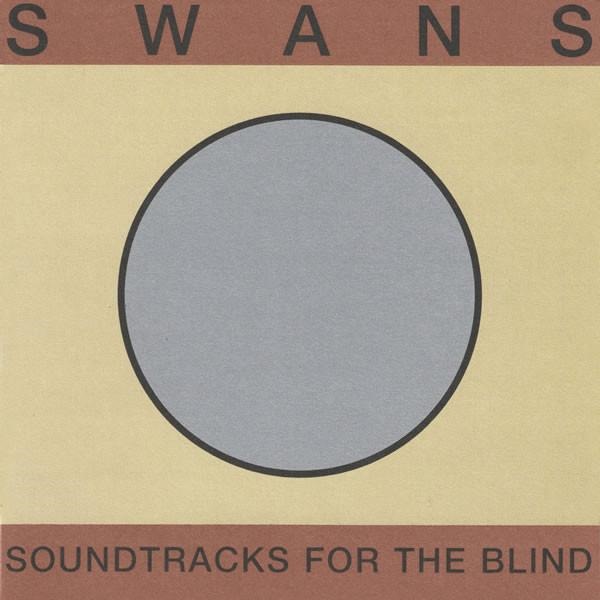
It’s perhaps too much to convey the experience of hearing Soundtracks for the Blind for the first time on its release in 1996. Admittedly, hearing any Swans release for the first time was memorable – I was introduced in the late 80s via Children of God, which, aged 17, was unlike anything I had heard before. It was what one might call a pivotal moment. I was compelled to explore their back-catalogue, which yielded a succession of further pivotal moments, not east of all on the discovery of Cop.

For all its length, The Great Annihilator was pretty straightforward, and represented a continuation of the White Light / Love of Life albums. Just a year later, Soundtracks for the Blind was altogether different, and represented a new expansion on all levels. It was about three hours long, for a start. The third song was over a quarter of an hour long, and there were extensive instrumental passages that bordered on ambient. Elsewhere, reworkings of older songs, bent almost beyond recognition (‘YRP’ and ‘YRP 2’ emerging from ‘Your Property’ from 1984’s Cop), surfaced amidst the churning soundscapes drawn from the contents of the library of tape loops and found sounds gathered by Michael Gita over the band’s whole career. It felt like the culmination of a lifetime’s work. It felt fitting it should be Swans’ final studio album, and it seems appropriate that its remastered reissue should arrive when Gira has again called time on the band. Its arrival gives us cause to reflect on the cyclical nature of the band’s career, and the differences and similarities between their first unbroken span and their later incarnation, which closed with another uber epic in the form of The Glowing Man and followed by a live document (as Soundtracks was accompanied by the conclusive Swans are Dead, so The Glowing Man was accompanied by Deliquescence).

This is the first time Soundtracks has been released on vinyl, and naturally, its formatting and packaging is something else: as the press release and Young God website detail, ‘the vinyl package will consist of four LPs in jackets enclosed in a box with a poster, insert and download card. The box set will be a limited edition of 4,000 copies worldwide and once sold out will be followed later in 2018 by a gatefold LP version. The album will also be reissued on CD featuring a repackage of the original digipak for the 1996 Atavistic release plus a bonus disc of the contemporaneous Die Tür Ist Zu EP (a German language version of some of the material from Soundtracks that also includes unique material) recently released for the first time on vinyl in the USA for Record Store Day 2018. Outside of the USA, Die Tür Ist Zu EP will be released as a limited edition companion piece double vinyl set, also on 20th July’. Yes, as with the previous reissues, they’ve gone all put to render a truly definitive edition.

Listening to Soundtracks now, it seems that Gira, having declared the band spent in 1997, spent a long time cogitating over the directions and possibilities that this album presented, and took them as the starting point for the post-millennial iteration: it certainly shares more with this period than its predecessors, with exceptions like ‘The Yum Yab Killers’ which delivers the same kind of punch as ‘Mother/Father’ on The Great Annihilator (and recoded live, with somewhat muffled sound, it still seems a shade incongruous in its inclusion here, although Jarboe sounds so fucking fierce I’d not want to make to big a deal of it). We’re reminded, too, that Soundtracks emerged during a fairly prolific spell for Gira, and it’s perhaps inevitable that elements of other projects – namely the solo album Drainland and The Body Lovers / The Body Haters. ‘All Lined Up’ is a different version of ‘I See Them All Lined Up’ which featured on Drainland. It’s simultaneously more distorted and weirded-out, and more explosive, more driving, more… Swans.

Some of the rambling monologues are quite disturbing (with recordings of Gira’s father talking about his life and excerpts from FBI tapes, amongst other things), but then so is the musical accompaniment that provides the backdrop: ‘I Was a Prisoner Inside Your Skull’ and ‘How they Suffer’ make for uncomfortable listening.

There are some incredibly tender, raw, emotive moments: Gira’s voice, cracked and plaintive on ‘Animus’, as woodwind bursts around him from a hovering hush, is one of Swans’ most affecting moments. For a band whose back catalogue contains some of the most intense sonic brutality ever committed to tape, it’s quite a contrast, and perhaps all the more moving in context.

It’s a sprawling expanse of sound, and it isn’t entirely cohesive. Gira’s conception of sound as something malleable and his approach to dynamics would evolve immensely in the time away from Swans, and as such, Soundtracks is as much a signpost toward the next phase as a bookend to the one it belongs. At the time, it was almost too much to digest. On revisiting, the same holds true. The density of both sound and ideas, the sheer scale of the album, the fact that it condenses fifteen years into two and a half hours… of course it’s too much to bear. This was always the way with Swans: even their gentler albums are delivered with an intensity that transcends words. And this, of course, is the ultimate objective of music – to touch body and mind in ways that are beyond any form of articulation. Soundtracks for the Blind doesn’t simply touch those parts, but poke, prod, squeeze and stab at them.

AA

soundtracks_grande

Unsounds – 60U – 1st June 2018

Christopher Nosnibor

Tout ce que je sais is the second part of Chaton and Moor’s ‘Heretics’ series, which, according to the blurb, sees the duo ‘revive the most obscure, violent, erotic passions, summoning the great gures of their personal mythologies. In the company of Caravaggio, Marquis de Sade, William Burroughs and gures such as Jose Mujica, the duo immerses the listener in another world history peopled by radical thinkers’. ‘Heretics’ pays homage to those heroes who have used transgression and excess as a necessary means for creation. In this new album, recorded live at the Carreau du Temple in Paris on the occasion of Périphérie du 35e Marché de la Poésie (2017), Anne-James Chaton and Andy Moor deliver a radical work at the confines of literary and musical creation.’ The first release came in a giant matchbox, complete with textured side and a huge matchstick. No, I haven’t burned my copy. Yet.

The fact it is a live recording creates a certain degree of difficulty in terms of how to weigh its realisation. Granted, there’s an immediacy to the stuttering, fractured ruptures of dissonance what scratch through at forty-five degree angles to the rhythms and overall shapes of the compositions. But to doesn’t feel like a definitive document: something is missing.

‘Casino rabelaisien’ is a stark, minimalist grind, throbbing and churning away at a short, repetitious sonic loop of bass and extraneous discord reminiscent of Suicide and with cluttering, scratchy guitars that call to mind The Fall pre-1980. The murky sound accentuates the claustrophobic atmosphere, and Moor’s monotone delivery. The words being spoken in French mean I’m excluded from their meaning and from their sense. Oftentimes, the language of sound is enough to transcend linguistic barriers. But with the musical aspect so minimal and the vocal aspect so much to the fore on this work, I fear that much of the significance – and quite simply much of the content – is lost. Burroughs et al – this is my field, so to speak. But I simply don’t recognise it, let alone connect on a level where I can engage critically in terms of its conceptual content. Nothing about Tout ce que je sais conveys the brutal perversion of de Sade on a sonic level, for example, and there’s nothing that brings the bewildering explosion of ideas or the narrative fragmentation of Burroughs’ writing here.

‘Conquins coquettes at cocus’ jolts and jars, the crunching guitars choppy over a haltering, stuttering rhythm worthy of Shellac. It’s sparse in instrumentation, but it’s intense, and Moor’s dry, almost inflection-free delivery provides a counterpoint and contrast.

There’s something deep and haunting in the very notes of ‘Clair Obscur’, but the limited instrumentation means it feels somehow incomplete, unfinished. And then here’s the applause and the shouting from the audience immediately after; while being there would have almost doubtless have been a quite remarkable experience, the material would equally doubtless benefit from a proper studio realisation in order to capture the nuance and the detail of the compositions and their arrangements.

‘The Things That Belong to William’ closes the set; a slowed-down, opium-slurred Burroughs drawl creaks through the jolting, jarring spasmic guitar chords. It’s interesting and uncomfortable, but doesn’t go any real distance to create the same kind of temporal dislocation of Naked Lunch or any of Burroughs’ cut-up works. Is this a failing? Probably not in real terms. We land, then, at a place where we’re faced with the disunion between expectation and actuality.

AA

Anne-James Chaton & Andy Moor – Tout ce que je sais

Textile Records – May 2018

Christopher Nosnibor

Just as I don’t really do jazz, I don’t much do country, either. But for every rule – or perhaps more of a broad, general guideline – there necessarily has to be an exception. So here I am, sipping hot black coffee having just ejected an album by Marc Sarrazy and Laurent Rochelle, which goes way over the limit on the jazzometer and has left me shaking my head and thinking there’s just no way I can review that objectively, and looking at a plain white paper sleeve stamped with six song titles under the header ‘J.O.M.F BLOOM’.

The biographical commentary that ‘the band is moving more slowly these days, with core members Tom Greenwood and Michael Whittaker living in the more rural corners f Northern California’ is perhaps an understatement: Bloom was a full three years in the making. But it’s not just its evolution that was gradual: compositionally, too, the pieces are slow-growing and sparse. The quietly picked guitar notes resonate outwards as woodwind trills over the hills on the instrumental intro piece, ‘Pipe’ It’s kinda quiet, sort of ambient. A sudden swell of noise ends abruptly to make way for the sedate country ramblings of ‘Radiating’. If you dig downbeat country tines that drag on for over eight minutes, this is going to do it for you bigtime. If you don’t… It’s laid back to the point of horizontal, the lyrics drawled rather than sung, and as such decipherable only in snippets.

But while this is very much a country album, it’s anything but conventional or straight ahead overall. ‘Wreck’ is slow-building, initially just guitar and Greenwood’s cracked croon. But before long, a tumult of crashing cymbals, overloading electric guitar feedback and straining saxophone create a glorious cacophony. Wild brass and woodwind shriek and squeal all over the raucous stomp of ‘Strike’. A sort of country/blues heart pulses beneath the chaotic racket that pummels in all directions and drives toward the horizon of abstraction. ‘Wildgeese’ brings dolorous trudging before the lo-fi plod of ‘Golden Bees’ thuds its way to the album’s conclusion in a muddy haze of echo.

On Bloom, Jackie-O Motherfucker fuse the mellowest, most downcast of country with the most awkward jazz dirges, which drone and wheeze and scrape at divergent angles across the linear country compositions. It may be country at its core, but it’s a whole lot more.

AA

Jakie-O Motherfucker

Christopher Nosnibor

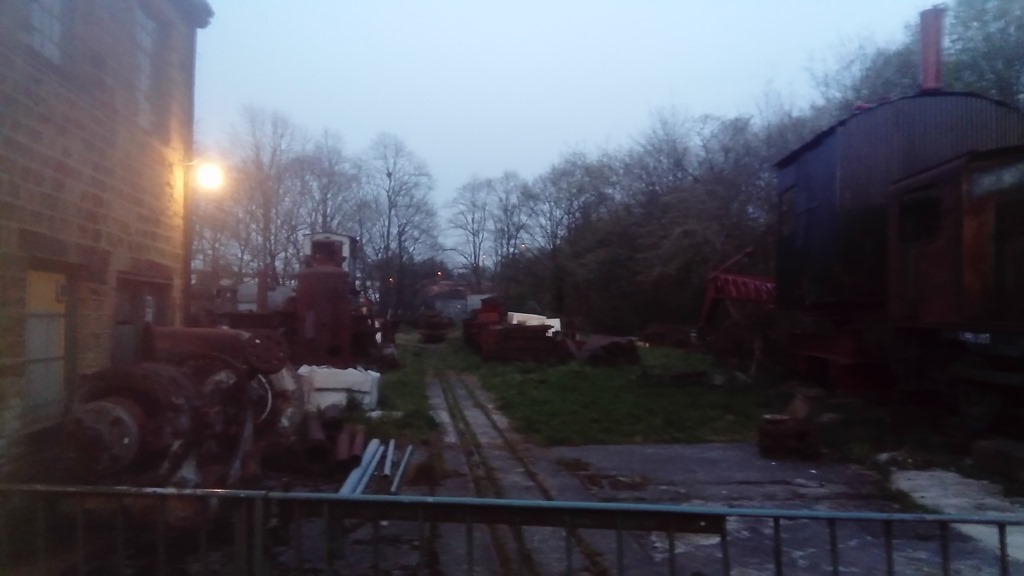
Live music tends to follow a fairly standard format, namely where artists perform on a stage either in a conventional venue, or outdoors if it’s a festival. Punters traipse in, stand around, talk (sometimes through the performances) and file out again, and judge their enjoyment based on the merits of the performances and the sound and perhaps the company. Music performed in conjunction with art tends to be installation-based in some sense, and the music then finds itself relegated to a secondary position. It was only on arriving at the Leeds Industrial Museum in glorious sunshine that I began to consider the fact that while field recordings are an essential part of a huge array of musical works in the more experimental and avant-garde fields, and that there’s a huge body of musical work which is concerned with responding to and working with specific environments, it’s rare for an audience to experience the music and the environment from which it originated simultaneously.

Having seen the event – and it is an event, not a mere gig, not even simply a night of music, but something that, as the evening progresses, I realise is something that will stay with me as an experience, something different and really rather special – was in the museum, I assumed it would simply be in the museum. To arrive at the PA required walking the full length of the labyrinthine factory space, packed with weird machinery and other abstruse-looking contraptions. Some were operating, clanging and banging away. Following the arrows, we arrived at the sewing room, where NikNak is spinning discs and adding some wild flavour to the established tradition of scratching. I assume the bar is just around the corner and that we’ll be assembling in or near here, so move on with a view to returning. Follow the arrows. Follow the arrows. I try not to panic that getting out again is going to add quarter of an hour to my walk back to the station, and instead marvel at the displays. I’m not really digesting: the museum is looking like a full day’s exploration, and I make a note to return before too long.
DSC_0560DSC_0558

Eventually, we stumble into what appears to be some kind of old engine house. Past that, the bar and toilets. A nice array of local beers, bit in cans and kegs. No commercial piss on offer here.

The sun is slowly sinking, but still casting a fair bit of light as Bambooman delivers his ‘site-specific’ set, which is built predominantly around field recordings captured around the museum in the weeks ahead of tonight’s show. He throws some solid beats, and bass loops and samples in abundance. Light, skipping motifs that hint of the orient and extraneous industrial sounds – repetitious mechanical clankings which forge heavy marches dominate, and are overlaid with oddly folky vocals. The incongruity actually works in its favour.
DSC_0556

Bambooman

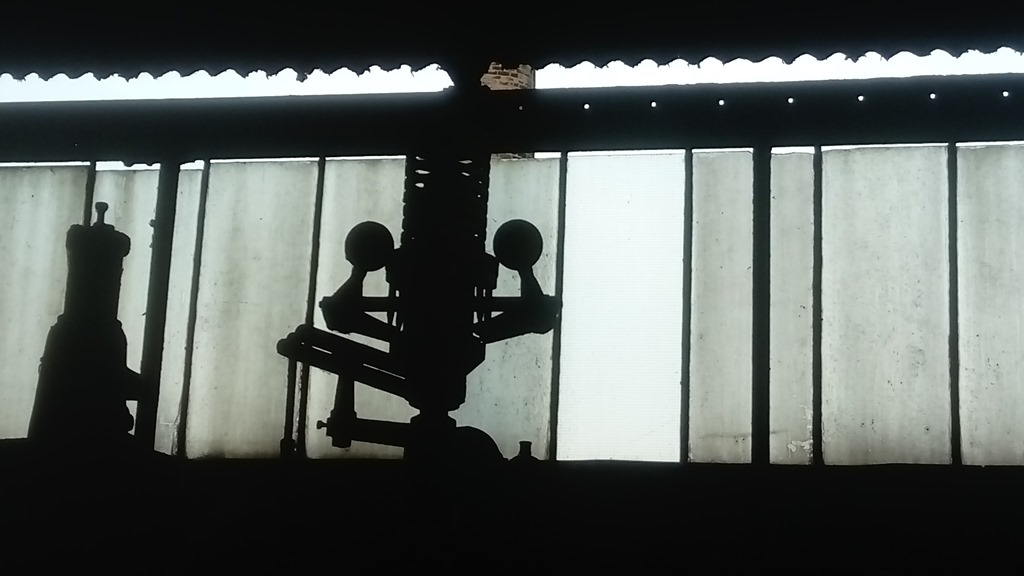
And it’s here that I begin to really experience – and to appreciate – the synergy of sound and space. It isn’t because the music isn’t engaging that I find myself casting my eyes around the space I’m standing in: it’s because the music compels me to do so. I cast my eyes upwards, and wonder what caused the various punctures and tears in the corrugated roof, through which the fading light seeps, purplish. People begin to pack in with greater density, legs and pelvises moving in time with the rhythms. A woman comes and stands too close to me, and keeps knocking my shoulder as she moves to the music. I let it pass.

My notes thin in density: a trip to the bar results in my missing the front end of Object Blue’s set, but time is already beginning to warp before her altogether more abrasive set assails my senses. Abrasion may be relative, but in any context, Object Blue packs some attack. The bass frequencies register around the pelvis, while the treble hits around the upper reaches of the cranium: the cymbal work is almost sharp enough to slice off the top like cutting open a boiled egg. The sounds are pushing the limits, fraying at the edges, and tug ant the nerve endings, but the PA is supremely crisp and clear and despite the respectable volume, I’m not feeling any need to get the ear plugs out. Object Blue’s approach to ‘industrial’ may be less literal than that of Bambooman, and more conventional in terms of genre, but with contrast comes impact. As a performer, she’s understated and demur, but sonically, her set is combative, aggressive, every frequency tweaked for optimal discomfort. I absolutely love it, and instead of raising the blood pressure, the sheer quality of the compositions and the attention to detail is uplifting. And with any uplifting uplifting experience comes a sense of quiet joy.
DSC_0562

Object Blue

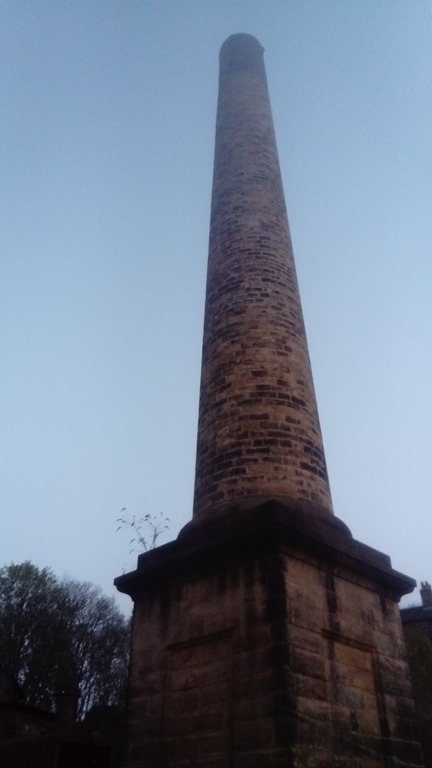
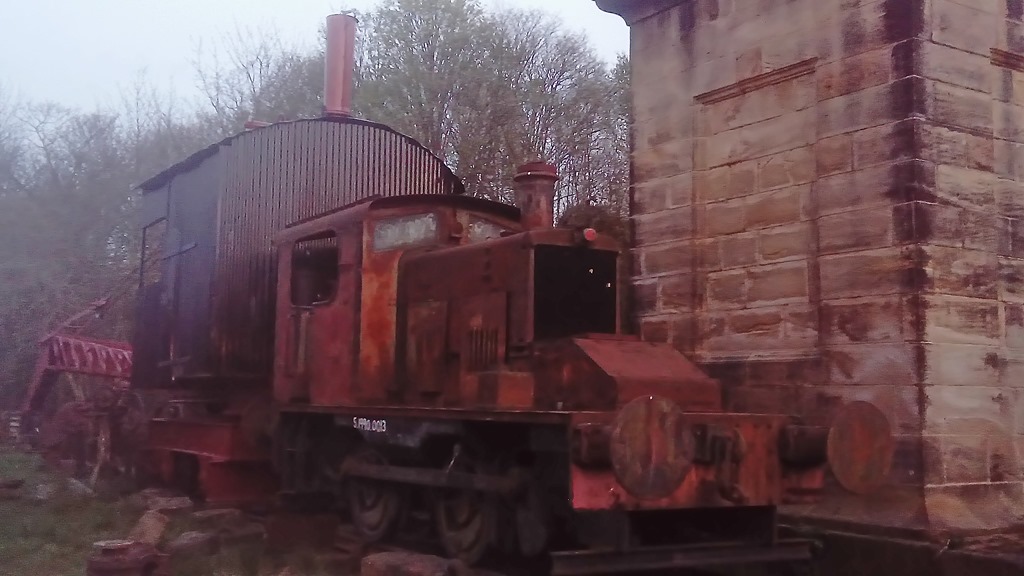
Time really begins to slip now, and it’s not about the alcohol consumed. I’ve actually been pacing myself, for a change against recent outings more immersed in the experience than the quest for obliteration. During the space between acts, and as the beats knocked out by the DJs echo out into the night, I talk to my friend about mental health. It seems oddly comfortable and in come ways appropriate: I’ve spent the last few months operating at a frenetic tempo, which has resulted in wild fluctuations in mood. Tonight, at one with my surroundings, immersed by the music, stepping out of my life and engaged by everything that’s going on and the sense of something different something new, I find I’m reattenuating, becoming once more aware of the details of my environment – the sky, the details of chimney tower, the rusted engine, the imposing hulk of the mill on the hill, the skeletal frame of an engine tunnel or something, rusty and covered in ivy, the inexplicable machinery at every turn. I’m breathing at a slower pace. I’m back in life.
DSC_0557DSC_0561

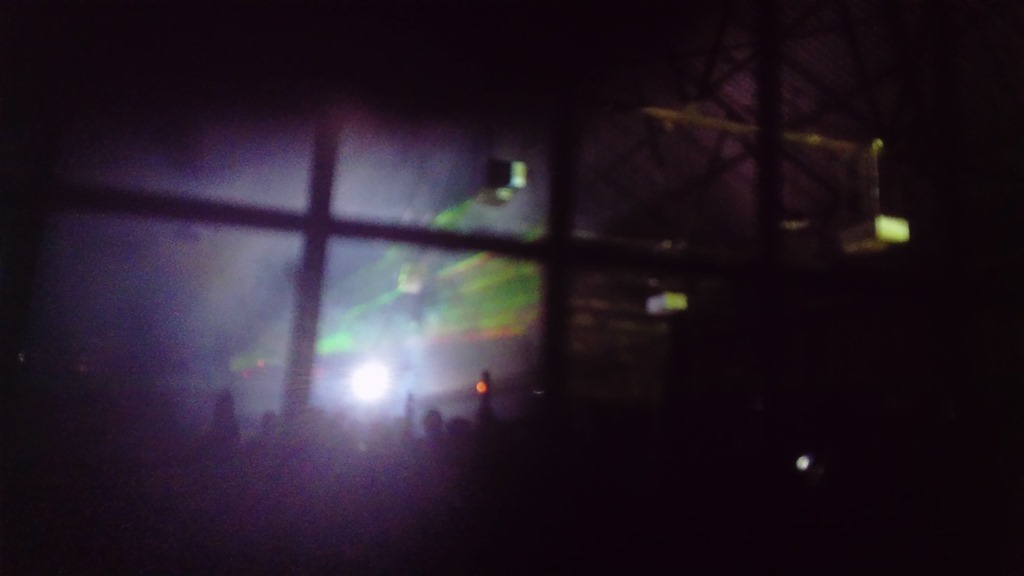
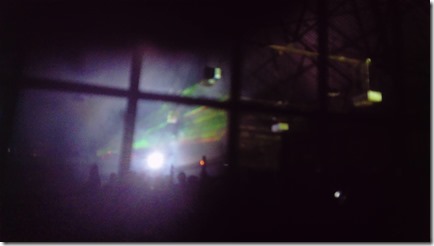
Pye Corner Audio delivers something special. The downtempo focus of the set is key to its hypnotic effect. One moment, I’m engaged, observing the laser lighting and the drift of illuminated smoke across the space where he performer is situated, attuned to every last nuance of the surroundings, from the wire fence to the way the other members of the audience engage. The next, I find I’m swaying on my feet, eyes barely ajar, in something approaching a hypnotic trance. It’s the best I’ve felt in months – zoned out, but not completely out of it – the music becomes a throbbing wash that envelopes my body and every last one of my senses. THIS is what immersion feels like. The moment is all, and nothing else matters.
DSC_0567

Pye Corner Audio

I remember, jerking alert between lengthy spells of complete immersion, that this is a life experience. For the first time ever, it’s one I feel comfortable being only semi-present for.
Acte – Acte 002

Christopher Nosnibor

The press release provides previous little detail about the release, or the artist, beyond a brief summary of his broad interdisciplinary pursuits which include dance, theatre, live electronics improvisations and audiovisual performances and installations. It’s quite an expansion on his biography last time I encountered his work, back in 2011, when he simply described himself as a ‘sound artist’. That was when he released the ambient-orientated exploration usure.paysage.

Transfert/Futur is a long way from ambient. Heavy on the synths, it’s a beaty work that packs some considerable attack amidst the airy pulses and breezy blossoms of effervescence. It contains two tracks, the first of which, ‘transfert (299 792 458 m/s)’ is the audio element of a touring sound/light installation from 2017. On CD, it’s simply sound without the light, and clearly, the interactive and multisensory aspect of the project is nowhere near fully represented. Nevertheless, musically, it works. Over the course of some eighteen minutes, Bernier builds the atmosphere but above all, builds the beats. Scratchy, stuttering, synthetic, exploding in all directions, the rhythms pop and thrum, marching surges halting abruptly to change direction before powering forwards once more embarking on a propellant trajectory. The surround synths glide, pop and bubble, but mostly click and bleep and elongate, morphing and stretching longways, occasionally plunging into expansive, oceanic depths and venturing into eerie subaquatic territories. With so many false starts, false ends, twists, turns and unpredictable stammers, it’s anything but linear.

The second composition, ‘synthèse (299 792 458 m/s)’ has no such obvious context attached, but again is centred around warping synths and woozy bass tones wrapped around bold beats. Over the course of twelve minutes, it swerves from oblique bleeps and minimalist electronic squiggles and arabesques, via slow-building crescendos, to passages approximating straight-ahead dance music that you can actually get down to. As the track progresses, its form gradually dissolves. The soundscape is increasingly rent with bleeps and whispers and tranquillity always gives way to tension after a few uncountable bars. Microbeats and circuit spasms come to dominate the swell of hyperenergetic electrodes in synaptic collapse. Finally, nothing is left but a quivering whistle which slowly decays to nothing.

What does it all mean? Probably precious little. Transfert / Futur is about the journey, and the algorithms, rather than the meaning. It’s not a journey that traverses from A to B, but burrows its way into its own unique space.

AA

Nicolas Bernier