Posts Tagged ‘Experimental’

Bearsuit Records – 14th July 2018

Christopher Nosnibor

The Bearsuit philosophy is, to the best of my understanding, essentially built round a l’aissez-faire approach to experimentalism and collaboration. Stuff happens, when it happens, as it happens. Sometimes it happens without input or collaboration. And it’s all fine as long as it’s not mainstream. Truth is, nothing any of the Bearsuit acts could produce in a million lifetimes would ever even hint at mainstream aspirations. The reason I’ve been a personal advocate of the label and its output for a while now is simply because they do what they so, and don’t give a crap about trends, commercialism, or anything else. As I wrote the other day, albeit in a slightly different context: it’s for the love, not the money.

The label’s latest release sees Haq (the alter-ego of another Bearsuit would-be legend, Harold Nono) return. Five years on from the ‘Nocturnals’ album, this EP offers three remixes frm the album, plus two new cuts.

Lead track ‘Antics in a Maze’ moves far beyond the avant-trip-hop leanings of its predecessor and froths with fanciful flights of incongruity, and brims with an air of otherness. Breathy vocals waft over drifting, trilling swathes of gauze-like synth, crossed with bursts of odd electronica, deep dub and driving drum ‘n’ bass. Warped snippets of thee tunes for fictional TV shows and films from the 70s and 80s emerge fleetingly for the ever-shifting compositional aneurysm.

‘Norvell’ is the second new cut: with sonorous, brooding synths and rich, layered strings that sweep and tug at the tear ducts, as well as percussion that simultaneously clatters and thunders, it’s a dissonant and haunting work that straddles industrial, goth and shoegaze, with hints of Cranes and a messed-up air of dark beauty about its detached, haunting evocativeness.

The remixes are varied, in terms of style, interest and significance – but at least they are varied. Senji Niban’s remix of ‘Are You the Elephant’ thumps along insistently, a far cry from the slightly eerie, chilled original, while The Autumna remix of ‘Bees in My Feet’ is but a humming drone that’s elevated above ambience by virtue of maintaining a pitch that’s impossible to ignore, however hard you may try.

There’s nothing ordinary about the music on this EP, and while it’s bewildering at times – as you’d reasonably expect from Bearsuit – it also contains moments of extreme elegance and grace which are spellbinding.

AA

Haq_Antics-front-cover

Grappa Musikkforlag – 24th August 2018

Christopher Nosnibor

I used to watch a fair few horror films when I was younger, but don’t get to so much these days: my wife isn’t a fan, and, moreover, I can’t watch movies and listen to music at the same time. Spending my evenings reviewing means it’s the movies that have had to give. But when I did have the time to watch horror movies, I always preferred the films that unsettled the mind rather than overloaded the senses with in-yer-face viscera and gore. It isn’t necessarily that I like to be scared: I just like to be mentally challenged, and the imagination is a powerful thing. For the same reason, I usually prefer to invest the time in a book rather than TV show or movie. Greater effort tends to yield greater reward, and what’s more, the mind can conjure scenes far beyond the scope of any film set and special effects.

The mind’s eye is a terrible thing, but also a wonderful thing. Just look at your dreams: they’ll likely present vistas beyond anything you’ve ever seen in any movie. And even if not, these scenes are your own, rather than something pre-presented, the product of someone else’s imagination.

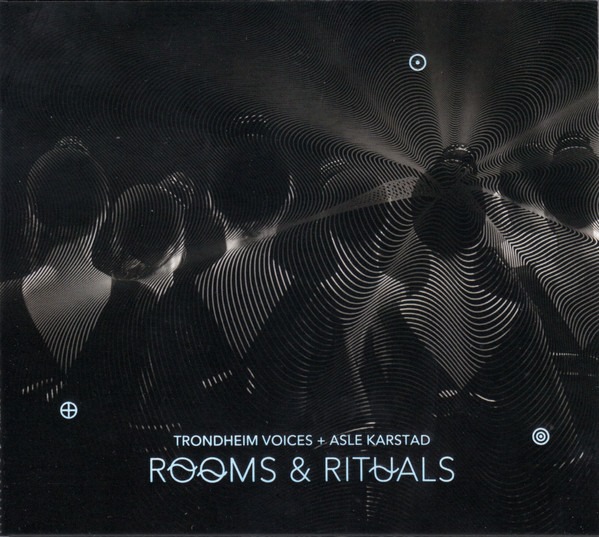
Rooms & Rituals is an album which engages the mind and encourages it to explore the darker recesses. The compositions are haunting, to the point of being outright scary. tapping into the deeper realms of the psyche, teasing out the horror of disquiet, and poking around in those dark, uncomfortable places. The voices are those of no less than ten female singers, although not necessarily at the same time. This is, indeed, a choir like no other.

‘Steamsaw’ sets the tone: dark, ominous, rumbling thunder and fear chords drifting almost subliminally… It’s minimal, and it’s a discomfort you can’t quite put our finger on. But it’s there, it’s real, and it gnaws at the pit of your stomach. ‘Pulser’ is eerie. Voices, disembodied, and as if rising from the grave, amidst unintelligible guttural utterances from the underworld, shrieks, and industrial pulsations and the occasional, sporadic clash of grating undifferentiated noise conglomerate to forge something stomach-churningly tense.

‘Ritual #3’ is a series of bleeps and tweets over a low-end rumble, and is reminiscent of some early Whitehouse, minus the trebly shouting. ‘Rise; is a voice lost in a gale, the sense of dislocation, distance and isolation rendered palpable in the drift. ‘Hymn’ pitches vocal melody that’s evocative, haunting, almost a Celtic folk piece, against a gnawing hovering synth hum, and elsewhere, ‘Gleam’ goes gloriously minimal, trilling organ pulses providing the backdrop to ethereal vocals that drift skyward.

Collectively and cumulatively, these pieces move and unsettle the listener, bringing a sense of dislocation, and disorientation. It creates a space for pondering. This is art.

AA

Trondheim Voices

Humpty Dumpty Records – 11th May 2018

Christopher Nosnibor

It’s quite the introduction: ‘Jérôme Deuson is an unstable musician’ is the opening sentence of the press release that accompanies his seventh album as aMute. But how many musicians are stable? And what even is stability? Is anyone entirely stable? Is it even a desirable state? So often, creativity emerges from a state of inner turmoil, or tempestuous emotional flux. There are, of course, infinite shades: this is just to peel back some of the layers of the initial and likely awkward response to the statement.

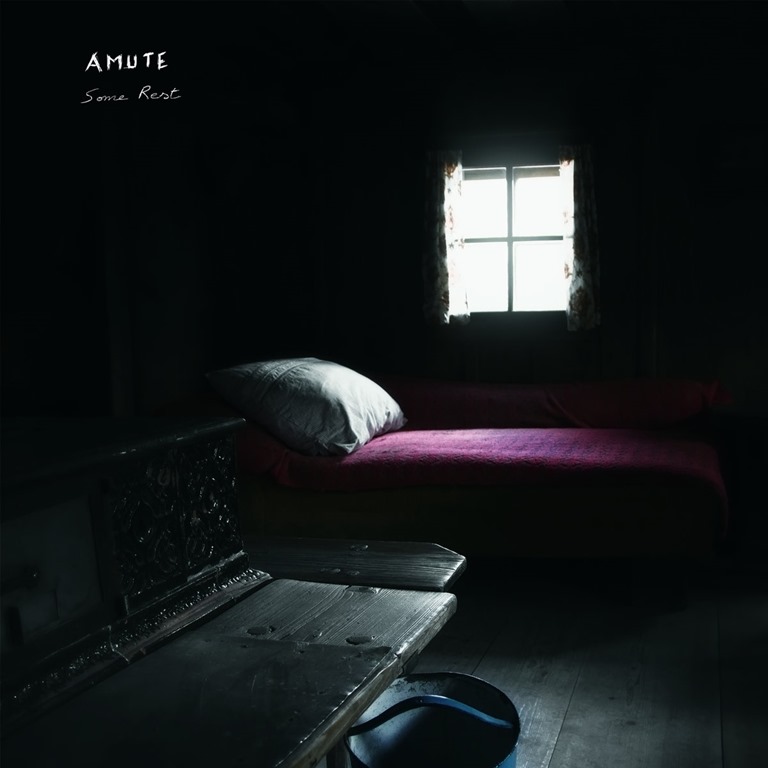
Some Rest is not the millpond calm the title may imply: it’s only some rest, not total rest, and in truth, the rest here is minimal, on an album that’s clearly the work of a restless soul.

The album’s structure and sequence is unusual, opening with the longest composition by far: the title track is almost eighteen minutes long, and transitions from a delicate swirl of strings through a vast, shoegazey post-rock vista to an expansive, driving rock workout. While there are strains of feedback amidst the humming melodic drifts and samples which echo, almost buried in the mix, and the whole thing builds to a sustained crescendo, it’s still a more sedate experience than its predecessor, the tempestuous 2016 album Bending Time in Waves.

Side two begins with the gloopy, bubbling ambience of ‘I’ve Seen it All’ before sliding into eerie dissonance on ‘Dead Cold’, which exploits ringing chimes which give way to softer, picked guitar and a more tranquil, melodic space, disturbed only be the vocal, processed and burred with distortion. It’s sort of melancholic, sort of trippy, sort of dislocated, sort of abstract, sort of shoegazey in a trilling organ swamped in echo sort of way. It’s all amplified into a fizzing digital funnel on ‘The Obsedian’, which features Christian Bailleau, emerging as a grand, slow-moving and mournful piece reminiscent in some respects of Dylan Carlson’s more recent work, exploring as it does the pitch, tone, and timbre of the guitar in near-granular detail. Closer ‘Maria’, with hints of early Pink Floyd, is similarly drifty, dreamy, trippy, echoey-warped, and it tapers away into vaporous clouds.

Because of its ever-shifting nature, and its sonic range, Some Rest provides only the briefest of respites for the listener to relax, creating as it does an atmosphere of flux and continual movement.

AA

aMute

Trace Elements Records – 3rd August 2018

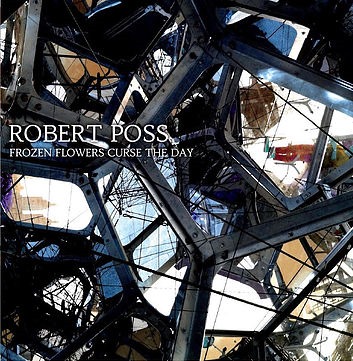
Frozen Flowers Curse The Day is the latest release from pioneering avant-guitarist Robert Poss, founding member of the legendary wall-of-guitars group Band Of Susans, who (in)famously started out with three members named Susan and usually maintained three guitarists in their ever-shifting lineup, which at one point featured a pre-Helmet Page Hamilton.

The development of the album Frozen Flowers Curse The Day was performed, recorded and mixed by Poss at Trace Elements Records studios in New York City with guest drummers including Dahm Majuri Cipolla (Torres, Lydia Lunch, Japan’s Mono) helping out on two tracks.

Being a solo release rather than a full-band effort, Frozen Flowers Curse The Day isn’t an overtly ‘rock’ album in terms of material or instrumentation and primarily features guitar and loops of strings, to sometimes woozy and disorientating effect. But Poss’ approach to guitar playing, lauded by none other than Steve Albini, is certainly distinctive.

Much of the material here is jangling drone, drifting, chiming indie shoegaze. It’s pleasant, easy on the ear, undemanding. In a good way. Frozen Flowers Curse The Day is an album which explores texture, tone, and mood, but above all, it follows the distinctive compositional template of Band of Susans in that the songs tend to bludgeon away at a simple three or four chord sequence while layers of droning chords or feedback build over the top as the song progresses.

This approach is very much to the fore on the album’s second track, ‘The Sixth Sense Betrayed’. Elsewhere, on ‘Partial Clearing’, Poss works the eddies and streams of swirling drone and exploits the basic mechanics of the instrument to create something quite compelling.

While much of the album is given to switch-flicking, string-tamping, knob-tweaking. It’s not so much about the simple chord motifs or notes which hang in the air, but more about their manipulation. But however much this an album shaped by technique you’d never call it a ‘technical’ album. Nores ripple and chime and collide against one another in washes of reverb in the most dreamy, immersive of fashions.

‘Time Frames Marking Time’ hints at ‘Elizabeth Stride’ from Band of Susans’ final album, 1995s Here Comes Success, and even echoes ‘Frere Jacques’, but these are fleeting moments, and that’s the whole point: this is really about transition ad ephemerality and the effects of the briefest of memory triggers from an artistic point of view. ‘I’ve got a Secret List’ is more up-front, a thunderous drum track thumping away beneath multiple layers of guitars, over which Poss strains over a repetitive lyric, while closer ‘I’ll Curse the Day’ comes on like Springsteen in a 4-track tape portastudio.  And yes, while battering away a single motif and simple chord structure, it does invite comparisons to BoS. Significantly, it holds up to those comparisons: Poss certainly hasn’t lost it.

Robert Poss

Radio Bongo

Christopher Nosnibor

The cover art – a photograph of the stump of a recently-felled tree – is one of those exercises in magnificent blandness. It’s the fact it’s clearly in an urban setting which perhaps gives the greatest clue to the music it accompanies; it’s the discarded trainer which actually makes the shot, however. The image really only makes sense in context of the liner notes, which begin ‘The spiral of a record. The routine of life. The growth rings of a tree. The rhythm of a drummer. The groove.’

Production credits go to a President Bongo, and Execution is listed as being the first volume in ‘Les Adventures de President Bongo’ – which, apparently, ‘is a unique work of art that will reveal itself over the next seven years, give or take, in the form of 24 LP’s.’ This is quite ambitious, and while I still have no real handle on the concept or direction after several listens to this album, ‘adventure’ seems to be an appropriate choice of word.

The album contains two tracks, ‘Drama’ and ‘Transmission’. ‘Drama’ certainly fulfils its promise, but in the most unexpected ways. It begins with gloopy electronic pulsations, a sort of semi-ambient dance vibe rippling, soft-edged and mellow. So far, so chillout-orientated, club-friendly mediocre. But then extraneous drones hover and scrape at oblique angles across it, at complete odds with the chilled waves. It takes a while to build, and before the beats kick in. ‘She can make it,’ croons Þormóður Dagsson, over and over again. It’s a cool groove, alright. His voice is so sweet, so smooth, so achingly soulful. He could probably sing a shopping list and still make you melt. But while the vocal sits with the mellow bubbling synth, it’s the discordant noise that swells to dominate the mix. The jarring incongruity of the clash forges less a dynamic tension than it serves as an apparent act of brutal sabotage. And then the drumming goes absolutely fucking berserk, and the whole thing whips into a brain-bending, bewildering mess of sound. The groove is buried in the tumult, from which eventually emerges a driving, bass-dominated jazz-rock groove. Where did that come from? Dagsson’s voice continues to float, untouched, surrounded by a halo of reverb, through the wild wig-out. It all goes jungle with added whistles and bleeps further down the line, and it’s fair to say you’re unlikely to experience a similar seventeen minutes of song anywhere else.

Well, apart from on side two, perhaps. ‘Transmission’ creeps in by stealth before taking a turn for the dubby. It strolls along, bouncing echoes hither and thither. The vocal performance is understated, low-key, yet all the more effective because of it. A note hangs in an echo as a kaleidoscopic spiral of synth notes swirls around the steady, toe-tapping beat. There’s none of the wild experimentalism of the previous track here, the focus instead being on building laid-back atmospherics and a smooching groove that shuffles on unassumingly.

Groove, then, comes in many shapes and forms, and some are less obvious than others. Tilbury take the groove and twist it, bend it, kick it around a bit, push it close to breaking point. The curious nature of the music indicates a curiosity about music on the part of the creators. The end result is pretty damn strange, but also strangely enjoyable. It’s all in the execution….

AA

Tilbury - Execution

House Of Mythology – 6th July 2018

Christopher Nosnibor

In expressing my lack of enthusiasm for David Tibet’s collaboration with Youth under the moniker of Hypnopazūzu, I seemingly gave rise to mirth with my reference to ‘pseudomystical bullshit’. Tibet can laugh it off, but after so long churning out material that veers between the indulgent and the vapidly whimsical, I’m not convinced it’s a laughing matter.

Now, I’ll admit, I’ve never really got to grips with Current 93 – their catalogue was beyond overwhelming long before I even discovered music beyond the mainstream, and their output exists s far beyond the mainstream that I had to pass through Throbbing Gristle, Whitehouse and a slew of others having spent my early teenage years mining the seam of goth and (what was then) contemporary industrial and real indie to even learn of their existence. Context counts, and however influential Tibet has been in ultraniche, cult circles, it doesn’t alter the fact that some of his art and affiliations over the course of his career have been questionable.

ZU93 is the effectively named new collaboration between David Tibet and the ever-changing Italian group Zu, centered around Massimo Pupillo and Luca Mai. Mirror Emperor operates around a concept or theme that’s never really rendered with any clarity. All of the song titles reference the titular Mirror Emperor, but they who, what, and wherefores are absent, and there’s little guidance in the lyrics, which are fragmentary, hallucinatory, abstract and non-linear. This in itself is no problem: life is fragmentary, hallucinatory, abstract and non-linear, and we’re all accustomed to postmodern art and its fragmentary, hallucinatory, abstract and non-linear representations of the life experience.

Musically, it’s sparse but powerful. In terms of composition and arrangement, Mirror Emperor is widely varied, but very much leans toward the dark and ominous. There are brooding strings that soar and sway, drift and drag. There are moments of deep resonance and thick sonic density. Far from being a skippy, trippy, easy ride, it’s often difficult and challenging. ‘Confirming the Mirror Emperor’ is built around a dense, murky bass that booms and surges over a slow, heavy beat, before layers creep over and lift it somewhere altogether different.

Tibet’s delivery is the stumbling block. Every word is delivered with the same sense of immense portent, as if each phrase is a revelation of cosmic proportions. Which it isn’t. ‘And quickly…. A knuckle cracks… into space… Opens up her… and feels…’ he gasps with breathless wonder. I’m more breathless with wonder as to how he can still pull this shit off.

Tibet’s despondency at the emptiness of contemporary culture is something to which I can relate: his wide-eyed mysticism, more of a throwback to 60s hippiedom than the escape routes available now, I can’t. It feels oddly disjointed and out of place. While his fans’ belief in his visionary prowess and the potency of his lyricism, convinces that posterity will see him aligned with Dylan and Cohen, I’m looking at the Mirror Emperor to check out his threads, and I’m seeing none.

It does get easier with exposure: Tibet slowly diminishes into the background as the music intensifies as the album progresses. ‘The Heart of the Mirror Emperor’ is forged from woozy electronic pulsations which glitch and glow. Ignore the breathy, triptastic babble about the sun and moon and it’s pretty good.

AA

ZU93 – Mirror Emperor

Constellation Records – 15th June 2018

Christopher Nosnibor

Bush Lady, originally released in 1985, is described as ‘a unique and magical record by any definition’, and as ‘an invaluable example of contemporary First Nations music that blends traditional folkways with modern composition’. Obomsawin is a member of the Abenaki Nation and one of Canada’s foremost activist documentary filmmakers: with over 50 films to her credit, she’s not primarily known for her musical output, with Bush Lady being released as a private pressing, half of which languished in her home for years and years.

It’s not easy to place. It’s not folk; it’s not spoken word. But then, these aren’t conventional songs either, although there are some charmingly pleasant flickers of woodwind and strings. But it’s primarily about Obomsawin’s vocals. Her voice conveys so much; against monotonous, thudding rhythms and trilling notes, eerie discord and wandering abstraction, she swings between blank monotone and quirky vocal contortions that jar the spine.

The real thing about Bush Lady is just how fresh and contemporary it feels, and sounds, never mind the fact it’s 33 years old. It’s not that nothing’s changed in this time, but an indicator or the creative prowess and sheer otherness of Alanis Obomsawin’s art.

AA

Les Albums Claus – 30th April 2018

Stuart Bateman

Ben Bertrand comes armed with a bass clarinet and a bunch of effects. Recorded live at les ateliers claus in October 2017, NGC 1999 doesn’t sound in any way live, and the five pieces feel very structured and are sequenced in a most cohesive fashion. While the number of singer-songwriters using loop pedals to fill out their sound seemed to explode about 12 years ago, to the point that it’s long been tedious and predictable to witness someone with an acoustic guitar and a little synth layering up the vocals and building simple three-chord strums up to epic choral dimensions.

Bertrand’s application of the equipment is both more subtle and more innovative. The repetitive motifs ripple and bounce against one another, and while there is layering, Bertrand’s restraint is noteworthy, keeping things sparse, low-key, minimal.

Taking its title from a dust-filled bright nebula in the constellation of Orion, 1,500 light years from earth – and distinctive for a black patch at its centre which is believed to be completely empty – the compositions are thematically-linked and contrive to convey a sense of floating in space.

Things to threaten to spiral out of control with shrill, electronic whistles sending the end of ‘V380 Orionis’ (a multiple star system at the centre of Orion and the primary source of light for NGC 1999) skyward. But thereafter it’s very much sparser and quieter. ‘Malkauns on Kitt Peak’ brings a change of tone for the album’s mid-point: a hushed, brooding expanse of elongated pulses which echo out into the darkness, it’s spacious yet strangely airless. For the first time on the album, the clarinet sounds like a clarinet as it meanders through a fizz of skittering treble that falls like shooting stars.

The pieces flow together and transition effortlessly as Bertrand bounces through the abyss with an assurance and tranquillity that’s soothing, but nevertheless strange.

AA

Ben Bertrand – NGC 1999

Hyperdelia – HEX002

Christopher Nosnibor

It seems to be something almost unique to the world of experimental and avant-garde music, that the titles are directly descriptive, functional, literal. Imagine if the practise was adopted in the genres of rock or indie. How would releases like Angsty shit ripping off the Foo Fighters, Adolescents who are pissed off because we can’t get laid and Ten three-minute derivative jangly guitar-based songs about life in college be received? Actually, they’d probably still sell infinitely more units than releases like this, but the point of differentiation is that this is art, and commercial considerations really are not leading factors in determining the work or its release into the public domain.

We learn that Womb is ‘a musical narration for abstracted ears and bodies – engulfing a listener simultaneously in subaquatic sonic environments, distant dreams of childhoods, memories and voices from the unknown: where time and space fold into each other.

The initial material of field-recordings of nature and body sounds, interviews and compositions has been re-recorded and re-amped underwater in a swimming pool – and has been re-arranged (partly by way of the impulse responses of the pool) now for stereo home listening.’ And so we’re very deeply into literal territory here.

It’s watery and muffled, womb-like every second of the way. ‘Cocoon’ sounds like someone typing – quite slowly, unsteadily – while slow ambient music with whale song and slow, arrhythmic beats pulse, all heard with cotton wool in one’s ears. ‘The Garden’ is a long, slow ebb and flow of elongated dronage, spiralling contrails of vapour and mist, an eddying vortex of mid-range that twists ethereal, occasionally rent with bulbous belches of sound which echo out beyond the reaches of perception.

The beats are glitches, pulses, crackles and thudding heartbeats, incongruously urgent and pacey and at odds with the sedate sonic swirls that hover and hang, Samples, muffled and heavily filtered, are abstracted amidst twittering birdsong, wide-sweeping drones, ominous fear tones and unsettling extranea.

The focus is beyond soft: it’s submerged, out of reach. Everything about Womb is warm, supple. There is a sense of depth – immense depth that extends beyond sound to the absolute core of being. A slow immersion that works its way inside, Womb is both meditative and introspective, and while it’s very much conceptual, it succeeds independently as a soundwork.

AA

AA

Kajasa Lindgren – Womb

Christopher Nosnibor

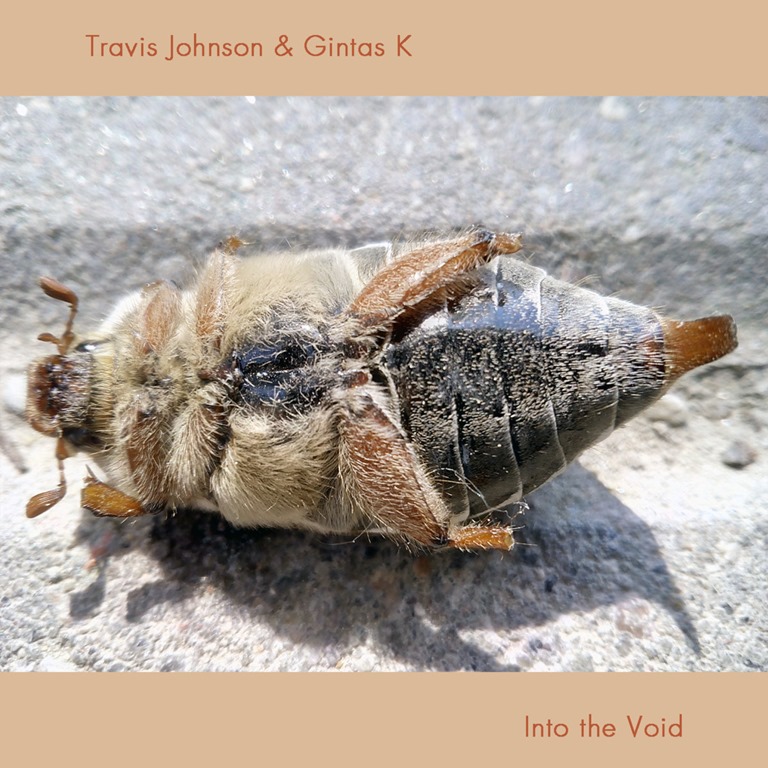
Into the Void is Gintas K’s second album-length release of 2018, and we’re not even quite halfway through. For this outing, the enigmatic granular sonic artist from Lithuania has delivered an array of 14 fragmentary pieces, the majority titled by number, spanning snippets less than a minute in length to quarter-hour brain-sizzlers, with the majority of pieces clocking in around the two-minute mark.

The limited notes accompanying the release state ‘Pieces created by Gintas K using Travis Johnson sound material.- rhythms loops.’ It’s perhaps worth noting that this is Travis Johnson (2) as listed on Discogs – the ‘sound designer, electronic music producer, improviser, and farmer from Suwannee County, Florida, United States’, and not the bassist with metal band In This Moment or either of the other two.

We’re all staring into one void or another, so there’s a degree of universality in the experimental intent of this release.

Those rhythms and loops are warped, splayed, disjointed, whipping backwards and forwards across the heads in a jumble of crazed anagalogia reminiscent in places of some of William Burroughs’ tape experiments from the late 50s and early 60s, when he and Brion Gysin, with the assistance of Iain Sommerville, who was an electronics engineer and programmer.

For the most part, it’s about variation – or not so much – on a theme. Beats stutter and funnel into disarray and fuzzy edges dominate the sounds as those beats crackle and fizz. Most of the loops on here sound sped up and pitch-shifted, gloopy electronica and synthy beats shifted up to resemble clicks and bleeps and scratches of static. Everything crunches and collides at a frenetic pace to create an overwhelming blizzard of sound, a sonic soup that batters rather than massages the senses and the brain. A great many of the rhythms are arrhythmic, or otherwise disturbed or distorted in some way or another. At times akin to a palpating heart, and at others a flutter beneath a screeching squall of static, a fizz of treble and a mess of skittering noise, Into the Void leads the listener into difficult territory, and at times threatens to abandon them in a sandstorm of sound that will leave them completely adrift.

There are some moments of variance: ‘Void4’ is a slow, woozy slice of opiate dub, and ‘Void6’ is largely distorted thumping and rumbling, and ‘Void12’ brings the emptiness of it all into sharp relief, a quavering, oscillating humming drone. It’s minimal, but delivers maximum discomfort.

Personally, I dig it, but as a listening experience, its uncomfortable and far from easy.

AA

Travis Johnson & Gintas K – Into the Void