Posts Tagged ‘drum machine’

Sister 9 Recordings – 9th May 2025

Christopher Nosnibor

Since showcasing single cut ‘Discretion’ last month, I’ve been totally gripped by this new EP by Italian post-punk electro duo Kill Your Boyfriend.

There’s something about the consistent use of one-word titles that adds punch. The complete catalogue of Foetus albums is a strong case in point: Hole, Nail, Gash Blow… Four letters, forming a single syllable, prove to be powerfully evocative, even when there is no context – or perhaps more so because there is no context.

The titles of the six songs on here are rather less abstract, more descriptive, but still strong and evocative in isolation: ‘Ego’, ‘Obsession’, ‘Apathy’… words with emotional connotations, words which plug straight into the beating heart of the human condition. And, just as ‘Discretion’ threatened, Disco Kills is a full-on sonic kicking that registers blows from every direction.

It’s all about that throbbing, hard-hitting rhythm section, and once again, I feel compelled to sing in praise of the drum machine. Much-maligned and still contentious when used in a ‘rock’ context, the relentless thud and crash of programmed percussion can be so compelling – hypnotic, yes, but also in the way it registers in a purely physical way, the toppy snare explosion sending shockwaves through the nervous system while setting eardrums quivering. From Suicide to Uniform via Metal Urbain, The Sisters of Mercy and Big Black, there’s a rich lineage of bands for whom a drum machine used well – and at an appropriate level in the mix – absolutely defines the sound. It doesn’t work for a lot of rock acts because they’re more about having a certain flexibility, but for absolutely smashing the senses with precision timekeeping, drum machines really come into their own, especially when solid, four-square basslines which follow the beats with equal precision are involved.

And so it is that for all the mesh of treble and distortion, Kill Your Boyfriend structure these songs around a punishing rhythm section. No fancy fills or extravagant bass runs – just hammering, solid grooves, which underscore all the rest. I say ‘all the rest’ as if it’s somehow lesser. It isn’t, not by a long shot. ‘Obsession’ would be dancefloor-friendly – to the point you could imagine people turning and clapping in time with the crispy snap of the vintage Akai snare sound, were it not for its dark, distorted vocal. ‘Apathy’ a bubbling dance banger that’s twisted by some dissonant chord changes and an echo-soaked shouty vocal, the end result sounding like The Prodigy remixing Alien Sex Fiend. Apathetic it is not: a Hi-NRG banger with a dark, serrated edge, it is.

They do trancey / shoegaze / synthwavey lightness on ‘Illusion’, which offers an unexpected – and unexpectedly welcome – pause for breath. But although it pulls back on the breakneck pace and abrasion of the tracks which both precede and succeed it, ‘Illusion’ is still dense, richly textured, and overtly beat-driven, with a thick, churning bass lurking beneath. It just doesn’t drive as hard or as aggressively, with an altogether gentler vocal delivery, and it builds tension with twisty guitars with strong echoes of the sound of 1984. Yes, it’s a bit gothy, and it sits well, and all of this means that the thick, buzzy, echoey electrogoth stomp of ‘Discretion’ hits even harder after the lull, highlighting just what an absolute beast it is. And make no mistake: it’s a pumping, pulverising dark disco monster. It’s brashy, it’s trashy, not so much a car crash as a flaming, petrol-tank-exploding pileup with Sheep on Drugs, Selfish Cunt, KMFDM, and Sigue Sigue Sputnik. It’s an instant adrenaline spike, a rush of pure exhilaration.

‘Youth’ begins darkly but offer something more buoyant as a bookend to the EP, like an electro Sex Pistols, it echoes and bounced its way in a rush to the end. It does feel like a rather flimsy add-on, but works in terms of bringing things down again to wrap it up.

Disco Kills is solid and fierce from beginning to end – and while it’s predominantly electronic in its instrumentation, it’s also very much rock, and it’s pure punk all the way.

AA

052932

8th April 2025

Christopher Nosnibor

It’s both an understatement and perhaps a needlessly obvious thing to remark that there is an overwhelming amount of new music around right now. And so it’s aggravating, not to mention disappointing, to hear people of a certain age – and I’m talking the over 35s here, but it becomes considerably more pronounced as the demographic slides up the scale – bemoaning that there’s no decent music being released anymore. No, that is not the problem. In fact, it’s simply not true, on any level. The problem is that there is so much new music that, depending on your tastes and preferences, finding the wheat among the chaff can be like finding a needle in a haystack, if we’re going to push some cliches. The cliches are relevant, because even among the ‘good’ music, stylistically, at least, a lot of what’s out there is a rehashing of other stuff, and finding anything that feels new or different is rare.

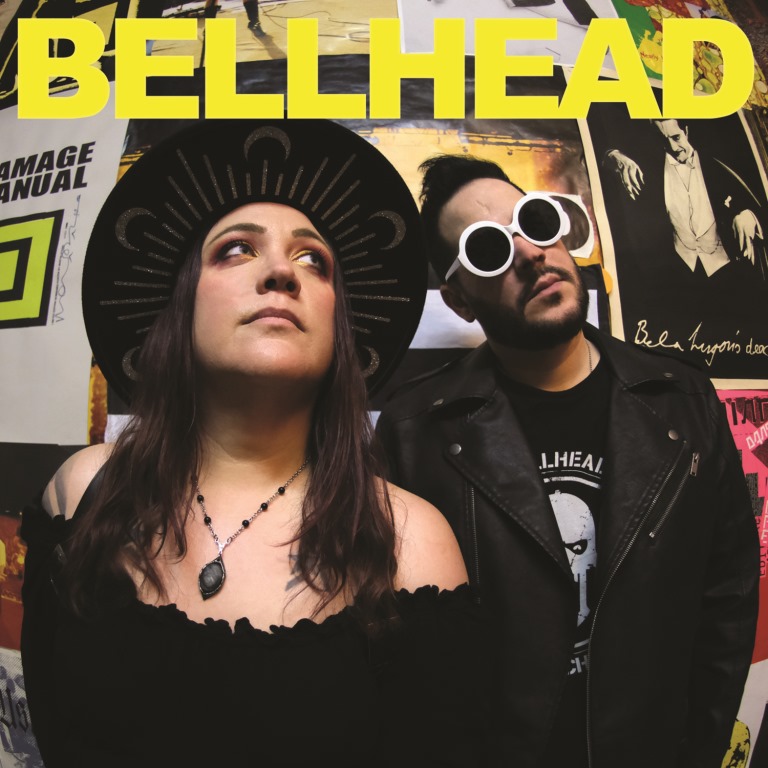
Bellhead are doing something different. Sure, there are elements of post-punk, goth, noise-rock, but there’s nothing ‘template’ or ‘by numbers’ on display here. The fact they don’t have a conventional musical lineup is a key factor, of course: two basses, a drum machine, and no guitar.

The title track is sparse at first, there’s reverb lead bass played high on the neck ringing out and taking the job of a lead guitar, over a grimy, low-slung low-end bass, with some menacing, distorted vocals snarling low and dark. It’s more atmospheric than industrial, at least in the verses – twisty, grindy, reminiscent of PIG with its breaking out into a roaring anthemic chorus – but that chorus sounds like UK goth circa ’86 when it collided with hard rock. It’s huge, it’s hooky, and it’s strong.

‘Heart Shaped Hole’ is hard and heavy, aggressive but with some well-conceived texture and a production that brings everything to the fore simultaneously, amplifying the intensity. The sound is dense, and having bemoaned how a few bands have suffered from their drum machines being too low in the mix during live performances of late, Bellhead utilize theirs to full effect, pitching the beats well up in the mix. It smacks you right in the face and lends the songs an essential muscularity, providing a relentless driving force to which the bass welds itself. The rhythm section is the pulsating heart of any band: with Bellhead, with everything being the rhythm section, more or less, the pulsations aren’t just strong – this is a relentless blast of bass and beats. And there is not much let-up, either. ‘Shutters + Stutters’ is gritty and dark but with a serrated pop edge.

The piano intro to ‘No Dead Horses’ is something of a false lull, because it soon twists and snarls and sneers, emanating menace and sleaze while crunching overdrive grinds over a loping rhythm.

The brace of remixes tacked into the end may be nice bonuses on one hand, but feel perhaps superfluous on the other, with a Stabbing Westward remix of ‘Bad Taste’ from their previous release, and a remix of ‘Heart Shaped Hole’ wrapping it up. The remixes are solid, the former being a super-high-octane dancefloor stomping smasher. But the EP’s five tracks alone are an outstanding document that feels complete in itself., balancing fire and force and heavy atmosphere. But from whatever angle you view it, Threats is all killer, and finds Bellhead taking things to another level.

AA

AA

Atomic Disc eco-pack Horizontal

Metropolis Records – 19th July 2024

Christopher Nosnibor

Metropolis Records – 19th July 2024

Cut back to not so long ago – in real terms – and the prospect of a new album from The March Violets was simply not something you’d imagine. 1987/88: The Sisters of Mercy had broken through in a major (label) way with ‘This Corrosion’ and Floodland; The Mission’s ‘Tower of Strength’ almost reached the UK Top 10 before Children scaled the heights of number two in the album charts, and this was the commercial heyday of goth… and one-time peers, The March Violets were a footnote in the genre’s history, having gone pop and signed to a major, only to go nowhere far and call it a day. They were fondly remembered by those who did, and compilation The Botanic Verses documented their body of work in the early 90s, but… Rosie was busy doing poetry and the like and Si was hiding behind smog as Nurse to Dr Avalanche as part of The Sisters of Mercy’s touring crew.

Then, in 2007, twenty years after they vanished, the band reconvened for a show in Leeds at what was then still the Met. It was a glorious celebration, not only of The Violets and their career, but also the heritage of the Leeds scene, with The Chris Reed Unit representing one of the city’s most singular and longstanding acts, and Merciful Release stalwart James Ray presenting thee magnificently eccentric ambient dance grooves of 25 Men.

Health issues stalled things for a while, but miraculously, 2013 saw the eventual release of Made Glorious – which was in fact their debut album, since the three previous long-players had all been compilations (I’m including the US-only Electric Shades among these). And now, after further setbacks – notably Denbeigh’s departure from the band following a stroke, but also some not insignificant touring under their belts – they deliver album number two, Crocodile Promises a mere eleven years later.

No-one could, or should, expect a band who’ve been going for so long and undergone so many changes – both personnel and personal – to sound exactly the same as they did when they started out. And nor should anyone want a band to exist in a state of suspension or arrested development. Here’s where The March Violets are a rare thing: a band which has evolved, expanded, grown, but equally has never lost sight of their roots. As their Bandcamp bio summarises it neatly, ‘Original Post Punk Drum Machine Band From Leeds. Started at the Beginning, Imploded, Reborn for the 21st Century. Play Loud Play Purple.’ Yes, they’ve even retained their original slogan. And it still works, too.

Whereas Made Glorious was a sprawling beast of a release, comprising sixteen tracks – a double album, effectively, Crocodile Promises is a taut, succinct nine-song document.

Single release ‘Hammer the Last Nail’ kicks the album off in classic style with a snaking drum-machine groove and twangy gothy guitar interweaving behind Rosie’s sultry, vampy vocals.

Where Made Glorious felt a tad slick, Crocodile Promises returns to the pumping, gritty sound that made the band one of the greatest first-generation post-punk acts. ‘Bite the Hand’ is a tangle of metallic, trebly, chorus-hazed guitar against a thrumming bassline and pumping mechanised drum machine, and it’s got the hunger and edge they displayed back in ’83. It’s likely a coincidence that the title is a phrase which featured in a quote from Andrew Eldritch when commenting on the Violets’ departure from Merciful Release… right?

‘Virgin Sheep’ maintains the angular energy, and once again recaptures blistering force of their first iteration, calling to mind the frenzy of ‘Radiant Boys’. ‘Mortality’, the title track from the album-in-progress which was shelved on account of Denbeigh’s stroke is another classic Violets cut, and what becomes apparent while listening to Crocodile Promises is that feels natural, comfortable, not a struggling, forced effort to recreate the past. Of course, the timing is beneficial: the next generation of new music-makers are discovering grunge, post-punk, shoegaze, and goth, and suddenly, the bands who were the progenitors of these styles are finding new audiences, and instead of sounding dates, the styles feel fresh once more.

Of course, great songs are timeless, and great songs are a feature of Crocodile Promises. ‘Crocodile Teeth’ is perhaps more fractal dream pop than goth or post-punk, but it’s got that late-80s Siouxsie vibe that gives the dreaminess a serrated edge. Its inclusion brings balance and space to the album, too.

It would be wrong to say that The March Violets are quite the same band they were without Denbeigh’s snarling interjections, but it would equally be a mistake to criticise the current iteration on account of this. The March Violets are survivors – and a great band. Ever-present co-founder Tom Ashton continues to prove pivotal in defining their sound, and, equally, their attitude. As much as they were a part of that early 80s Leeds milieu, The Violets stood apart, and that slightly wonky, sharp-edged, skewed guitar was, and remains, integral. And moreover, Crocodile Promises is a great album. Its strength lies not only in its consistency, but also its energy and its atmosphere, both of which it brings in abundance. But best of all, this is a true return to form. There isn’t a dud cut here, and every song is up there with the singles up to ’86. It’s incredible that a band at this stage in their career could drop a definitive album – but that’s exactly what The March Violets have done.

a2052340793_10

1st December 2023

Christopher Nosnibor

I may have mentioned before that I’m a sucker for the sound of vintage drum machines – partly by association with so many of the innovative acts which emerged in the late 70s and early 80s, which used them in a host of different contexts, exploring the near-infinite avenues these little bits of kit afforded. For a start – and perhaps most significantly – it was possible to make solid percussion without the need for a drummer or drum kit, meaning furthermore, thanks also to the advent of the portastudio, there was no need for a proper rehearsal space or studio to rehearse and record music. In fact, with relatively cheap synths, you could record as a band without even having a band. The other thing was that, if amped up right, these things could be immensely powerful. And so it was that we saw the emergence of acts as diverse as The Sisters of Mercy and Metal Urbain, Young Marble Giants, and The Human League.

Poly Ghost are a German synthpop trio, and ‘Ananas Ring’ is a quirky, fairly minimal tune that brings together the primitive sound of the aforementioned Young Marble Giants with the retro-chic of Stereolab, delivered with a humourous twist that could only come from a German act. Anyone who says the Germans lack humour is simply missing it. Absurdist wordplay might not be everyone’s bag, but from Die Toten Hosen to the deliberately clunky lyrics on St Michael Front’s first album, there’s no denying that there’s a thread of quirky amusement that’s uniquely German.

And so we arrive at Poly Ghost’s ‘Ananas Ring’, and while the twisted punning of the band’s name is one thing, the inter-language incongruity of ‘ananas’ – French for pineapple – with the English ‘ring’ (the French word for ‘ring’ is ‘bague’) from a German band takes messing around with language to another level. Despite the lyrics seemingly being in English, I have absolutely no idea what the song is actually about. But, I do have functional ears, which are totally sold on this quirky sound. The accompanying video is daft, and ‘Ananas Ring’ is a nifty tune that brings all the analogue, and the squeaky, inflected vocals just make it all the more wonderous.

AA

su80615-AnanasRing-Thumb01m