Posts Tagged ‘Drone’

Gizeh Records – GZH70 –4th November 2016

Christopher Nosnibor

Aiden Baker’s name features on a staggering number of releases, and while Nadja – the duo consisting of Baker and bassist Leah Buckareff – may only be one of many side-projects, the discography they’ve amassed since 2003 is substantial, to say the least. On The Stone is Not Hit by the Sun, Nor Carved With a Knife, they offer three immense ambient doom tracks which make for a welcome addition to that discography.

‘The Stone’ opens the album with a deep, slow bass. A delicate guitar is soon obliterated in a deluge of overdrive. Over the course of the track’s imposing twenty-two minutes, they build a pounding groove, the drum machine and bass in combination emphasising the heavy rhythms. Baker’s vocals are low in the mix, and with the textured, picked guitar chords, they straddle the grinding abrasion of Godflesh and the majestic shoegaze of Jesu. The contrast between the mechanical, industrial drum sound and the rich, organic sound of the guitar is integral to the sound, while the space between the notes is a core aspect of the composition: the stop / start mid-section of ‘The Stone’ jars the senses.

‘The Sun’ provides the album’s colossal, megalithic centrepiece. It takes its time to rise, and a steady, soft, meandering clean guitar and gentle, reverb-heavy vocal owes more to psychedelia and shoegaze than ambient or doom. But there’s a simmering tension that builds slowly but surely. The textures and tones gradually transition from clean to distorted, before drifting out into an extended ambient segment. Yawning drones roll and rumble: these are vast expanses of sound, twisting out toward an infinite horizon. And when the guitar and bass return, it’s with an even greater, more crushing force. The drums are distant, partially submerged by the snarling, thunderous bass and immense guitar which carries the listener on am oceanic expanse of sound.

A subtle, amorphous drone hovers atmospherically through the final track,’ Knife’. Arguably the album’s most ‘pure’ ambient passage, it’s hushed, mellow, almost soporific and marks a real contrast with the previous two tracks. There’s a part of me that, on first hearing, found ‘Knife’ a shade disappointing in context of the album as a whole: ‘The Stone’ and ‘The Sun’ set a certain expectation that, at some point, devastatingly heavy, thunderous bass, crashing drums and cinematic drone guitar will hit like a landslide, but it simply doesn’t happen. However, on reflection – and this is an album which requires much reflection – it’s a well-judged change of form. In confounding expectation on the final track, Nadja show that they’re not tied to formula.

In exploring the contrasts of volume, texture and mood, The Stone is Not Hit by the Sun, Nor Carved With a Knife is a more considered and ultimately rewarding work.


Nadja - The Stone is Not Hit

Christopher Nosnibor

Soma Crew were an obvious and natural choice of support for cult psych at The Lucid Dream on their first visit to York in their nine-year career. I first heard The Lucid Dream back in 2010, when they set their stall out with a brace of impressive EPs. Since then, they’ve released two long-players, with a third out next week – hence the tour.

Soma Crew, playing their second set of the day, are on top form. They’re loud, and they’re in synch. In other words, they’re exactly as they need to be for an optimum performance, and they piledrive their way through a set which opens with the spiky, angular ‘Remote Control’ and culminates in a squall of feedback.

DSCF5938

Soma Crew

Call me prejudiced, but I had low expectations for Eugene Gorgeous. It’s a shocking name, for a start, never mind the fact the band members and the gaggle of mates they’ve brought along, who have little to no grasp of gig etiquette or what moshing is about, are barely old enough to drink but fuck me, they’ve got songs and, mannequin-like bassist notwithstanding, energy. Stylistically varied, there’s an alternative / punk edge to the bulk of an impressive set. And, credit to them and their fans, they don’t do the all-too-common thing of sodding off afterwards, and instead stick around for the headliners. It’s a wise choice.

DSCF5952

Eugene Gorgeous

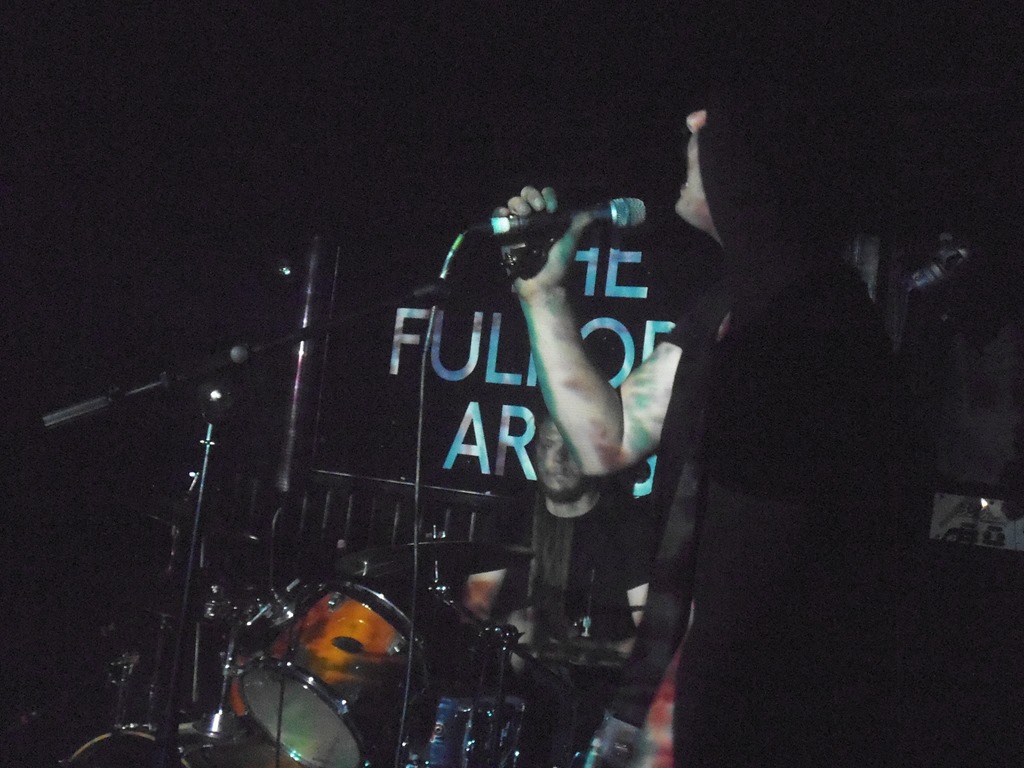
The Lucid Dream ae stunning, and seem determined to make their first trip to the city is memorable one. They may look mundane, but musically, they’re sublime, and they sizzle their way through a set of kaleidoscopic songs which are densely layered and deeply melodic. It’s hazy, blurred, hypnotic shoegaze par excellence. With an early start to the set, it looked like being an early finish, but The Lucid Dream have slowly but surely built a following based on slow-burning epics, and when they announce that they’ve got three songs left and they’re quite long, they’re not kidding: the segued three-track finale sees them lock into a sustained crescendo that explodes for the best part of half an hour. With the set crashing to a climactic close, it makes for an exhilarating and convincing performance. If only they’d had copies of the new album on sale…

DSCF5987

The Lucid Dream

Dronarivm – 18th July 2016

Christopher Nosnibor

Like most writers, and not just music journalists, I sustain myself financially with a demeaning, underpaid yet unduly stressful and arduous day-job in an office. The multinational firm who employ me, being fifteen years behind the times in terms of progressive thinking who have in the last year and a half decided halt the future is digital and that the place to pitch for market share in the coming years is on-line, have gone all blue-sky thinking and have fitted out a large rectangular room in each office with rising rows of seats, like some hideous postmodern parody of a colosseum in MDF. These ‘in the round’ meeting rooms, where the speakers stand in the middle (and consequently have their back to a quarter of the audience at any given time) have been preposterously named ‘agoras’. While throwing out quips about fluffy rabbits and jumpers, I’ve managed to decline all meetings in said room by claiming to be agoraphobic.

The reason for this preamble is that this album’s title is something of a play on words, a hybrid of ‘agoraphobia’ (a fear of public or open spaces) and the suffix ‘phone’, meaning sound. It only half works, in that phonia and phonic tend to refer specifically to speech. And, as anyone with access to a computer will likely know, ‘agora’ (in reference to either a space in an office or a word which simply means ‘public’ or ‘outdoor’) is a misnomer, in that the term ‘agoraphobia’, coined by the German psychiatrist Carl Friedrich Otto Westphal, was taken from the Greek ἀγορά, meaning ‘large public square/marketplace’ and -φοβία, -phobia, meaning ‘fear’. Still, based on the popular perception of the two terms, it makes an obvious punning sense which works in the context of what the album is about, in that it’s ‘a work which explores the relationships between people in given environments, and is specifically set in public spaces, namely the squares, or plazas’.

One might broadly classify this as a work of ‘ambient’ music, but in drawing together field recordings and manipulating the sounds and incorporating them into the rich sonic tapestry that constitutes samples and shimmering drones which form the material of Agoraphonia, Giannico and Aldinucci have gone far beyond the realms of background music and of atmospherics. Agoraphonia is a deeply evocative work, and one that requires a substantial degree of attention and focus.

Created using sounds submitted on-line, the album is a new kind of collaboration, and the end result is a work that requires attention and contemplation. Voices, passing cars and motorcycles and a low-level continuous chatter run through an indecipherable public speech seemingly made outdoors – at least judging by the trebly, tannoy echo – run through the first track, ‘Koutoubia’, as long, lingering drones simmer and eddy, building slowly in volume and intensity.

‘Plaza de Mayo’ finds the soft drones upscaled to vast, multitonal sonic washes which all but obliterate the voices audible at the start and end of the track. But this (im)balance is integral to the album’s purpose. In the world, the voice of man is not always dominant, and the relationship between human life and the environment it has created and inhabits is one which is infinitely variable and in constant flux.

There’s also the relationship between public and private, which at times is uneasy and for some extremely difficult and in some respects the recordings here are manifestations of that seemingly eternal fascination which surrounds the two states, which do not necessarily stand in diametric opposition or exist in binary formation. Giannico and Aldinucci do not offer answers here, but instead provoke thought as they lead the listener through the various locations.


agorophonia-500x500

Agoraphonia Online

Rock is Hell – RIP67

Christopher Nosnibor

This one’s been out a little while now but has only recently landed with me. I can’t feel too much guilt: Regolith aren’t exactly the fastest of movers, however you look at it. They’ve been going for a full decade, and despite having racked up a substantial catalogue of EPs and split releases, it’s taken until now to get around to a proper album (although, arguably, 2009’s Music for Hot Air Balloon, with its three tracks spanning a full hour, would constitute an album by most people’s reckoning). Musically, they’re not exactly about pace, either, trading in crawling ambient drone of almost incomprehensible proportions.

Their debut album proper isn’t exactly about the immediate hit, the hooks or the general accessibility, either, and necessarily requires time to engage, cogitate and digest.

I is a monster work: a double album comprising just four tracks. And the sound is as immense as the album’s duration, inching toward the 80-minute mark, with each of the tracks clocking in around 20 minutes in duration. But it’s not just about the length: feel the weight. The sounds may be produced electronically using analogue synths and a vast array of effects, and Regolith may describe themselves as ‘tech freaks’, but the material is heavily steeped in the tropes of doom. Having spent my childhood living on the flight path of the takeoff / landing of the RAF Vulcans, I feel qualified to make the analogy of the drones sounding like jet engines rumble and roar, a spectrum of lower-end frequencies that focus on the ribcage, the particle-splitting noise is also more than enough to terrorize the most dulled eardrums. ‘Platinum’ sounds like my young recollections of the Falklands War. The molecule-destroying, air-shredding sound engulfs the listener; the experience is immersive and annihilative.

‘Comet Tails’ is a far sparser affair, echoed beats decaying into the void, the space between the sounds comparable to the distance between planets. Gradually, as slowly as a planet on the outer reaches of a solar system orbits its sun, a low drone begins to rise and swell, a dark, large sonorous body of sound, a black hole cruising closer with inexorable determination. The hum continues to grow until its edges begin to distort and disintegrate and bleeds into ‘Star Trails’. One benefit of hearing this in a digital format is the two tracks do run together. Of course, the downside is simply that however enormous the sound, the full enormity can only really be conveyed via the medium of vinyl, and ideally on a decent set-up with a solid amp and some fuck-off powerful speakers. It’s an album that has the capacity to make the earth move.

The sound is more than fitting for a band named after ‘a layer of loose, heterogeneous superficial material covering solid rock, which includes dust, soil, broken rock, and other related materials and is present on Earth, the Moon, Mars, some asteroids, and other terrestrial planets and moons,’ and whose objective is to create ‘music on a geological scale; music of mountains, shifting like glaciers, slow and relentless processes on grand timescales’. The tracks on I are at once heavy on the ground, and beyond gravity, simultaneously tectonic in their movement and of galactic proportions.

Regolith

Regolith Online

Ritual Productions – 22nd April 2016

Christopher Nosnibor

The Poisoned Glass is the current musical venture of G. Stuart Dahlquist and Edgy59, formerly of Seattle doom metallers Burning Witch who called it a day in 1998. While former bandmates Stephen O’Malley and Greg Anderson have gone on to achieve world domination, Dahlquist and Edgy59 have maintained rather lower profiles. As such, The Poisoned Glass are unlikely to garner the kind of attention Sunn O))) receive, but this is no sleight on their output: 10 Swords is dark, heavy, textured, and immensely atmospheric.

The album begins sparse, stark and dark, with the six-and-a-half minute ‘Plume Veil’; a ringing drone hovers icily. Anguished vocals intonating impenetrable lyrics emerge amidst erratic percussion that hits like cracks of thunder, and bass notes that register the kind of vibrations that could cause mountains to crumble.

‘Toil and Trouble’ is an elegiac, spiritual piece, haunting in tone and vast in magnitude, its sepulchral tones rent by demonic howls of pain and extraneous crackles of surging noise which seemingly rise from the underworld.

It’s incredibly dark stuff that borders on the oppressive at times; drones and groans, rumbling piano chords echoing in empty rooms of crumbling castles. The vocal harmonies on ‘Verbatim’ are overtly rock in style, but set against a doomy bass trudge that’s as crushingly heavy as planets colliding.

CD bonus cut ‘The Still Air’ marks quite a departure from the rest of the album; it still features brooding, droning atmospherics, but is led by a soulful vocal acapella which is every bit as compelling as the cold noise that radiates from the other tracks.


New (March) PG album cover

The Poisoned Glass at Ritual Productions Online

Gizeh Records – GZH65DP – 18th March 2016

Christopher Nosnibor

Gizeh is a label which grasps the importance of the complete music experience, and never stint on their packaging. Anyone purchasing their product can feel a tangible sense of both art and artefact, and Anders Brørby’s brooding instrumental album Nihil, the second release in their ‘Dark Peaks’ series, is no exception, housed as it is in a textured gatefold sleeve, the radiating sunburst design raised from the surface, in heavy black ink on a matt black background. How much more black could it be? The answer is none. None more black (the white paper band printed with the artist’s name and album title which much be carefully slid from around the sleeve in order to access the contents notwithstanding).

The presentation provides a suitable indication as to the sonic experience it prefaces. Nihil meaning nothing: while it has, since the 19th Century come to connote a negativity, manifesting as antagonism or rejection through the widespread use of ‘nihilism’, as of and in itself, ‘nihil’, or ‘nothing’ implies an absence. Neither positive or negative, it is simply a lack. Absolute nothing is beyond the human ken, and so, in artistic terms, there is a need to portray nothing, absence, with something. This is something Norwegian composer sound artist Brørby achieves on the 10 pieces which comprise Nihil.

Primarily, the music is dark. There is a lack, an absence, of light, at least in terms of the overall sensation it conveys. Melding elements of drone and dark ambient with more abrasive sounds, the compositions infer an experimental bent which places atmosphere at the fore. The structures are almost subliminal, the shapes of the pieces largely evolve and emerge briefly through a succession of transitions as layers of sound overlap and drift across one another almost imperceptibly. Musical forms are therefore explicitly absent, expounding the concept of ‘nihil’. As such, Nihil is a work of subtlety, and a work which bears theoretical scrutiny, and sits alongside works by the likes of Christian Fennesz, Lawrence English and Tim Hecker.

But subtlety should not be read as a synonym for sedate or tranquil. ‘As Dead as the Stars We Watched at Night’ builds layers of dark noise and swelling drones scrape and torment the nerves, and while the gentle, chimes which ripple in cadence through ‘I Will Always Disappoint You’ offer a glimmer of light and warmth, ‘Put Your Ear to the Ground’ finds a harsh, thick distorted fuzz that obliterates the smooths contrails beneath and accentuates the unrest on which Nihil is constructed. Likewise, the serrated howl of ‘From the Window Above the Lake’ conveys the anguish of emptiness.

Through the medium of sound, Brørby creates a conceptual absence (not to be confused with an absence of concept). There is no message, and Brørby does not purport to convey anything through the work beyond ‘raw atmospheres’. ‘Raw’ implies unfiltered, unadulterated, without manipulation nor refinement, and while this may not be strictly true of Anders Brørby’s creative process, Nihil nevertheless presents itself as being self-contained, a work about absence of anything but the sounds it contains. It is not ‘about’ Anders Brørby, and if anything, the artist is, if not completely absent, then very much hiding in the shadows.

It’s an album that’s best appreciated in a semi-present state, to allow the sounds to slowly wash over the senses and most of all, to be heard without preconceptions or expectations. Because nothing can often leave you with so much more than something.

Anders Brorby - Nihil


https://bandcamp.com/EmbeddedPlayer/album=4022471447/size=large/bgcol=ffffff/linkcol=0687f5/tracklist=false/transparent=true/


Anders Brørby Bandcamp

It’s sad that in 2016 there should be a need for a York Stand Up To Racism benefit gig. But, as one of the speakers noted, periods of austerity tend to bring division, and invariably, race-blame is one of the ways in which frustration at social deprivation and disparity manifests itself. And so, as war rages in the Middle East and we bear witness to the biggest mass displacement of people since WW2, there’s a disconcerting negativity toward asylum seekers, continually referred to in the media and beyond as ‘migrants’ (like it’s a dirty word, and somehow associated with vagrants), with a particular antagonism towards Muslims (as if all Muslims are extremists, and that’s before we consider Christian extremism, which has seemingly been acceptable since the Crusades).

But we’re all here – and yes, it’s a more than respectable turnout – for a mix of speakers and music-makers, disparate in style but united in the opposition to racism, to social division, to stigmatism, to segregation.

It is, necessarily, a mixed bag, and some of the speakers are more compelling than others: Pinar Aksu spoke lucidly of her experience of life in the UK since arriving as an 8-year-old asylum seeker from Turkey in 2001 and living in Glasgow, and Labour MP for York, Rachael Maskell was passionate and rousing during her succinct and well-paced speech. Some of the other speakers seemed less confident, less organised and less cogent, undermining the importance of their messages. But it would be wrong to criticise their contributions: this is about inclusivity. Not everyone can be a great public speaker, but that doesn’t diminish their societal contribution. If anything, tonight’s event highlights the way in which the current right-wing government, and the equally right-wing mainstream media are exerting their control by means of slick manipulation of the mainstream media channels. Tonight is not about spin, but the voices of real people, who have experienced the traumas of racism, of war, being heard.

Of the bands, Low Key Catastrophe and Orlando Ferguson proved to be the night’s real standouts: the former, on early, and making their debut appearance had an infectious energy that infused throughout the audience. Their brand of punky / post-punk tinged dub reggae has something of an anarcho vibe to it, and while the band as a whole are busy working out some chilled grooves overlayed with some tetchy, angular guitars, front man Jim Osman is a real live wire – a charismatic performer, he’s got the kind of passion you can’t fake and is and utterly compelling.

Low Key

Low Key Catastrophe

In contrast, Orlando Ferguson – duo John Tuffen and Ash Sagar – push hard on their avant-garde credentials and are all about the drone. Summ O))) without the power chords or distortion, ‘Earth 2’ reimagined without the gut-churning metal grind, their set, sculpted with duelling bass / guitar feedback and essentially nothing else is the droniest of drone. And it’s ace. There’s no overt political message here, but it’s clear that these guys are on the side of good.

Orlando Ferguson

Orlando Ferguson

The running order changed a few times, and things were running spectacularly late, which meant that after a long day at work after a 4am start, I wasn’t up for watching ZiZ (and I’m prey hardcore about staying it out to the end of a gig). Irked as I was at times by the apparent lack of organisation, and the conversation over performers (Nick Hall, offering his own brand of Folk Rock / Americana had a particularly tough battle against the endless babble), it was a landmark night that brought people together, and that’s what matters.

Pomperipossa Records – PRLP2 – 16th April 2016

James Wells

An act called drøne can surely only be about one thing, and yes, drøne (Mark Van Hoen, who’s renowned as a solo artist as well as for his work under the Locust moniker, and Mike Harding – no, not the folk singer / comedian known as the ‘Rochdale Cowboy’) are indeed masters of drone. Reversing into the Future contains two tracks, ‘This Strange Life’ I and II, although the digital version masters them as a single continuous track with a running time of some 42:45. Really, how much drone – or drøne – do you need?

Drone-heavy as it may be, ‘reversing into the future’ manages to hold the interest by exploring a wealth of different textures, creating a is a collage consisting of field recordings, short wave radio, and modular synth, assembled seamlessly to forge a journey of electrically-charged dissonance, drones and electronic melodies.

It would be an absurd act of pomposity and pretention to devote 500 words to the transportative effects of the music, just as it would be an exercise in needless intellectual onanism to effuse over the nuances of the way the various textures and tones resonate with and against one another to achieve various effects.

Reversing into the Future is an intriguing album, and one which will resonate in different ways with every listener. It’s dark, it’s ominous, but it’s also uplifting, graceful. For those who respond on a more technical or theoretical level, there are near infinite depths to explore.

Don’t be deceived: Reversing into the Future offers so much more than mere drone.

Drone

Drøne Online

Gizeh Records – 12th February 2016

Christopher Nosnibor

Æmaeth is the project of Owen Pegg (A-Sun Amissa / Hundred Year Old Man), and he’s already scored a number of films. Independent flick The Roman is a silent work which to which ten segments of improvisational drone-based passages played on guitar and piano were composed by way of an accompaniment.

Since the film premiered in May 2014, its soundtrack has been evolving, developing, accruing layers and details, until finally, the ten pieces came together to form a fluid, brooding sequence that stands as a whole, and as a powerful sonic journey. It’s fitting for a film which is no gung-ho Hollywood take on history based on a succession of cast off-thousand battle scenes. Simon Rawson’s movie, shot in Yorkshire, is outlined as a story of two men, lost, who are ‘challenged and tested by nature, each other and the inner most conflicting primordial affiliations with man’s body and mind’.

Pegg’s soundtrack conveys so much, its dark, tense tones resonate as they connote psychological drama. The battles fought within the mind, the conflict and the uncertainty. The barren, unforgiving landscapes, shadowy woodlands and bleak moors. These are the scenes portrayed within the compositions, which are spacious, often sparse. Delicate piano notes drift airily but ponderously, gradually eclipsed by deep, dark, thunderous rolling drones, stormy and threatening. At times, the sheer weight and density of the ominous tones are oppressive, the sounds so large as to create a sensation of a pressure being applied to the skull.

That isn’t to say the soundtrack lacks subtlety: far from it. There are passages of quiet, so hushed as to compel the listener to strain their ears listening for some faint sound – and invariably, there is something, something small, soft, indistinct. Or there are layers of sound, often in the upper frequencies, needling the senses, tugging at the peripheries of the psyche, somewhere in the background or half-hidden, off to one side. These, like the brief moments of light which occasionally present themselves, are integral to the soundtrack’s dynamics, and the power of its effect.

There is torment, there is discomfort. There is also an ever-present sense of danger, sometimes distant, sometimes heart-stoppingly close.

The final passage, the nine-minute ‘Neptune’ is vast, built on a slowly turning vortex of sound. A rumbling rhythm lingers as it pulses just beneath the surface of its soft tonality and offers a hint of redemptive relief at the conclusion of a journey which is most worthy of the term ‘epic’.

Æmaeth - Roman


Æmaeth – The Roman at Gizeh