Cruel Nature Records – 27th February 2026
Christopher Nosnibor
It’s a small world, as they say, especially if you live in York. As a city, it has more of a town feel, and round my way to the south of the city, it’s more like a village. It’s rare that I go for one of my daily walks or head to the local shops without seeing at least one person I know to nod or say hello to, and it’s nigh on never that I turn up at a gig where there aren’t people I know – mostly from previous gigs, and it’s a positive thing: there’s a palpable sense of community. So it’s more of a surprise that despite mutual friends, I’ve never encountered Andy Goz, or his band Neon Crabs, a transatlantic collaboration with Matt Nauseous of Dallas, Texas (I’m guessing those aren’t the names on their birth certificates), which has been operating since 2021. They made their debut last year with Make Things Better? on Half-Edge Records, followed by Drop It On Ya on Metal Postcard Records, with the cassette edition of This Puppy Can See A Frog representing their first physical release.
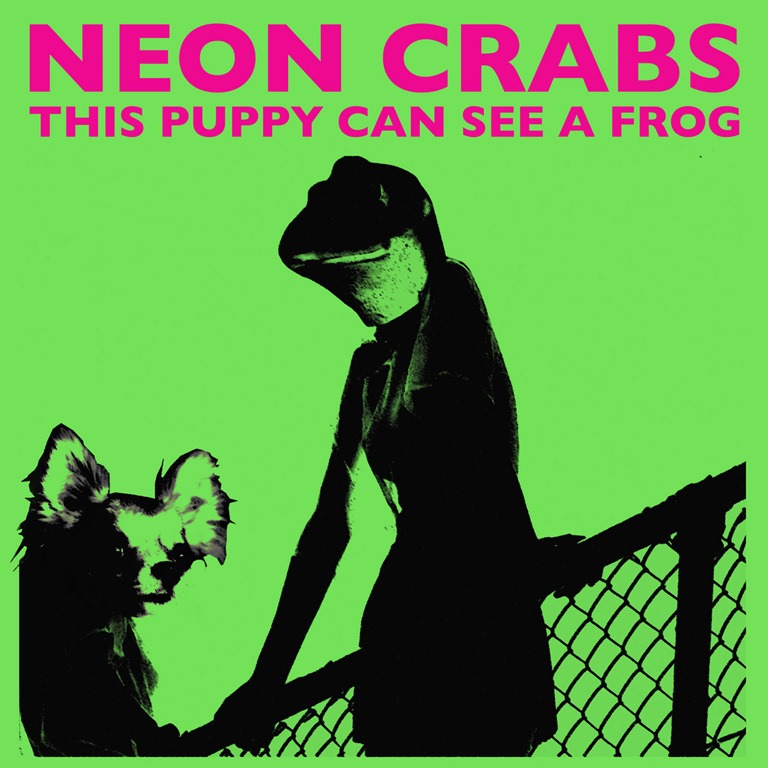
I’m going to guess that the colour scheme of the cover is no accident, a knowing reference to Big Black’s Songs About Fucking – although the material it houses is more in the vein of The Hammer Party.
It’s pitched as a collision between The Stooges, post-punk, and 90s noise rock, and as a fan of all three, I’m sold. The way in which they draw these elements together to conjure a sonic hybrid is inspired: here, we have the mechanoid, piston-pumping drum sound of Big Black paired with the scuzzed-out guitar fuzz of Metal Urbain. Just as The Stooges were punk years before punk was even a concept, and Metal Urbain and offshoot Dr Mix and The Remix (a huge influence on both Steve Albini and The Jesus and Mary Chain), so Neon Crabs launch themselves headlong into that space where acts were feeling their way around forms, styles, and technologies which seem primitive now, but where limitations led to innovations. This Puppy Can See A Frog has a raw energy, an underproduced, analogue feel with jagged guitars and some loose but dynamic playing.
The songs themselves are simple in both structure and chords – the guitars often straying away from chords to create texture rather than melody. The same is often true of the vocals, Matt swerving between semi-spoken word and drawling, occasionally singing but weaving around a tune rather than following it, in a style that’s perfectly suited to the frenzied maelstrom of discord which fizzes all around. ‘White Collar Witch’ is a messy collision between early Pavement and The Fall circa 1983, and is arguably Neon Crabs’ equivalent of ‘The Classical’.
‘Creature Violence’ adds free jazz to a murky mess amidst which Nauseous lives up to his name with what appears to be an extended riff on the ‘your mum’ insult with some scatological references as an added bonus. Or something. Maybe. The Fall comparisons stand on ‘Vicious Debasement’, a snarling, mess of layers spilling every whichway over a throbbing motorik backing – but then again, there’s a bit of the irreverent chaos of Trumans Water happening here, and a whole lot more.
Things seem to get darker, starker, and more desperate and ugly and experimental during the second half the album, dragging in dubby bass which seems to reference Bauhaus and squalling, scratchy guitar work with hints of Gang of Four and Wire abounds.
The simple act of titling a track ‘Lisa Kudrow’ evokes the spirit of 90s noise rock, the likes of Butthole Surfers and Tar and sure enough, that’s pretty much what you get, with added samples.
This Puppy Can See A Frog is a wild assimilation of sources, a rackitacious mess of noise heaped together as an album. It sounds like it could have been recorded in a dingy basement on an 8-track, or even a 4-track, in the space of a week – and is all the better for it, because it possesses an immediacy and energy that’s rare here in 2026.
AA
AA

 Aural Aggravation