Posts Tagged ‘Consumer Electronics’

Editions Mego – 21st February 2025

Christopher Nosnibor

Russell Haswell and Florian Hecker are both prolific as solo artists, each with numerous collaborations with other artists to their respective credits, Haswell also having been a contributor to and touring member of Consumer Electronics. The UPIC Diffusion Sessions are a long-running collaborative project which began in the early 2000s, exploring Iannis Xenakis’ UPIC system as the sole instrument.

As the accompanying notes outline, ‘The UPIC is a computer music system that generates sound from visual input. The original intention of the system developed by Xenakis was to make a utopian tool for producing new sounds accessible to all, independent of formal training. One can locate footage of Xenakis and a group of children making drawings for the system in the 70’s.’ They continue, ‘The duo set off experimenting with a diverse array of hand-drawn images to feed the UPIC system including news photographs of disasters and atrocities, “food porn” through to depictions of the natural world and microscopic images of molecular structures (including ‘the blackest ever black’). The resulting eccentric audio from these images is claimed by the artists to heighten synaesthesia and is as mysterious as it is baffling.

I suppose the potential outputs for the UPIC are as infinite as the inputs, and this alone makes for a fascinating project, and the results here are, indeed, mysterious and baffling. The recording from this session is represented by a single track, just over half an hour in length.

Immediately, trilling oscillator tones rise in pitch – and keep rising, until you feel the pressure build inside your skull. There are glitching spasms of sound which flash across like subliminal messages. The pressure drops and the siren wails fade out, before scuttering blasts of seemingly random noise collage and intersect across one another, buzzing and fizzing, humming and thrumming… the forms move quickly, and shift from dark to light, hard to soft instantaneously. Shimmering sprays of abstract sound burst like fireworks, short interludes of harsh noise wall, microtonal bubbles and ZX Spectrum like babbles and bleeps all intersect or pass within mere seconds of one another. It is, very much, a sonic collage, the audio equivalent of William Burroughs’ cut-ups, an aural articulation of the simultaneity of experience of life in the world. Burroughs’ contention was that linear narrative is wholly inadequate when it comes to representing the real-world, real-time lived experience, whereby overheard conversations, snippets of TV and radio, and all the rest, not to mention our thoughts and internal monologues, overlap, and to present them sequentially is not true to life.

Leaping disjointedly from one fragment to the next at a bewilderingly rapid pace, listening to this is rather like the way the mind, and often conversations, skip from topic to topic without ever seeing any single train of thought to a defined conclusion, bouncing hither and thither in response to triggers and associations which often seem to bear no logic whatsoever.

There are thick, farting sounds, buzzes like giant hornets, choruses of angry bees, weird sonic mists and transcendental illuminations… of course, these are all conjured in the mind in response to these strange, sometimes otherworldly, sci-fi sounds, part BBC Radiophonic Workshop, part tinnitus and nightmare of imagination. Unpredictable isn’t even half of it as alien engines and spurs of 80s laser guns crossfire against earthworks, roaring jets, explosive robotics, skin-crawling doom drone, whispers and whistles, proto-industrial throbs…it’s a relentless blizzard of sound.

‘Experimental’ has become something of a catch-all for music that draws on eclectic elements or perhaps incorporates a certain randomness: this, however, is truly experimental, given that there is no way of knowing how the programme will interpret the input provided. And as much as the output involves oscillatory drones and the kind of synthy sounds associated with analogue, and with woozy, warping tape experiments, it evokes the drones of collapsing organs, wild sampling and everything else your brain could possibly conjure.

At once exhilarating and exhausting, UPIC Diffusion Session #23 is… an experience.

AA

eMego316V front

Christopher Nosnibor

Something is wrong. Seriously wrong. That there is something wrong with the enigmatic Paul T, who is Foldhead, almost goes without saying: purveyor of strange and dark noise via means of a multitude of collaborative projects as well as solo channels, creator of avant-garde visual art, William Burroughs nut, and passionate left-winger, Paul is the epitome of the fringe polyartist who confuses and confounds all things mainstream and normal. These are all the reasons I like the guy and so enjoy collaborating with him whenever we manage to get our shit together. He gets it: he lives and breathes cult and outsiderdom, and has both the means and the theoretical comprehension. Which in the eyes of the many, makes him wrong. He doesn’t fit and neither does his work, and his output as Foldhead is just so much noise to most ears.

The (at least on the surface) inexplicably-titled liveBufferingErrorTimeout (I must clean the black milk with brine) is typical, and wrong on every level. This is electronica that splinters the peripheral senses. It focuses on frequencies that register almost subliminally and that hurt the most, with shards of brain-piercing treble attacking from all sides while whipping whorls of stuttering circuit crackling prod the synapses like needles. It’s a relentless crackle, pop, hiss and fizz, like a firework display exploding inside your cranium exploding over a wash of analogue froth.

Recorded on 19 October 2019, the recording features just the one piece – ‘rotting tongue: nature’s assailed’. It’s as brutal as whiplash and ten times more likely to induce tinnitus, and with a running time of only 7’34” – instead of a classically Burroughsian 23’ that’s more typical, something is very wrong indeed. The noise stops abruptly, and in the absence of information accompanying the release itself, the clue, I suspect, is in the title.

Equipment malfunction or failure is one those things that plagues the recording artist in the digital age. And so what was mapped out to be an hour of racket has emerged as a mere seven minutes; a single rather than an album. But what it lacks in duration, it makes up in pian infliction. A short, sharp shock indeed.

AA

Foldhead - Buffering error

Wharf Chambers, Leeds, 4th April 2016

Christopher Nosnibor

Despite there being a fair few middle-aged blokes in black jeans milling about, the demographic of the crowd who’ve turned out to Wharf Chambers on a Monday night is pleasingly diverse.

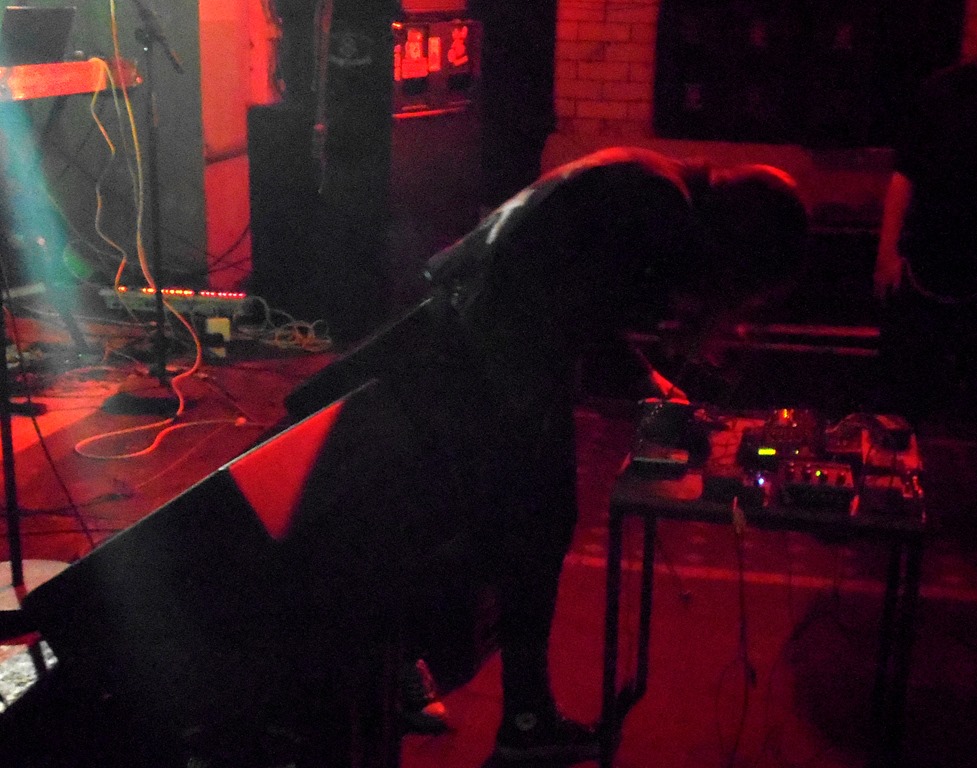
Knifedoutofexistence is one man, Dean Robinson-Saunders. A lone artist with a substantial array of pedals and electronic bits and pieces and a bleak outlook. A fairly standard stereotype on the noise scene. He’s dressed in black, long hair down over his face as he hunches over his spread of kit, laid out on a table on the floor on front of the stage, in near darkness, growling and howling impenetrable intonations of pain and anguish amidst a wall of raging noise. But Knifedoutofesistence stands out by virtue of being making a raging wall of noise that’s texturally interesting, and by the sheer intensity of the performance. He clutches a chain, which he wields and occasionally thrashes against the ground in nihilistic fury.

Knifedoutofexistence

Knifedoutofexistence

A common shortcoming of noise and power electronics shows is that the lineup will be packed out with acts all doing pretty much the same thing, which ultimately gets wearing long before the headliners take the stage. So, credit is definitely due in recognition of the diversity of the bill here.

Circuit Breaker, who’ve been supporting Harbinger Sound label-mates Consumer Electronics around Europe may have proven somewhat divisive amongst the audience members, but the Milton Keynes duo’s brand of dark synth pop, overlayed with screeds of murky guitar provided vital contrast. Wirth his eyes obscured by his hair, and an idiosyncratic style of enunciation which reminds me of Brian Ferry (think the footage of Roxy Music performing ‘Virginia Plain’ on TOTP), I find myself spending much of the set looking at the singer’s teeth. Musically, they’re more like a guitarier, gothier Gary Numan.

Circuit Breaker

Circuit Breaker

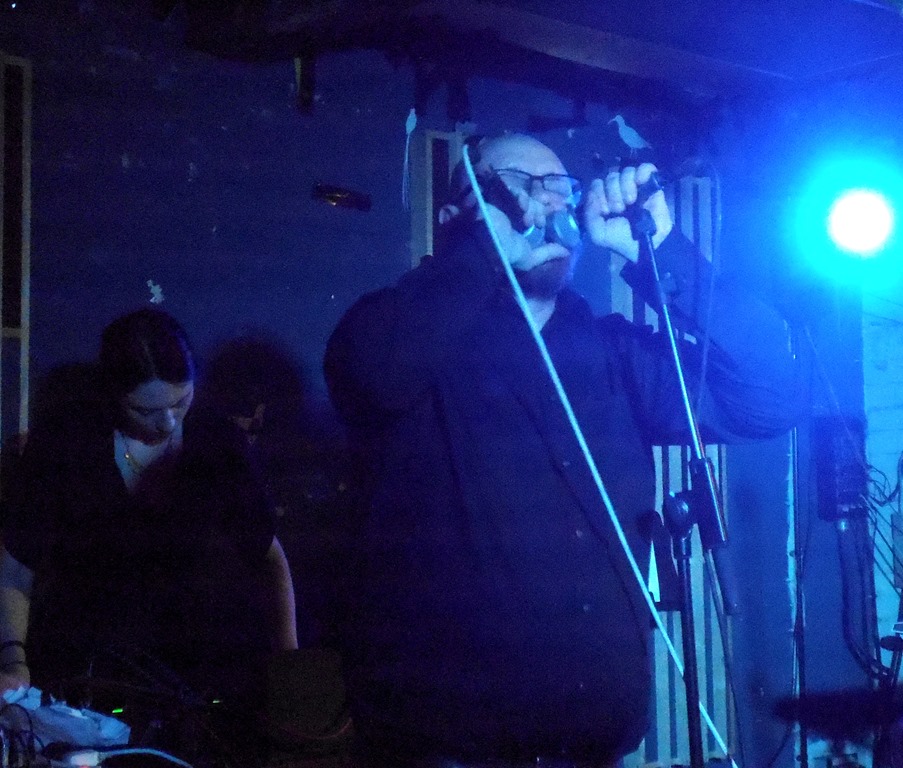
Sarah Froelich – aka Sarah Best – has very nice teeth. She also has some serious lung capacity, and opens both her lungs and mouth wide to vent streams of lyrical abrasion. Flipping in a blink of an eye between sultry poses and a serene expression to raging banshee, she presents a formidable and fearsome presence on the stage. Her whole body tenses as she hollers maniacally, giving her performance a ferocious physicality. Wild, unpredictable, dangerous, she’s the perfect foil to Philip Best’s splenetic tirades.

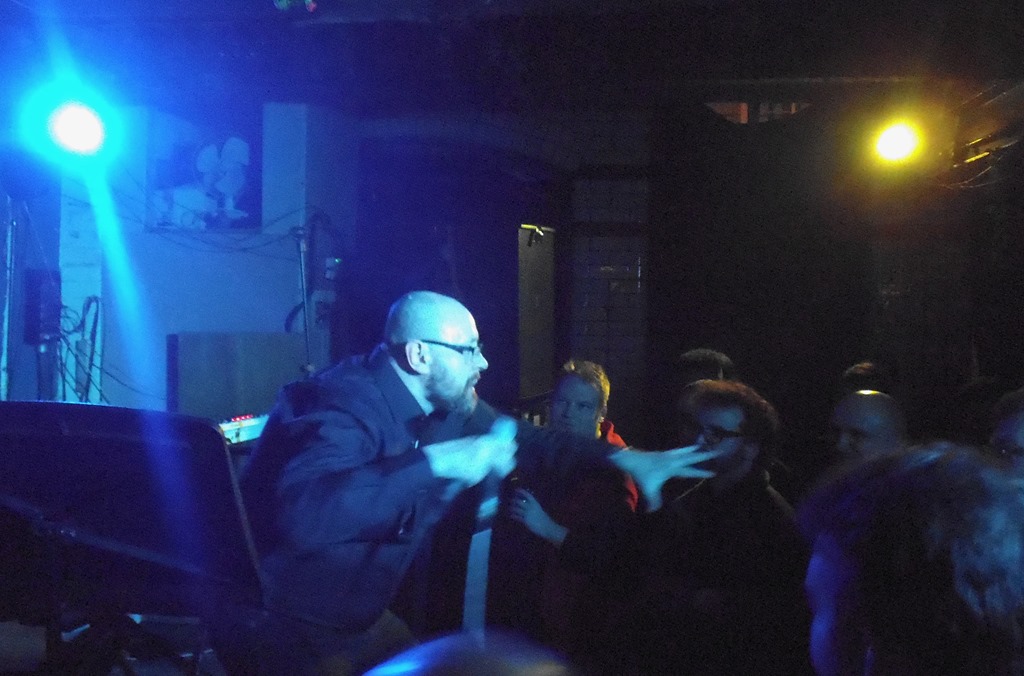
Having seen Best perform with Whitehouse on four occasions between 2003 and 2007, it’s reasonable to expect some crossover in his stage act, but while he still throws the occasional power pose and postures with parodic lasciviousness as he tweaks his nipples, it’s the differences between Consumer Electronics and Whitehouse which are most evident tonight.

Consumer Electronics 1

Consumer Electronics

First and foremost, the thudding beats which drive many of the tracks mark a clear separation from the largely arrhythmic noise of the overlords of the Power Electronics genre. There’s a more overt sense of structure and trajectory to the compositions, and while there is noise, there’s also a greater diversity of texture, and a sense of restraint. More than anything, the sonic attack is used as a means of adding emphasis to the lyrical content, rather than something that buries it.

Best’s lyrics have a poetic quality. We’re not talking pretty pastoral vignettes or vogueish socio-political commentary with a hip-hop vibe, but nevertheless, this is not just some guy shouting obscenities in a blind, inarticulate rage. In fact, you’d be hard-pressed to find rage more articulately expressed, and on numerous occasions during the set, I felt like the Consumer Electronics live experience is in many respects a (brutal, vitriolic) spoken word performance, with the emphasis very much on performance, bolstered by beats and extraneous racket.

Russell Haswell’s contribution to the dynamic shouldn’t be undervalued, either, and his featuring in the current lineup brings new dimensions to the sound. Standing unassumingly at the back, and often nipping off stage, as he unleashes shards of sharp-edged analogue fire.

Consumer Electronics 2

Consumer Electronics

There are some tracks that go all-out on the assault – ‘Co-opted’ finds Best and Froelich duelling over the most ferocious delivery of the refrain ‘Cunts! Co-opted by cunts!’, but much of the set, culled largely from the two most recent albums, Estuary English and Dollhouse Songs, shows just how much Consumer Electronics have refined Power Electronics and the extent to which they explore nuance and contrast. Tonight, they’re nowhere near as loud as many Power Electronics acts, not least of all Whitehouse at their most explosive, but the impact of the set is truly immense.