Posts Tagged ‘Ambient’

Rock is Hell – RIP67

Christopher Nosnibor

This one’s been out a little while now but has only recently landed with me. I can’t feel too much guilt: Regolith aren’t exactly the fastest of movers, however you look at it. They’ve been going for a full decade, and despite having racked up a substantial catalogue of EPs and split releases, it’s taken until now to get around to a proper album (although, arguably, 2009’s Music for Hot Air Balloon, with its three tracks spanning a full hour, would constitute an album by most people’s reckoning). Musically, they’re not exactly about pace, either, trading in crawling ambient drone of almost incomprehensible proportions.

Their debut album proper isn’t exactly about the immediate hit, the hooks or the general accessibility, either, and necessarily requires time to engage, cogitate and digest.

I is a monster work: a double album comprising just four tracks. And the sound is as immense as the album’s duration, inching toward the 80-minute mark, with each of the tracks clocking in around 20 minutes in duration. But it’s not just about the length: feel the weight. The sounds may be produced electronically using analogue synths and a vast array of effects, and Regolith may describe themselves as ‘tech freaks’, but the material is heavily steeped in the tropes of doom. Having spent my childhood living on the flight path of the takeoff / landing of the RAF Vulcans, I feel qualified to make the analogy of the drones sounding like jet engines rumble and roar, a spectrum of lower-end frequencies that focus on the ribcage, the particle-splitting noise is also more than enough to terrorize the most dulled eardrums. ‘Platinum’ sounds like my young recollections of the Falklands War. The molecule-destroying, air-shredding sound engulfs the listener; the experience is immersive and annihilative.

‘Comet Tails’ is a far sparser affair, echoed beats decaying into the void, the space between the sounds comparable to the distance between planets. Gradually, as slowly as a planet on the outer reaches of a solar system orbits its sun, a low drone begins to rise and swell, a dark, large sonorous body of sound, a black hole cruising closer with inexorable determination. The hum continues to grow until its edges begin to distort and disintegrate and bleeds into ‘Star Trails’. One benefit of hearing this in a digital format is the two tracks do run together. Of course, the downside is simply that however enormous the sound, the full enormity can only really be conveyed via the medium of vinyl, and ideally on a decent set-up with a solid amp and some fuck-off powerful speakers. It’s an album that has the capacity to make the earth move.

The sound is more than fitting for a band named after ‘a layer of loose, heterogeneous superficial material covering solid rock, which includes dust, soil, broken rock, and other related materials and is present on Earth, the Moon, Mars, some asteroids, and other terrestrial planets and moons,’ and whose objective is to create ‘music on a geological scale; music of mountains, shifting like glaciers, slow and relentless processes on grand timescales’. The tracks on I are at once heavy on the ground, and beyond gravity, simultaneously tectonic in their movement and of galactic proportions.
Regolith

Regolith Online

Someone Good – RMSG – 18th March 2016

Christopher Nosnibor

Reading the info accompanying the album, I was relieved to learn that it has nothing to do with football. Granted, it says more about me than it does anything or anyone else, but I’ve never been a huge fan of sport. It probably never helped that apart from being quite a handy medium-pace bowler with a nifty Yorker, and a decent cross-country runner (I discovered early on that by getting a move on, I could be back in the changing rooms, showered and reading a book before anyone else got halfway round the course. I loved reading, and hated communal showers), I was shit at sport. It also happens that many of the kind of people who are big sports enthusiasts simply aren’t my kind of people, and I consider fantasy football leagues the biggest, stupidest waste of time going. But let’s not focus too much on the cover art (I’m thinking that despite Tuttle’s Australian background that it’s baseball rather than Aussie rules, but what do I know? And what do I want to know? It could be squash or lacrosse for I care. What matters is that Andrew Tuttle’s fantasy league is about a utopian environment. Said environment sets social interaction against total isolation, self-reflexivity against self-confidence.

It’s an interesting proposition, and Tuttle plays an interesting and rather unusual array of instruments in order to create the sonic structures by which to explore this concept: computer, synthesiser, banjo, and acoustic guitar. Hardly your average configuration for music making. But then, Fantasy League is not an average album, in any respect.

Broadly speaking, it’s an ambient work. Banjo and guitar are present, but woven subtly into shifting, drifting soundscapes of drones and undulating widescreen sounds. Bubbling, bleeping electronics, ripples and swishes are all fundamental parts of the album’s sonic fabric. The strummed and picked strings add a unique slant amidst the burrs of fizzing treble bursts which erupt, wibbling every which way: with hints of hillbilly blues over a static hiss on ‘Forgtten Username?’ and gentle folk motifs informing ‘Forgotten Password? before insect scutters scrabble all over and devour them, the resultant output sounds like country music from another dimension. Elsewhere, there are Tangerine Dream-like moments, notably on ‘Public League’, where multiple time signatures pulse and interweave to form a sonic latticework.

What renders Fantasy League so intriguing and compelling is the way in which Tuttle distorts the familiar: the sounds themselves are no challenge to compute or comprehend, but the way in which they’re juxtaposed and twisted together is uncanny, as if Fantasy League is a soundtrack from a parallel universe. And it sounds like a place well worth visiting.


Andrew-Tuttle_thumb.jpg

Tavern Eightieth – TVEI24 – 29th April 2016

Christopher Nosnibor

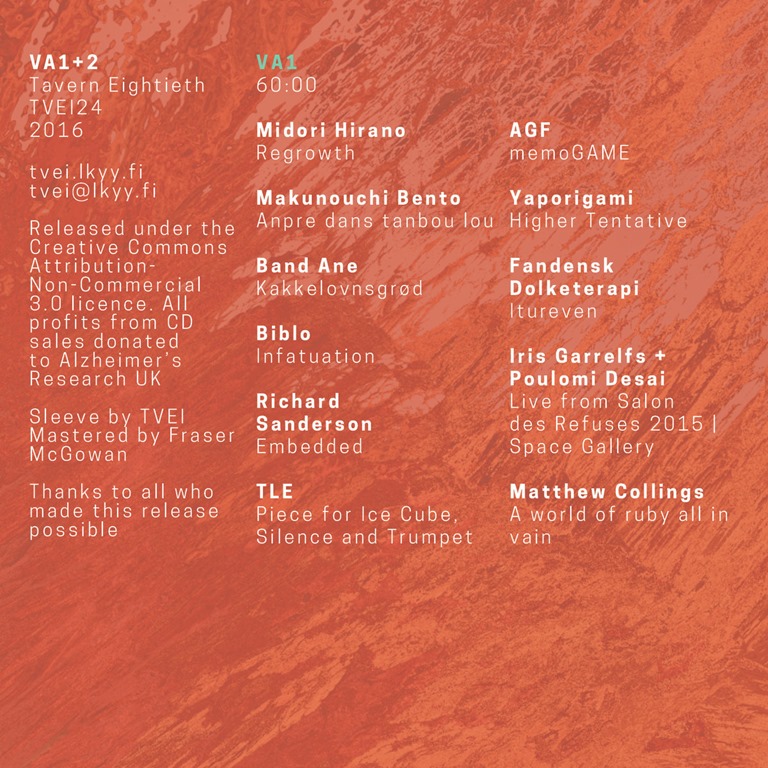
Described as ‘a large compilation of diverse and exciting music from new and exciting artists,’ VA1+2 is, first and foremost, a fundraiser for Alzheimer’s Research UK. Arguably, that’s reason to purchase it in itself, but of course, in truth, any compilation sells on the basis of the music. The immense range of music on offer on VA1+2 is its real strength, and offering over two hours of music (that’s 22 tracks by 22 different artists packing out a brace of discs), it’s a veritable boon of contemporary electronic, ambient, experimental, electro-acoustic, improvisational and more.

From the semi-ambience of Midoro Hirano’s ‘Regrowth’ and the swampy Latina stylings of Manouchi Bento’s ‘Anpre dans tanbou lou’, there’s much to soak in on disc one. Band Ane’s bleepy, space-age ambient Krautock is particularly intriguing.

Disc two spans the dolorous yet delicate piano-led instrumental of International Debris’ ‘Translucent Orb’ to the eerily ominous ‘Kiki and Bouba’ by Isnaj Dui, via the ethereal transcendental post-punk folk hymnals of ‘This Thought Won’t Last’, the contribution from Zelienople and Glacis’ elegiac epic ‘As long as water flows’.

One of the common pitfalls of compilations, and in particular compilations to raise funds for charity, is that they’re often a bit of a hotch-potch mess, no better than the naff giveaway discs that come with magazines (or used to come with magazines: I don’t know as I stopped buying magazines some time ago, at the point when the quality of features and reviews vs cover price became unfavourably skewed toward the latter) plugging whatever was hot at that moment in the eyes of that publication, with a bunch of album tracks and B-sides taking up the majority of the space. VA 1+2 feels – and sounds – very different. Tavern Eightieth haven’t just taken anything that’s been floating around, and while I despise the overuse of the word in our post-postmodern hipsterised word, there’s a sense that they’ve actually curated a compilation which represents the label. There’s clearly a lot of thought and effort gone into this, from the selection of material itself to the mixing and sequencing of the tracks. And so, while it is a fundraiser, and for an extremely meritorious cause (I’ll spare the lecture here on the underfunding of research into Alzheimer’s given the number of people it affects).

Finally, mastered by Fraser McGowan with an ear on optimal clarity and dynamic range over volume, there’s a sense that every aspect of this release is about doing the music justice. And in turn, they do the charity and the listener justice. Everyone wins.

Tavern Eightieth VA1 2

Tavern Eightieth – VA1+2 at Bandcamp

OKTAF – OKTAF #12 – 27th May 2016

Christopher Nosnibor

Marsen Jules has long been established as a unique sculptor of sound, redefining ‘sound poetry’ while working within the territory foreshadowed by the likes of Brian Eno and Steve Reich. Shadows in Time marks a huge leap, not so much sonically, but conceptually, as a project, which touches on matters of marketing, consumerism, issues of art and artefact, and the role of the recipient in the artist/audience equation. Shadows in Time is, ostensibly, an ambient work. But ambient carries connotations of background sound, of a given environment. It suggests mood music, but also something that isn’t a focal point as of and in itself.

The soft, supple sounds of Shadows in Time are mood music, in that to immerse yourself in the recording is to create an environment which slows the heart rate and unwinds the mind. But Shadows in Time is more than a mere ambient work. It’s a concept album, the concept of which is only partly about the audio you will hear.

If every individual hears music slightly differently, experiences music on a personal level, coloured by their own senses and experiences, then the fact Shadows in Time exists in some 300 different forms effectively means the already infinite listening experiences are increased to an absolute point.

This review is based on the experience of just one person – me – listening to the CD version. A single track, 49:29 in duration. It begins cinematically, a shimmering expanse of organ-like tones gently sweeping and gliding. The long notes ripple and roll, emanating tranquillity and calm. It also exudes a sense of scale, in a galactic sense. Or perhaps that’s just my mind uncoiling, my tension dissipating. I find myself wondering about the infinite potentials, and what the other versions may sound like. What multiple versions may sound like played simultaneously. Or all of the versions. The vastness is almost beyond comprehension. And from thee calm emerges a sense of infinity. It feels good.

Sit back and enjoy the experience – in whatever form it takes.

Marsen Jules - Shadows

Marsen Jules Online

Room40 – RM474

Christopher Nosnibor

Sometimes, this reviewing business is personal. How can it not be? Surely no-one can get into music reviewing without being a mad rabid fan of music above all else. Sure, some may do it for the ligs, but in a non-paying market, first and foremost, it has to be for the love. Yes, I speak personally here. I’m certainly not in it for the money.

I’ve been a fan of Swans since I was in my teens in the early 90s, after being passed a recording of Children of God. It’s an album which will remain with me forever, for so many reasons, not least of all the juxtaposition of thunderous intensity and elegant beauty. I was quick to seek out – and spend my money on – their back catalogue, with Cop proving to be nothing short of pivotal in my musical education.

But as much as I developed a bewildered admiration for Michael Gira both as a lyricist and an artist in the broader sense, I also came, fairly quickly, to appreciate the guitar playing of Norman Westberg. His playing was stark, minimalist, brutal, and seeing him perform live in the current incarnation of the band only cemented my respect. I can’t think of a guitarist less concerned with heroics, who better appreciates the idiom that less is more. He’s nonchalant, cool, peeling off shuddering chords at infinite decibels and grinding out the same riff for what feels like an eternity requires discipline and appreciation of the bigger picture, but more than anything, it has impact.

MRI is not about grinding repetitive chord sequences and squalls of feedback, and as such, reveals another side of Westberg’s guitar playing. If anything, listening to MRI has only furthered my appreciation. Building droning ambience from oscillating feedback and eternally sustaining notes which hum and simmer, MRI is subtle, soft and understated.

In fact, MRI is very much a response and intentional counterpoint to the punishingly high-volume output he’s spent much of his career producing. As the press release explains, MRI is the result of Westberg’s encounters with the heavy medical scanning technology following his recognising diminished hearing. “I started to notice a loss of hearing in my right ear,” Westberg explains, “and decided that it was high time that I had it checked out by a professional. The audiologist confirmed the uneven hearing loss and recommended an MRI. The purpose of the MRI was to make sure that there was not something other than my own aural misadventures causing the uneven loss.” Described in the press blurb as ‘a coda to this experience’, and as ‘a collection of reductive rolling guitar pieces that are embedded strongly in the American Minimalism tradition’, MRI was recorded in 2012, and appears here remastered, post-produced and augmented by a brand new piece, ‘Lost Mine’, recorded in 2015 as an echo of the processes that led to the original recordings.

MRI doesn’t sound like a guitar album, but in many ways, that’s one of its great strengths. It’s testament to Norman Westberg’s unconventional approach to playing the instrument, and reasserts his significance. But, perhaps most importantly, it’s a wonderful and extremely soothing sonic experience.

Print


Norman Westberg – MRI at Room 40

An ambient and sinister downtempo work, LDP 1 is the debut EP from south London innovator Zaflon. It contains two songs featuring Zaflon’s latest collaborator, Gilan_Music, among the cyclonic sub-bass, abstracted guitars, harmonic piano and crooked percussive breaks.

Coming on in places like a stark, electronic Cranes with some hefty beats, in other places it brings with moments that are by turns claustrophobic and immensely spacious with a woozy Ketamine undertow and a deep sense of yearning. It all makes for a set that’s pretty other-wordly. We dig it here at Aural Aggravation.

Listen to the EP as a continuous stream here.


Zaflon