Posts Tagged ‘Ambient’

Gizeh Records – 13th October 2017

Christopher Nosnibor

Otto Lindholm is based in Belgium. More pertinently, he plays double pass and is an electronic producer. Divided into four colour-inspired, long-form movements, the press release informs us that Alter takes off from Lindholm’s previous work (a self-titled album released in 2015), and ‘pushes the already abundant palette of sounds even further’. It also references Greek chamber-doom merchants Mohammad by way of a touchstone, but suggests that Lindholm’s latest may focus more attention on textures and melody.

Alter is very much a slow burn, to the extent that it crawls from the speakers with the first track, ‘Fauve’, which starts low and slow and gradually burrows deeper, with a long, low, resonant bass throb providing the undercurrent over which tremulous strings brood and sweep. ‘Lehener’ is sparser and more tentative-sounding, exploring more the space between the sounds, as the notes pulse and decay. The bass rolls in by stealth, before a range of sounds, all attenuated to different tones, textures and frequencies, as well as modulations. The notes rub against one another as they shift in different times and spaces.

At ten and a half minutes, ‘Alyscamps’ is the album’s longest piece, and Lindholm explores dark spaces through shuddering sonic shapes in slow collision.

The final composition, ‘Heliotrope’, is perhaps the most conventionally ‘orchestral’ of the four, and the one which offers the lightest of mood, with bowed bass and strings combining to create a delicate and graceful feel. But there’s a magnificent fluidity about Lindholm’s compositions, and these moments of levity emerge but briefly from the sombre atmospherics, before being subsumed into shades of grating dissonance.

The structures may be obscure, but there is a definite sense of form lurking behind the shape-shifting ambience of Lindholm’s work. And through those near-subliminal structures, which tease at the senses and inch into the subconscious, Lindholm achieves something which reaches beyond the listening experience and into another realm altogether.

AAA

Otto Lindholm – Alter

13th October 2017

James Wells

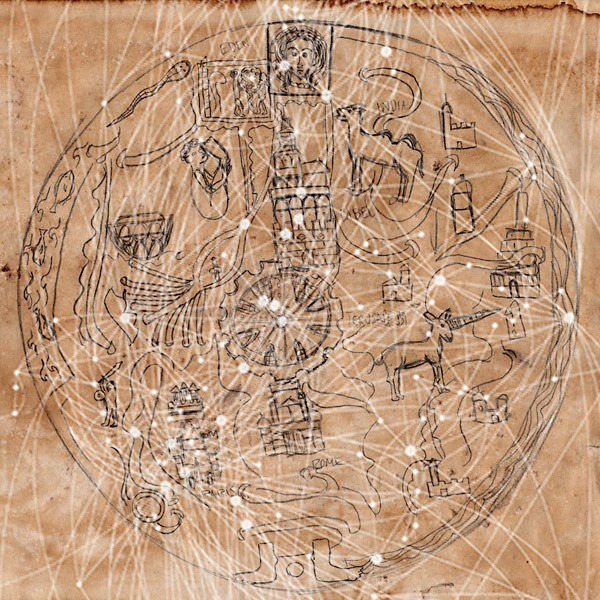
This the first CD released by drøne, a collaborative project featuring the pioneering Mark Van Hoen and Mike Harding (not the 80s comedian also known as The Rochdale Cowboy). The accompanying text informs us that ‘Mappa Mundi traces and describes audio surrounding and occupying the planet earth’. In fact, the album comes with one hell of a write-up, which quoting at length is instructive:

Workers toil in smithies, call signs and chants-at-prayer reveal attempts to order the chaos, which always remains one step ahead. Post-lapsarian for sure, but smoke signals and drums have morphed into the ‘bing bong’ of the attention-grabbing, mind-polluting PA system. The coded simplicity of the whistle (“Start!”) has evolved into a more deliberate attempt to control rather than inform by explicit, structured language. Announcements have become commands; signs bark orders. Thus ‘no’ becomes a powerful rejection, rather than merely a preference; and no-ers are more easily to spot… “You’re going the wrong way”! (To which the only sensitive and mature response is: “Good!”)

Call signs, IDs, audio sigils and signatures all combine to describe a polluted, confusing atmosphere which threatens to leave us powerless and bewildered. "Decipher the sounds and you win the game! First prize is, guess what? You get to take the audio poison! Congratulations! You’ve lost!”.

As for the actuality, there’s perhaps something of a disparity. Because ultimately, not a lot happens on Mappa Mundi. It crackles and fizzes, clicks and pops, humming and droning along the way. But it’s largely quiet, unobtrusive,

The album’s five movements, with a total running time of thirty-five minutes, are mastered as a single continuous track, at least on the advance digital. On the one hand, it’s frustrating, but Mappa Mundi is an album which is best experienced in a single sitting, uninterrupted. And it is an experience, albeit an uncomfortable one.

Drøne - Mappa Mundi

Clang – 29th September 2017

Christopher Nosnibor

There’s probably a press release somewhere, but I should probably just listen and lose myself in this. Endless Undo is a work of infinite subtlety, layered and detailed. It is, of course, the result of meticulous editing, a restive mind working and reworking, doing and endlessly undoing in order to achieve moments of microtonal bliss.

Böhm’s field is, ostensibly, the space between ambience and beat-propelled electronica: the compositions are rhythmic at heart, and while there are distinct and definite beats, they’re rarely dominant, and are often subdued, restrained or otherwise bouncing agitatedly in the background.

‘Heissenberg’ is built around bleeps and whistles, crackles drones and some swampy avant-electro percussion, and creates an enticing atmosphere without disclosing even a fraction of the range of the album as a whole.

‘Liub’ goes scratchy and glitchy against clanking electronica, explosive blasts of shuffling, processed beats and while it’s paired back and sparse on the surface, there is a lot going on: ‘Dezembur’ bumps and scrapes, bumps and scrapes its way through tremulous fear chords and dramatic yet understated piano. Glass tinkles and chimes while a single picked note hangs in the air for an eternity, swelling before a slow decay. It segues into the dense swell of ‘Klicker’, which builds to a bubbling, bassy groove which is far from ambient, bit so swampy as to be submersive.

There’s a definite arc to Endless Undo, and while it may only contain five tracks, over the course of its thirty-five-and-a-half-minute running time, Böhm may not exactly develop a sense of narrative, but does build upwards in solidity and intensity before the sparse, crystalline ‘Madeira’ turns in on itself to bring the album to a delicate yet moody close.

There’s a sense that Endless Undo is an album about potentials: the end product is simply the version the artist has settled on after a relentless tweaking and adjustment. It could have been a very different album. But then again, perhaps not, but we will never know.

Volker Böhm – Endless Undo

Room40 – 1st September 2017

Christopher Nosnibor

In certain circles at least, Tony Buck requires little to no introduction as the percussionist of longstanding Australia purveyors of avant-jazz trio The Necks.

Unearth is an immense departure in many respects, not least of all in that it not a percussion-led composition. His first solo work, recorded over a number of years, is an expansive, long-form piece spanning some fifty-one and a half minutes.

It’s a quiet, unsettling composition, with layered sounds building and overlapping, dark rumbles and drones juxtaposing with vague clattering incidentals, hisses, scrapes, hums, drips, plops and thuds.

Around the fifteen-minute mark, conventional instrumentation emerge, with ratting percussion, sonorous bass notes and picked guitar strings drifting across sampled voices and fragmented field recordings. However, it’s clear that the tension isn’t about to break any time soon, and nor is Buck about to unleash a square slice of rock tunage. Plinks, plonks and rattles shade across creaks and yawning ultra-low bass which hangs dense and heavy in the air.

There is a transitory moment of graceful musicality around the half-hour point, where chiming guitars and irregular, delicate percussion combine to create a subtle passage that’s ethereal, atmospheric and pure post-rock. And here comes the build: cymbals clatter and crash in a rising crescendo; gongs boom, and a tempest of sound rises as if from nowhere, as the treble of electronic bleeps cut through the evolving cacophony.

Things to settle into a less disturbing, less abrasive roll of swirling ambience thereafter, with chanks and chinks trembling over skittering sinews of sound stretched over weary, low-end drones which crawl and scratch.

Nothing about Unearth is easy or accessible, although Buck’s grasp on the slow-evolving dynamic of the longform composition is abundantly clear as the gradual transitions flow s effortlessly as to be unnoticeable.

A

Tony Buck -Unearth

Macaque Records – 21st August 2017

Christopher Nosnibor

Gilman Mom is the musical vehicle for Dominic Francisco (which has a star quality of its own). As Dominic explains, Manifest Destiny ‘plays heavily with texture and field recordings melding with emotional chords and words in attempt to convey my mental transformation from a vulnerable state to a confident one’.

The text which accompanies the release is almost uncomfortably direct, and it seems appropriate to quote in full:

I want it to feel like a troubled night walk of self-reflection that blossoms into realization.

This album isn’t for you so much as it is for me. I needed a way to document my circular thought process. Around and around until I stumbled upon developments. It’s not for everybody but it’s what I felt in my head when I thought about you for so long after that night. Nature surrounded me almost perfectly as this unfolded; you left me in the rain and by the time that storm ended I had found myself again. With this piece I want to remember who I was and how I got here. However fragile we were and unfit for each other, I gained so much insight into who I am from what was us. With your inadvertent help I’ve entered a state of definity. This is my journey to that place.

It’s clear from this that Manifest Destiny originates from an intensely personal place and one feels almost voyeuristic by simply being in its presence, without even listening to it. Should you listen to it? It sounds more like a work of therapy following a sequence of breakdown and recovery. Is it even intended for the ears of the casual listener?

In contrast to the write-up, the music the album features is uncomfortably indirect. Rumbling piano, distant discord that rolls like thunder way, way off, an unsettlingly sparse piano and muttered vocal snippets, the words inaudible, congeal into a dense mass of sound which offers little by way of shape, form, or tangibility.

At times barely there, eddying arabesques of synth contrails surround distorted, hushed vocal snippets, the actual words unintelligible. Gloopy tremors shiver amidst subaquatic hums and bubbling drones. Clicks, clatters and muffled extranea ebb and flow in the sonic swamp.

Any sense of linear progression, narrative flow, or emotional shift over the sequence of the album’s eleven tracks is difficult to determine: it feels more like a murky sonic miasma, slowly pulsating through a fog of introspection, apart from the glimmers of light briefly afforded by ‘Fool’s Gold’ at the mid-point. This is in no way a criticism: as an experience in ephemera, a vague allusion to sequence of events and emotions largely unknowable, the context matters less than the recordings themselves. And these are deeply atmospheric, sparse yet subtly immersive compositions, which exist in a realm of detachment, a world between worlds.

AAA

Gilman Mom - Manifest Destiny

Christopher Nosnibor

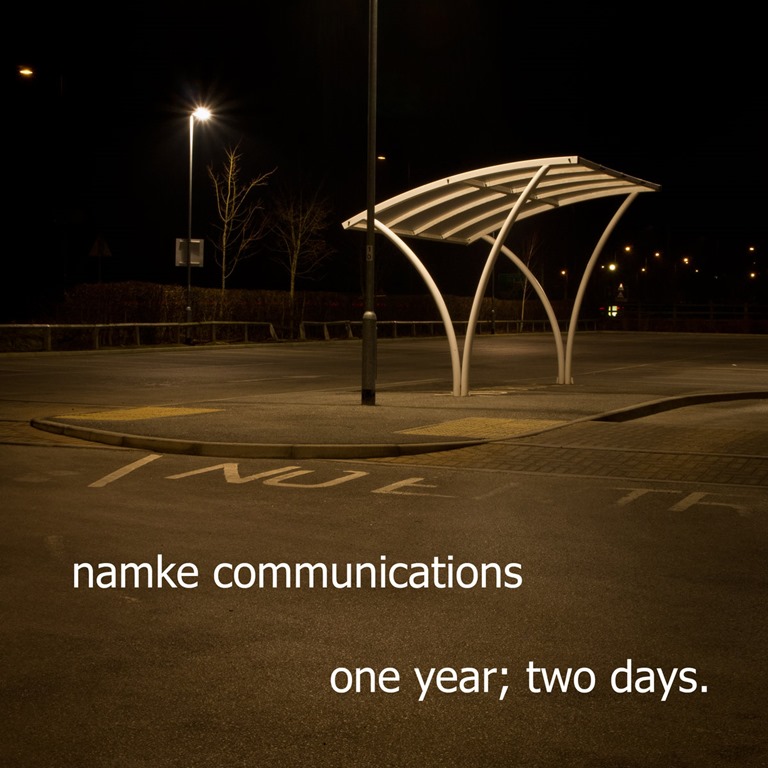
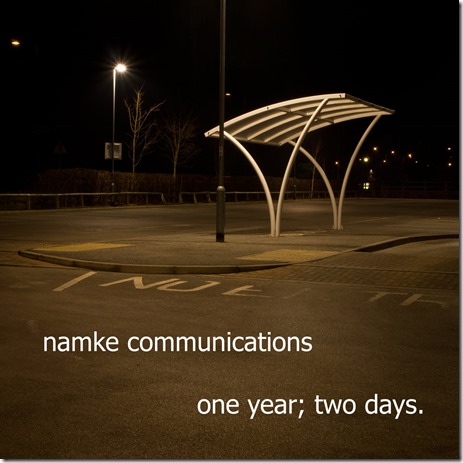
I know very little about this release, at least in terms of specifics. I do know that it’s the work of the prodigious John Tuffen, who also performs as part of Neuschlaufen and Wharf Street Galaxy Band amongst others. I know its physical edition is in a hand-numbered run of 50 CD-R, housed in a paper foldover sleeve in a PVC wallet, with an appropriately blank image by way of cover art. There’s a bleak, quasi-modernist feel to the night-shot photograph of a structure constructed as some kind of shelter. But a shelter without people and a car-park without car is simply dead space. One Year, Two Days is a night-time work. Recorded at night (we’ll return to that shortly), it’s the soundtrack to empty spaces and time without people. And abstract as the sound sequence are on One Year; Two Days, it’s reasonable to summarise the project as a work about time and space and a certain absence.

I do know that John likes his kit, and to fiddle with it, and that a lot of his works are ‘project’ based, centred around either a piece of equipment (e.g. 808 // Whammy (2016) and Field Memory Recorder (2017) recorded exclusively with a novation circuit) or specific times / locations. I also know that John has been working under the Namke Communications moniker for some seventeen years now, and has built quite a body of experimental work in this guise.

The track titles are simply dates and times, and show that the four pieces were recorded over two days in 2016 – as the EP’s title suggests. In some ways, it marks a continuation of the 365/2015 project, which saw Tuffen record – and release – a track a day for the entirety of 2015.

This project and its predecessor provide a considerable insight into Tuffen’s creative modus operandi, which could equally be described as a work ethic. It’s one I can personally relate to, as I strive to produce and publish at least one review a day. This does, of course, raise the inevitable question about quality control, but there are two very different positions on creativity: the first suggests creativity is something which cannot be controlled, is spontaneous. It says you have to wait or the moment, the idea, the impulse. To wait and to go with the flow. The second says that creativity is like a muscle: the more you do, the more you’re able. In time, quantity begets quality as a committed, systematic approach to making art.

‘2016-08-08-2202’ sets the tone, a distorting oscillation provides the backdrop to creeping notes which gradually rise majestically before bleeding into ‘2016-08-08-2318’. It may be growing later, but the mood grows marginally lighter. The sequencing of the tracks is a major factor in the listening experience here, as there is an overall arc from beginning to end. The mid-section, as represented by ‘2016-08-10-1909’ transitions into hushed ambience, before fragmenting into darker territory with fractured distortion and dislocation taking hold. Eventually, it spins into hovering metallic drones, the frequencies touching on the teeth-jangling.

The final track, ‘2016-08-08-2256’ forges a cloud of amorphous sonic drift, a sonic cloud without tangible form. It’s immersive, but at the same time entirely engaging, as the oscillations and quavering notes which fade in and out of the rumbling thunder slowly dissipate in a drifting mist.

While locked in time and space in terms of their creation, in terms of reception, the four tracks on One Year; Two Days transport the listener beyond both time and space. And herein lies the power of this release, in that it both freezes time, and stretches it out over a frame which has no fixed limits.

HHHHH
Namke Communications – One Year Two Days

24th August 2017

Christopher Nosnibor

Although he’s released two solo albums under the guise of Wiekie, Adam Weikert is perhaps best known as the drummer of Her Name is Calla. This first release under his own name marks something of a departure, and given its inspiration and evolution, it’s perhaps not unreasonable to say that Weikert’s decision to release an album as ‘himself’ represents a stripping away of the layers of artistry to reveal a work which is more directly personal.

The blurbage contextualises the release as follows: ‘Born years ago as response to cope with a traumatic event of his youth, and revived years later after ill health forced Adam to temporarily stop singing – USIDOH showcases the scattered fragments of poems alongside happenstantial Neoclassically themed works, creating a unique and personal experience.’

Attempts to unravel the meaning of the album’s title, which I take to be more of an initialism than an acronym, during the writing of this review bore little fruit of use. The poems – which are contained in an 80-pagebook which accompany the physical release – are considerably more instructive as to the true meaning of the project. That isn’t to say they’re in alignment with the album’s eleven (instrumental) tracks, because the poems – plural – essentially blur into a single, drifting longform work which has its own shape and tempo, as well as illustrations which augment rather than impinge on the experience. That is to say, the two elements of the project are complimentary rather than directly parallel. Nevertheless, the poems are absolutely integral to the overall experience, rendering USIDOH more of a multimedia work than simply a musical piece.

The words are weighty and the presentation is not only highly visual but intrinsic to the execution. Just as the music on USIDOH draws on aspects of the postmodern and the avant-garde within its broadly neoclassical framework – Wiekert conjures a vast array of atmospheres and emotions through the use of abstraction and semi-ambient field recordings and found snippets in conjunction with mewling saw, sweeping strings, brooding piano and nagging banjo – so the poems pull on high modernism, postmodernism and concrete poetry to further accentuate the lines, disparate and abstract yet unified by virtue of emanating from the same mind, over a period spanning the six years from 2005 to 2011.

‘Die Puppe’ weaves in and out of experimental atmospherics, before ‘Vardøhus Festning’ forges an imposing, imperious mood. ‘Sloth’ is a simply beautiful piano composition, which rolls and drifts mellifluously. There’s almost a playfulness about ‘A Constant Repose’, which first aired via YouTube aired a couple of months ago, the nimble piano work affecting a lightness of mood. But beneath it lies a subtle undercurrent of nostalgic melancholy. And if anything, it’s this emotional layering and the depth of nuance and detail which makes USIDOH such an appealing and compelling work, musically.

As a complete package, there’s a lot to unravel. USIDOH is very much art: Wiekert has poured everything into this, and it shows. There are times when it’s not easy to penetrate, but that in itself is reason to set aside some time to explore a work that multifaceted, deep and resonant, and achieves this without slipping into pretentiousness. There’s no question that USIDOH is ambitious, but Wiekert succeeds in delivering something which conveys the vision.

USIDOH

Hallow Ground – September 2017

Christopher Nosnibor

Hallow Ground is one of those niche little labels that exceeds in catering to a small but devoted audience. The quality is pretty consistent, and while you know broadly what you’re going to get from anything in their catalogue, there’s nevertheless a sense of challenge with each release. And so it is with The Expanding Domain, which is pitched as showcasing the way in which the producer’s ‘fascination with ambient becomes a blank slate upon which [he] and his collaborators serve shimmering Trance-derived melodies, murky Industrial grooves and all-consuming Harsh Noise attacks.’

If it sounds like a difficult and disparate blend, it is, making for 23 intense minutes, but it works. ‘Cold Bloom’ may be brief, but moves through a succession of quite contrasting passages, from ominous ambient rumbles and analogue tweets through expansive orchestral strikes lifted straight out of 90s clubland. As such, it condenses all aspects of the album into under two and a half mind-punishing minutes.

On the one hand, it seems like a bad idea and waste of energy to become overly concerned with genre definitions and intersections. On the other, The Expanding Domain seemingly less invites and more demands that type of scrutiny.

‘Lil Puffy Coat’ – which I’m taking as a playful reference to The Orb’s ‘Little Fluffy Clouds’ amalgamates dislocated Krautronica with shades of abstract industrial to forge a sinister expanse of liquid concrete: grey, heavy, but tactile, its form transitional, not yet set firm, and therefore difficult to define.

The volume and aggression are ratcheted up on the heavily percussive attack that is ‘Fear in Reverse II’, the pounding barrage of metallic hammering reminiscent of Test Department providing the perfectly painful foil to the howling discord that screeches above it.

The title track is definitive: with Dominick Fernow (aka Prurient) and Death Grips drummer Zack Hill contributing additional percussion and Dirch Heather bringing the modular synths, it’s a perfect hybrid of delicate, semi-ambient electronica, gnarly, dark ambient that broods and churns, and throbbing industrial. The result is immersive and unsettling, an album somehow at ease with its incongruity which is melded into a perversely cogent form.

Dedekind Cut – The Expanding Domain

Ventil Records – V006

James Wells

I know next to nothing about this release. Here’s a moment of transparency: music reviewers receive absolutely shedloads of stuff to review. Press releases are handy, not just as a shortcut when it comes to research, but also for locating inroads into a work. But even with a press release to hand, details surrounding Wealth are sketchy.

Consisting of Michael Lahner (synths) and Manuel Riegler (drums, synths), Wealth draw on a range of different forms of electronic music to create what they consider to be a ‘highly organic mix’. Sonically, there’s very much a preoccupation with soft-edged pulsations: the beats are largely rounded, bulbous, and when more angular rhythms do emerge, as on ‘Plate LXXVI (Diagram for Lilies), they’re countered by altogether less aggressive synth tones with hazy outlines.

Subtle, stealthy, glitchy ambience with backed-off beats are on offer with Primer. Sonic washes and rippling, elongated, undulating bleeps eddy around agitated, juddering rhythms so backed off in the mix as to be barely subliminal. ‘Floor’ lays a deep groove; not so much one to get down to as to lie down and allow total immersion.

Primer is a delicate, balanced work, with considerable range beneath its more subtle, subdued surfaces.

Wealth - Primer

Crónica – CRÓNICA 126-2017

Christopher Nosnibor

The title of the latest album by the super-prolific experimental composer and student of film and musique concrete, Emmanuel Mieville, comes from the Japanese translation of the Sanskrit word and alludes to a chapter of the Lotus Sutra, a renowned text from Māhāyana Buddhism. Apparently. It’s hardly my field of expertise. And so the inevitable question arises: what’s my point of entry?

Juryo is by no means an accessible album and its four longform tracks, which span between nine and eighteen minutes don’t readily lend themselves to lengthy debates about Buddhism and the path to enlightenment. Similarly, that the album consists of four compositions shows no obvious correlation with the twenty-eight chapters of the Lotus Sutra. As such, it’s fair to surmise that the allusion which connects the title to the contents is in largely an oblique one, beyond the fact that the album features field recordings captured in Asia.

This is swampy, abstract, murky noise. On the surface, it’s a formless conglomeration of noise, grating, grinding scrapes and bumps. Woozy rippling bubbles flit and floom over tidal waves of surging extranea, which may or may not be the swash of actual water rippling over rocks: it could equally be an aural illusion, or an intentional simulacrum.

Top-end whistles sustain for an eternity and aggravate not only the aural receptors but the mind on ‘Nyorai’, although in the mix are recordings of Tibetan nuns and FM radio from Hong Kong. These manifests as chants and clattering chimes and finger cymbals which emerge around the midpoint of the seventeen-minute sonic journey. According to the liner notes, ‘Murasaki’ means ‘purple’ in Japanese, but the spinning, swirling sonic discombobulations which eddy and swirl present a kaleidoscopic vista.

In the sleeve notes, Mieville explains that ‘Taisi Funeral’ (the fourth and final track) is a ‘recording of Buddhist chanting for a deceased person recorded in a small village in Taiwan, mingled with my own synthetic sounds. Tanit Astarté is a quotation from Antonin Artaud’s book Héliogabale and refers to the moon goddess, as described in Phoenician myths’. It’s certainly the most overtly musical and rhythmic of the four compositions, but as a rising surge of amorphous sound rises to wash away the voices and the rhythm peters out, it transforms to an altogether more ambient soundscape. Morever, while still linking back to the overarching theme of the Lotus Sutra, we can see that Meiville’s sphere of reference is considerably broader than may first appear.

Juryo is subtly complex and had both range and depth. It doesn’t readily conform to any one genre, but to lazily slot it into the broad space occupied by ‘experimental / avant-garde’ is to fail to recognise the spectrum of stylistic elements it incorporates.

Emmanuel Mieville – Juryo