Posts Tagged ‘Ambient’

Supernatural Cat – 8th November 2018

Christopher Nosnibor

Eerie strings streak across an ominous low-end throb, transitioning expansive vaporous drones with serrated edges on the album’s first track, ‘Hefy Lamarr’ and it sets the ominous tone for the rest of the album, as piano notes hover in rarefied atmospheres with a slow-decaying sustain carried on a cold, dry echo. It’s minimal, sparse, dislocated, disconnected. There are no sonic hugs on Doppeleben. It’s an album that builds walls, force-fields. Nihilism, isolation, introspection… these are the moods of Doppeleben.

So what do we know about the artist? The Mon is the solo name of a new project by Urlo, best known as the lead vocalist, bass and synth player in heavy trio Ufomammut. Doppelleben is The Mon’s debut album, and, as the press release notes, ‘where Ufomammut create mind-expanding, heavy psychedelic, almost other-dimensional sounds, The Mon by comparison is far more intimate, looking inward, as Urlo explores and examines his inner most thoughts through music.’

And Doppeleben is very much an introspective set, which is far from heavy and as such, it is very much a departure from Urlo’s work with Ufomammut. But heavy is relative, and ‘Relics’ still manages to come on like Ministry on ketamine, with distorted, raw-throated vocals hollering out against a backdrop of plodding percussion and howling feedback. It’s representative, but it isn’t: the atmosphere of Doppeleben recreates the claustrophobic intensity of The Cure’s Pornography, while drawing on the stark discomfort that pervaded the alternative scene circa 1979-1983.

Fear chords ripple, delicate notes drip and drop over slow surges of dark density which rise and swell through interminable sustain. ‘Hate One I Hate’ sounds like Earth circa 1992 covering ‘One Hundred Years’ by The Cure. Devoid of percussion, the glacial synths and thick, crawling guitars coalesce for create a spine-stiffening tension.

With clattering metallic drums battering away in the background, ‘Blut’ grinds hard at a bleak post-punk seam, landing somewhere between Movement era New Order and Downward Spiral era NIN, with hints of Visage’s ‘Fade to Grey’ thrown in for good measure. It’s compellingly intense and makes optimal use of a handful of chords in a descending sequence.

In contrast, ‘Her’ offers a bend of shoegaze haze and Bauhaus-hued art rock as it washes blank curtains of synth and monotone vocals before a cascade of slide guitar swerves its way into the mix. And yet never could it be as far removed from country as the notes bend and glide and slide to fade.

Low, slow, and dark, there’s an oppressive density to Doppeleben which is hard to define and even harder to let go.

AA

The Mon – Doppeleben

Soundtracking the Void – 5th October 2018

Christopher Nosnibor

Collectively and individually, Gavin Miller and Thomas Ragsdale (worriedaboutsatan, Ghosting Season) have produced an impressive volume of work – although perhaps even more impressive than its quantity is the consistency of the quality. They’ve always been something of a yin/yang pairing, and the individual differences are integral to their collaborative works. So, while Ragsdale tends to bring the beats and beefy bass, Miller is the man who contributes wistful soundscapes and delicate atmospherics. The fact they’ve released solo efforts within a few short weeks of one another not only highlights their productivity, but affords the opportunity to compare and contrast the similarities and differences of their musical approaches.

Honley Civic Archives Volume 1 marks not only the first in a prospective series, but something of a departure, being almost entirely beat-free (there’s a distant clattering on ‘Pick Up Sticks’ but it’s almost buried by the sonar bass frequencies), and adopting from the outset a soft, piano-led sound and an elegiac tone.

In contrast to Gavin Miller’s near-simultaneous solo release, Shimmer, Honley Civic Archives Volume 1 is a much more overtly ambient work: the electroacoustic elements are filtered by synthesis, so while Miller’s ambience contains elements of shoegaze right at the fore, Ragsdale takes abstraction as his form, and runs with it. Many of his signature elements are in evidence: layered electronics, strings, and field recordings are all carefully interlaced to forge a sonic cloth as delicate and intricate as lace. However, the vocal samples lifted from film and radio which can be found in abundance on other recordings and in his live set, are as conspicuous by their absence as the beats.

In abstraction lies evocation: with so little overt or explicit signposting, the listener’s mind wanders free through the intangible forms. Without any temporal location in sonic terms, it’s left to the lister to fill in the gaps of space and time. But the titles of the compositions are referential, with several making direct reference to nursery rhymes – ‘Pick Up Sticks’ and ‘Four and Twenty’, for example. They remind us that so many of these rhymes have a darker undercurrent. Elsewhere, ‘Will You Still Love Me Tomorrow’ lifts its title directly from The Shirelles’ 1960s hit. Sonically, there’s no relation, but again, the sentiment of the title connotes a certain sadness, even anxiety: vintage pop lyrics, too, often cast shades of darkness when you scratch the surface and wipe away the bubblegum delivery. And it’s creeping darkness that pervades the slow, deliberate sonic expanses of the more dolorous passages of this album, of which there are many.

And so Honley Civic Archives Volume 1 provides the conduit for the listener to engage with their own interiority, exploring at leisure and from a distance, the images and scenes conjured by the mind’s eye in response to the sonic provocations. There’s something disquieting and disorientating about Honley Civic Archives Volume 1 – an album you feel first, and hear some time later.

AA

Thomas Ragsdale - Honley

Sound in Silence – 30th September 2018

Christopher Nosnibor

Collectively and individually, Gavin Miller and Thomas Ragsdale (worriedaboutsatan, Ghosting Season) have produced an impressive volume of work – although perhaps even more impressive than its quantity is the consistency of the quality. They’ve always been something of a yin/yang pairing, and the individual differences are integral to their collaborative works. So, while Ragsdale brings the beats and beefy bass, Miller is the man who contributes wistful soundscapes and delicate atmospherics. The fact they’ve released solo efforts within a few short weeks of one another not only highlights their productivity, but affords the opportunity to compare and contrast the similarities and differences of their musical approaches.

Shimmer comprises six tracks, simply titled parts one through six. The tones are soft, the textures deep. It begins with vaporous drones, soft-focused, broad in spectrum, providing a backdrop to delicately picked, reverby guitar and a hesitant bass, bringing hints of the instrumentation of Julee Cruise’s ‘Falling’.

Piano notes reverberate and organs trill and wheeze. There’s a lot of air and a lot of space: this is music which breathes, drifting, an organic ebb and flow providing the irregular patterns of ever-shifting form. The pieces don’t so much segue as melt into one another, while the individual instrumental sounds blur together, a gauzy halo surrounding each note which ultimately creates a sense of vaporousness.

With Shimmer, Miller trades in intangibles. That isn’t to say the pieces are without form or structure, but that the forms are ever-shifting and impossible to pin down, the structures possessed of an opacity which renders them indistinct. So while the successive passages are interesting in their own right, Miller doesn’t resort to repetition or motifs to hold them together, instead allowing them to flow freely. It’s the kind of ambience that fades in and out of the foreground of consciousness: as such, it’s not completely background, but it is ideal for after a mentally strenuous day at the office or equivalent.

AA

Gavin Miller - Shimmer

Kranky – 28th September 2018

Christopher Nosnibor

Total immersion. This is what I get from Tim Hecker, both recorded and live. Responding critically to such a sensation is a major challenge.

My first attempt to review Konoyo redefined ‘failure’, as I sat, vacant and staring for the duration without typing a word. Yes, other things happened around me: emails continued to ping into my inbox, text messages, Facebook notifications, and so on. So much peripheral shit. But while pushing all of this noise to the peripheries, I struggled – nay, found it impossible – to get a firm grasp on the drifting soundscapes of Hecker’s latest album. My second stab proved no different. I can no longer blame the distractions: I’m reminded of ‘seeing’ Hecker’s performance at the Belgrave Music Hall in Leeds a few years ag. Purple smoke filled the room. It was so dense I couldn’t see my friend standing next to me: I felt as if I was in an isolation tank or a sleeping bag. With my surroundings completely removed, I found myself alone with the music, and in an almost trance-like state, swaying on my feet, in my own world. When things like this happen, I immediately assume I must have drunk more than I should or that I’m tired or something. But music at its most potent is like a drug, and Hecker has the capacity to transform the mental state and one’s relationship with one’s surroundings. And this is certainly true of Konoyo.

Inspired by conversations with a recently-deceased friend about ‘negative space’ and the banal density of contemporary music, Konoyo was largely recorded in a temple on the outskirts of Tokyo with a view to creating something that has room to breathe, rather more cerebral than physical, drawing back from sonic force to invite a different kind of engagement.

The first composition, ‘This Life’ wails eerily, resonant low notes hanging ponderously beneath escalating layers of discord that bow and shriek, before oriental motifs chime a certain note of freshness and innocence… but the notes are bent, the underlying washes of sound begin to twist, scrapes of extraneous noise swell to shrieks of metallic feedback.

As is Hecker’s signature, Konoyo, is very much about shifting textures and juxtaposed tonalities, but more than anything, the incidentals, the way layers fade in and out, and extraneous knocks and clatters suddenly appear from nowhere, and then disappear just as quickly. There are murky pulsations and hazy echoes that resonate through spatial densities that range from the subaquatic to the zero-gravity. Hecker conjures space outside of space, spaces which transcend both time and space to exist in another realm entirely, suspending time in the process. It’s ambience with edge.

An abrupt halt in the soothe drones just 20 seconds into ‘Keyed Out’ provides the album’s first real indication of just how difficult Hecker can – and will – make this. Jolting discord and jarring dissonance rupture the smooth, vaporous backdrop as thigs become overtly challenging around three minutes into this ten-minute journey through dissonance and sonic difficulty, across which a lacey cloak of accessibility slowly settles. The fifteen-minute finale, ‘Across to Anoyo’ is a slow-evolving epic which mutates from quiet mellowness into a warped, woozy discord, which twists Japanese motifs into funnelling electronic abstractions.

Piano tones which should offer tranquillity and comfort are rendered with an edge of attack and amidst a metallic edge of reverb, and nothing is quite as it seems or should be on Konoyo. It bends the brain and pushes the listener to explore unexpected spatial experiences, challenging connections to concrete orientation. The physical world disappears, and time evaporates. Konoyo delivers a path to transcendence.

AA

Hecker

Southern Lord – 24th August 2018

James Wells

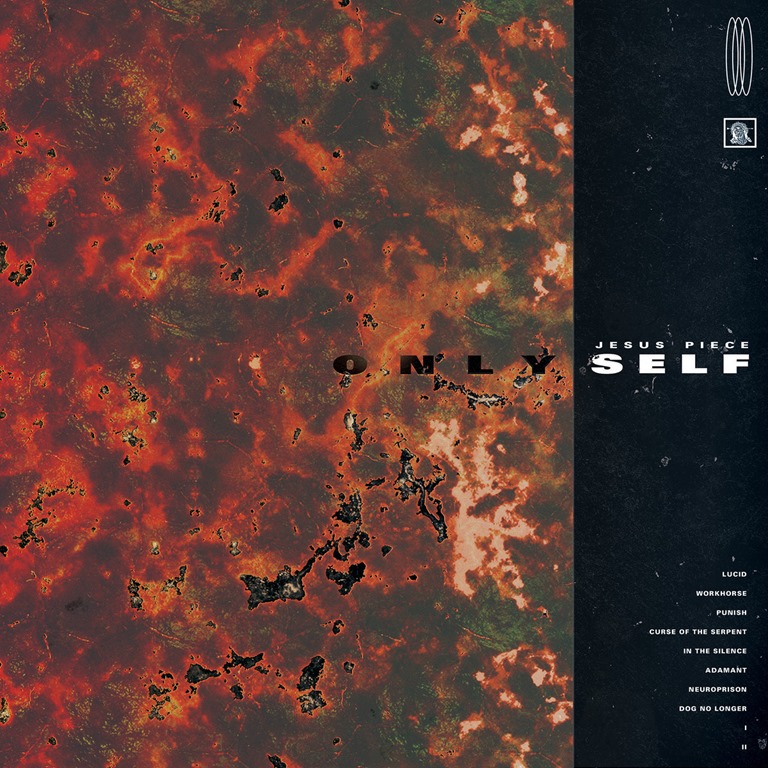
According to their biography, Jesus Piece ‘have left craters in their path over recent years, quickly developing a reputation as one of the heaviest, most uncompromising acts both on record and on the stage. With the brutal grooves of Y2K-era metallic hardcore at the core, the band also incorporates elements of noise, ominous tones, and haunting atmospheres into their dynamic songwriting.’

‘Lucid’ batters its way out to herald the album’s arrival: rapid pedal-work on the kick drum powers the cutty, hard-edged guitar. Its brutal, regimented, industrial, grinding like early Godflesh, but with snarled, guttural vocals spitting and howling nihilistic dismantlements of personal struggle and loss, racism, police brutality, and social and political injustice.

They distil all of these violent emotions and unspeakabe rage into short explosive packages: the majority of the songs on here are under three minutes. ‘Punish’ brings a sinewy, spectral lead guitar to twist its way over the grinding churn of the rhythm section, hinting at the dynamics of early Pitchshifter.

When they do slow things down, as on the stripped-back ‘In the Silence’ where the bass wanders and weaves a murky path and haunting chorused guitar notes rise from the swamp quite unexpectedly to create an unsettling atmosphere, the impact remains undiminished, and for the most part, it’s the heavy pummelling that defines Only Self.

The album concludes with an immense shift in style and sound in the form of a pair of contrasting but complimentary atmospheric pieces titled by number only: ‘I’ something of a monastic, ritual ambience to it, as voices echo in the mist before the doomy guitars break through in a slow landslide on ‘II’.

With such variations and deviations from the template of howling aggression and blind fury, Only Self stands apart from so many albums of its ilk, and reveal Jesus Piece to be capable of more than just endless anger – although they’ve got the rage in spades, and bring it to devastating effect on what is one hell of a debut.

AA

Jesus Piece – Only Self

Gizeh Records – 31st August 2018

The Great Lake Swallows is a collaboration between Canadian cellist Julia Kent and Belgian guitarist/tape machine manipulator Jean D.L. The former came to my attention some time ago, and her nuanced style of playing had yielded some compelling works. Jean DL, however is an unknown quantity to me, and I came to approach the release without any real preconceptions. I leave it with none either. It’s ambient and droney, but offers infinite layers. The Great Lake Swallows doesn’t really fit anywhere in terms of genre, and this is very much a positive. Sometimes, music simply is.

The Great Lake Swallows is a graceful and co-ordinated suite in four parts, and finds the duo creating sonic interplay that displays a certain musical connection, even telepathy. Collaborations of this type, which find musicians with such different approaches (and modes of instrumentation) requires a certain intuition to achieve coherence.

Its brevity contrasts with its scale and scope. The four tracks have a total running time of a shade over 25 minutes, but the aching cello bends and melts over hushed, brooding atmospherics to create compositions of great atmospheric depth and imbued with great significance. At times manifesting as dark portent, others seeping sadness without words to describe it, the layers build and pull at the senses almost subliminally.

The press release informs us the album was recorded in Charleroi, Belgium in 2015 during a video installation with Sandrine Verstraete, and that the music was created using field recordings, processed guitar and cello and serves as a soundtrack to the video of the same name. And the soundtrack qualities of the compositions are very much evident: the parts bleed together to forge a single, continuous piece, which slowly and subtly transition between place and mood.

On ‘Part 3’, a low throb slowly oscillates beneath the ebb and flow of strings that weft and warp, before ‘Part Four’ forges an expansive vista of surge and swell, as ghostly voices echo in the shadowy background. The effect is haunting, but also beautiful and as a whole, the work is deeply evocative. The Great Lake Swallows doesn’t just occupy space, but creates it.

AA

GZH84DP-Sleeve

Constellations – 24th August 2018

Christopher Nosnibor

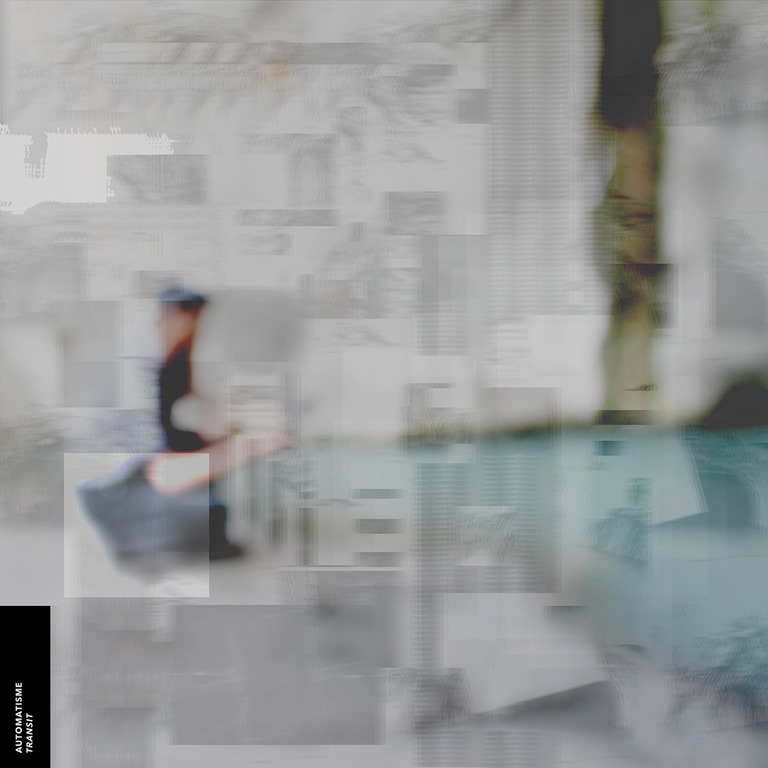
Automatisme is the moniker of reclusive glitch artist and electronic music producer William Jourdain. Transit is the follow-up to 2016 debut Momentform Accumulations, and has been formulated using modular synth racks and a vast library of field recordings.

As the title suggests, Transit is an album of movement. In transit are not only the creators, but the listener, who finds themselves being taken – often at pace – to unexpected destinations. But there is no stopping – each port of call is no more than a glance and a wave out of the window, perhaps a quick photo, before you’re on the move again.

The first suite – ‘Bureau’, a work in four movements, combines ambience and rhythm to often disorientating effect, and explores brooding expanses of sound and juxtaposes them with often jolting beats. ‘Bureau 0’ rapidly shifts from softly swirling cloudlike ambience to snarling, grating overloading noise – and back again. Blast of distorted beats and speaker-crackling overdrive create some disturbing kind of Dalek disco. ‘Bureau 1’ casts shades of gloopy glitchtronica which crackles and hisses, before bleeding into the more overtly groove-orientated ‘Bureau 2’. Groove is all relative, of course, and there are natural non-beat-orientated rhythms, too: shuddering oscillations swell like thunder on ‘Bureau 3’.

‘Registrariat’ stands alone between the ‘Bureau’ and ‘Bateau’ suites, and forges a more overtly dance beat. Only, the tempos shift erratically and sampled voices echo in the swirling sonic mists, and it gets too fast and before long, you feel your heart race increasing and instead of wanting to get down, you’re on the edge of panic.

The two-part ‘Bateau’ builds tonal intensity and volume, culminating in a dense eddying swell of noise that fills the cranium and creates an all-encompassing throb.

And it’s only at the final destination – a roar that abruptly leaves silence – that the album’s overall route becomes clear, a deleterious course from A to B via Z, Q and an unexpected assortment of curious places. You cast your eyes back over the map but it by no means conveys the experience of the territory. And after a pause, a moment of quiet reflection, you can’t quite recall the sequence of events that brought you here. You turn, and start to retrace your steps…

AA

cover_1528731707797039

The Helen Scarsdale Agency – HMS048 – 17th August 2018

The pitch for Maps’ as ‘minor-key’ where ‘tear-stained notes of piano, organ, and guitar veer along elliptical orbits as a soft-whisper lilt of Ekin’s voice narrates more by emotive decree than by literary couplet’ is but a flavour.

The album is largely inspired by her first winter on an island in the Sea of Marmara, away from the hustle and bustle of Istanbul, Maps is a completive work that reflects on experiencing silence and isolation. It’s relatable, and as is so often the case, in the personal lies the universal.

Isolation is not necessarily geographic, and distance doesn’t need to be great (the Sea of Marmara lies within the greater metropolitan umbrella of Istanbul) to have an effect on the psyche. Distance also needn’t be geographic: there’s no distance more isolating than emotional distance. It’s immeasurable, impossible to quantify, but manifests as a relentless ache, a sense of emptiness that sits in the gut and echoes around the chamber of the chest cavity. Mere inches in physical terms count for nothing when there’s that separation, and it grows to a pulling desperation, a gap that can’t be bridged. So close, and yet so far… just out of reach. There’s no-one to turn to, nowhere to go. Because you’re alone. And there are no words. Maps charts a journey through inner space, its hesitant notes representing the hesitant steps into unknown territory, alone.

On Maps, there are no words: this is the language of sound which communicates the message in its entirety. The warm-tones and sparse arrangements define the atmosphere of Maps. Fuzzy-edged guitar notes hanging in rarefied air for an eternity allude to Fil’s delicate, understated approach. Her music is sparse yet warm, delicate yet rich.

It’s a remarkably quiet, soft, understated work. It isn’t that nothing happens, but that evens unfurl discreetly, subtly, solely, with a certain delicacy. Organ wheezes as feedback whines on ‘Away’, while on the majority of the compositions, it’s a soft, echo-soaked piano that provides the main focus for this hushed, sparse song sequence which drifts together to create a very natural flow.

Maps doesn’t offer a direct route from A to B. But it does remind that the map is not the territory, and that the geographical terrain is not the mental space.

hms_048_M2

Christopher Nosnibor

Paul K first came to my attention with the release of Glitch Code’s debut album, Gifted_Damaged, a real standout release for 2016 in the sphere of dark electronic pop. Omertà saw Paul venture out as a solo artist last year, and revealed a very different musical aspect: instrumental, dramatic, and in places a bit proggy, it found him explore some expansive sonic territories with impressive results.

The Fermi Paradox sees Kirkpatrick expand on this – immensely. And expand is the word: this is expansive both conceptually and sonically, and he explained that ‘the album is about the theme of isolation, exploring our place in the universe and questions “are we alone?” to the perspective of social isolation through social media… It looks at the space race and the billions spent on wondering if we are alone in the universe vs. the juxtaposition of so many lonely people on our own planet.’

As such, The Fermi Paradox ranges from the macro to the micro, casting an eye to the farthest reaches to the most inner of anxieties. So while in terms of what it delivers, The Fermi Paradox isn’t a million miles from its predecessor, in terms of intent and focus, it’s a very different beast from Omertà.

Such isolation is something that’s immensely relatable: I’ve found myself in discussions with a surprising number of people, many with anxiety issues, conflicted over social media. It’s a different kind of paradox from the question of alien lifeforms the title refers to, but nevertheless, it’s a paradox. The dependence on the endless stream of posts and comments is countered by the despondency the belief that your own life is no match for others’, the sense that other people breeze through life, happy and carefree while your own life is fucked. Any sense of connection feels flimsy, secondary to a sense of disconnection and inadequacy. And what happens when, just for five r ten minutes, your phone goes silent: no texts, no notifications? The silence you’ve been craving is a howling void of emptiness.

It’s with ponderous piano and soothing strings that ‘Anomaly’ opens the album, and it’s mellow but twistedly poignant. It’s clear that Kirkpatrick knows how to tug at the emotions without words. The motif that runs through ‘Sagan’ makes me think of ‘Forever Autumn’ from ‘The War of the Worlds’ – surely one of the most heartbreaking songs ever committed to tape. Or maybe I’m just a sap. Nevertheless, regardless of whether this is about the music itself or my response to it based on, its drift into lilting piano and achingly sad strings is simply beautiful.

It’s on ‘Ecce Homo’ that Paul reaches into expansive territory, a cinematic, layered progressive-style piece with soaring chorals and supple rhythms, it drives, but also meanders. At times, as on the opening of ‘Exegesis’, Kirkpatrick slides into near-ambient territory, but for the most part, it’s about sedate, spacious soundscapes, defined by rolling, soft-edged bass. As the album progresses, the song titles suggest a shift from the more inward-looking to gazing out into the cosmos.

Are we alone? Always. Intensely. But with The Fermi Paradox, Paul K has produced a magnificently-crafted soundtrack to play into the void.

513298210