Lunar Forms is Rupert lally’s second release on Milton Keynes label Mortality Tables, following his Interzones album, released in November last year, and forms part of the latest ongoing project by the label, dubbed The Impermanence Project (which so happened to feature a tense but lugubrious ambient work by some guy called Nosnibor a short while ago).
Sometimes, while I try to work through my review pile in a broadly systematic way, I have to reshuffle my priorities according to mood. And right now, my mood is jittery, jumpy, tense, unfocused, meaning that what I need is something fairly gentle, somewhat abstract, if not necessarily ambient. But also something which feels relevant, in some adjacent fashion. And so here we are: bombs are dropping and missiles are flying, and it’s maybe easy to dismiss it as taking place at a safe enough distance away…. But is any distance truly safe enough?
And so, it’s necessary to seek solace in distraction, solace in abstraction, something that offers layers and textures that draw you in, captivate the attention… but at the some time, offers something more to reflect on while listening to the glitches and echoes, woozy, skitty fragments of analogue pull my attention in different directions.
Impermanence… as polyartist and the innovator of the cut-up method, Brion Gysin said, ‘we’re all here to go’. And we are. We fear it, but it’s impossible to escape the inevitable. It’s not a question of if, but when.
Lunar Forms transitions between stuttering, glitching minimal techno and slowcore EDM, and more expensive, cinematic instrumental sounds which are overtly ambient. Electronic fuzzed and buzzes spark over swirling soundscapes, and at times we’re led into Tangerine Dream territory, while at others, we find ourselves adrift. The fact that, including bonus tracks, Lunar Forms features eighteen pieces, and has a running time of some seventy-four minutes, is significant. It’s a vast and expansive work, and one which is easy to get lost in, since the tracks are distinguished only numerically, ad those numerical titles are not tagged sequentially.
There is a lot of dark atmosphere, a lot of rumbling. There is much haunting reverb, considerable space, a great deal of bubbling, blipping, hovering. The deeper it plunges into spacious, cloud-like disturbance, the more immersive and simultaneously the more the power of this work increases. Breathe deep… and feel everything this represents. ‘313’ May be sparse, but it also edges its way into the space between dance music and the BBC Radiophonic Workshop, while ‘325’ pitches jittery microtonal beats against sonorous strong-like sound. It’s simultaneously tense and introverted, and outward-facing through cloud. The beats of ‘303’ are like the dripping of a tap amidst synthesizer drones and swirls. And it goes on. As such, Lunar Forms is more than varied: it straddles boundaries in a way which renders it almost impossible to place.
And so we arrive at the end of another era in the epic history of Swans. When they called it a day in 1996 with Soundtracks for the Blind, and a farewell tour documented on Swans are Dead, it really did seem as if that was it. Swans had run their course, and the colossal Soundtracks double CD summarised everything they had achieved over
It may seem strange that the bookend to this phase of their career should be titled Birthing. But such is the cycle of life, and indeed, the avant-garde: death gives way to new life, to build anew one must first destroy. And so in this context, Birthing, which Gira has announced will be the last release of this epic, maximalist phase, makes sense. With a running time of a hundred and fifteen minutes, it’s comparable in duration to its predecessor, The Beggar, and The Glowing Man (a hundred and twenty-one minutes and a hundred and eighteen minutes respectively) , but on this outing, the individual pieces are all immense in proportion, with the album containing just seven tracks, with only one clocking in at less than ten minutes.
‘The Healers’ makes for a suitably atmospheric, slow-burning opener. Around seven minutes in, the gentle eddying begins to swell, like a breeze which wisps and ruffles the leaves on the trees – a minute or so later, the drums have entered the mix, and the ambient drift begins to take a more solid form, and there’s a change in the air temperature, the barometer plummets and the breeze becomes a wind. In no time, there’s a swirling wail of sound surrounding Gira’s increasingly exultant enunciations, but as he growls and mumbles and raises his voice higher, he’s increasingly drowned by the maelstrom. And yet, it’s nowhere near a crescendo, and I’m reminded of their set on the 2013 tour, where, having told my friend that having seen them in the same venue three years previous that they took volume to another level, the first twenty minutes of the set was loud, but not remarkably so – and then suddenly, there was a leap of around thirty percent that felt like a double-footed kick in the chest. Will it happen here? Around the fifteen minute mark, it tapers down to a haunting whistle of wind – and it’s the calm before the storm, as a raging tempest suddenly erupts, a frenzied wall of noise that has become their signature, and the song surges to a powerful sustained climax.
While the delivery is considerably less brutal than it was in the early 80s, Gira’s lyrics are still riven with dark and disturbing imagery, and now coloured with a hint of abstraction and madness, and this is nowhere more evident than on ‘I Am a Tower’, which was aired as a lyric video a little while ago. ‘With thin boneless fingers and pink polished nails, I’m searching for the fat folds of your blunder. Speak up, Dick! …Bring your fish-headed fixer to whisper in my ear. Please worry me here, tongue that victim in there…’ he intones like a cracked messianic cult leader against a backdrop of swirling drones. Attempting to unpick sense or meaning from it feels futile, and potentially traumatic, so instead, it’s perhaps experienced holistically, as a jumble of images and impressions, a fractured collage, a derangement of the senses whereby you allow it to transport you to another plane, away from anything concrete or grounded, beyond all that you know. Seemingly from nowhere, a motorik rhythm kicks in and we get something approximating a driving Krauty post-rock riff, hook and all. It could be Swans’ most pop moment since the White Light / Love of Life albums in the early 90s.
The title track arrives in a ripple of proggy synth that has a hint of Mike Oldfield about it, but gradually builds into a dramatic swell of sound, the likes of which has come to characterise the last decade of Swans, with a single chord struck repeatedly for what feels like an eternity. And then, from nowhere, they launch into something approximating a jig – on a loop, where the bass and drums simply hammer away repeatedly, like a stuck record. It is, if course, pure hypnotic magnificence. Gira’s words slip into soporific sedation amidst descending piano rolls. ‘Does it end? Will it end?’ he asks at the start of an extend wind-down, and it does feel like this would make a perfect gentle close – but there are more jarring, jolting ruptures to come, whipping up a truly punishing climax by way of a close, and by the end of the first disc – a full hour in duration – we’re left drained and hollowed out, tossed this way and that on a sonic – and emotional – tempest only Swans could create. Disc one, then, feels like a compete album. But this is a Swans release, and a landmark one, at that there isa whole further album’s worth of material yet.
‘Red Yellow’ begins in a dreamy drift, but soon slides into a warping drone pitched against another of those relentless, repetitive grooves, this time with some jazz horns freaking out in every direction. And at this point, there does arise the question of what new this iteration of Swans is offering at this point, but the immense, immersive soundscapes provide the answer in themselves. Swans have certainly evolved, but they have always done so gradually. The first half of the eighties was devoted to crushing slow grind, and you’d have to be a glutton for punishment to listen to more than one album in a sitting. The point is that Swans have always pleased themselves and made music that tests the listener’s limits, and Birthing is no exception.
Reviewing a Swans album is always a challenge, especially their comeback releases. They’re not about songs, and, broadly speaking, not really about impact in the way their early works were: instead, they’re about transcendence, about moving beyond mere music.
‘Guardian Spirit’ starts out textured an atmospheric, but ends full Merzbow, before ‘The Merge’ takes noise to the next level, albeit briefly. It’s as if Gira is toying with us. Perhaps he is, but when the noise erupts, it really erupts. ‘Rope’ returns us full cycle to there My Father Will Guide Me, while making an obvious connection with all phases of their career, through which ropes and hangings have been a perpetual theme.
Birthing is not an easy album, but it is one which requires listeners (and reviewers) to do something different in terms of approach. You don’t listen so much a feel it, and ride its endless waves: sometimes slow, gentle, at others an absolute roar, Birthing brings together everything Swans have done, and achieved, over the course of this iteration. It’s often overwhelming, and almost impossible to reduce to words. The second disc does feel softer, more abstract, and leaves on wondering precisely what the next phase will look or sound like.
This one may have started at the beginning of the year, but is an open-ended project which has been added to over the subsequent months, meaning that there’s more to absorb now than there was previously, and some five months in, it seems like a reasonable point to take stock of the progress so far. Although released under his Sunday name and therefore perhaps not a release that leaps out, Ash Sagar has been operating as Meanwoood Audio for a while, as well as being involved in numerous Leeds / York based collaborative works, notably The Wharf Street Galaxy Band and Neuschlafen, and perhaps notably the one-off experimental improv collective Beep Beep Lettuce, who will one day be hailed as a 21st century Big in Japan or Immaculate Consumptive. Well, we can but hope.
M/A/R/R/S tools is one of those albums that could only ever exist in the digital age, consisting as it does of some fourteen experimental pieces with a running time of around a hundred and eighty-five minutes. Yes, that’s over three hours – even longer than recent sprawling Swans releases.
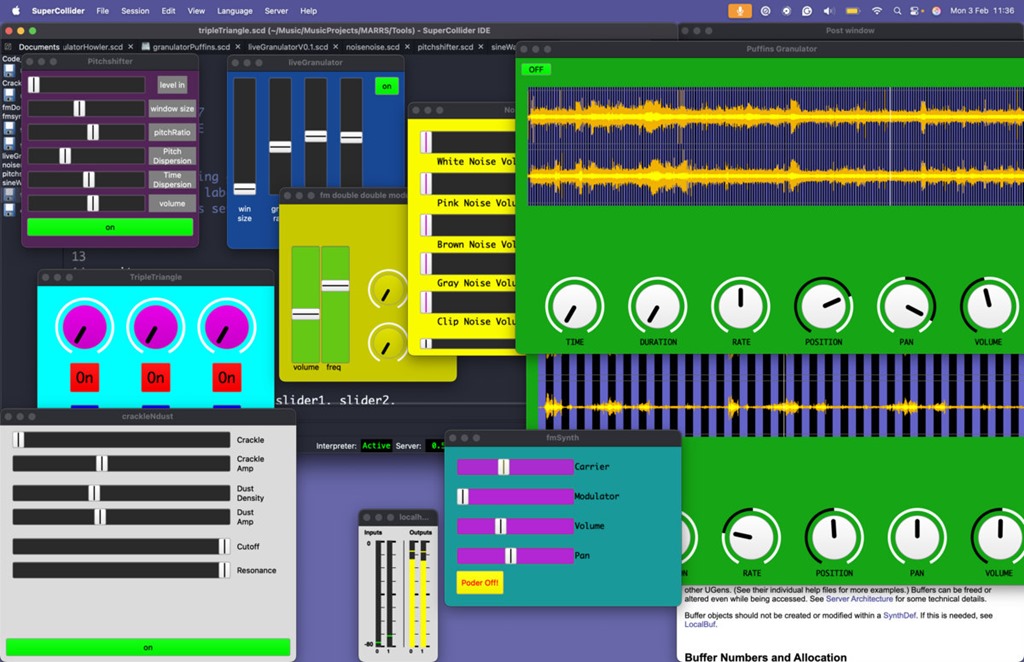
Sagar’s notes are succinct – or scant, depending on your perspective – summarising M/A/R/R/S tools as ‘Audio recording from tests of building tools in SuperCollider for Meanwood Audio Recording & Research Services {"M/A/R/R/S"}.
My instinct is – because my instinct is dictated by my brain, which is brimming with stupid nonsense and is excessively prone to misfired associations – is to ‘pump up the volume’. But this proves to be rather unwise, as the release contains an endless stream of unsettling discordant rumbling, hovering hums, and fizzing extranea which is just around the tinnitus range.
‘Audio_25_01_20_1’ makes me feel tense: it reminds me of a ‘breather’ in a Teams call – there’s always one freak who positions their unmuted mic right in front of their open, gasping mouth, and the sound is like a gale on a mountain top.
Dripping, dropping, dribbling electronic abstractions dominate, with microtonal bibblings running on and on, sounds like twanging elastic bands and scratches and scrapes, atonal strings and R2D2 malfunctioning. I recall running my nails along an egg-slicer as a child. It’s a memory I had largely forgotten until hearing this remined me. M/A/R/R/S tools offers up an oddball array of sounds, and it feels random in the extreme. Oftentimes, it’s barely there, or it’s nothing more than the rumble of passing traffic or a distant radio. Occasionally, there are stuttering drums. Other times, there is not much at all.
This is a work which has been a long time in development: there are two full live sets, recorded five years apart, with a set recorded in London sitting at the midpoint, and another live set, recorded in Leeds, drawing the curtain on this colossal release. The fifteen-minute London set is a challenging work, which confirms what anyone who has seen Ash live will already know, and that’s that he in unafraid to test an audience with monotonous, woozy oops which are as uneasy on the intestines as they are on the ears. This is reinforced by the thunder-filled, sample riven discomfort of the Leeds set – something that his set in Leeds just this last weekend extended still further. Distorted, heavily reverbed and practically impenetrable vocals spitting out randomly sequenced words cut through the speakers, and it’s almost too much, too disorientation. A derangement of the senses. Both John Cage and Brion Gysin would have been proud. It’s dark and murky, and droning notes quaver in the background.
M/A/R/R/S tools is not an easy listen, not only on account of its duration. Despite its superficial minimalism, there is a lot going on. And none of it is kind, comfortable, or particularly easy on the ear or mind.
With his latest offering, Gintas K promises a work of ‘ambience, electroacoustical micromelodies and noise played and record live without overdub.’ That he is so relentlessly active is perhaps one of the reasons its possible for him to create such wild improvised works on a first-take basis – which in turns means it’s possible to crank out new releases at such a staggering rate.
The first of the seven sequentially-numbered pieces is eleven and a half minutes in duration, and begins as a barely audible drip, a tiny trickling sound at the fringe of perception. Instantly I find myself on edge: it’s a sound I’ve become increasingly and acutely aware of in recent days, as the shower in my bathroom – only an internal stud wall away from my office where I listen and write – has progressed from a slow and infrequent drip to a full, continuous dribble, a nagging, torturous sound which has led me to place the shower head in the bath in order to mute it. There’s something of a liquid, and sometimes foamy, frothy sound to many of Gintas’ works, and Atmosphera begins with all the promise of being another one of these. And, indeed, as the drip and trickle increases in rate to become a gurgling stream, there is a sense of growing volume – in terms of liquid, rather than sonically. But a sparse piano rings out over the babbling stream, and as the piece progresses, creaks and bleeps and bumps and strange warps in the very fabric of time and space disrupt the flow. And yet, as the abstract interruptions and distractions become increasingly frequent and ever-more alien, sometimes extending to washes of fizzing distortion, and even fill-on frenzies of chaotic noise, echoing drips and splashes, like water falling from above into the lake at the bottom of a heigh-vaulted cavern, and reverberating piano notes remain at the core of this bewildering sonic collage.
There is a certain sense of evolution as the pieces run into one another: by Atmosphera #3, there is a sense of ambience blended with dissonance, and slow pulsations merge with the brooding and often melancholic piano lines, and these elements certainly contrast with the organic yet equally turbulent, almost artificial grunts and gurgles. Atmosphera #5 is the sound of lasers set to stun, with robotic squawks and a relentless whistle of feedback that hits right at the tinnitus pitch and congeal into concoction of wrongness, like a stew with a bunch of ingredients that should never be combined.
The album winds down gradually, sparse piano notes and a soft trickling liquid flow slowly descending, falling, and fading away…
Something about listening to Atmosfera is like watching a large fish tank. Just as the fish flit blithely and without any attention to the world beyond their own, darting here and there without any predictable linear path, so Atmosfera doesn’t follow a linear flow – and is all the better for it.
Most blurbs which accompany releases are either factual, unspectacular in their biographical detail, or tedious in their technicality. Some are vaguely amusing or otherwise entertaining, but the words accompanying Jeugdbrand’s 3 × hullo, hullo, courtesy of Lieven Martens are outright deranged. I mean, there’s a narrative there, but it’s more of a slab of gonzo fiction than anything. And that’s before we get to the whole mole thing….
‘Well, it went like this: I open the glass door to the garden, the early morning coming to its midday end. That everyday anxiety that overcomes late risers from time to time kicks in. “Fuck, almost half a day wasted!” But abruptly, this sentence in my head gets overdubbed by the Queen’s English: “That shit mole, that blimey shit cunt mole!” I see the expat owner of our Airbnb punching his bare fists on his green lawn. A spotless lawn, but with here and there a few molehills. His grass, like a billiard cloth in a smoked bar, serves as a contrasting pathway to the black volcanic rocks at the back of the house. Behind these rocks, the ocean foams and growls. “Luv, get the poison! I wanna finish the bugger now and for good. Bloody hell!” I watch this scene with amusement, until suddenly, when the landlord notices me, he cleans up his act. “Ooh, these are funny little creatures, eh, these furry moles. Cheeky peng. Eh, fancy a cuppa?” The landlord’s head and belly are so ridiculously red that I can almost hear a lobster scream in a pot of boiling water. He looks like a walking can of Spam, its contents cooked by countless days under the Indian Ocean’s sun. The Indian Ocean, where sharks migrate between Africa and Australia. And where the Hawaiian-shirt-wearing tourist bravely builds new islands of trash. Yes, the very true meaning of re-creation. Someone once told me that lobsters don’t really scream.’
I once caught some shrimps and prawns in a rockpool while on holiday in Devon. I was probably about twelve. We took them back to the cottage, and my dad cooked them up, tossing them into boiling water. I understand the sound of them being boiled alive was actually the air escaping their shells, but they did sound as if they were screaming, and I have referred to them as ‘squealy prawns’ ever since.
That I have digressed in response to an epic digression seems only fitting, and all of this seems appropriate when it comes to this album. 3 × hullo, hullo definitely falls into the category of ‘weird shit’. ‘Lonely, Sure, but It Is Getting Late and My Grandmother Is Calling’ flits between blasts of noise, stuttering percussion, jolting rumbles, whistling feedback, mumbling, grumbling, and demented yelling, yodelling and ululation. It’s a lot to pack in to less than six minutes, particularly when it’s six minutes spent scratching your head, looking around and wondering what the fuck is going on.
By the end of the album’s five tracks, I’m none the wiser. It makes me think of when I see a post on social media which is both seemingly cryptic and linguistically nonsensical, and yet it’s followed by a series of responses which bewilder not only in their equally coded babble, but in the realisation that people actually understand the initial post. It isn’t that I don’t get the way language evolves and how each generation develops its own spin, but… words. They mean what the mean, no? No. It seems I am wrong.
In fairness, I do understand the words and the narrative Jeugdbrand offer, it’s just that the narrative is crackers, and it’s fitting because the album is also crackers, a collage of craziness from beginning to end. ‘Tomorrow, Tomorrow? I’m Talking About Now, Forget about It!’ starts with a ticking clock and then goes haywire, making for a head-spinning eleven and a half minutes of tribal percussion, drones, discordant church organs, surges of sound add rapid depletions, hollers, yells, grunts, and yelps. Elongated notes quaver, quiver, and fade in and out, while there are twangs of guitar and the occasional, incidental thump and scrape. ‘There’s No Word for Ambient in Dutch’ is dark, haunting – at least after its strange, murky start, reminiscent of Throbbing Gristle’s noisy, oddball experimentalism.
‘Motorcycle Oil on Canvas’ is eleven and a half minutes of spooky, spaced-out woozy, warping drones and oddity, again with snippets of chants, record scratching, clicks, pops, crackles, toots and parps and, amidst the rumble of engines and the snarl of prehistoric reptiles, one finds oneself completely adrift and perplexed. It ends with anguished wailing atop a tempest of noise. There is a lot going on. Much of it is hard to process.
I’m accustomed to all shades of avant-garde and experimentalism, and I’m even more accustomed to my friends defining my musical tastes as ‘weird’, but this is far and away some of the weirdest shit I’ve heard – period.
One thing you have to say about Tim Hecker is that his output has been varied, and his career interesting. This isn’t a case of damning with faint praise: it’s very much about highlighting what makes him such a remarkable artist – the fact he doesn’t simply mine the same seem in perpetuity. The difference between the organ-based compositions of Ravedeath, 1972 (2011) and the dark ambience of No Highs (2023) is vast, and is emblematic of an artist who simply cannot be confined within narrow constraints. Electronic music is an immensely broad church, and Hecker’s output ventures the field far and wide.
This is perhaps exemplified no more clearly than on Shards, ‘a collection of pieces originally written for various film and TV soundtracks Tim Hecker has scored over the last half decade. These compositions were originally written for scoring projects including Infinity Pool, The North Water, Luzifer, and La Tour.’
The album’s seven compositions highlight Hecker’s capacity to mould mood.
‘Heaven Will Come’ evolves and expands over the course of its four minutes and forty-eight seconds, growing from delicate but expansive elongated organ-like notes to a swirl of anxiety, with dank, rumbling bass lumbering around, as if without direction, amidst warped, bending undulations, an uneasy discord. ‘Morning (piano version)’ is very pianoey… but also brings booming bass resonance, and slight, flickering, glimmers of sound, almost insectoid, and mournful strings which bend and twist and ultimately fade… to be replaced by a deathly bussing drone and distortion which fills your head in the most uncomfortable way.
The hectically scratchy plink and plonk and looping delirium of ‘Monotone 3’ hints at the trilling of woodwind-led jazz, but there are menacing drones and weird shapes being sculpted here.
Hecker specialises in the disorientating, the unheimlich: the majority of the pieces here are superficially calm, tranquil – even the more brooding ones. But something about each isn’t quite right – there are dark undercurrents, or there is a twist, from out of nowhere. And herein lies Hecker’s unique skill as a composer.: he can twist ambience into discomfort, and at the most unexpected times and in the most unexpected ways. Consequently, Shards brings many twists and turns: at times soothing, at others tense, and at others still claustrophobic and even almost overwhelming, and it completely take you over as you feel this range of different sensations.
Shards – appropriately titled in that it draws together splinters of Hecker’s diverse and divergent output is an exercise in depth, range, and magnificence. Sit back, bask, and take in the textures.
Bath-based microlabel Institute For Alien Research tends to focus on compilation releases, with open submissions, on various themes. One long-running series is Collage Music, each of which features fifteen works, the only stipulation being that their duration is 4:33. Not a second more, and not a second less. They’re not looking for interpretations of John Cage’s seminal work, and as such, the duration is in many ways arbitrary beyond the idea that artists respond to limitations and set parameters in different ways, and as this – the twenty-eighth in the series (as the title indicates) – illustrates the point unequivocally.
With ‘Circumstances’, Support Group ease us in gently with some slightly woozy, echo-soaked, ambience, before Lezet stammer and glitch through a multi-layered slice of abstraction with ‘Colonnades of Fear,’, which may also be ambient, but it far from relaxing, although it’s Robert & Lamy who are the first to venture into much darker territory, with the kind of doomy, drony warped tape and noise experiments that are reminiscent of Throbbing Gristle in places.
The arrival of ‘bruits de la vie’ by samelectronics feels like something of a watershed moment, being the first piece to present big, bold sounds – feedback and immense powerchords, which, instead of feeling heavy or oppressive, open an expanded horizon, to surprisingly uplifting effect. The rough, lo-fi punkiness of ‘Johnny got no respect’ by This is The Utter vs Chelsea comes as a surprise bang in the middle, being the album’s first straight-up guitar-based cut, and it’s a savage semi-cover to boot.
Along the way, there’s a superabundance of weird shit, with collages and field recordings and ethereal haunting soundtrack-like compositions, dark electronica, spaced-out BBC Radiophonic Workshop type soundscapes, and banging dance, courtesy of Sbilts, with ‘Acid Dog’, who mine a vintage techno sound propelled by old-school drum machine sounds. That snare! Samples! It’s a sonic time-machine!
Just as grassroots venues are essential on so many levels, so are labels who put out releases like this. Most of the contents of such compilations is ultra-niche, and will never expand beyond being so – and that’s ok. There is a huge audience with niche tastes who simply aren’t catered for by bigger labels, bigger venues. Most of the acts here are unlikely to ever play to more than twenty-five people, assuming anyone will put them on, and they’re never going to be snapped up by a label which has aspirations of making money. Self-releasing is find, but it’s hard to reach the tiny, fragmented target audience. But a label like Institute For Alien Research, having established a reputation for providing a platform for the full spectrum of experimental electronica and beyond, creates its own niche. It may seem hard to believe when there are maybe a few hundred or so people who are into it, but this really is what the world needs. Capitalism is killing cultural diversity, and it’s killing art.
The fact that Collage Music (28) is a mixed bag is a good thing. It would be all too tempting for the label to be picky, sniffy, selective, and offer up a compilation which is more homogeneous, unified, that presents, ultimately, a curated collection determined by personal taste. And that would have been fine, and entirely their prerogative. But Collage Music (28) is all the better for its wild eclecticism. You might not like all of it – and it would be probably be a bit strange if you did – but in listening to it, there’s a chance you’ll find your eyes are opened to something you didn’t know you would like, and it’s absolutely guaranteed you’ll hear artists you would never have otherwise encountered. So dive in!
Ambient music is, in many ways, music for reflection. Or perhaps, music which provides the backdrop to reflection. Time was that I had very little interest in ambient music, but I have come to appreciate it has having quite significant functions, whether by the design of the artists or not. Reviewing requires a level of focus and attention that regular music listening does not, and when it comes to ambient works, a greater level of attention is necessary: I feel there is a requirement to tilt the ears and pluck out the details, the textures, to venture into the depths to extrapolate the moods and meanings. Sometimes, I fail, and find my mind wanders down different paths as space opens up through sonic suggestion, and random associations are triggered completely unexpectedly. Regardless, ambient music is generally best received in darkness, or by candlelight. Please… close your eyes and absorb without distraction.
As Oliver Richards – aka Please Close Your Eyes – writes, “Music for Floating is a document of transition. It collects pieces that were made over a three year period, nearly three years ago. They were all made before my last Mortality Tables release, ‘Nibiru’ / ‘Heaven On The Fourth Floor’…It’s a consciously-composed modern classical album. I have no classical training at all, but when I was making it, I set out with the intention of composing for the first time, consciously and intentionally. The music I made before under the name Goodparley was all created improvisationally and instinctively. With this I would step back and ask myself, ‘What am I actually going for here?’”
I ask myself this question often, and not just about creative endeavours, but life generally. How many of us really have any idea, about anything? Music for Floating, then, provides a magnificent soundtrack for contemplation and reflection, on the world, on life, and all things. But it’s not simply an ambient work: it’s a collection of pieces which span a broad sonic range, and while gentle and mellow throughout, there’s much more to it than drifting clouds and soothing sonic washes.
There’s something of an underwater, soft-edged soporificness about ‘The Moment Before We Sleep’, and it’s one of those pieces which lends itself to immersion and letting oneself cut adrift. In contrast, ‘The Hollow’ brings a busier, more bustling feel, not to mention something of a progressive vibe, as synth piano ripples and rolls with waves of energy. Augmented by synth strings and other elongated, organ-like sounds, the seven-minute ‘Piano for Floating’ is a standout, compositionally, structurally, and sonically. It’s subtle, layered, and casts the listener adrift on a rippling expanse of tranquil sound. Music like this has a profound effect that’s both physical and mental: you can feel your spine elongating, your muscles gradually becoming less knotted. I find myself yawning, not out of boredom, but through a rare relaxation.
At under three minutes, ‘Deeper Blue’ provides an interlude at what stands as the notional start of side two, before the six-minute ‘Heaven, Faced: or, The Fairies’ Parliament’, and the epic finale, the nine-minute ‘The Time Before the Last’. The former traces shimmering contrails through an azure sky; it’s the sound of slowly rippling aroura, of silent snowfall in a windless winter sky, of your mind spinning in amazement at the wonder of natural phenomena… while the latter brings slow abstract drifts which evoke the vastness of space, eternal in its expanse. It’s bewildering, but so, so calm… Time evaporates, and nothing matters. There is nothing.
Tomoyoshi Date’s biography makes for an interesting read: he’s described as ‘a physician and musician known for his releases on prominent ambient labels such as 12K (US), LAAPS (France), and QuietDetails (UK)’. There’s much to be said for having a creative outlet which is completely separate from one’s day-job, especially when that day-job carries a degree of responsibility and likely brings with it no small level of stress.
Tomoyoshi Date has gone a step further, though. You couldn’t really call being a musician releasing ambient works on avant-garde microlabels a ‘side-hustle’ – which seems to be all the rage of late, and seems to be something people are proud of and the media love as much as they used to love contestants on Big Brother after they’d left the house, rather than acknowledging that this is a symptom of how capitalist structures are failing so many working-class people: this is more of a parallel career, and presumably Tomoyoshi Date’s ‘professional’ occupation affords the time and space to pursue the ‘other’ career.
Having recently written on how the four-CD box by Dolium, and the near hour-long single track album Leaves never fall in vain by Fear of the Object require a certain time commitment, I’m here in the face of not one, but three albums. Because Piano Trilogy is not a set of three compositions, but three separate works, recorded between 2021 and 2024, which collectively form a trilogy, released as a cassette package in an edition of 150 copies. It’s niche, alright, and as I said, there’s no way this would pay the rent as a primary occupation – which is a shame, but it’s the crappy capitalist world we live in, unfortunately. Were things different, I could write about music all day long and put food on the table.
This trilogy is formed of ‘ 438Hz, As it is, As you are, released by LAAPS and selected as one of Bandcamp’s Best Ambient albums in January 2023; Tata, composed for Silver Gelatin’s exhibit at Tata in Koenji, Tokyo; and Requiem, a piece dedicated in memory of a close friend who passed away too soon’ and ‘All three albums are packaged in special jackets featuring found photographs curated by Silverわ Gelatin and are being released simultaneously.’
An album trilogy released simultaneously is a lot to assimilate, and few, if any, listeners are ever going to listen to these three albums back-to-back, not even Tomoyoshi Date’s biggest fans. But for review purposes, that’s precisely the task I have set myself.
Date is clearly a gifted composer and musician, and it’s certainly no criticism to observe that the music drifts by, lightly and effortlessly. Amidst the piano notes which ripple serenely are stutters and glitches which deviate from the more classically-orientated template and explore more electronic, experimental territories. But Date does so subtly, delicately.
438Hz, As it is, As you are is a most soothing work, consisting of four compositions spanning around half an hour. Drones and slow-turning ambient tones, and birdsong occupy much of the space between piano notes, and the effect is relaxing, like a walk in nature. It’s the shortest of the three, with Tata and Requiem both stretching well beyond forty minutes I duration.
Tata is more ‘pure’ piano, and runs for almost forty-five minutes, while Requiem is sparse and melancholy, and stands apart: a pure piano work, it comprises six pieces, all over five minutes and up to more than eight and a half minutes in length, and rich in low-key melancholy.
These are clearly separate and distinct works, but they’re very much complimentary, and work together as a suite.
Simon Whetham’s latest work is a fascinating hybrid which incorporates found sounds and elements of layering in order to create a whole other world, a different dimension. The album itself is part of a larger project, which is more readily explained through quotation than a stumbling stab at paraphrase:
Successive Actions is an iteration of the larger kinetic sound performance project series Channelling in which various motor devices, salvaged from obsolete and discarded consumer technology, are activated by playing sound recordings through them. In turn, this produces new sounds from the devices, which are amplified using various microphones and techniques. The title comes from Dirk Raaijmakers’s "The Art of Reading Machines" as a term for mass production processes. As such, the recordings played through the devices are recordings of other devices used in previous versions of Channelling, in which the sounds used were seemingly mundane sound phenomena that occur unpredictably and irregularly in everyday life, as passing traffic, wind, doors closing. So now the sounds of devices malfunctioning and breaking from their programming are causing further action and disruption.
Successive Actions contains sixteen pieces, although only four extend beyond four minutes in duration, with the majority sitting only a short way over the two-minute mark, giving the album a fragmentary feel. But there’s a strong sense of cohesion, too: the title of each of the pieces ends in ‘action’, from ‘Action’ to ‘Protraction’, via ‘Inaction’, ‘Impaction’, and ‘Abstraction’.
While much of the album takes the form of abstract ambience and general murk, there are moments which stand out with levels of heightened discomfort: ‘Reaction’ conjures the bleak whistling wind of a nuclear winter. ‘Inaction’ scrapes and buzzes; it’s unsettling, but it’s not uncomfortable to the point that it’s unbearable: it just makes you feel tense, awkward. You want to seem a less stressful environment. But there s no less stressful environment, and life is stress: to escape that is to deny the reality of the everyday, for the majority. Under capitalism, we are all stressed, and on Successive Actions, Simon Whetham gives us a soundtrack to that stress and anxiety.
Mass production is, arguably, a fundamental source of our woes in the modern age. The Industrial Revolution brought so much promise, but as capitalism has accelerated and expanded at a pace which exceeds our capacity to assimilate, so it has become an ever-greater source of alienation. And here we are, overwhelmed by the road of the big machine as it continually whirrs and grinds. Sometimes its but a crunch and a gurgle, a hum and a thump. A buzz of electricity, a mains hum, as dominates both ‘Retroaction’ and ‘Counteraction’. It’s a cranial buzz and pushes frequencies which are uncomfortable, and as the album progresses it plaiters, and turns dark.
For myself, I feel a certain sense of release while immersing myself in the textures and layers of Successive Actions. There are moments when the album really achieves a heightened sense of – and in panic, of anxiety, of intensified reality. Other moments are altogether more sparse, steering the listener inside themselves into a the depths of an interior world.
Successive Actions is deep, dark, difficult. And so is life. On Successive Actions, Simon Whethamcaptures it, all elements of life that is. It crackles and fizzes with tension, and tension is high.