Archive for September, 2023

Panurus Productions – 6th October 2023

Christopher Nosnibor

Heavy music doesn’t have to be po-faced or excessively serious, and there have been a few comedy metal and noise bands through the years. Lawnmower Deth are one which swiftly spring to mind, but the likes of Municipal Waste, and lesser-known acts like Grindcore Cakemakers also make hard noise while being a far cry from the existential rage more commonly associated with their genres. And that’s good. The world needs variety, and there’s more than one way to alleviate the grimness of life on this sorry planet.

This album from Black Shape is perhaps the absolute antithesis of Godflesh’s seminal Streetcleaner. With the lumbering weight of a runaway bin lorry, Black Shape rumble their way through eleven tracks of bin themed absurdity, utilising their knack for writing material that is as colossally heavy as it is varied and comedic. Most of the tracks are around the two-minute mark, with just a couple of four-minute outliers. On the surface it’s a whole mess of noisy shit, but closer listening soon reveals a wildly varied album which incorporates jazz, spoken word, nu-metal, rap and thrash.

‘The Beast from the North East’ is a dirty, shouty punk effort – more Anti-Nowhere League than The Pistols. Dense, muscular, with filthy sludge guitars, pant-soiling bass, and a wild solo which occupies half the song’s duration. The production is rough and raw, and this works in its favour: the guitar on ‘I Wanna be a Binman’ positively tears from the speakers, and it’s like being at a gig and standing so close to the PA that your nostrils vibrate. If you’ve never done it, you need to at least once, although earplugs are recommended. You still feel the force without fucking your hearing for the rest of your life. It’s a throbbing stomper reminiscent of Ministry circa Psalm 69. Only instead of burning for the needle, it’s a hard craving for lugging refuse. They pillage every style going here: ‘Dogshit Bin Juice’ takes a turn for the choral in the verses between ball-busting glam stomp riff breaks. It’s hilarious, but also makes you think. You sometimes hear that binmen are pretty well-paid. But would you do this, for any money?

If ‘Put Me in the Bin’ is the most overtly old-school punk cut, the recording is again more industrial, which couldn’t be more at odds with the offbeat, off-the-cuff lyrics, while ‘Once a Binman, Always a Binman’ throws a curveball with a gentle intro and unlikely lift of ‘Love Lift us Up Where We Belong’ before going full-slugging nu-metal / grunge crossover, with the meaty heft of Tad bringing the blue collar grit to proceedings. There are some moments of astute observation and social critique which land quite unexpectedly, but it just goes to show that it’s a mistake to write of a so-called ‘comedy’ album – or indeed any comedy – as shallow, lacking in content, or emotional depth. ‘The Story of How I Died’ brings lilting harp and Pam Ayres style narrative.

Beyond bin-related themes, this is not an album that’s predictable in anyway, lyrically or stylistically, with piano ballads pressed against squalling hardcore assaults. And because of the punk / thrash / metal leanings, and the overall daftness of many of the lyrics and the overall concept, Black Shape’s musicianship is likely to be overlooked. But the range is a measure of immense versatility and competence. Black Shape are the Bill Bailey of dustbins, and BINS is a work of sheer brilliance.

AA
a2313098061_10

343 Collective / Broken Soundtracks / Jam Recordings –15th October 2023

The arrived of this album piqued my curiosity for a number of reasons, and one of the first things I felt compelled to do was unravel, or at least understand, the context of the title, since it seems to connote being the music which accompanies a movies. On my journey, I discovered that in film, a score is, at least according to Masterclass.com, ‘the specific musical piece or incidental music that accompanies a scene or moment in the film, and a soundtrack is the compilation of songs and sounds that comprise all of the film’s music. Scores are usually created by one or more composers, while soundtracks typically feature songs by different bands, artists, or musicians.’

But equally, a score is notation, usually in manuscript or printed form, of a musical work, believed to derived from the vertical scoring lines that connect successive related staves.

This album is neither notation nor featured as part of any movie – at least, not one that’s been produced yet.

The ensemble founded by Jon Dawson, and John Bundrick as a side project to Third of Never has expanded considerably, now standing as a six-piece, with this outing features additional contributions from Rabbit (The Who), Steve Kilbey (The Church) and Doug McMillan (The Connells), and was recorded alongside the forthcoming Third of Never album.

They describe the album as ‘a lysergic mood journey of epic proportions’, and advise that it be listened to ‘all at once, in the dark, accompanied by someone you trust, and a lava lamp.’ Well, it being a wet night at the end of September, it’s been dark since before 8pm. I’m alone in my office, and in the absence of a lava lamp, I have a couple of candles lit, and as such, my listening experience and ultimately my review are in the spirit of the album and its intentions – penned in a single sitting, straight through, no pauses, no rewinds, no munching popcorn. Just the quiet sipping of an Islay single malt.

To describe it as ‘epic’ isn’t hyperbole, but a statement of fact: the scope and impact of Original Score is vast. There’s no delicate, slow-building introduction: ‘Attention’ says a voice urgently but dryly, before a sound-collage begins to layer up before our very ears, and that rapidly evolves into a space-age jazz workout with rolling piano and hectic drums driving through fluttering cut-ins and cut-outs, and everything’s happening at once, for a time pinned together by a crunking, choppy bass before ethereal voices float in a chorus of reverb to carry it all away. Done differently, it could be a chaotic disaster, but it’s more Burroughs than Beefheart, and in filmic terms feels like the accompaniment to a three-way-split screen with rapid intersections and scene changes across all three.

Perhaps it’s the power of suggestion, or the potency of the whisky, but Original Score does feels like a very visual audio.

Because of the fact the eleven pieces are segued to form one continuous work, if you’re not actually looking at the CD display, there’s no way of really knowing when one ends and the next begins: because the individual tracks aren’t linear or overtly structured, the transitions between them are seamless.

There are some uplifting, light-hearted passages, and some incredibly dark, almost spooky ones, as haunting voices float hither and thither over wailing guitar feedback, undulating organ notes, and ponderous bass, fractured, treated vocals adding to the unsettling disorientation.

There’s a strongly proggy space-rock vibe, and the quavering keys and strolling bass segments lean heavily towards that seventies sound. I’m not well enough versed to differentiate Yes from King Crimson, but these are the touchstones that spring to mind, melted into Hawkwind wigouts. At times, the images it conjures are of spinning through space, hurtling headlong into the void; others, simply of a band on a massive stage with a drummer and three percussionists, multiple keyboardists with tassled sleeves delivering fifteen-minute solos to a Woodstock-sized crowd, with bearded guys in flares utterly losing their shit. It may be all of this and more, or none of these things when it comes to your own experience.

And this is, undoubtedly, the beauty – and artistic success – of Original Score. It’s the real-time unravelling soundtrack to the movie that you picture in your mind’s eye.

AA

a1597649542_10

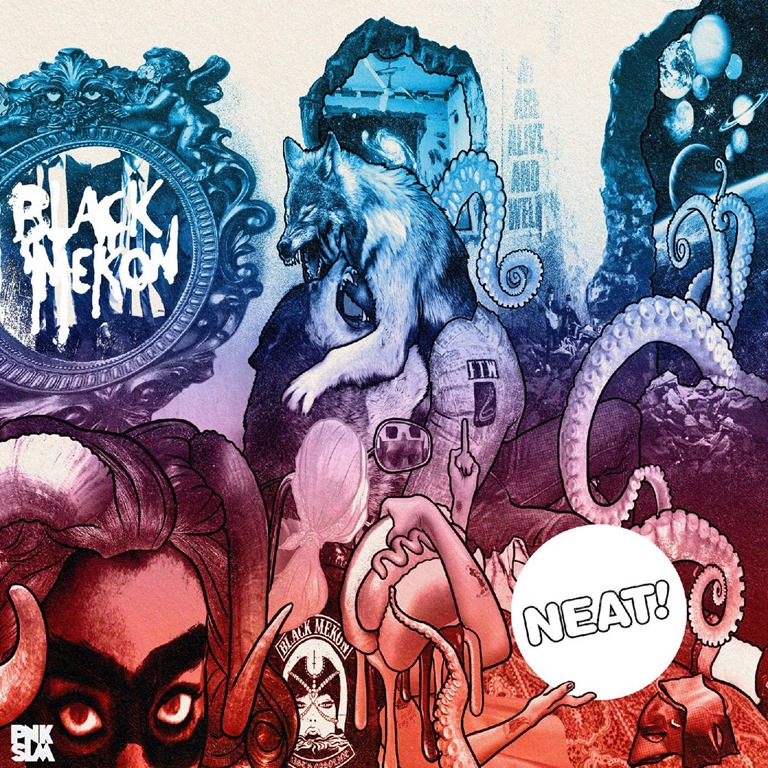
We’re still not 100% sure where exactly Christ’s Gasoline is, but garage punk duo Black Mekon have spent the best part of the last two decades putting their birthplace on the map. The two masked brothers have been handpicked to tour across America, Europe and Japan by the likes of Jon Spencer Blues Explosion, Guitar Wolf & King Brothers – and  released no less than twelve albums, and nine 7” singles. And that’s not to mention finding time to somehow create their own video game, action figures, bubblegum, a fully functional Arcade Machine, the “Mekonizer” fuzz pedals, an animated movie, and several comics along the way.

Their 13th album will be released into the world on Friday 13th October, titled NEAT!, naturally named after their own fanzine. In an unexpected deviation from their strict “one-take-will-be-fine” DIY ethos, for the new album they teamed up with Stockholm based garage rock legend Lucern Raze to share production duties. “I mostly did it for the money, but I also wanted to help create a Mekon record that doesn’t instantly make your ears bleed” , shares Raze; “this one’s probably 10% more listenable than the rest.”

NEAT! will be released worldwide via the bands long term sufferers PNKSLM Recordings on October 13th, with an exclusive pink and white vinyl version available exclusively from Rough Trade as well.

Ahead of the album, you can listen to all 2’11” of ‘Cheap Date, Expensive Drugs’ here:

AA

a3438878462_10

Sinners Music – 30th September 2023

Christopher Nosnibor

As the album’s title suggests, this is not Andy & Grace’s first work together, but does come after some time since their last collaboration. By ‘some time,’ I mean a long time. Like two decades long. As the bio which accompanies the album outlines, they first met in the late 1990s ‘as founding members of the ambient chillout band Chillage People’, under which moniker they played ‘long, improvised sets in sweaty chill-out rooms in gloomy Sheffield clubs’ and resulted in the album Solid Water, released in 2001.

There’s much of the intervening time unaccounted for, presumably because life. So many creatives in all media seem to suddenly disappear from view. Work, families, and ordinary everyday adult pursuits take over and there simply isn’t the time or the energy. Some accept this comfortably, even embrace it, others wrestle with the opposing forces of creative juices fermenting and slowly gnawing at their guts while enduring.

Whatever the reason for the gap in his musical CV, recent year have seen Andy becoming a part of the Electronic Music Open Mic (EMOM) movement, appearing at venues around the North of England playing with his modular synthesiser. This is where Sinner Records come in: Ian J Cole is also a face on the EMOM circuit, a musician in his own right, who recently established Sinners Records. And let’s not forget Grace – that’s Grace Griffin, who at the time of joining Chillage People, was already a highly sought-after live sound engineer, working with some of the biggest names in the music business.

‘You name them and it’s a fair bet that Grace will have worked with them,’ says the bio. On top of that, and being ‘an accomplished musician with a gift for crafting fascinating textures and grooves, she is also an adept photographer and video editor.’

She’s remained engaged in music. There may be a worry that after twenty years and their lives having taken such different trajectories, reconvening would bee awkward, but the clue is in the title, really: Reunited speaks of coming together, coming home and picking up where you left off. And listening to Reunited, for all its crazy crossover and stylistic divergences, it feels like an album that has been dying to get made, whether they knew if or not before they started work on it.

Over the span of thirteen pieces, the pair explore a host of soundscapes and varying moods, all incredibly rich in atmosphere, shifting constantly. The first of these, ‘Deady Long Legs’ transitions from shifting sands of electronic noise to somewhat unsettling echo-drenched ambience, eerie chimes and shooting stars spinning off course against a warping backdrop of slow-melting vintage synth tones and shuffling groundworks, and there’s a lot going on here. It’s an album dominated by rippling waves and space-age spins, and there are some tracks which find the pair go full dance – or EBM or EDM or whatever it is in America. The beats aren’t often dominant, but they are frequently driving. At times, the tones are brittle, reducing from full range to clipped, tight compressions mingling with undulating synths forge cinematic techno.

There are moments of expansive tranquillity, such as ‘Sad Major’, and this is an album that places tone and texture to the fore in terms of the way the sounds are sculpted into songs. It’s immersive stuff, and on a number of occasions I find myself zone out, not through boredom but the music enveloping my mind and body. And perhaps some tiredness, too. But ‘Forty Winks’ a bleepy wakeup, and one suspects the title is a reference to Josh Wink.

Reunited is the sound of old friends coming together and finding they still have an intuitive connection. There are some neat grooves – like the buoyant almost funk-tinged workout of ‘Groovy Machine’ and the stuttering harder beats of the mellow ‘Mallets of Entanglement’, and there are elements of playfulness in evidence, as on the skittering ‘Wasted in Da House’ and the irreverently-titled ‘When A Seagull Ate My Icecream’ – which reminds me of the time a giant cockerel nicked my baguette, but that’s a story for another time.

Reunited is a cohesive work which strolls through numerous different terrains of electronica, and shifts from light to dark, but mostly ambulates the spaces in between in fine style.

AA

Andy _ Grace Cover

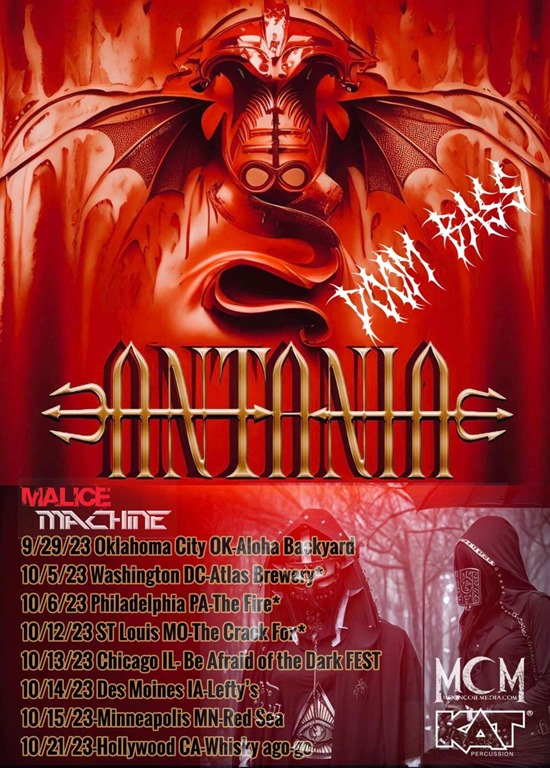
"Doom Bass" duo, Antania recently announced a string of North American live dates.  Performing in direct support will be Cyber-Punk band, Malice Machine.
Antania will be touring in support of their debut album, Lividity, which recently received a thumbs up from us here at Aural Aggro.

The duo has also recently unveiled their video for the song, ‘The God Complex’.  Director Matt Zane (Society 1) says, “I loved working with them.  Amazing aesthetic.”

The songs on Lividity were written right from true crime stories, Each song represents a true story of murder and violence as the Antania duo find their inspiration from real events.

Lividity is available on all digital platforms including Bandcamp!

Watch the video here:

AA

32811456-4333-75f1-bd83-b08649293741

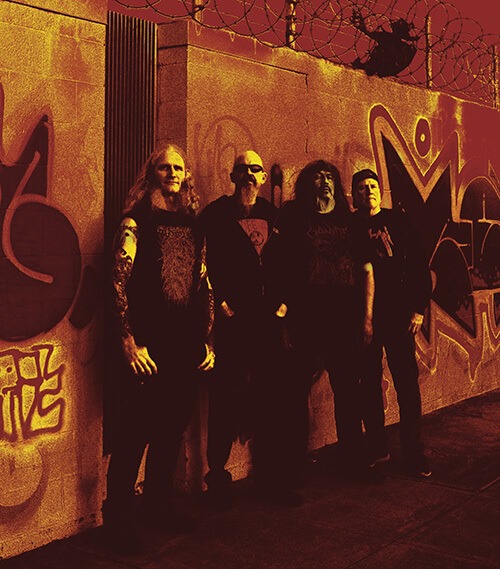
After the announcement of their new album Ashes, Organs, Blood and Crypts, Autopsy peel back the skin of their new record with a bloodied single, ‘Throatsaw’. The track is whirling dervish of razor sharp riffing and serrated vocals that slice through the mix delivering that signature Autopsy sound.

Regarding the single, Chris Reifert had the following to say:

“For this selection we have decided to cast aside musical acrobatics, high-brow labyrinthian showings off of scales, sweeps and noodlings, lush sonic passages and deep audio journeys rare and untold, egotistical trains of thought and neo-classical wizardry and well…just cut your fuckin’ throat wide open and giggle like cretins while the blood sprays in every direction. Doesn’t that sound like fun, kiddies?”

The single is accompanied by an animated lyric visualiser created by Andrea Mantelli Productions.

Watch it here:

Hot on the heels of 2022’s universally lauded opus, Morbidity Triumphant, the US death metal greats now return for a new sermon of sickness, with ‘Ashes, Organs, Blood & Crypts’, featuring brutal bouts of riffery feral attacks, soul crushing doom and all out skull splitting heaviness.

Emerging from their sepulchre comes yet another horrendous piece of art from long time collaborator Wes Benscoter (Bloodbath / Slayer). Inspired by the title, the band let Wes’ imagination run amok, conjuring up yet another horrifying monument to Autopsy’s latest musical offering.

IMG_7786-500-

Photo by Nancy Reifert

Sub Rosa  – 22nd September 2023

Christopher Nosnibor

So many reissues recently have taught me a valuable lesson. I don’t know nearly as much music as I thought I did. Of course, it’s impossible know all the music, and despite feeling I’m reasonably knowledgeable, and compensating what I don’t know with enthusiasm. Time was, I was worried about knowledge gaps: they made me feel stupid, ignorant, and I’ve spent evenings with people who have reeled off bands in genres I’m interested in and not recognised the name of a single one, let alone heard them. I felt like a fraud claiming to be a music enthusiast and worse still, a music writer (I never proclaim to be a music journalist. I write about music, and do so very much from a personal perspective. Sometimes, I stab at maintaining an element of objectivity, but the appreciation of art isn’t objective. As I’ve written elsewhere, the reason we appreciate art is because of the feelings it stirs in us, the way it speaks to us, not first and foremost because of its technical proficiency.

This is a lengthy circumnavigation to the confession that Die Anarchistische Abendunterhaltung completely bypassed me in the day – in fact, until today, the week of the reissue of their 1995 self-titled full-length debut. I suspect that they didn’t get much coverage in the UK music press, and this was still a while before the advent of the Internet as we know it – and I was a relatively early adopter, setting up my eBay account in 1999 following the demise of Yahoo! Auctions.

As the accompanying bio outlines, ‘The band consisted of four young, ‚classically derailed’ musicians who played their own compositions exclusively their with acoustic instruments such as violin, cello, clarinet and accordion… Their work contained influences from Roma music, Eastern European folk, klezmer and jazz, but was performed with the energy, rebellious spirit and Sturm und Drang of a bona fide punk band. DAAU was part of the fertile Antwerp scene, which also produced dEUS, Zita Swoon and Kiss My Jazz, and soon signed an international record deal with Sony Classical.’

dEUS may have briefly made a mark here in the UK in indie / alternative circles, but the others, not so much, and I suspect that even with its first vinyl pressing, this re-release will likely have a bigger landing in Germany and, indeed, the rest of mainland Europe, than this pitiful island that still celebrates Britpop, and which spent 1995 dominated by turgid sludge by the likes of Oasis, whose pinnacle release (What’s the Story) Morning Glory? and Blur’s Great Escape (which was anything but great); the best we got was The Bends, while Robson and fucking Jerome dominated the singles charts for half the year. As if we needed further proof that we’re a small, crappy island with an overinflated sense of self-importance that the longest hangover from the Empire ever. It’s embarrassing, as is the fact that this domestic Brit-centric bullshittery has denied us introductions to many great bands. Die Anarchistische Abendunterhaltung is a perfect example.

It’s perhaps not hard to grasp why this extravaganza of neoclassical extravagance and its wild woodwind and unpredictable compositional forms didn’t grab the attention of the British Music press, but they missed a work that’s hugely innovative and belongs to no one genre. It’s wild and it’s challenging , but these are positives.

Die Anarchistische Abendunterhaltung is droning strings, it’s by turns melancholy and slow, and remarkably lively. It’s an untamed beast almost with a life and energy all of its own. But the compositions aren’t in sequence!

‘V Drieslagstelsel’ is the first track, the first of five ‘Drieslagstelsel’ pieces, and it’s followed by the frenzied yet droning folksiness of ‘II Drieslagstelsel’: it’s pretty, but it’s strange. Or, it’s pretty strange. I’m on the fence, while it sounds like they’re stripping the fence with some frenzied violin work. ‘III Drieslagstelsel’ scuttles in with some cheeky chamber stylings before popping in all directions, and it’s kinda cheeky – and perhaps tongue-in-cheeky – jaunty, incredibly busy, and extremely varied. It isn’t the kind of explosive, head-spinning jazz I sometimes find myself wrestling with here, but it covers a lot of terrain in just five and a half minutes, with stage musical qualities pushing to the fore before dipping back down to something altogether less ‘production’ orientated. The last of the ‘Drieslagstelsel’ sequence is ‘I Drieslagstelsel’, and following the frenzied strings and dramatic orchestral sculptures of ‘VI Drieslagstelsel,’ it’s a compact piece of neoclassical music which fulfils the oft-underrated and oft-overlooked purpose of entertaining. It’s a fun and often frivolous piece, in parts a wild hoedown with wind instruments, with an eye-popping energy which delves in to drones and darker territory at times.

What happened to IV? Maybe it doesn’t matter. Rounding the album off is the eleven-minute ‘Doorloop’, which appears to be a traditional track, and its slow, drawn-out notes are funereal at first, before thing go g=crazy and there are even vocal.

Over the course of these six pieces, Die Anarchistische Abendunterhaltung brings massive range. Back in 95, I probably wouldn’t have appreciated it, and nor would anyone else I knew. But here we are, looking at an accomplished album with much texture and range.

And now, I appreciate it. Perhaps I wasn’t ready, perhaps it was out of step with the times for all but a few – and even fewer here in Britain – but Die Anarchistische Abendunterhaltung is a remarkable album, and one which is timeless.

AA

a3688988726_10

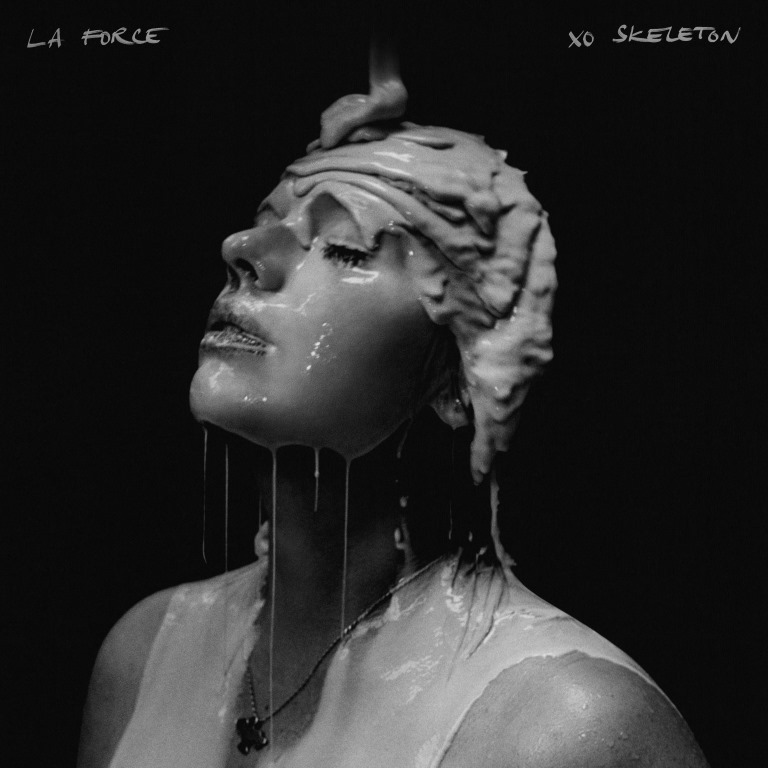
La Force, the mesmerising solo project from Ariel Engle, unveils today the title track from her brand-new album ‘XO SKELETON’.

“’xo skeleton’, the song – is the overarching theme of the record,” says Ariel. “It’s an image I’d love as protection. A carapace that keeps the goo inside. This protection is in love, kisses, and hugs. It’s what bolsters us in life. The love is an invisible shroud that we adorn others in and are adorned in. It’s a reminder that within us are skeletons. Symbols of death and yet the architecture that animated us while we are alive. It’s a song about the inevitability of death as both a motivator to love fully and at times disincentivizing Force – why bother if I’m going to die versus I must do so much while I’m still alive.”

‘XO SKELETON’ the sophomore full length will be out this Friday via Secret City Records.

Early singles from the album have been praised by MOJO, Rolling Stone France, Stereogum, Brooklyn Vegan, Clash Magazine, NYLON, The Fader, BBC6 Music, Exclaim! and more. The new album was included in CBC Music Fall Guide: 19 new releases you need to hear, and the twelve Quebec albums to hear this Fall from Journal de Montréal.
‘XO SKELETON’ is the supple, steady, uncanny new album by La Force: a mixture of haunted pop and hot-blooded R&B that glistens at the meeting point between life, death, and love. The album was coproduced by La Force and Warren Spicer (Plants and Animals). “The theme of the album revealed itself in the making,” she explains, recalling how the title track is rooted in a telephone call with her life-insurance broker—one everyday banality on the periphery of death. “At one point she said, ‘God forbid you should die.’ I was gobsmacked. ‘Well, there’s one thing guaranteed: no god or goddess is going to keep me alive.’”

Watch the video here:

AA

7553a19a-0ecb-7b1f-61a0-4dfe2b46a63b

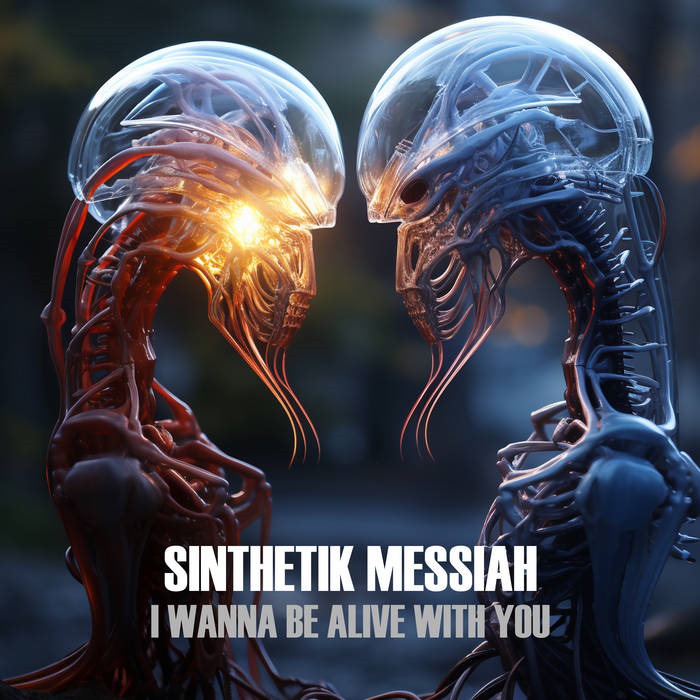
Louisiana’s ‘Industrial Bass’ pioneer, SINthetik Messiah has just unveiled their new single, ‘I Wanna Be Alive With You’.

‘I Wanna Be Alive With You’ tells the tale of a ghost watching and wanting to be alive with his lover  The track is a hybrid of Industrial Noise and Drum ‘N’ Bass.

Blending various elements of industrial, electro, dance, rock, ambient and pop. The international act, SINthetik Messiah(SM) is the work of the Cajun songwriter and sound designer, Bug Gigabyte. The name is a misspelling of the of the term ‘synthetic messiah’, which is the pronunciation used by the band. SM has received radio play, publicity and respect from peers alike from around the globe.

Watch the video here:

AA

190929

Neurot Recordings – 29th September 2023

Christopher Nosnibor

I’m finding myself on something of a Neurot trip this week, following my fervent frothing over the mighty new album by Great Falls. As if to prove that the label has been putting out outstanding records for a very long time (and with unstinting singularity, presenting a broad stylistic range, too: this is anything but heavy), twenty years on from its original release, Grails’ debut is getting a reissue. While the nice coloured vinyl pressings (in ‘Coke bottle clear’ and ‘beer’ hues) aren’t necessarily for everyone, the release does afford a timely opportunity to reflect on the debut release of a band who have gone on to forge a significant and varied career, with their latest album – number eight – being released next month.

Steve Von Till’s comments about hearing the demo for the album, on which the offer of’ the release was made, reminds us of the musical landscape of the time in 2002: ‘Most instrumental music at the time was trying to emulate Godspeed You! Black Emperor or Mogwai, but this was different. This seemed to have elements from more diverse sources that I loved such as Dirty Three, Comus, Richard Thompson, and Neil Young, not to mention, who in hell would dare to cover Sun City Girls?’

There was a lot of instrumental post rock around, and while there was a wealth of great bands around, locally as well as nationally and internationally, it’s fair to say that a large proportion of it was much of a muchness, with myriad explorations of chiming guitars and slow-building crescendos.

The prominence of acoustic guitars, softly picked and strummed, and rather unconventional use of violin creates an unusual dynamic on these compositions, which tend to be sparse in arrangement and with considerable space between both the instruments and the individual notes, and the crescendos are few and far between – the first doesn’t arrive until over halfway through the third track, the slow, meandering ‘The Deed’, when the swell of guitar pushes upward through yawning strings and finally the full drum kit crashes in. But the impact is less from whacking on the gain on the instruments, but the musicians utilising the dynamics of playing, and the simple equation that playing harder is louder. Against the prevailing tide of pedal boards as big as drum risers packed with effects, this stands out as being not only very different, but bold, the emphasis on the tones and timbres of the instruments in unadulterated form, the sounds the result of technique.

The soft piano of ‘In the Beginning’, when paired with picked guitar has an almost pastoral feel; the heavy smack of a drum feels incongruous before a soft yet almost clumsy waltz emerges briefly, and structurally, the pieces seem to belong more to jazz than anything else, although ‘Space Prophet Dogon’ (the Sun City Girls cover) draws together elements of Celtic-influenced folk and psychedelia, and goes for a long toe-tapping groove over a crescendo by way of an extended climax. It takes a certain courage to fly in the face of fashion in such an obtuse fashion, as well as to play in such an intimate way that you can hear the sweep of a finger across a fret, where natural reverberations become as integral to the sound as the notes themselves. This is nowhere more apparent than on the hyperpsarce intro of ‘Broken Ballad’, a sedate almost country-tinged tune and one of the album’s more conventionally-shaped pieces. The slowly-unfurling ‘White Flag’ shares a certain common ground with later releases by Earth: slow, spacious, revolving around a simple, picked guitar motif, but it does swing into an exhilarating full band finale that’s different again.

Closer ‘Canyon Hymn,’ presumably a reference to Laurel Canyon, the name of the and when they recorded the demos which would become The Burden of Hope, is by no means an anthem or a theme, but encapsulates all aspects of the album’s range within a soothing five minutes. If the title, The Burden of Hope, implies a certain weight of responsibility, the music it contains sees that hope take wings. Twenty years on, The Burden of Hope sounds uplifting, and still fresh.

AA

cosmicimg-prod.services.web.outlook