Archive for March, 2021

29th January 2021

Christopher Nosnibor

I have a hunch that the ethereal, bohemian songstress may not have been born Gabrielle Ornate, but it’s certainly fitting for the kind of light, decorative, yet expansive and kaleidoscopic electropop showcased on her debut single, ‘The March of the Caterpillars’.

Yes, it has that quintessentially 80s vibe, but then that in itself has become something that’s grown beyond its origins to become a genre unto itself, meaning that this single is both of a time and timeless. Propelled by a solid beat and buoyant bassline, it balances elements of both rock and pop, it’s a perfect vehicle for Gabrielle’s vocal, which switches from quiet and contemplative to full and bold in the choruses.

Lyrically, it’s about evolution and ‘respecting one’s roots’, but said lyrics are largely oblique and poetical, spinning together a succession of thoughts and images to form a semi-abstract flow, which works nicely.

It’s a strong debut, and Gabrielle seems to have emerged in full-fluttering glory.

AA

promo-photo-2

Bloodshed666

Christopher Nosnibor

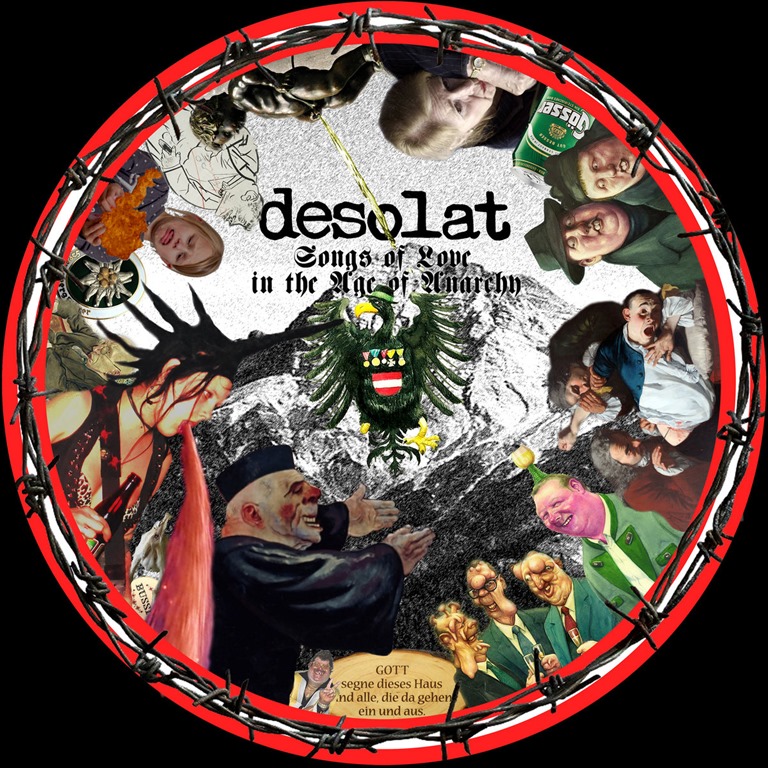
This Viennese collective describe themselves as purveyors of ‘heavy stuff (crust, sludgemetal, noise rock’ but ‘rooted in diy-anarcho-punk’, and they follow the subtly-titled Shareholder of Shit 10” EP with a 12” picture disc mini album containing five gloriously gnarly blasts of dirty guitar-driven noise.

Much of the appeal of anything that’s crust-orientated is just how grimy and raw it is, and while a few samples cut through with clarity on several tracks here, for the most part, Desolat deliver a set that is little short of a wall of incendiary rage, a snarling, spitting, guttural roar coughing blood and venom against guitars so dingy they positively drip gunge.

If opener ‘Nuclear Extinction to Human Civilisation’ doesn’t exactly sound like a love song, it does probably intimate the band’s perfect misanthropic fantasy, while the title track is the sound of Satan’s innards after a phall. Make no mistake, this is intense, and there’s not a second’s respite at any point: ‘The Bureaucrat’ is a full-throttle sonic inferno that blasts through its three-minute duration at a hundred miles an hour ravaging everything in its path: the guitars a whiplash-inducing blur or fury.

The lumbering closer, ‘Dreams of Slaughtered Yuppies under Starlit Night Skies’, is a six-minute slow-riffing sludgefest that batters away brutally at a simple four-chord trudge. It’s heavy, it’s nasty, and its glorious – which pretty much sums up the record as a whole as it raises a stinking, shit-coated middle finger to all things capitalist and mainstream.

AA

a2246575036_10

Hallow Ground – HG2101 – 12th March 2021

Christopher Nosnibor

Norman Westberg, of Swans legend, has a long association with the cranking out of heavy noise. For over three decades, his style was a defining feature of one of the most singular bands, and a rare entity, namely a guitarist who was more than happy to bludgeon away at the same two or three chords for anything up to a quarter of an hour. I would even venture so far as to say that Westberg is a truly unique guitarist, and his appreciation and understanding of space is unparalleled – a player who isn’t only comfortable, but whose signature is a seemingly infinite pause between chords.

In more recent years, Westberg’s output has shifted towards a less abrasive angle, with a succession of solo releases from 2016 onwards exploring overtly ambient territory, through MRI¸ The All Most Quiet, (both 2016) and After Vacation (2019).

First Man in the Moon sees Westberg connect with double bass player Jacek Mazurkiewicz, who supported Swans on tour in Europe in 2014 under the moniker of his solo project 3FoNIA,.The result of their collaboration, recorded during some downtime ahead of Michael Gira’s two Warsaw shows toward the end of 2019, is five improvised tracks of richly resonant evocation. The pitch promises a work ‘beyond the boundaries of atmospheric drone, abstract jazz and experimental music [which] blurs the lines between the acoustic and the electronic.’

It’s all a blur: supple washes of sound painted in broad strokes provide the cloud-like ambient backdrop to clatters and creaks, and the occasional bleep and whirr. It’s very much about the contrast: Mazurkiewicz’s playing is versatile, with his double bass work ranging from deep, brooding sounds that are very much of the instrument, to sonorous booms, to the sound of a tree groaning and about to topple.

How deep do you delve into a work so overly ambient and abstract? At what point does dissection become futile? First Man in the Moon is an album that warrants space, and reflection, to breathe and to simply run its course – an album to bask in, rather than to pick apart. It creates a supple, evolving atmosphere of soft drone and a soporific soundscape in which to cut loose.

A hesitant bass emerges from the misty contrails of ‘That was Then’, and it’s ‘Falsely Accused’ is a slow, tidal throb that ebbs and flows… and not a lot else. First Man in the Moon is an album that drifts on, remaining in the background: it does not demand attention of focus. Attention and focus bring different rewards, but there is a lot to be said for simply sitting back, dimming the lights and sipping a whisky while the sounds of this subtle, nuanced work immerse you.

As collaborations go, Westberg and Mazurkiewicz make for a magnificent pairing, creating an album that shows a touching musical intuition: everything about First Man in the Moon simply flows, effortlessly, naturally, and creates a space in space – that is to say, a mental space in which to empty oneself. It’s rare, and it’s special.

AA

HG2101_front

26th March 2021

James Wells

‘Quiet down – you’re just a voice inside my head,’ sings Tom Farrelly, presenting the crossover between the internal / external monologue that we play out to ourselves. Even when sanity threatens to slip and we find ourselves talking to ourselves, we pull ourselves back with a good talking to. Strangely, there is no contradiction here.

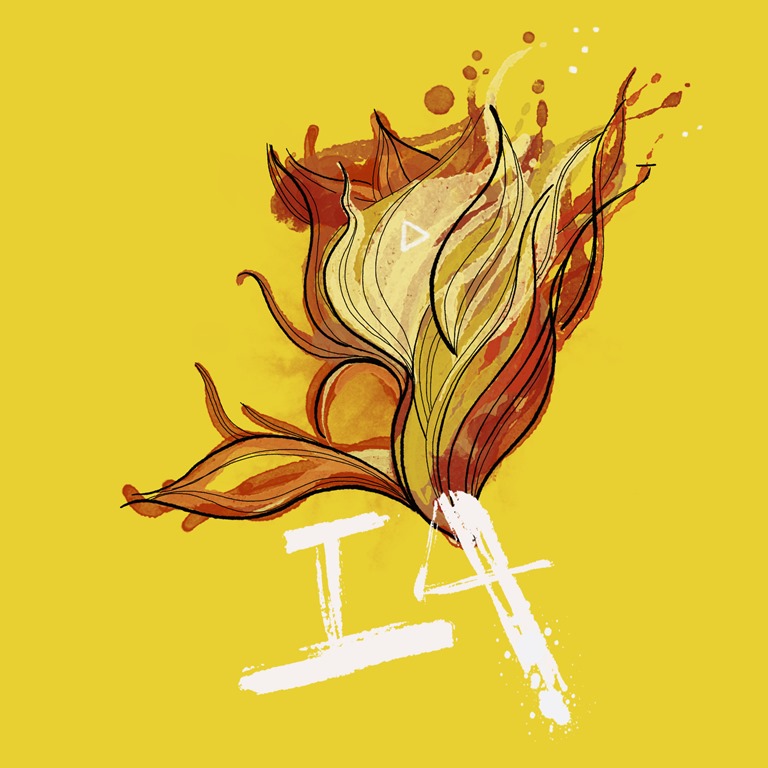
Is ‘I A Fire’ as deep and meaningful as it is anthemic, or is it simply a fortunate lyrical stab that hits a certain level of resonance in verses that exist as much as anything to fill the space and provide a bridge from one chorus to the next? Benefit of the doubt says that this is a genuinely soul-searching moment of introspection that’s found its way into one of the biggest, most stadium-friendly tunes I’ve heard from any act, let alone a new one on the scene, in a long time.

Comparisons to the likes of The Killers and U2 are entirely warranted, but ‘I A Fire’ equally calls to mind the early noughties, and the emergence of Coldplay and Keane, before they came to represent the face of drab musical conservatism and instead marled the arrival of a new breed of acts who placed great emphasis on songwriting and the conveyance of emotion. More than anything though, something about this – and not the title – suggests that ‘I A Fire’ could – and should – be Third Lung’s ‘Sex on Fire’, their breakthrough moment. It ought to be.

Third Lung Artwork

Panurus Productions – 2nd April 2021

Sometimes, an understanding of process helps in shaping the appreciation of a musical work. Sometimes, it doesn’t. When presented with Only Then by Left Hand Cuts Off The Right, I can’t decide either way. The album contains two longform tracks – the twenty-five minute ‘2 – 6 – 17’ and the thirty-five minute ’23 – 6 -19’. Both were recorded live, and showcase a blend of improvisation and composition. The track titles do, unsurprisingly, mark the dates of the performances, both f which took place at the legendary Café Oto in 2017 and 2019.

On the former piece, a scraping drone hovers somewhere in the distance, relentless, nagging, always in the background but always within the reals of awareness: you simply cannot tune it out. Atop of this, there are crackles, scrapes, flickers, scratches and microcosmic, microtonal glitches, and gently tinkling picked notes casting sparse scales and oriental motifs, with the zither providing a unique, and, to western ears, exotic flavour. Over time, the details dissolve and blur into a metallic scrape that gnaws at the senses as allow, slow, undulation persists long after any trace of melody had dissipated, swallowed by currents of dissonant sound.

Slow-hammered xylophone notes emerge and steer toward the end of the first piece, and then stop: cue a cascade of applause which reminds us that this isn’t a studio work and that this happened. Not just that live performances used to be a thing, but, quite simply, that the audio contained here is not a studio-controlled contrivance, but an event that happened in real-time. Something about that realisation is strangely affecting.

Coughs and splutters and a general clamour of voices preface the fall to silence and the first echoing sounds on side two. Audience behaviour is so telling: the respect (or lack of) given to a artists whose performances are on the quiet aside can make or decimate the enjoyment for may of those present. Here, Left Hand Cuts Off The Right command over half an hour of hush. From clattering drips and clangs, the track builds from sparse sound echoing into emptiness, slow-dropping notes decaying into a soft ambience.

As to the technique and the technical aspects, the press release informs that ‘both sets were created with zither, melodica, synthesizer, bent electronics, field recordings, mbira, tape loops, percussion and effects. Side A comprises of 6 improvised sections each with specific performance, composition and sonic parameters. Side B is centred on 2 pre-recorded compositions which are mixed and performed live and interspersed with improvised sections for set sound sources.’

It’s actually quite difficult to unravel precisely what this means, beyond the fact that often the composing, improvising and performing processes overlap – informing one another as new works are created. And while the live performance of prerecorded pieces interspersed with improvisation and improvisation within predetermined parameters are clearly different disciplines, ultimately both methods combine a certain element of random with planning. Moreover, while delivered as works in the ,ids of an eternal evolution due to the nature of their form, these pieces as performed and as recorded are not works in progress, but works in their own right.

Only Then captures a moment – one I suspect many of us wish we could return to right now.

AA

a1540115934_10

15th March 2021

Christopher Nosnibor

It’s been a full decade since I first encountered the surreal & fantastical world of Sone Institute, the vehicle for electronic artist Roman Bezdyk, and I’ve followed his work up to 2018’s Where Moth and Rust Consume, which was championed by 6Music’s Gideon Coe.

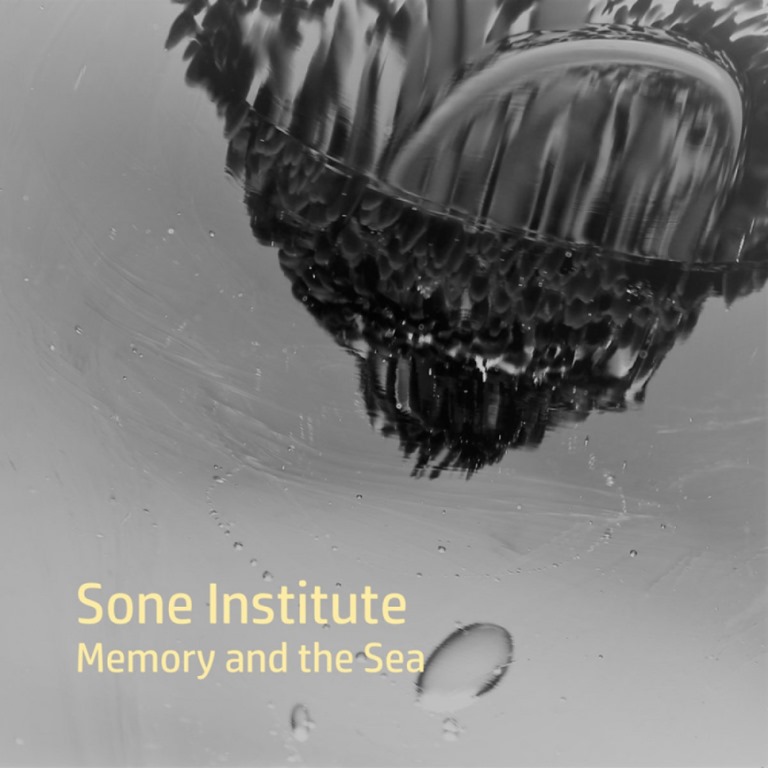
Bezdyk’s output has always been interesting, and always evolving, and this standalone single release, which spans a full ten minutes, is an evocative work which draws together, as the title suggests, the sea and the echoes of memory.

There is something unique about the sea and its pull, and I suspect many of us have some memory connected to the sea, be it a family holiday or a journey by boat or ferry. And because the sea is capable of such very different states or moods, from the tranquil lapping of a low ebb to the raging torment of a storm or even a tsunami, so our relationships with the sea are likely to be wide and varied, and a love of the ocean must necessarily be tempered by a certain caution.

Chiming bells ring out against a sloughing wash of waves on a beach, and ‘Memory and the Sea’ brings the more tranquil aspect of the tides to the fore instead of elevating the tempests that can destroy lives and landscapes, through a combination of field recordings and abstract wavering drones. Amidst woozy, warping electronic tones the listener is pulled back to some kind of reimagining of the sea in some almost generic form: every moment spent either building sandcastles or otherwise simple staring out across the rolling waves merge together to forge a new consciousness which may or may not be real. The colour fades and takes on a Polaroid filter, or the soft hue of a dream. Wish you were here?

AA

a4243834059_10

Born of the long dark winters of Norway Årabrot was too black for metal and too avant-garde for punk so it forged its own path. Hewn from empty roads and the cold impenetrable depths of the fiords of its home.

A Norwegian Gothic, tales sung and stories told in screams and whispers. With its steel guitar, a steely gaze a sneer and

a Stetson, Årabrot is the bastard offspring of Billie Holiday and Elmore James. It is The Velvet Underground if Johnny Cash was a member and Nico was able to sing. It is Camus, Sartre, Poe and Burroughs cut-up and regurgitated in an unholy erotic mass. It is all the great bands you haven’t even heard of. It is you. It is here it is now and there are other bodies to bury. Årabrot is not fucking around.

Årabrot is Kjetil “Tall Man” Nernes and Karin “Dark Diva” Park. They live in the Swedish countryside with their two children in the old church that they own. Rock’n roll is their religion.

Discussing their two part short film Kjetil comments,

It is the tale of Årabrot, preachers of rock’n roll. The videos are shot in the church where we live and its surroundings, our neighbours and friends as the congregation. Karin is 8 months pregnant. If you want to know what Årabrot is all about this is where you want to start. Brilliantly directed by Thomas Knights and Kassandra Powell of Obscure Film Collective.’

Watch the video now for part 2, ”Hailstones For Rain / The Moon Is Dead’ here:

AA

thumbnail_FY7A9632 ret

New Heavy Sounds – 26th Mar 2021

Christopher Nosnibor

It was supporting the mighty Black Moth at their final gig at Leeds’ Brudenell a couple of years ago where I first encountered latest New Heavy Sounds signings Sky Valley Mistress. If the world hadn’t gone off the rails, if live music hadn’t been halted, there’s a very good chance that Sky Valley Mistress would have been well on the way to stepping into the gap left by Black Moth, with their no-messing riff-centric brand of rock, having honed their sound and style in front of more live audiences. Because this is how bands so often evolve, and build fanbases. Everything was perfectly positioned…

Still, credit to the band for not resting on their laurels or simply waiting for life to resume, and for maintaining their profile with this new EP, picking up the slack after their lockdown tribute cover of Nine Inch Nails’ ‘Every day s Exactly the same’ back in June of 2020, which feels like a lifetime ago. Back then, lockdown still had an element of novelty, it felt like there was an opportunity to use the time gifted creatively, and that maybe the ‘new normal’ could afford something beneficial despite the closure of public spaces.

That optimism has given way to fatigue and a widespread sense of emptiness, , and the acoustic sessions EP very much feels like the stop-gap that it is. Unable to write, rehearse, record, and perform together as a full band as they usually would, laying down an EP containing acoustic versions of songs from their debut album, Faithless Rituals, and coincidentally – or otherwise – marking the anniversary of its release.

To their credit, they’ve done something a bit different: there’s a synth bass that growls in the low-end regions on ‘You Got Nothing’. It returns to bookend the EP on the reworking of ‘She Is So’. In between, acoustic guitars and piano provide the main musical accompaniment to these stripped back reworkings. And they are well-executed, and as such, hard to fault – and makes you long even harder for live shows and for new material proper.

AA

a4029561750_10

Opa Loka Records – 5th March 2021

Christopher Nosnibor

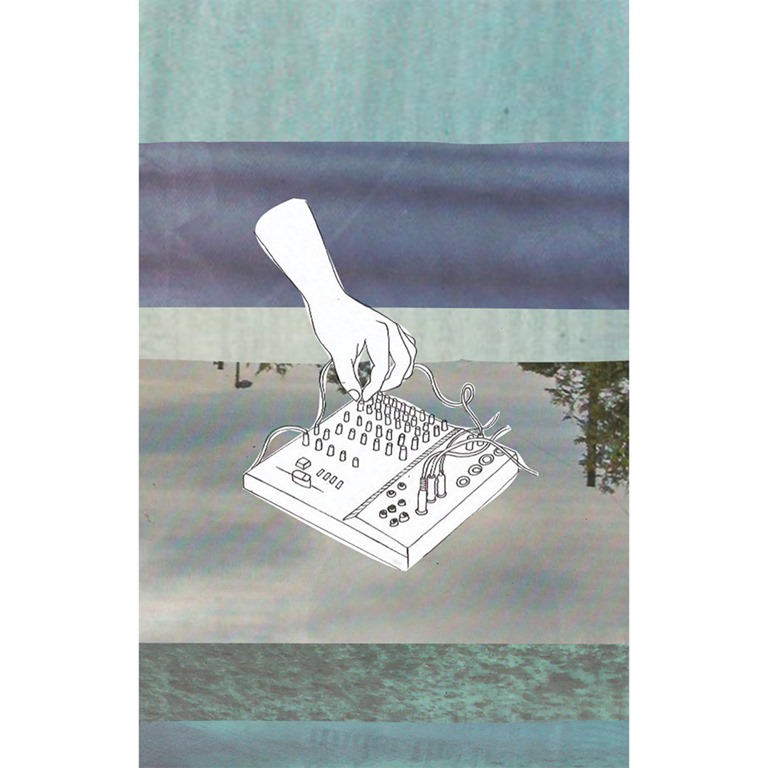
Breath Mule is the third album for Dutch multi media artist Richard van Kruysdijk under the moniker Cut Worms, and after a gap of over three years, completes a trilogy along with Lumbar Fist (2016) and Cable Mounds (2017).

As the accompanying blurb outlines, ‘Cut Worms’ sound palette is firmly rooted in the lower frequencies’, detailing how ‘As the droney, cinematic tracks evolve, their slowly unravelling, gritty sounds evoke the audio equivalent of brutalist architecture: Concrete walls of sound that are as majestic as they are elementary, yet intrinsically detailed when examined with a magnifying glass.’

The majority of the tracks are long, and not a lot really happens, meaning that there is time given for each composition to breathe and explore the tones and textures in full detail. The low-booming opener, ‘Slug Sirup’ sounds like a ship’s horn sounding out over the miles through a dense and played back at half speed. First distant, it grows in volume, but little else happens for a very long time. And then, somehow, more than nine minutes has evaporated, and drifted into the slow-booming drone of ‘Come Lightly’. There isn’t much light about it: it’s dank and ominous.

There are crackling creaks enveloped in the dense, crawling fog of ‘Cinder Locks’. The sound is thick, heavy, immersive, and yes, it is ominous but at the same time, I find a certain comfort in such vast expanses of thunderous ambience. The more condensed the sound, the more it billows like smoke, the more impenetrable and more solid it becomes, the more it feels somehow like something that’s a source of a certain warmth and security. The same is true of the throbbing ‘Denmark Spiral’, but the thin, trilling wisps of Girly Totem’, while more overtly and quintessentially ‘ambient’ are somehow more difficult to settle in with – particularly in context.

The darkness really comes to the fore on the final track, the eleven-and-a-half-minute ‘Slashed Hostage’. The title provides a fair indication of its weight, and it begins with a low, slow, oscillating throbbing hum, one of those drones that nags at the senses like a far-off helicopter that you scan the sky for but can’t see. Again, it’s a slow-builder: the sound expands, louder, denser, but no different, and this is where it really starts to get into your head and burrow into your skull. It’s along this journey that the slow-moving drone expands to a different level of immersion, and when the swell tapers down, hushed vocals echo menacingly, too low in the mix to decipher the actual words, a poem by the enigmatic Italian composer Giacinto Scelsi (1905-1988), who wrote surrealist works in French. Because. That said, Scelsi is an interesting choice, as a composer who, according to his Wikipedia entry, ‘composed music based around only one pitch, altered in all manners through microtonal oscillations, harmonic allusions, and changes in timbre and dynamics, as paradigmatically exemplified in his Quattro pezzi su una nota sola (‘Four Pieces on a single note’, 1959)’.

On Breath Mule, Cut Worms offers more than a single note, but then again, there are no notes: only thick, swirling billows of sound and layers of drone on drone. It grips you, immerses you, hold you… and it’s not unpleasant, as long as you don’t struggle.

AA

CW-M013-digipack-3P_1CD-6-x-8mm-z-kieszonka V7

Golem 202020 is a 10-track recording synthesis curated from the full soundtrack of the classic silent horror film ‘Der Golem, wie er in die Welt kam’ created by the Italian avant/post rock band STEARICA.

The soundtrack was originally commissioned by The Italian National Museum of Cinema and the Traffic Free Festival and was performed in the Museum’s cinema as a live soundtrack to the film as part of the MiTo Settembre Musica in September, 2011.

The ten tracks, which cover the five chapters into which the film is divided, were recorded live in 2014 during a studio session organised to immortalise the work, with further embellishments added in 2019 while still maintaining the original arrangement.

’How He Came into the World’ is the latest single to be shared from the soundtrack with the band commenting,

‘Entrust fate to your own hands and immerse them in clay to give shape to the Golem.
Follow instructions alchemical up to challenge God, planning to bring inanimate matter to life.
This is where the weight of responsibility of those who hold the sacred role of salvation can lead.
The frustration against the emperor, who wants to take over the village, pushes the Rabbi to alter the universal order to create a colossus defender of the People.

A creature of death and life, able to frighten the enemies and bring security, but all this has a cost for those who alter, even for a noble cause, disposition, natural and inscrutable things.’

Listen to ‘How He Came into the World’ here: