Archive for July, 2017

Hominid Sounds – 30th May 2017

Christopher Nosnibor

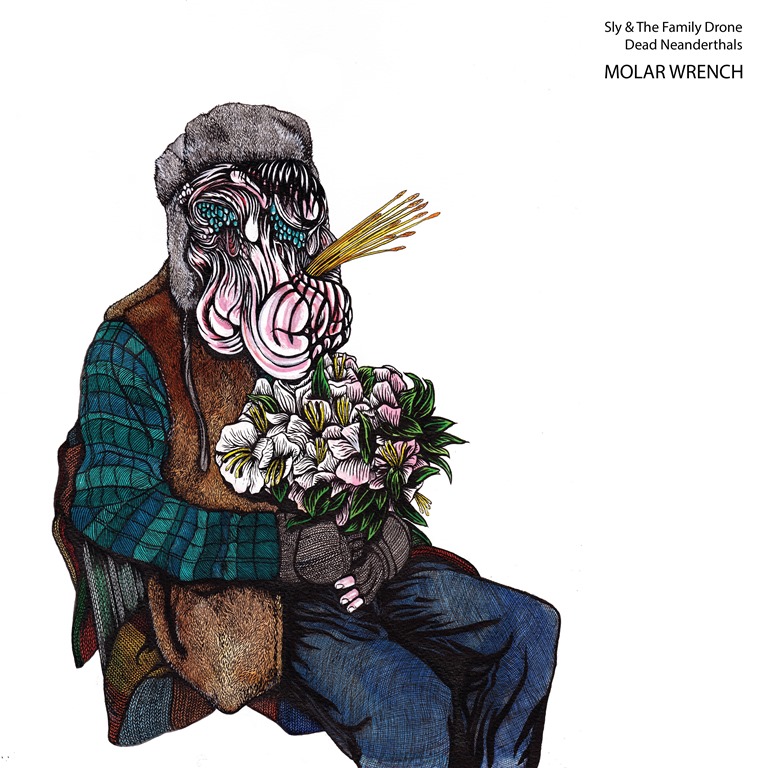
Matt Cargill’s project still has one of the best names around: it’s not only an example of punning genius, but also one of those band names which sets expectations as to what you’re going to get musically. I say musically, but that’s very much a matter of perspective. SATFD don’t make music in the conventional sense, and Molar Wrench is as sonically challenging as any of the previous releases SATFD have put out. On this outing, they’re joined by Dutch/British free jazz unit Dead Neanderthals, to form what they describe as ‘the ultimate tag team of the murky European underground’.

Given that the two acts featured on a split release last year, this collaboration seems like a logical progression. It certainly marks a departure for Sly, in that the trademark subterranean grind of endless, dark drones and unsettling atmospherics is matched with and at times consumed by the maddest jazz shit going.

The album contains just four tracks, but packs in a hell of a lot of racket. It all kicks off with a frenetic, a wild, free jazz cacophony, a melange of clamorous, ultra-hyped parping horns, sonorous lowed drone and is dominated by truly frenzied, cacophonous bent. Circuits fizz and hum while the percussion thrashes and crashes arrhythmically, throwing the listener around with reckless abandon a rollercoaster of tempestuous sonic mania.

There are two ‘Muck Man’ tracks and the first is ten minutes of slow, throbbing churn made up primarily of low and mid-range sludge, the drums holding a ragged but hard rhythm amidst a maelstrom of thick, dirty, pulsating noise. It’s almost a riff, but more a succession of waves in a rhythmically surging sonic tide, a with the density of liquid mud. Immersive would be one word.

‘Muck Man Part 2’ is altogether more low-key, a dark, atmospheric piece that manifests as a prehistoric sulphur swamp in sonic form. Slowly, the murky drift builds to a screaming tempest of noise; the brass develops from a low drone to a shrill shriek of pain and the drumming transitions from a sedate trudge to an explosive riot of noise, abrasive blasts of snarling electronica and whatever the fuck else bursting in waves of sonic shock.

The title track closes off the album, and it’s an eleven-minute trudge that calls to mind the claustrophobic brutality of Swans’ ‘Young God’ EP. The plodding percussion provides a doomy and tense prickling spine to the oppressive grind that lumbers on for what feels like a skull-crushing eternity.

There is a definite structure to Molar Wrench, in that it starts off wild and winds down to a grinding crawl, but it by no means feels like the energy displayed at the outset dissipates as the album progresses. It’s more a case that having exhausted the listener with frenetic kinetics and gone all-out on the attack at the front end, the album seeks to bludgeon the listener into submission in the later stages. And highly effective it is, too.
cover

Christopher Nosnibor

Perhaps I need a break. I love music and I love reviewing it. But looking through my to-review pile and my groaning inbox, I feel overwhelmed and despondent, disinterested even. I look at the tiles and the artists, knowing instinctively that some will leave me cold and others will irritate me. Perhaps stirring my frustration with break the ennui, but it’s almost 11p, and

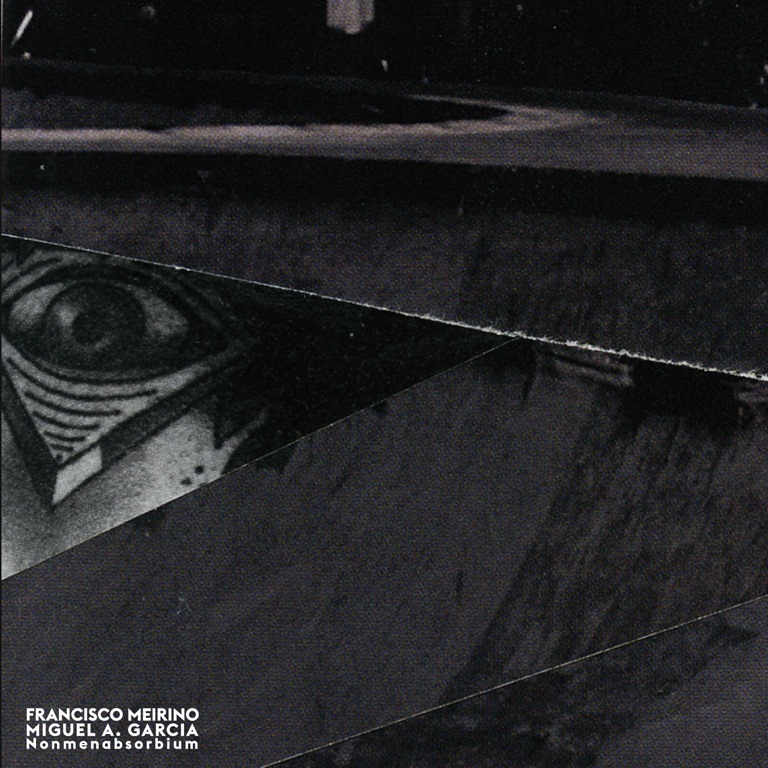
I pick up Nonmenabsorbium on a whim. The dark cover, not so much black and white as many shades of grey, from mostly within the darker end of the greys spectrum, tells me nothing. I can’t locate the accompanying press release. I’m flying blind, with only my senses and my instinct to guide me.

It’s pleasing to discover that Nonmenabsorbium contains no music in the conventional sense. No songs, no singing. No chords, no melodies, no tunes. No identifiable shapes or structures, no instruments or rhythms. Sparse, minimal drones and high-end tweets trill and hover. Thuds and thumps, sounds recorded seemingly too close to the microphone and booming through disproportionately loud against the barely-there backdrop jolt the senses. These are sounds without context and without overt structure or direct relation to one another. Often, the incidentals are disproportionate in volume to the ever-shifting grain of the backdrop, booming and crackling mic and speaker distortion as single notes ring out and resonate.

During ‘Abholicater’, the churning clatter coalesces to create a sort of arrhythmic percussive form, hammering and beating amidst a swirling swell of amorphous grey sound, which gradually dissipates to be replaced by the fizz and pop of electrostatic, shrieking diodes and the grumbling grind of low-end hum. #

‘2nd nalicii – 197degree5’ sounds very like R2D2 building for a breakdown, an electronic work based around rising frequencies which threaten to burst the tension. But it doesn’t happen. Sonar pulses radiate amidst the crackling clatter and wowing incidental of the eleven-minute closer ‘Horrorrydclowses’, as a rain of static pink noise showers down on electronic Catherine wheels. Monitor bleeps blast into cerebral flatlines amidst a relentless whupping churn and grind of static noise which owes a clear debt to the lineage which brought us early 80s Whitehouse, Prurient, Merzbow et al. Meirin and Garcia may belong to a different musical heritage, but Nonmenabsorbium is an intense sonic assault that requires a cautious approach.

The atmosphere is one of building expectation, and tension builds with the growing sense that there must be a point at which the threat of all-out noise is realised. But such cathartic release fails to materialise. Instead, the bumps and clanks are nerve-fraying after a time, and it becomes increasingly difficult to distinguish from the sounds on the disc the possibility of someone ascending the stairs, moving in the next room, stumbling around between plant pots and dustbins in the back lane or the yard outside. Consequently, the pleasure to be derived from listening to Nonmenabsorbium is perhaps a rather perverse one. Nonmenabsorbium provides an unsettling distraction, a removal from the humdrum and the sonic wallpaper of the everyday / mainstream. But, by way of escape, and also as an example of difficult but rewarding listening, Nonmenabsorbium offers an immersive and awkward sense of entertainment.

Francisco Meirin Miguel A. Garcia

23rd June 2017

Christopher Nosnibor

Ashley Reaks’ relentless release schedule continues apace with the arrival of Track Marks, his eleventh album. Because it’s an Ashley Reaks album, it’s characterised by off-kilter experimentations in dub and socio-political commentary. But whereas jazz provided the core influence on 2015’s Growth Spurts, it’s spectacularly spacious prog-rock wizardry that arrives fresh on Track Marks to bring the all-important new, unexpected and so-incongruous-it-shouldn’t-work-but-somehow-does feature of the material.

‘Stale Mate’ opens the album with a suitably eclectic mix of ingredients, with the blippy electronica of the opening bars immediately being submerged by one of the wandering basslines that define Reaks’ output regardless of what he’s doing. Somehow it moves from here to ultimately culminate in a knowingly gratuitous guitar solo.

‘I’ll Take My Pilgrimage’ is seemingly about as much a yearning to find faith as a criticism of religion per se, and melds a stormy, rolling drum to another phat bassline and some progtastic guitars and synths, while packing in some jazzy sax too. The jazz direction, which came to the fore on previous album, Growth Spurts, becomes increasingly dominant as Track Marks progresses. ‘Exposing Fiona’ gets pretty wild in its horn-parping intensity.

‘Stick Thin Worms’ pitches a stomping rhythm beneath some more abstract lyrical content, while poet and bluesman Paul Middleton (who hails from Reaks’ hometown of Harrogate) provides spoken word on ‘Tank From Grimsby’, which continues the extending thread of collaborative efforts which have become stablished as a feature of Reaks’ receny output. It’s actually a piece about some musicians, and marks a departure into mellow flamenco guitar.

If it all sounds like overload, it’s credit to Reaks that somehow, it all hangs together with a remarkable cohesion. It’s not immediate: one has to first surrender to the strangeness, the otherworldliness that Reaks creates. But there are some – many – undeniably great musical moments here. They’re not preoccupied with hooks or choruses, but there’s a certain atmosphere that envelops Track Marks – an album where the darker second meaning is (wisely) left unhinted at in the cover art. And once again, it’s Reaks’ refusal to pursue any obvious avenue which is the key to his success as an artist. Whether it’s a detriment to him in commercial terms, well, who knows? But that’s not what he’s about, and precisely why he deserves respect and attention.

cover

Ipecac Recordings – 7th July 2017

Christopher Nosnibor

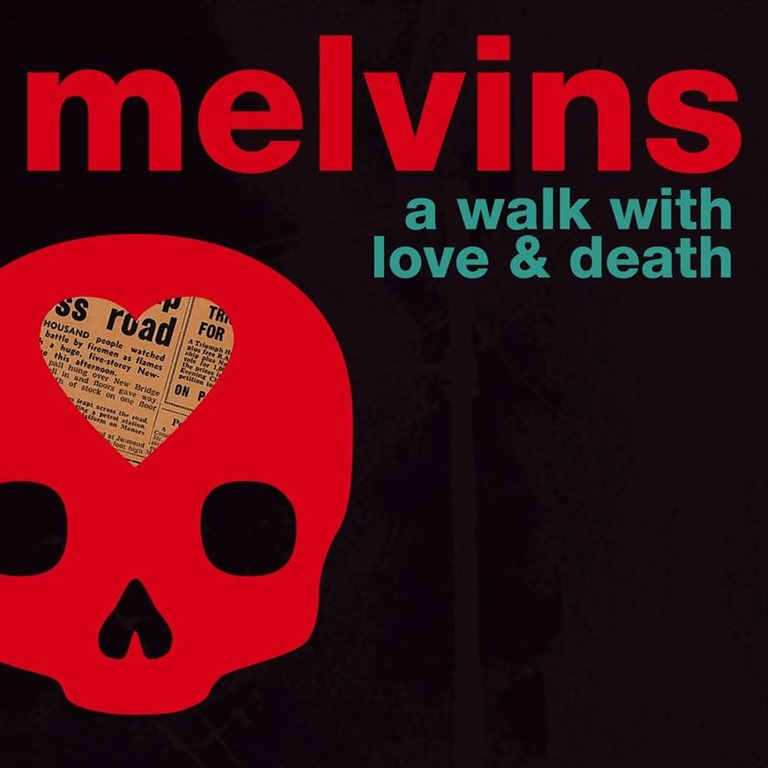
Melvins’ 415th album since their formation in the Mezozoic era is a double: their first. As if the founding sludgelords, the masters of the megalithic, needed to take it to another level of epic indulgence. A Walk With Love and Death isn’t exactly a concept album, as much as an album of two halves. So says the press release. If anything, it’s actually two distinct albums released together: Death, a proper Melvins’ release and Love, the score to the Jesse Nieminen directed, self-produced short also titled A Walk With Love and Death.

But of course, it’s a Melvins album. Which means that, fundamentally, it sounds like a Melvins album. That’s no criticism: I want a Melvins album to sound like a Melvins album but then, would it ever sound like anything else?

They really make full use of the double-album format for this outing. It begins with a slow-building, expansive six and a half-minuter that has echoes of ‘Mine is No Disgrace’ from The Crybaby, but instead of erupting into a blistering wall of noise, keeps the focus tight on a proggy trip with a vaguely psychedelic hue.

‘Sober-delic’ follows, a mid-tempo trudge which also stretches beyond the six-minute mark and ‘Euthanasia’ is vintage Melvins, a hefty sludge trudge with heavily treated vocals. ‘What’s Wrong With You?’ is a warped psychedelic stoner rock tune with a twisted pop edge, propelled by a thumping bassline and wild guitars. The nine songs which make up the Death album don’t exactly offer up any surprises (which is arguably a surprise in itself given the band’s wildly varied output over the last 30 years), but do deliver a Melvins album that’s as solid as anything they’ve done. It brings the grind. It hammers with the riffs. It’s sludgy, grungy, yet packs some great pop moments. And what at times it lacks in terms of attack, it compensates in scale, with the prog leanings of ‘Flaming Creature’ partially submerged by the low-end churn that they’ve made their own.

Commencing with a vaguely experimental intro track, in which mellifluous piano notes drift through the sound of chatter, the Love set is a very different proposition. The fourteen tracks are shorter and stranger, leaning toward noisy ambience, and find Melvins revisiting the kind of territory explored on Prick and the playfully perverse ‘Cowboy’ single from the mid ‘90s.

When they do actually play tunes, it’s whacked out, trippy psychedelic pop or fucked -up jazz: ‘Give it to Me’ is a zany, mess of doodling Hammond organs and theramins duelling with thumping percussion that’s pure 60s garage. But mostly it’s weird shit like ‘Chicken Butt’ and ‘Halfway to Bakersfield’, and it’s all very much ‘what the fuck’?

It’s Melvins’ eternal capacity to confound which is an integral aspect of their enduring appeal. It would be so easy, and no doubt more career-savvy to work to their tried and tested formula and to put out an album of straight ahead sludge rock every two to three years, instead of going off on infinite tangents and releasing two albums a year. But the fact is, they’re actually very good at producing weird, far-out experimental shit, and the results of some of their collaborations have been as strong as unexpected. It’s their drive to create, and to endlessly push in so many different directions which keeps Melvins fresh, and above all, relevant.

Melvins - Love and Death

Another ‘supergroup’ eh? But seriously, check this for a lineup…. Dead Cross, consist of Dave Lombardo (ex-Slayer/Suicidal Tendencies), Justin Pearson (Retox/The Locust), Mike Patton (Faith No More/Tomahawk) and Michael Crain (Retox, Festival of Dead Deer). And ahead of the release of their debit album, they’ve unveiled the video for the track ‘Seizure and Desist’.

Watch it here:

Leeds singles club Come Play With Me have announced their next split single, to be released on the 14th of July. Continuing their tradition of highlighting the exceptional and diverse talent in the Leeds City Region, this next single will feature Leeds bands Furr & RIIB. These two fast risings acts find themselves joining the CPWM roster alongside the likes of Cinerama (The Wedding Present), Harkin (Sleater Kinney, Sky Larkin), Team Picture, Her Name Is Calla, Fizzy Blood, Deadwall, OFFICERS, ZoZo, Laminate Pet Animal, Esper Scout, Ceiling Demons & Maggie8.

The next CPWM single features indie-math-pop-rock band RIIB, and riffy alt-rock indie foursome Furr.

Furr’s Sam Jackson explains their contribution to the Come Play With Me single – “Another Fable is the frankenstein of all these different musical influences that make up what Furr it is about. If someone said ‘what do Furr sound like?’ this would be the song to play them. Loud in your face guitars and popish vocal melodies. There might be a guitar solo! It’s the first time we’ve been critical of things going on around us and what’s been pissing us off recently. It’s about how obsessed with people we are about people we’ve never met and all this pop culture we have shoved in our face constantly….”

Watch the video to ‘Another Fable’ here: